How to Apply the Ethos of the Craftsman to Our Leadership

gunsmith

By Dr. Barrett Mosbacker

This is not another article on leadership admonishing us to be more productive, relational, or visionary. There are too many of those. Instead, this is an article about how to apply the ethos and values of craftsmanship to our leadership.

I first ran across this concept in an inspiring article in the Art of Manliness blog.* I am borrowing heavily from that article. My contribution is providing examples and biblical references for tailoring the principles of the craftsman’s ethos to school leadership. The best place to begin is to quote the opening of the article from which mine is derived:

Across cultures and time, the archetype of the craftsman has represented man’s ability to create and has been the mark of mature manhood. He is homo faber – man the creator. Instead of passively consuming and letting things happen to him, the craftsman fashions the world to his liking and proactively shapes and influences it …

When we think of the archetypal craftsman, images of a bearded man clad in a leather apron and rolled-up sleeves, toiling away in his workshop producing beautiful and useful items comes to mind. What’s interesting is that the ancient Greeks had a much more inclusive idea of the craftsman than our modern conception. Besides masons, potters, and carpenters, the ancient Greeks included jobs now considered “knowledge professions” like doctors, legislators, and administrators under the craftsman label. Even the work of a father was considered a craft of sorts that required the same care and attention to detail as that of the carpenter. Indeed, the ancient Greeks believed that the values and ethos of craftsmanship were things all should seek to live by. In so doing, a man could achieve arete, or excellence, and thus experience eudaimonia (human flourishing), or a flourishing life … Below we take a look at how these overarching principles of the traditional craftsman can apply to all areas of your life, no matter your profession.

Brett McKay, the publisher of the AoM blog, lists nine principles of the craftsman:

  1. Do things well for the sake of doing them well

  2. Plan but not too much

  3. Measure twice, cut once

  4. Work with what you got

  5. Cultivate patience

  6. Let go of your ego

  7. Develop your practical wisdom

  8. Mastery brings meaning

  9. Find your workshop

Do Things Well for the Sake of Doing Them Well

This principle states what should be the primary motivation for our work. We are to do our work well not so we will be praised, not so we will be rewarded, and not so we will feel good about ourselves. While not bad in and of themselves, these motivations are subordinate to the more noble motivation of doing things well because doing so is intrinsically worthwhile, it is the right thing to do. “Fundamental to the code of craftsmanship,” writes Brett, “is the desire to do something well for its own sake.”

This is a noble motivation but even this is subordinate to the Christian’s ultimate motivations. There are three scripture verses that set forth the motives for our work:

So, whether you eat or drink, or whatever you do, do all to the glory of God. 1 Cor. 10:31

And whatever you do, in word or deed, do everything in the name of the Lord Jesus, giving thanks to God the Father through him. Col. 3:17

Whatever you do, work heartily, as for the Lord and not for men, knowing that from the Lord you will receive the inheritance as your reward. You are serving the Lord Christ. Col. 3:23–24

The quality of our work is to reflect well on God. It is also to be done as though we were doing it for Christ.

For example, in preparing a presentation, the motivation is not to do well so that our audience will be impressed with us; our motivation is to impress them with God. And, we should devote the same energy and attention to detail in preparing and delivering our presentation as we would if we knew Jesus was going to in the audience—because he will be.

Likewise, how we conduct a meeting, how we teach a class, how we make decisions, how we train staff, and how we craft an email are all to be done with such craftsmanship that God is honored and Christ would be pleased if he were on the receiving end of our work. Imagine Jesus sitting in the audience, our class, our meeting, or at his computer reading our email. Those images should shape the motives and quality of our work.

There are two examples that will serve to illustrate what craftsmanship in our work looks like—one from “old world” craftsmanship and one from the biography of Steve Jobs, founder of Apple:

Furniture Making

“Make every product better than it’s ever been done before. Make the parts you cannot see as well as the parts you can see. Use only the best materials, even for the most everyday items. Give the same attention to the smallest detail as you do to the largest. Design every item you make to last forever.” – Shaker Philosophy of Furniture Making

Computer Making

[Steve Jobs’s father] tried to pass along his love of mechanics and cars. “Steve, this is your workbench now,” he said as he marked off a section of the table in their garage. Jobs remembered being impressed by his father’s focus on craftsmanship. “I thought my dad’s sense of design was pretty good,” he said, “because he knew how to build anything … Fifty years later the fence [his father built] still surrounds the back and side yards of the house in Mountain View. As Jobs showed it off to me, he caressed the stockade panels and recalled a lesson that his father implanted deeply in him. It was important, his father said, to craft the backs of cabinets and fences properly, even though they were hidden. “He loved doing things right. He even cared about the look of the parts you couldn’t see” …

Jobs’s father had once taught him that a drive for perfection meant caring about the craftsmanship even of the parts unseen. Jobs applied that to the layout of the circuit board inside the Apple II. He rejected the initial design because the lines were not straight enough.

Plan (But Not Too Much)

With any project, the craftsman creates twice: first mentally and then physically. Before he sets chisel to stone or hammer to wood, the craftsman has already created his work in his mind. In other words, he plans how to bring out the object from the rough materials and tools before him.

On the other hand, while the craftsman understands the importance of planning, he isn’t over-fastidious about it. Instead of detailed blueprints, the master craftsman prefers the rough sketch because he knows that unforeseen problems (or opportunities) can arise once he’s actually working.

For any leader planning is critical. Properly crafted plans steer our schools in the right direction and ensure that we have allocated our physical, financial, and human resources for maximum impact. But for some, procrastination masquerades as planning. Plan well but don’t spend so much time planning that little time or energy is available for execution. It is much easier to turn an aircraft carrier when it is moving than when it is dead in the water. Plan but get moving.

Measure Twice, Cut Once

This is one of the simplest and most memorable maxims of craftsmen, although it’s not always easy to follow through with in your everyday life. Suffice it to say that while you should leave room in your plans for improvisation, when it comes to making decisions that you can’t take back, make sure you’ve studied and pondered the choice thoroughly before you make your “cut.”

During my career as a school leader I have had the privilege of starting several significant initiatives. Two stand out in my mind: starting a new Christian school from scratch and launching 1:1 computing programs in two schools, one in the late 1990s and one this year. I have followed the BS/BS model: “Build Slow, Build Solid.” It is far better to spend the time, attention, and energy preparing properly than to rush headlong into a project and then be faced with cleaning up the resulting mess.

The adage to “measure twice, cut once,” was taught to me by my father when I helped him build houses. He taught me that, “lumber is expensive. Before turning on the circular saw measure again—make sure of your measurements then, and only then, cut.”

There are a lot of applications to this principle but hiring is at the top of the list. It is far better to be thorough and careful in finding the right person for a position the first time than to be faced with cleaning up after a bad hire and to do it over and over for the same position. Take your time, be thorough, hire right. Measure twice, cut once.

Work With What You Got

The master craftsman understands that most times he’ll never have the ideal materials, tools, or environment to work with. Unforeseen knots are discovered in wood and hidden imperfections in stone are revealed. Instead of becoming frustrated by such curveballs, the master craftsman adjusts his plans and works these imperfections into his creation so that you’d never know they were there … Instead of seeing these constraints and contingencies as obstacles, see them as creative opportunities and incorporate them into your life as unique and interesting pieces of texture. Remember, some of history’s greatest men turned what could have been a weakness into a strength.

Do not use your lack of gifts or resources as an excuse for not being a craftsman. No one has everything he or she needs or desires. Personal abilities and school resources are always limited.

Instead of focusing on what you do not have, make the most of what you do have. This is consistent with Jesus’s parable of the talents—each steward was given a different amount. He was not accountable for how much he was given, he was accountable for what did or did not do with what he was given. This should be our attitude as leaders—what has God provided? Let’s make the most of it by being creative, by focusing on possibilities rather than on limitations.

Cultivate Patience

A good craftsman has the patience to stay with frustrating work, even when it takes longer than he originally thought. He avoids frustration by living by the following maxim: when something takes longer than you expect, stop fighting it and embrace it

Us moderns have a perverse expectation that things should happen NOW. We want emails answered immediately and we even expect success to come right away … The reality is that things almost always take longer than expected, especially those things that are good and noble. So instead of fighting it, embrace it as the calm craftsman does. Life will become instantly more enjoyable and less stressful once you cultivate this virtue of patience.

Patience is a virtue often mentioned in the scriptures. Consider these examples:

Be patient in tribulation, be constant in prayer. Rom. 12:12

And we urge you, brothers, admonish the idle, encourage the fainthearted, help the weak, be patient with them all. 1 Thess. 5:14

Be patient, therefore, brothers, until the coming of the Lord. See how the farmer waits for the precious fruit of the earth, being patient about it, until it receives the early and the late rains. You also, be patient. James 5:7–8

We put no obstacle in anyone’s way, so that no fault may be found with our ministry, but as servants of God we commend ourselves in every way: by great endurance, in afflictions, hardships, calamities, beatings, imprisonments, riots, labors, sleepless nights, hunger; by purity, knowledge, patience, kindness, the Holy Spirit, genuine love. 2 Cor. 6:3–6

You, however, have followed my teaching, my conduct, my aim in life, my faith, my patience, my love, my steadfastness. 2 Tim. 3:10

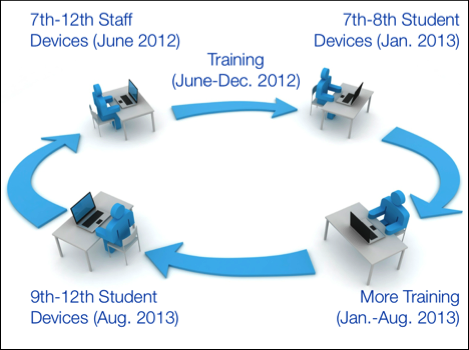
I recently learned the value of patience. After nearly three years of planning I was ready to launch our 1:1 computing initiative called Learning Unleashed. My plan was to implement the program last January in grades 7–8 and this fall in grades 9–12. My board suggested another plan—use January through June to conduct a small pilot program in the seventh grade before deploying the entire program in the Junior High.

After three years of hard work and having successfully launched a similar program several years prior, I was convinced we were ready. The delay was not necessary. It was time to move forward.

Although frustrated, I decided that the biblical thing to do was to embrace the delay, graciously submit to the board’s advice, and to publicly support the board’s recommendation.

While we would have been successful with the earlier and larger rollout of the program, the pilot revealed a number of unanticipated issues that would have made the launch more difficult and frustrating than anticipated. The delay gave us the opportunity to correct these problems and to provide more training before we deployed more broadly. By being patient and embracing the delay, we ended up with a smoother and more effectively deployed program.

Let Go of Your Ego

This principle is so important and so well stated in the original article that I am going to quote it at length.

The craftsman willingly opens himself up to teaching, criticism, and judgment from his peers and clients because that’s the only way he can improve. He doesn’t take criticism personally because the craftsman is more concerned about doing good work than feeling good about his work. A true craftsman understands that nobody cares how he feels about his work. In the end he knows that the only question that matters is: “Does it work?”

Modern culture has indoctrinated us that it’s more important to feel good about our work than to actually do good work. Self-help and career books tell us that we should find work that feels “authentic.” School children are taught that the only thing that counts is their effort, not if their work is actually good or correct. Crawford calls this emphasis on feelings as opposed to results a consumer ethic as opposed to a craftsmanship ethic.

The problem with the consumer ethic is that it creates individuals with self-inflated and fragile egos who are unable to withstand the sometimes harsh criticisms and judgments that invariably come in life and in work. Clients and bosses don’t care if you felt authentic” when writing a memo or if you tried really hard on a project. All they care about are the results. In life, it often takes mistakes in order to get better. You can’t get better if no one ever points out your failings.

If you wish to become the best man you can be, you must rid yourself of the consumer ethic of feelings and replace it with the craftsmanship ethic of results. Does your creation work? Does it look good? Does it add something to the world? If not, seek feedback and use that criticism to improve your work.

I am going to be transparent. I don’t like to have my work critiqued. For whatever reason I have a high need to be and to feel competent. Anything that threatens my sense of competence produces anxiety and stress. Usually, the main threat to my sense of competence is criticism or “second guessing” of my decisions.

This attitude of resisting criticism, of allowing ego to blind us to our shortcomings, is wrong for both biblical and practical reasons.

Biblically, it is clear that pride is the fundamental underlying sin of human nature. Pride was the fountainhead of Satan’s rebellion resulting in his rejection from heaven. Pride was the cause of Adam’s and Eve’s sin.

All of the subsequent suffering, turmoil, and death in our world has its origin in pride. Pride is deadly. Pride kills careers. Pride kills marriages. Pride kills testimonies and effectiveness. Pride leads eventually to physical and spiritual death. And, pride stops us from learning and growing.

The antidote to pride is humility, exemplified by Christ (Phil. 2:3ff). The Bible tells us to be humble, to listen to the advice and counsel of others:

Pride goes before destruction, and a haughty spirit before a fall. It is better to be of a lowly spirit with the poor than to divide the spoil with the proud. Prov. 16:18–19

There are six things that the Lord hates, seven that are an abomination to him: haughty eyes … Prov. 6:16–19

Therefore it says, “God opposes the proud, but gives grace to the humble.” Submit yourselves therefore to God … Humble yourselves before the Lord, and he will exalt you. James 4:6–10

Practically, it is important to embrace the truth that there is “wisdom in many counselors.” (Prov. 24:5–6) One of the roles of a good counselor and friend is to point out our shortcomings. “Faithful are the wounds of a friend; profuse are the kisses of an enemy.” (Prov. 27:6) We need honest counselors and friends to show us our blind spots, faulty thinking, character flaws and weaknesses.

We need others to point out our shortcomings—there is no other way to improve. Failure to embrace the critiques and criticisms of others is to embrace mediocrity and pride—both of which are dishonoring to Christ and detrimental to us and our schools.

Develop Your Practical Wisdom

Through years of experience, the craftsman develops what Robert Greene calls a “masterly intuition.” He can sense problems and solutions by merely looking at an object or listening to it operate. I liken it to how a man will often know if there is something wrong with his car just by feeling the way it drives or hearing something subtle that wasn’t previously there …

Aristotle called this kind of intuition phronesis, or practical wisdom. The ancient philosopher believed that the phronesis was a virtue that all men should develop, not just carpenters or masons. Practical wisdom is what allows us to make good judgments when we face decisions when there’s no clear right or wrong answer. It gives us the ability ”to do the right thing, at the right time, for the right reason.” Aristotle argued that practical wisdom for everyday life develops the same way craftsmen develop theirs — through experience and trial and error.

School leaders make hundreds, if not thousands, of decisions every year. In making some of these decisions we will not have all of the facts. In many instances there will be no clear right or wrong answer. We are often faced with a Solomon like decision in which we must “cut the baby in half.”

To make wise decisions when you do not have all of the facts or when faced with ambiguity, follow these steps:

  • Pray earnestly for wisdom, which God has promised to provide.

  • Study the scriptures for principles to apply. God does not give wisdom in isolation, he generally provides much of it through his word.

  • Seek the counsel of godly, biblically literate, and experienced Christians.

  • Take time to gather as much information as possible and to ponder the applicable biblical principles and counsel received. Then make your decision.

  • Assess the impact of your decision and amend if possible and appropriate. At the very least if your decision proves to be less than perfect-learn from it just as the craftsman learns from his mistakes.

Mastery Brings Meaning

Mastery is the goal of the true craftsman. As an apprentice, the would-be craftsman devotes years of his life humbly submitting to quiet observation. He watches his master work and gives an attentive ear to his instructions. After years of passive observation, an apprentice begins experimenting his craft to determine his skill. Through years of trial and error, he slowly hones his skill to a sharp edge. Even when a craftsman has obtained the level of master, he continues to dedicate his life to constant improvement. He understands that by increasing his ability, he increases his value. By mastering his trade, the craftsman is better able to live by the craftsmanship ethic, which in turn allows him to feel deeper personal satisfaction, develop confidence, contribute to his community, and thus discover greater and greater meaning and fulfillment in his work.

In Drive, Daniel Pink highlights research that has shown that, contrary to popular belief, it’s not the type of work that we do that leads to personal fulfillment. Rather it’s mastery of our work (along with autonomy and purpose) that brings us satisfaction. If you feel like you’re lacking meaning in your work or in your life, follow the example of the craftsman by seeking mastery. If you’re a computer programmer, make it a goal to constantly improve your programming chops; if you’re a manager, read the latest management research and apply it in your daily work. By seeking mastery, you’ll increase your self-efficacy and your ability to leave a mark on the world.

Each of us have been given “natural” and spiritual gifts for use in serving others and glorifying the God whose image we bear. We have a two-fold responsibility—to use these gifts and to hone and cultivate them so that we become masters of our “trade.”

Paul instructs his young apprentice Timothy to improve his teaching gifts: “Until I come, devote yourself to the public reading of Scripture, to exhortation, to teaching. Do not neglect the gift you have, which was given you by prophecy when the council of elders laid their hands on you. Practice these things, immerse yourself in them, so that all may see your progress. (1 Tim. 4:13–15) In his second letter to his apprentice in the faith, Paul writes, “Do your best to present yourself to God as one approved, a worker who has no need to be ashamed, rightly handling the word of truth.” (2 Tim. 2:15)

The day we think we have arrived is the day we stop growing and our effectiveness begins to diminish. Keep learning. Keep growing. Keep striving. Keep improving. Become a master of your gifts so that you can serve others well and mentor those who will follow you.

Find Your Workshop

We often imagine the archetypal craftsman toiling alone in his shop, but historically, the vocation of a craftsman was and still is very social. When a master craftsman wanted to commune with his fellow masters, he’d head to the nearest guildhall where new insights were shared and policies governing the craft debated. And now, as then, a craftsman’s workshop is the real hub of his sociality. Here he mentors and teaches an apprentice or journeyman, works alongside his peers, and interacts with his clients.

The workshop and guildhall give the craftsman a sense of community, identity, and belonging. Crawford says this of the community that craftsmanship fosters:

“So my work situates me in a particular community. The narrow mechanical things I concern myself with are inscribed within a larger circle of meaning; they are in the service of an activity that we recognize as part of a life well lived.

Mimic the craftsman by finding your metaphorical workshop. Be intentional about forming life-long brotherhoods. Find your platoon of men that will hold you accountable to a code of honor that demands excellence and honesty in all you do.

Where is your workshop? Who are the master craftsmen who mentor you and hold you accountable for excellence in your work and nobility in your character?

Where is your sphere of social interaction and influence? If you are a teacher it is your classroom. If you are a coach it is the locker room, the field, the gym. If you are a school leader it is your office, the meeting room, the faculty lounge, the hallway, the auditorium…It is everywhere you work and interact with others. This is where you ply your trade.

What are our tools? They are God’s word, good research, a good book, a hallway conversation, a presentation, an email. Perhaps an article or book or a football.

We have many tools at our disposal. Our calling is be a master at using them to craft lives. Craftsmen, traditionally understood, work with wood, metal, stone, clay, etc. Our material is nothing less than eternal souls. C.S. Lewis wrote:

Every human being is in the process of becoming a noble being, noble beyond imagination; or else, alas, a vile being beyond redemption…The dullest and most uninteresting person you can talk to may one day be a creature which, if you saw it now, you would be strongly tempted to worship or else a horror and a corruption such as you now meet if at all only in a nightmare. There are no ordinary people. It is immortals that we joke with, work with, marry, snub, and exploit. Immortal horrors or everlasting splendors."

You and I are craftsmen. God has called us to work on eternal souls. To do this well requires the grace of God and the biblically informed ethos of the craftsman. By adopting and living the traditional values of the craftsman we will be a blessing to others, glorify God, advance His kingdom and as Brett notes, “find more personal fulfillment and meaning, enrich our family and community, and hammer, mold, and sculpt an indelible legacy as a [leader].

References:

Measure Twice, Cut Once: Applying the Ethos of the Craftsman to Our Everyday Lives by Brett, artofmanliness.com, July 3rd 2013

[Ref2]: Isaacson, Walter (2011–10–24). Steve Jobs (pp. 6, 74). Simon & Schuster. Kindle Edition.

[Ref3]: C. S. Lewis in his essay, “The Weight of Glory.”

Six Simple Steps to Create an Engaging In-service Training Program

By Dr. Barrett Mosbacker

"That was a waste of time!" I have often muttered those or similar words to myself after sitting through a workshop. I walk in hoping that the workshop will be different from so many others, hoping that it will be engaging, informative, and practical. I usually emerge disappointed and frustrated.

That is the bad news. The worse news is that too often our teachers leave the training sessions WE conduct or arrange thinking or muttering the same thing--or worse.

After a few years of enduring fragmented training programs that are long on talk, short on practice, and with little accountability and follow-up, teachers soon learn to go through the motions of professional development. "This too shall pass" is the oft unspoken mantra. They make their appearance and then disappear with little evidence that the training changed anyone or anything. That is a waste of time, talent, and money.

It does not have to be this way. It should not be this way.

Professional development should be engaging and practical for teachers. It should also propel the school forward in achieving its core mission and strategic initiatives.

Here are six simple steps for creating an engaging and relevant professional development program.

Strategically Align Your Training Training programs should align staff values and skills with your school's strategic initiatives. For example, if one of your strategic initiatives is to enhance STEM instruction, then your in-service program needs to emphasize training in these areas. If one of your strategic initiatives is to strengthen student writing, then your in-service should focus on developing teachers' writing skills and their skills in teaching writing.

Surprisingly, aligning training with the school's strategic plan is rare. Usually, in-service training programs show little sustained connection with strategic objectives. As a result, training is disjointed with a different focus each year.

Road sign direction arrows confused.jpg

Take dead aim at your strategic objectives when planning your professional development program. Every tributary of training should flow into the strategic stream so that everything is moving in the same direction and mutually reinforcing. Your training should support your strategic plan and your strategic plan should inform your training plan.

Sustain Your Focus Old habits die hard. New skills require time and sustained practice to become new habits.

The best way to create positive change is to maintain sustained focus in your training. Focus on a few key concepts and skills over several years. Avoid the trap of annual de jour training. Serve up the same basic entree for several years but add courses to the training entree from year to year.

This one and half minute video beautifully illustrates the power of focus:

Apple WWDC 2013 Intro video dots.mov

Scaffold Your Training To maximize your ROI, professional development programs should be focused, sustained, and scaffolded.

Skills work build future plan.jpg

For example, if your goal is to improve student writing, you could design a focused, multi-year, scaffolded training plan. For example:

  • Year 1: Train teachers to improve their own writing skills. After all, you cannot teach well what you have not mastered.

  • Year 2: Train teachers how to effectively teach writing.

  • Year 3: Train teachers how to efficiently and effectively assess student writing.

  • Year 4: Train teachers to help students use technology to produce and publish their writing to authentic audiences.

Clearly the training sequence above can be shortened. By combining training objectives, the above training can occur over two to three years. The point is that one week of in-service training will not produce significant improvement in the ability of teachers to teach writing, or any other skill. Unless training is sustained and scaffolded, there will be marginal impact on the quality of student writing.

This should not be a revelation. It takes years to teach students to write well. Why do we assume that we can teach teachers to become experts at teaching writing, or any other skill, in one week?

Less is More We try to cover too much. I have been guilty of packing too much training into the in-service week. While well intentioned, this is not effective. Like too many clothes stuffed into a suitcase, teachers come out of training feeling pressed and wrinkled, not crisp and sharp, ready for a new year.

An individual can only absorb so much. The central question to ask is; "what are the two or three specific behaviors I want teachers to demonstrate in the classroom from this point forward?" The answer to that question should determine the scope of training. Discard or delay everything else.

Do an excellent job on a few things rather than a mediocre one of on many. Do not seek to cover topics, seek to master two or three.

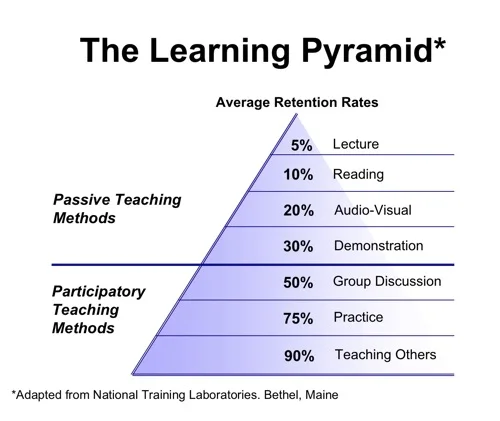
Hands-on Lectures play an important role in training but lectures seldom change professional practice. Consider the following diagram:

The-Learning-Pyramid.jpg

Reflect on the diagram for a movement. If the majority of your training is lecture-based then the majority of your training is lost, it is not affecting classroom practice.

Practice changes practice. There is a place for lecture, e.g., providing important background knowledge or explaining the rationale for the training but only hands-on-practice will change how teachers teach. Accordingly, the dominate form of training should the practice of new skills and concepts.

The best illustration I can give is technology training because we have all experienced bad technology training. The typical training involves a group assembled in front of a computer instructor. He or she demonstrates on the screen how to do "x." We watch, take notes, and perhaps fiddle with our computers. But, if we do not quickly start practicing what we have been taught we will forget. Remember, there is a difference between being taught and learning. Practice produces learning.

If, on the other hand, a short presentation of a technique is shown and ample time is provided for practicing the new skill, then we begin to understand and use it. The more time we have to practice the more likely we are to incorporate the skill into our work.

Here is a good rule of thumb; a ratio of 1:3 should be used for training. For each hour of training 15 minutes should be lecture or demonstration and the remaining 45 minutes for hands-on work. Doesn't this sound like good classroom teaching? If this is good classroom teaching it is good professional development.

Add Accountability

The adage, "what gets measured gets done" applies to teacher training. Because change is hard we need help and accountability. It is seldom enough to provide the rationale for change or even to practice new skills. If there is no consistent and transparent accountability for implementing new concepts and skills in the classroom there will be little change.

It is easy to make accountability a part of your professional development program. Revise your teacher evaluation instrument to include an assessment of the training provided. For example, if you provide training on techniques for teaching writing skills, add those techniques to the evaluation instrument so that they are assessed as part of the evaluation process.

Professional development can be effective and enjoyable. But is must not be ad hoc or an annual *de jour* experience. Good professional development is strategically aligned, is focused, sustained and scaffolded over several years. It is also hands-on with high levels of accountability for applying the training.

When these six elements of professional development are consistently practiced by school leaders, teachers are more likely to emerge from training declaring, "that was helpful, I can do that!"

Google

How to Enhance Teaching and Learning at No Extra Cost

By Dr. Barrett Mosbacker

Change is hard, even dangerous.   Attempts to change the behavior of others or an organization's deeply entrenched practices will run headlong into active and passive resistance, if not outright hostility.

Acutely aware of the difficulty but confident in the rightness of the cause, we embarked on changing the school's traditional schedule.

This was no small undertaking.  The schedule had been in place since the school's founding.  Various school constituencies had a stake in the current schedule.  The prevailing consensus was, "If it isn't broke, don't fix it."  And arguably, it was not broken; "We were doing just fine, thank you very much."  Classes were full.  Faculty and student retention rates routinely stood at 94-95%.  We had a 100% college admission rate.  The senior class was routinely awarded millions of dollars in college scholarships and our ACT/SAT scores were high and rising across all tested disciplines.  Complicating the problem was a lurking skepticism about school "reform."  In the U.S., too many educational fads had come and gone, creating a "this too shall pass" cynicism.  This was particularly true concerning "block scheduling," which carried with it negative connotations, mostly deserved.

So why mess with a good thing?  Because, as Jim Collin's points out, "Good is the enemy of great."  We were good but we were convinced we could do better.  The choice before us was clear; we could rest competent and content or press toward our goal of creating a Christ-honoring world-class program that propelled teachers and students to higher levels of achievement.  We chose the latter.

I am happy, and frankly relieved, to share that the new schedule has exceeded our expectations.  It is an Extended Period (EP) schedule, not a block schedule.  This is an important distinction.

What Is an Extended Period Schedule?

The Extended Period Schedule is a hybrid of a traditional schedule with features of block scheduling, but without the drawbacks.  Teachers start at 7:30 each day.  This new schedule has three components:

  • Traditional seven period days on Mondays, Tuesdays, and Fridays

  • Two days of Extended Period Instruction (EPI) and

  • A late start on Thursdays.

Monday  (traditional schedule)                 8:00 a.m.     3:00

Tuesday  (traditional schedule)                 8:00 a.m.     3:00

Wednesday  (EPI)                                           8:00 a.m.     3:00

Thursday late start & (EPI)                         9:00 a.m.      3:00

Friday  (traditional schedule)                    8:00 a.m.      3:00

Why the Change Was Made

We changed the schedule to provide students with more hands-on, active, engaging, and collaborative learning opportunities.  Extended periods provide more time for practicing writing and editing skills (essential for college success), for interactive science labs, for learning how to work on collaborative projects (also an essential skill for college and work), and for integrating technology into teaching and learning.  Extended periods provide time for more variety, more creative instruction, and more practice resulting in richer learning experiences and deeper learning.  In short, extended periods enhance teaching and learning by giving teachers and students time to think, not merely digest information.  Students move about and work in teams.  And, as our Learning Unleashed program (1:1 computing iPad program) is rolled out, students move from learning to use technology to using technology to learn.

The Extended Period Schedule also includes a late start Thursday.  The Thursday late start provides time to train teachers to work in teams to create integrated, creative, and engaging lessons that include the appropriate use of technology.  Teachers are also engaged in technology and pedagogical training on Thursday mornings.  The late start on Thursday also provides extra time for students to complete homework assignments, work on projects, and study for exams.

How the Change Was Made

Change is hard but not impossible.  To increase the likelihood of success and to ensure that the change was systemic and enduring but not cosmetic, we implemented a four-pronged strategy: Education, Communication, Training, and Accountability.

Education

Our first task was to break through a comfortable mindset rooted in academic and geographic isolation.  Too often administrators and teachers are isolated from developments in the world.  This is particularly problematic for Christian schools where staff and students can be culturally isolated, existing in a marginalized Christian bubble.  We may catch a glimpse of world affairs through the news but understanding the deeper implications for our students requires more information and deeper analysis.  It requires constant exposure gleaned by "being in the world."

We began several years ago to heighten the awareness of our faculty about how the world has changed and the implications of those changes for our students.  We demonstrated through reviewing international test scores, movies such as Two Million Minutes and quotes from leading industrialists, technologists, and economists that our students now compete against the best students in the best schools anywhere in the world.   Here is but one example:

 With the ability to make anything anywhere in the world and sell it anywhere else in the world, business firms can ‘cherry pick’ the skilled...wherever they exist in the world. Some third world countries are now making massive investment in basic education. American firms don’t have to hire an American high school graduate if that graduate is not world-class. His or her educational defects are not their problem. Investing to give the necessary market skills to a well-educated Chinese high school graduate may well look like a much more attractive investment (less costly) than having to retrain...a poorly trained American high school graduate.1  (Neef, 1998)

This was not a one time presentation. Multiple presentations in a variety of venues were made over several years.  This "set the table" or "set the mindset" for further discussion.

Communication

Communication was sustained, accurate, and careful.  The communication that occurred over several years was intentional and followed a logical path.  The communication did not start with the end in mind (e.g., Extended Periods), it began with deepening understanding of the fundamentals of Christian education, the place of the Christian school in culture, a deeper understanding of what it means to think Christianly, the shifting context in which our school operates (a globalized, technological, always connected world), an increasingly diverse and competitive educational marketplace (traditional public schools, charter schools, private schools, Christian schools, homeschooling, and online schools), the rise of Asia, and the fall of the U.S. from the top-tier of academic performance relative to the rest of the world to the middle or lower tier relative to the industrialized world.

Language was also important.  We made a decisive distinction between being "world-class" and being “worldly.”  We differentiated between being excellent and being elitist.  And, we used terminology that was accurate yet benign.  For example, we realized early that many of our teachers and parents would confuse our new schedule with block scheduling.  Although the EP schedule had a few elements common with a block schedule, it was not a block in the traditional sense.  It was also more than a traditional schedule.  What to call it was the question.  Although not creative, we choose to call it an "Extended Period" Schedule because that is what it is; it extends the period from approximately 50 minutes to nearly 90 minutes, extending the time teachers have to engage students in deep learning and collaboration.  Language is important.  It must be accurate while avoiding negative connotations.  Because the language we use is important, it must be planned and intentional.

 Training and Accountability

Our greatest fear was that teachers would lecture to students for 90 minutes.  We knew that if that happened our students would be bored to death, our academic goals would be undercut, and our parents frustrated.

We also knew that habits die hard.  The only way to ensure that extended period teaching was more than an elongated lecture, we provided practical training coupled with constant supervision and accountability.  We began the training process two years ago by approaching the matter indirectly.  With a desire to improve student learning and anticipating an extended period schedule, we devoted two years of training to how the brain learns.  The training included books (e.g., How the Brain Learns and teacher written responses to the contents of what they read.  We also hired outside experts to train our teachers on the science of how the brain learns AND on how to teach based on this science.

In addition to this foundational training, we also hired four Christian professionals with extensive experience teaching in extended periods from two other Christian schools.  They spent two days with our teachers showing them how to create lesson plans and how to teach the effectively in extended periods.  This practical "hands-on" training was just "what the doctor ordered."  While the training on brain research laid the pedagogical foundation, this practical "how to" training is what finally created the "mind shift" we were looking for.  We noticed a discernible level of "buy in" and even enthusiasm after this training.  The theoretical was married with the practical and a new perspective on teaching was conceived. We started out with worldview, the goal of developing a world-class school, and the study of cognitive science and ended up with the creation of actionable lesson plans.  We moved from theory to practice, from presentation to application, from "this too shall pass" to "I can and want to do this."

Training, however, in the absence of accountability is a bit like throwing jello against the wall and hoping it sticks.  Notwithstanding initial enthusiasm, most of it slides off to the floor.  Training is the same way.  To put teachers through a day or even a week of presentations is unfair to them and does not change practice.  Practice changes practice.   This means that teachers must practice what they are being taught at the time they are being taught and from that point forward.  There is no going back.  The application of training to teaching is not an option, it is an expectation, a requirement.

This means that teachers must be held accountable to incorporate the training in the classroom.  The only way this can be done is through direct observation, the requirement of artifacts to demonstrate application, and through evaluations that measure consistent classroom application of training.  Anything short of these measures will result in minimal, spotty change, if any.  Without this level of accountability, we foster the "this too shall pass" attitude that plagues so many schools.

On the observation side, the junior and senior high principals and the Director of Curriculum and Instruction (DOCI) spend most of the day on Wednesdays and Thursdays reviewing EP lesson plans and observing every classroom.  They offer help and advice but also look for compliance. It has been said that "what gets measured gets done."  While we would love to think that everyone is intrinsically motivated to do what is asked, the truth is that all of us need accountability, administrators no less than teachers and students.  If something is worth investing time and money in, it is worth monitoring and evaluating.

The Cost

Some change can be expensive but most change costs very little in money but a great deal in thought, hard work, and even courage.  Aside from the purchase of books and honorariums for our trainers, there is little cost associated with our change to extended periods.  But, there is a potentially huge payoff in student engagement and learning.  Low cost combined with significant gains in the quality of teaching and learning creates a high Educational Return on Investment (EROI) and increased marginal value for our parents.  Everyone benefits.

The Results

Although it is too early to have data to measure the results, I can share that all of the anecdotal feedback from students, parents, principals, and teachers has been positive, in fact, more positive than we expected at this early stage.  This is a tribute to professional, gracious, and hardworking teachers who deeply care about students and about doing a superior job.  It is also attributable to extensive Education, Communication, Training, and Accountability.

Change is hard and risky but it is not impossible.  With vision, planning, and hard work, undergirded by prayerfulness and a love for staff and students, we can create change that changes the lives of our students.

What have you changed lately?


Reference: Neef, D. (1998). The knowledge economy. Boston: Butterworth-Heinemann.

How to Design & Deliver High Impact Presentations: Before & After Examples

By Dr. Barrett Mosbacker

Leaders make presentations. Transformative leaders deliver inspirational, informative, and persuasive presentations.

Good presentations are hard to design and deliver, which is why we have suffered through so many poorly delivered seminars and workshops. Although I like to think of myself as a decent speaker and presenter, the truth is that I’ve given my share of poor keynotes and boring seminars.

Fortunately for those who must listen to me (my staff) and those who will do so voluntarily during conferences, graduate classes, and workshops, I’m improving. My growth in giving higher impact presentations is the result of reading articles and books, the critique of others, and trial and error. I offer the following tips with the hope that you can benefit from my reading and experience.

image

PREPARATION

Preparation Time

The amount of time that you spend on your presentation will vary based on the subject and context but in general, a 30-60 minute high impact presentation will require 36-90 hours of preparation. You read that right; a quality one hour presentation = 36-90 hours of preparation.

Presentation authority Nancy Duarte, author of the book Slideology and principal at Duarte Design (clients include Apple, Cisco, and Al Gore among many others), puts it this way; “The amount of time required to develop a presentation is directly proportional to how high the stakes are.” Duarte goes on to provide this guidance:

  • 6-20 Hours Research and collect input from the web, colleagues, and the industry

  • 1 hour Build an audience-needs map

  • 2 hours Generate ideas via sticky notes

  • 1 hour Organize the ideas

  • 1 hour Have colleagues critique or collaborate around the impact the ideas will have on the audience

  • 2 hours Sketch a structure and/or a storyboard

  • 20-60 hours Build the slides in a presentation application

  • 3 hours Rehearse, rehearse, rehearse (in the shower, on the treadmill, or during your commute)

Total Time: 36-90 hours

Is that accurate? Thirty six to ninety hours for a one hour presentation given all that I have to do? For what it is worth, that has been my experience lately. It takes a long time to prepare a good presentation. I have spent hours over several weeks preparing and designing presentations.

You are a steward not only of your time but of your audience’s time as well. Don’t waste your time or theirs by giving a poorly designed and delivered presentation. Don’t abuse your audience with a mediocre presentation.

I recommend that you schedule time throughout the week for several weeks to prepare your presentation. Your preparation time will be more efficient if you work on it in small, frequent chunks over an extended period of time.

Know your Audience

Your presentation is not about you; it is about your audience and what they need to hear, learn, and/or do. Your presentation is a service to them.

To serve your audience well you need to know them and their perceived as well as real needs. If I am speaking to an outside group I make it a habit to ask my host the following questions:

  • How many will be in attendance?

  • What is the average age?

  • What is the average educational level?

  • What will be the gender mix: balanced, mostly women, mostly men?

  • If this is a school audience, are most in attendance teachers, administrators, board members? If all three, in what proportion?

  • What are the primary areas of interest or concern of this audience regarding this topic? What are some of their likely questions?

Tailor your presentation to your audience. The stories you tell, the examples used, and the graphics employed should match the demographics and needs of your audience. Otherwise your presentation will be largely irrelevant.

Know the Venue

To prepare properly you need to know the venue and to request things that you may need. I typically ask:

  • What type of room/auditorium will I be in?

  • What type of sound and video equipment will be available?

  • Will I be controlling my slides or will you have an AV tech. assisting?

  • Will there be a podium mic? May I use a lapel mic.? (I prefer a lapel or head mic so that I am not restricted to standing behind a podium.)

  • I am using a Mac/Windows PC, can I load my PowerPoint/Keynote presentation on the local computer or do I need to have my computer on the platform?

SLIDE DESIGN-Less is MORE!

Less is MUCH MORE! This is probably the most important lesson I have learned from my reading and my experience. Keep it simple, clean, and elegant. Remove everything that is not absolutely necessary on your slides and charts.

Less is more-fewer slides, fewer points, less text, and less time.

This is harder than it seems! We want to add information, not eliminate it. When designing your slides keep the following in mind:

  • You want to talk to your audience and you want them to listen and watch you. You do not want them reading slides!

  • Slides are NOT a teleprompter! Do not design and use slides as an outline of your talk.

  • Slides are used to illustrate key points. They should be simple, clear, and uncluttered.

  • Eliminate most transition effects--they distract from your presentation.

  • Have few to no bullet points.

  • You should seldom have more than six to eight words on a slide.

  • Use large easy to read font.

  • Use consistent font styles and colors.

  • Do not use clip art! It is cheesy and unprofessional. Find good photographs or graphics.

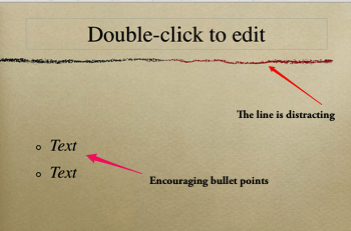
You should seldom use template designs for the same reason--they are distracting. Here is an example of a distracting verses a good slide template:

Distracting Template:

image

Good, Clean Template:

image

Good and Bad Examples

Assuming that a “picture is worth a thousand words,” here are some examples of before and after designs. Many of these are slides that I have produced--both good and bad and a few are provided from other sources as examples. My slides are indicated by the initials BLM.

THE BAD

image

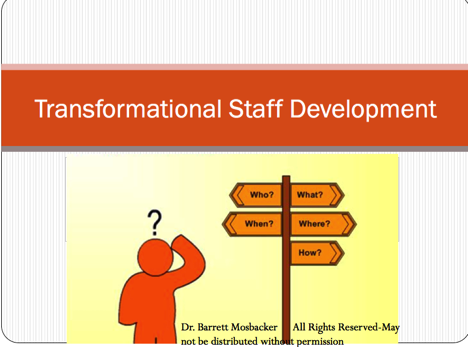
BLM (Cheesy clipart, poor color selection, distracting text)

image

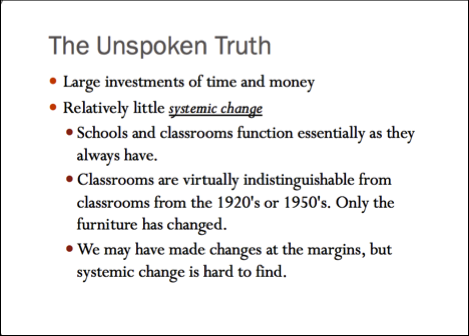
BLM (Boring with no graphics or illustration, small font, too many bullet points)

image

BLM (This one is so bad it is just embarrassing. There is nothing good about this slide. The graphics are terrible. Too many bullet points. Font too small. Poor color selection.)

image

BLM (The slide has too much text, which is too small. The illustration is poorly done and the overall impact of the slide is boring and distracting.)

image

BLM (The slide has too much text and cheesy clip art.)

THE BETTER

Here is the same topic being covered with a redesigned slide from the one above.

image

BLM (This one has no clipart and no text. A high quality photo covering the entire slide is used. The photo speaks for itself. It is much more impactful than the one before with the same point to make.)

image

BLM (This title slide is affective because the professional photo reinforces the title, which is very short and to the point. The photo also matches the audience, this presentation was given in Canada in the winter.)

image

BLM (One word with a photo matching the key concept.)

image

BLM (Transition slide to next topic--simple text on solid background)

image

BLM (This is a playful slide using a professional photo but with a font matching the playful mood. This slide was designed to communicate with and encourage elementary teachers thus the colors and playfulness, which are characteristic of elementary programs.)

The following five slides tell a story and reinforce each other.

  • Slide 1 acknowledges how many feel when faced with significant change.

  • Slide 2 encourages the audience to laugh and relax because we will provide time and resources to ensure their success.

  • Slide 3 reassures that we are confident that they will be successful as a team.

  • Slide 4 reassures that we are confident of success because….

  • Slide 5 communicates that we will deal with big change in small bites.

  • Slide 6 illustrates why they will be successful--a slow, deliberate training and implementation cycle.

image

BLM Slide 1

image

BLM Slide 2

image

BLM Slide 3

image

BLM Slide 4

image

BLM Slide 5

image

BLM Slide 6 This slide has animations so that each date appears and disappears in sequence.

A Word About Charts and Numbers

Charts can be very helpful in a presentation but just like your slides they need to be simple with all distracting and unnecessary elements deleted.

Numbers are usually confusing to the audience. Use as few as possible and allow extra time for the audience to do the math. Numbers should never be ultra precise: “Anticipated revenues of $660,101.83” looks silly. Are your numbers that accurate? Just say $660 thousand.

image

This is a busy, hard to read and understand chart with too many words and numbers.

image

BLM This chart is much better. Easy to understand, clean with no distracting elements, e.g., grid lines, unnecessary numbers, and text.

DELIVERY

Arrive Early and Test Everything!

It is stressful and embarrassing to stand up to deliver a presentation only to discover that something is not working. Worse, it is distracting to your audience and immediately reduces your credibility and impact.

You only have about 1 minute to make a first impression. Don’t make it with you trying to get your computer to work or your slides to show up on the screen.

Plan for Murphy to show up. He always does. Plan for the worst case scenario. What will you do if the computer crashes and burns, the video system goes out, or the sound system does not work? Prepare for the unexpected. When you do, you can go with the flow and not skip a beat.

Have your presentation so well rehearsed that you do not need slides as prompts (more on this later). You should be able to speak spontaneously. If you can’t, you don’t know your subject well enough.

If you must have notes, have a printed copy readily available.

Have electronic backup copies of your slides on a thumb drive (for use on a local computer if yours crashes) and your online for immediate download if needed. I use an iPad for this purpose.

Have copies of your notes and slides available for distribution or access online.

Talk to Your Audience, Do Not Read!

Whatever you do do NOT look at your slides and read from them! Keep your eyes on your audience. Make eye contact with individual audience members.

Remember, your slides are to illustrate key ideas, concepts, trends, and facts. Do not use your PowerPoint or Keynote presentation as a teleprompter.

Presentation Style Tips

Remember, your audience will form a first impression within 60 seconds or less! Make that first minute count!

  • Dress appropriately for your audience. It is best to “dress up” rather than “down” if in doubt.

  • Tell real life stories that reinforce your topic.

  • Turn off your cell phone.

  • Jump right in and get to the point.

  • Give your rehearsed opening statement; don't improvise at the last moment.

  • Use the opening to catch the interest and attention of the audience.

  • Briefly state the problem or topic you will be discussing.

  • Talk at a natural, moderate rate of speech.

  • Project your voice.

  • Speak clearly and distinctly.

  • Speak with enthusiasm.

  • Use appropriate well timed humor but not jokes.

  • Pause briefly to give your audience time to digest the information on each new slide.

  • Keep your eyes on the audience.

  • Use natural gestures.

  • Don’t turn your back to the audience.

  • Don’t hide behind the lectern. As much as possible don’t use a podium at all but if you must or the host site has it there for other speakers, move in front or to the side.

  • Avoid looking at your notes. Only use them as reference points to keep you on track. Talk, don’t read.

Length

  • To end on time, you must PRACTICE!

  • The audience will love you if you end short of your time. Never go over! Remember, less is MORE.

  • As a rule of thumb, plan to use 80% of your allotted time.

Demeanor

Show enthusiasm. Nobody wants to listen to a dull presentation. On the other hand, don’t overdo it. Nobody talks and gestures like a maniac in real life. How would you explain your ideas to a friend?

Recommended Reading

All truth is God’s truth. We can learn from unbelievers because by God’s common grace he reveals truth to believers and unbelievers alike. Although I do not endorse everything in the following books (e.g., some have Buddhist and Zen philosophy embedded in them), nevertheless, some of the principles are true and can help anyone design and deliver better presentations.

Biblical Integration Lite: Telling it Like It Isn’t

Feather colour panteneGuest Article by Mark Kennedy (ACSI Canada)


When someone tells me that his school’s Christian character “goes without saying” I can’t help thinking, ‘that school may be in trouble’. Too often what goes without saying gradually goes without being, until it is simply and completely gone. It’s so easy for an educational institution to drift from its foundations with hardly anyone noticing. Historically that happened to some of North America’s most prominent universities and independent schools. Although they were once fervently Christian many of them are now completely secular or just superficially religious. They may be wealthy and respected institutions - places like Upper Canada College and Harvard University- but the Christian distinctive that so strongly marked their early years have vanished. A classic example is the entire public school system for the Province of Ontario. Founder Egerton Ryerson once declared that instruction in his public schools would be “but a sounding brass and a tinkling cymbal when not founded upon and sanctified by the undefiled and regenerating religion of Jesus Christ.”* How tragically prophetic.

These days the erosion of a school’s Christian character can start when it abandons the quest for authentic biblical integration and settles for ‘integration lite. On the surface ‘integration lite’ looks just fine. The word “Christian” is in the school’s name. The teachers are all born again and they believe in the inerrancy of Scripture. And when it comes to teaching a Christian worldview, well that’s covered by using Christian school textbooks. But there is a lot more to genuine biblical integration than that.

What’s in a name?” says Juliet in Shakespeare’s famous play “That which we call a rose by any other name would smell as sweet.

Along the same lines (and with apologies to Shakespeare), giving a skunk cabbage a more complimentary name won’t improve its aroma.

So it can be when ‘Christian’ is spliced into a school’s name. In an ‘integration lite’ type school the word ‘Christian’ in its name doesn’t guarantee moral or educational quality or even ethical standards of operation. On the other hand ‘Christian’ in the name of a school that pursues genuine biblical integration means something. It says that the school is trying to follow scriptural principles in every aspect of its ministry, even if doing so drives away potential students or causes loss of income.

Just having Christian teachers doesn’t help either unless their character is exemplary as per Jesus’ assertion in Luke 6:40 “A student is not above his teacher but everyone who is fully trained will be like his teacher.” And Christian school educators need to have the spiritual gift of teaching. In 27 years as a principal I only had to fire 3 teachers in the middle of the academic year. They were all unquestionably believers and two of the three were among the most highly trained educators I’d ever met. But they didn’t have the gift of teaching and they weren’t particularly outstanding role models. I hired them because they were Christians with impressive academic credentials. I missed the things that matter the most.

When it comes to teaching a Christian worldview ‘born again’ teachers can be counter-productive if they have only been trained in secular educational philosophies and practices. Secular teacher training operates upon the assumption that God is irrelevant in learning about the “real world”. And that’s what some Christian teachers with secular worldviews may inadvertently communicate to their students. The regrettable part isn’t that they failed to meet some kind of subjective and artificial spiritual standard. Biblical integration isn’t about twisting reality to fit into a pseudo-religious mold. It is first and foremost about teaching the whole truth on the clear understanding that all truth is God’s truth. That means a teacher has to learn how to give God back his rightful place in the classroom, in the curriculum and in the overall learning process. ‘Integration lite’ educators don’t do that. They presents pretty well all aspects their program in exactly the same way that secular teachers do – with the occasional Bible class tossed in as a mild christianizer. ‘Integration lite’ doesn’t try to present the whole truth. It is satisfied to ‘tell it like it isn’t’.

In the early years of ACSI, co-founding President Dr. Paul Kienel estimated that it took about three years of in-service training for secularly prepared Christian teachers to develop distinctly Christian educational philosophies and practices. Because our society has drifted farther away from any sort of Christian consensus since then, it probably takes longer now. Ongoing in service teacher training is a key in developing authentic biblical integration in the classroom.

Teaching a Christian worldview through biblical integration used to be a hot topic 30 years ago when the Christian school movement in North America was young and vigorous. Back then we devoted significant time and effort to it. Sometimes we got it wrong, shoe horning Bible verses awkwardly into lesson plans where they really didn’t belong or inappropriately transforming simple science lesson into didactic morality tales. But at least we took a whack at it. And we discovered that the development of effective biblical integration was a major project requiring intentional planning, research and goal setting over significant periods of time. Both then and now, even well established schools that have thoroughly explored the topic and implemented specific integration initiatives re-evaluate their program annually. They ask themselves,

“How can our school become more His school in this upcoming year?”

The ‘integration lite’ approach of depending upon Christian school textbooks to provide a biblically integrated curriculum falls short of the mark too. Aside from the fact that the most effective kind of integration, with the greatest potential blessing for students is carried in the hearts and minds of their teachers, textbooks, even Christian ones, sometimes have flaws. They may occasionally have scientific and historical errors. Some Christian academic series may unwittingly promote the view of one specific denomination or political group as ‘the Christian perspective’ even where there is a divergence of opinion among believers. Good teachers challenge students to think critically about what they read both in secular and Christian publications because they want their students to seek truth and because total inerrancy belongs to the Bible alone. Textbooks can be useful tools but they hardly ever change lives. Good teachers do.

As one pundit put it “A little Christianity can be a dangerous thing, especially for Christian schools.”- and ‘integration lite’ is the epitome of a little Christianity. The problem is that Christianity is not a little faith. It’s not just a church thing, not limited to a system of moral regulations and behaviors or religious exercises or private personal beliefs. Jesus compares his kingdom to a mustard seed, the smallest of seeds that ultimately produces a tree in which birds can perch. His kingdom encompasses all aspects of truth – and it is sometimes much bigger than we present to our students. Consequently our mandate is clear. Paul says,

We demolish arguments and every pretension that sets itself up against the knowledge of God, and we take captive every thought to make it obedient to Christ. (2 Cor 10:5)

For Christian schools, that scripture highlights the importance of genuine biblical integration and repudiates the idea of ‘integration lite’. And that does not go without saying.

* “Egerton Ryerson and His Times” by Neil McDonald, MacMillan Canada, 1978

I Just Returned from the Future

clip_image001

By Dr. Barrett Mosbacker

I just returned from the future.

In one of the strangest experiences I have had in a while, I lived the future as I read about it! I did not realize it for a while but then it struck me suddenly over dinner—”I am what I’m reading!”

Let me explain.

As I write this I am nearing the end of my annual Think Week (you can read details about Think Week in these two articles: How to Reduce Stress While Getting More Done; and in How To Find Time to Focus, Think, and Work). During my Think Week my primary focus is prayer and reading. On this trip I took several books with me including Humility (Andrew Murray), The Culture Code (Clotaire Rapaille), Think: The Life of the Mind and the Love of God (John Piper), Derailed(Tim Irwin), Death by Meeting (Patrick Lencioni), and Generous Justice (Tim Keller).

I also took Anywhere: How Global Connectivity is Revolutionizing the Way We Do Business (Emily Nagle Green). This is the book I was reading when I realized that I was living the future. I will summarize some of the key points of this book and their implications for our schools in a subsequent post but for now let me simply state the theme of the book;

Within the next ten years the global ubiquitous digital network will connect most of the world’s people, places, information, and things, which will fundamentally alter the way we live, work, teach, and learn.

The author, Emily Green, knows what she is talking about. She is the President and CEO of the Yankee Group—one of the world’s premier research firms on the impact of the global connectivity revolution with operations in North America, Europe, the Middle East, Africa, Latin America and Asia-Pacific.

One of the most fascinating parts of the book is her description of five consumer segments: Analogs, Technophytes, Digital Shut-ins, Outlet Jockeys, and Actualized Anywheres (AA’s). As I was enjoying my dinner and reading it suddenly dawned on me just how much I was exhibiting the characteristics of the Actualized Anywheres. The short description of AA’s is that they “bring the concept of a ubiquitously connected consumer to life.” This is when it struck me—-I was literally living the future she was describing!

Here is how I know. I wrote down how I was handling my recreational and work related tasks during Think Week. Here is a short list.

  • All of my books, newspapers, and magazines are on my iPad. I read, highlight, annotate, and share my reading content electronically.

  • I downloaded a book immediately onto my iPad based on a recommendation from the book I was reading at the time.

  • I held a video-call with my daughter and grand daughter using FaceTime on my iPhone.

  • I sent an email through Facebook to some friends and family. I accepted a connection request with a professional colleague on LinkedIn.

  • I used the Yelp application on my iPhone to find restaurants and read reviews before choosing a place to have dinner. I also wrote my own review on Yelp for the benefit of others.

  • I used my Garmin GPS to guide me to the restaurant.

  • While driving and while dinning, I used an iPhone application called SoundHound to identify and order songs to download. I liked the songs but could not remember the titles. SoundHound solved that problem.

  • I used an application called NoteSelf on my iPad to take notes using a stylus, including notes for this blog article. No paper or pen needed.

  • I used the Evernote application to send clippings from the books I was reading to my administrative assistant for her to type so that the information could be put into my Endnote program for future reference and citation.

  • I used Logos Bible Software on my computer to study and write a devotional for my faculty.

  • I used Adobe Acrobat to print the devotional as a PDF. I uploaded it to Box.net (cloud storage and collaboration) so it could be shared with our parents with a hyperlink in an email, and then I emailed it to all school staff using Outlook.

  • I used LoseIt on my iPhone to track my calories and my running.

  • One of the books I was reading referenced a 2004 NYT article on how Apple Outflanked Sony in music players (this had to do with Disruptive Innovation). I went to the NYT website and downloaded the article.

  • I am using my laptop to type this article using Live Writer, which I will then post to my blog using the same program.

Now, before you react with something like “are you crazy?!” let me highlight the key point. I am using mobile devices connected to a global digital network everywhere I go to get things done and to enhance and enrich my life. I have a seminary’s worth of books in my Logos Bible program. I have an entire library on my iPad for reading. I have a huge music library of beautiful music in my pocket. I can find and read reviews on local restaurants before deciding where to eat. And I was able to speak with AND see my granddaughter even though I am hours away in a hotel.

Some of my readers, perhaps many of them, have no intention or interest in using technology in the ways I describe above. That is okay. They are most likely Analogs. Most people are. All of us fall into one of the consumer segments that Emily Green describes in her book.

What does this have to do with our schools? Plenty! What I just described is how most of our younger parents and our students will conduct their personal and professional lives.

As school leaders we must understand that our younger parents (those born in the mid to late seventies) and certainly our current students and our future parents DO CARE. They will live and work much as I have described above. Mobile computing and connectivity will be a given—it will be woven into their lives. Their expectations are, and will increasingly be, that our classrooms and school-to-home communication reflect the realities of the new Anywhere Global Connectively.

This is a sea change. It is as evitable as the sun rising tomorrow.

Are we preparing our school infrastructures for this change? Are we preparing and training our faculty? Are we preparing our students for the new work world of tomorrow? Are we providing a biblical framework for understanding and using technology for God’s glory? Are we modeling the use of technology for our teachers and other administrators?

This is one of my favorite quotes from the book:

New things are an easy target for those who lack imagination … Years ago, no one understood why e-mail was worthwhile. Now, no one thinks twice about it—but they’re busy talking about why Twitter is stupid. Bob Metcalfe

Let’s put our sanctified imaginations to work—let’s travel to the future and then return to our schools to get ready!

How to Reduce Stress While Getting More Done

Multitask_Productive_Work_Business

By Dr. Barrett Mosbacker

Too much to do!  Too much stress!  Not enough time!  More expectations!  More demands!  More information!  More interruptions!  People, meetings, calls, emails, documents, events to attend, speaking engagements, budgets, training ….. and the list goes on!

Does that sound familiar?

In today’s world, we are constantly bombarded with information, the urgent, and ever increasing expectations. 

The weight upon us and the pace of our lives often leave us feeling dissatisfied, stressed,and sometimes burned-out.

There must be a better way!  There is!

How I work

Over the years I have worked hard at working smarter. My goal is to increaseeffectiveness and to decreasestress. I make no claim to having arrived—I haven’t. I have learned to juggle the myriad demands paced upon my professional and personal life by developing habits and leveraging technology to help me work smarter.

Below is a brief summary of how I approach my work and responsibilities. If you want more detail or have a question, simply leave a comment and I will respond with more information.

clip_image002

Calendar & Meeting Management

Time of Arrival at the Office

I am usually in my office by 6:00-6:15 AM, sometimes earlier—depending on how often I hit “snooze” on my alarm! This enables me to beat the rush hour traffic, making me less stressed and more efficient. I’m also in a better mood for devotions.

Prayer and Devotions

I start the day with prayer and Bible study. My devotional time is blocked and locked on my calendar. It is not always easy to begin the day with prayer and Bible study. Some days I don’t feel particularly spiritual and don’t feel like praying or reading my Bible. I am tempted to start reading and responding to email.

It doesn’t matter how I feel. I pray and study my Bible anyway. My soul is almost always warmed and enlivened through prayer and Bible study (coffee also helps!) but not always. It does not matter—I pray and study anyway. God never told me to feel like praying or to feel like reading my Bible—he simply commands me to do so.

My prayer is that the “Lord will bless the work of my hands, that he will grant wisdom, that as I plan my way he will direct my steps, and that he will grant me holy rather than selfish ambitions in my work.”

I am currently reading through the Bible using the ESV on the iPad. I leave the computer off and go to another chair in my office to pray and read. This is called “fleeing temptation.” J

Review of Next Action Items and Upcoming Appointments

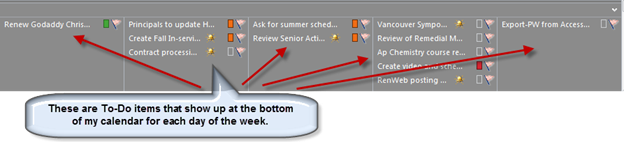
After devotions, I have 30 minutes set aside to review reports, NEXT ACTION items, the day’s appointments, etc. I am able to do this easily and effectively because I use the Task function in Outlook to manage my To Do list and projects. I am able to see at a glance what is due today and for the week.

clip_image004

clip_image006

Meetings

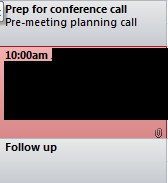
Time is scheduled before and after every meeting for prep, travel, and follow-up. This allows me time to walk into a meeting well prepared with documents gathered. It also ensures that I setup follow-up meetings, write a memo or email, etc., immediately after the meeting so that “balls are not dropped.”

clip_image007

When someone other than a parent or staff member stops by and asks “do you have a minute,” usually a salesperson, if I’m not in a meeting or leaving for one, I will give him or her a little time in order to give a good testimony of the gospel. However, if this is an unscheduled drop-in, I start by meeting him or her at the door. I remain standing. This significantly shortens the unplanned meeting. I will invite the unscheduled guest to sit IF I believe the issue has the potential to benefit the school and if I have time. Otherwise, the meeting will end as a standup meeting or my assistant will schedule a follow-up meeting. In other words, in so far as possible and polite, I attempt to control my time rather than having someone else control it.

I also use lunch for meetings. I have to eat anyway so I might as well make it productive. Very seldom do I eat without meeting with someone.

I normally leave the office at 4:00. I go home and run four miles on the treadmill while catching up on the news—I accomplish two things at once! I shower and eat and then go to any evening meetings or events that I may have.

I am almost always in bed by 10:00 and up at 5:00 the next morning.

Friday mornings are blocked on my calendar for project work—off campus to minimize interruptions. This is an important time each week. I am able to focus on those BIG rocks that can be crowded out by the urgent.

Phone Calls

I have the blessing of having a wonderful administrative assistant. I have instructed her to log all phone calls into Outlook’s Notes function. This provides a permanent record of every call. After returning the calls I make quick notes on each log. This ensures that I return calls in a timely fashion and I have a record of my response—which can be as easy as “Returned, Left Message, Referred, etc.

clip_image009

I also return calls in the car using hands-free voice activated dialing. NEVER dial when driving. (That sentence will make my attorney happy!)

Managing Email and Information

email communication overwhelmed

clip_image010

Email management is a challenge—but not impossible! Rather than outline strategies for managing email in this article, I have created a PowerPoint Presentation that you may find useful. At the end of the presentation are links to short Microsoft training videos.

Click HERE to download the PowerPoint Presentation. You may share the PPT with whomever you wish; I only ask that you refer them to this blog.

Think Week

clip_image011

My Think Week is one of the most important practices that I have developed over the years. As I write this, I am preparing to leave for my Think Week. I will be reading 10 books and a stack of research documents—all on my iPad. For more information on Think Week see my previous post: How To Find Time to Focus, Think, and Work.

I got the idea for Think Week from articles I read about Bill Gates and his Think Week. Here are two articles that may interest you: Article 1: Bill Gates in Secret Hideaway, Article 2: Bill Gates Think Week.

Tools I Use

  • I strive to be as paperless as possible. To the extent that I have everything in digital form (which is almost everything) I can have my documents with me anytime and anywhere. They are also searchable and shareable. This is far more productive than keeping up with paper, legal pads, notebooks, post-it notes, etc.

  • I use a Dell laptop on a docking station with two monitors. On the left is my project management/brainstorming software—Mindmanager from Mindjet. The center monitor is used for Outlook and other Microsoft products (Word, etc.)

clip_image012

  • I make extensive use of video-conferencing. I use ooVoo-think Skype on Steroids! Video-conferencing makes phone calls far more personal, there is less temptation to “multitask” while on a phone call, and you can share your desktop and/or files while on the call. Video-conferencing also reduces the number of emails I must process.

· I use the iPad for virtually all of my reading and note taking. There is a very effective and powerful note taking application called “Note Taker HD.” Used with a stylus it is as effective as a legal pad but with the advantage that all of your notes are in one location, searchable, and shareable.

Software I Most Frequently Use

  • Microsoft’s Office 2010

  • Docs-to-Go on my laptop and iPad. This program syncs all of my laptop documents to my iPad so that I have everything with me at all times. Docs-to-Go also enables me to read, create, and edit Microsoft documents-Word, Excel, and PowerPoint.

  • Mindmanager with a Catalyst subscription—for project management, brainstorming, and collaboration. The program tightly integrates with Outlook and Microsoft Office products making it an extremely effective task and project management tool.

  • The new I.E. 9 browser and Google's Chrome. They are fast, secure, full-featured, and customizable.

  • Note Taker HD—replaces a legal pad.

  • Logos Bible Study software—on my laptop and iPad. For in-depth Bible study.

  • Kindle software on the laptop, iPad, and iPhone—I carry my library in my pocket.

  • Skydrive—for online document storage, creation, and collaboration. Skydrive and MS Webapps integrate seamlessly with Microsoft Office.

  • ooVoo for video-conferencing.

  • Twitter—for keeping up with the news.

  • Jott—for leaving myself reminders when I’m in the car.

  • Adobe Acrobat Pro—for PDF creation and electronic forms completion and signing.

  • Loseit-see below.

Personal Health

clip_image014

Staying fit is critical to reducing stress and being efficient and effective. Although it gets tiresome, I count calories (I use a software program called LoseIt on my iPhone) and I track my exercise using the same program.

I run four miles a day six days a week (Sunday off) unless providentially hindered. I maintain my weight within the “ideal range,” for my height and age.

I do NOT like running and I do not like counting calories—but—doing so makes a big difference in how well I sleep at night and how much energy I have each day.

Because I do not like running, I do not sit down when I get home—not even for a minute!! I walk immediately to the closet and change into my exercise cloths and mount the treadmill.

Life is hectic and our jobs are demanding. Learning to thrive rather than merely survive as a leader is a challenge. It can be done. Attention to one’s spiritual and physical health, establishing good practices and habits, and making appropriate use of technology can all, when used in combination, reduce stress while we strive to accomplish more for God’s glory.

Product or Produce?

By Dr. Barrett Mosbacker

image

I love dessert.  One of my favorites is pecan pie.  When I sit down to enjoy a piece of warm pecan pie Ala Mode there are two things that I am careful to do: 1) I eat slowly savoring each mouth watering morsel and 2) I am very careful not to waste a single crumb.  My dog can lick a plate clean but he has nothing over me when it comes to getting every last morsel of taste off of my plate! (yes that is my dog--like father like son!) 

When it comes to my dessert, I do not waste it!

Are We Wasting Our Lives and Ministry?

Dessert is trivial when compared with one's life and ministry.  One of my fears is that my efforts will be wasted.  I sometimes ask myself, "in the end, will all of my hard work and long hours, the stress in dealing with upset parents and the occasional recalcitrant employee, and the energy expended in creating a world-class Christian school prove to  be for naught?  What if the only thing that I have achieved is the creation of a great product--superior students, excellent staff, and an outstanding school--but I have not borne fruit?  What if I am doing many good things but ultimately not the essential thing?  What if I am building and running a very efficient factory rather than planting and cultivating an orchard?"

If I build a great school and produce great students but those students do not grow to love and obey Christ and if they do not learn to love their neighbors--and if the fault lies with me because I failed to do what was necessary to produce spiritual fruit rather than creating a great product--then I will have ultimately failed in my calling.  I will have wasted the ministry entrusted to my stewardship.  That would be tragic.

Distinguishing Produce from Product: What Does Fruit Look Like?

To ensure that we are cultivating produce and not merely producing a product we need to be clear what produce or fruit is.  What does authentic fruit look like in a Christian school?

In answering this question I would like to expand upon the typical definitions, which include producing students who: Love Christ, evangelize, raise godly families, and who are serving in a local church. All of these are essential evidences of spiritual fruit in the lives of our students.  Unless these things are true we clearly have not produced the desired fruit.

Nevertheless, I would like to offer a broader understanding of the fruit we desire to produce -- an understanding that incorporates and expands upon our typical definitions so that the spiritual completely engulfs the secular.

Education Pyramid

Below, for lack of a more creative title, is what I call the "Educational Pyramid" for Christian schooling.  The limitations of a blog article do not permit a comprehensive treatment of each component of the pyramid so a concise summary will have to suffice.

Each block of the Educational Pyramid builds upon the other. Beginning with the foundational understanding that Christ is the source and object of knowledge, the biblical doctrine of mankind's general call to exercise dominion and stewardship over creation is realized through each individual's vocational calling.  (for more information on this subject and the Creation Covenant, click here and see below.1)

Discovering and preparing for one's calling requires the development of a comprehensive course of instruction and co-curricular and extra-curricular programs.  Fulfilling one's calling for God's glory and in fulfillment of the Creation Covenant requires that one's time, talent, and treasure, realized through and arising from one's calling, be consecrated to God and to loving one's neighbor. 

Consecrating one's time, talent, and treasure through the dedication of one's vocation to God's glory and in loving one's neighbor inevitability leads to cultural transformation as Christians function as salt and light in this world.

More specifically, each block of the Educational Pyramid provides a rich framework for an expansive understanding of Christian education and for defining more comprehensively what we mean when we say we are striving to cultivate fruit, not merely create a product.

Christocentric Foundation

Christ is the ultimate source and object of all knowledge.  There is no knowledge, no truth, no harmony, no beauty, no freedom--nothing apart from Christ.  He is quite literally the Alpha and the Omega of existence and therefore of knowledge. 

For from him and through him and to him are all things. To him be glory forever. Amen. (Rom 11:36, ESV)

He has delivered us from the domain of darkness and transferred us to the kingdom of his beloved Son, in whom we have redemption, the forgiveness of sins. He is the image of the invisible God, the firstborn of all creation. For by him all things were created, in heaven and on earth, visible and invisible, whether thrones or dominions or rulers or authorities--all things were created through him and for him. And he is before all things, and in him all things hold together. And he is the head of the body, the church. He is the beginning, the firstborn from the dead, that in everything he might be preeminent. (Col 1:13-18, ESV)

Covenantal Mandate—General Call to Dominion and Stewardship (Gen. 1:27-30, 2:15)

Man has been called to the twin duties of exercising dominion and stewardship over creation. This is the raison d'être of his existence—to glorify God by engaging in creative and redemptive acts of dominion and stewardship over creation under the Lordship of Christ. To subdue and rule implies the sovereign exercise of control—the subjugation of creation to man. Cultivation is a stewardship activity—the process of preserving, nurturing, and improving creation for the purpose of increasing its beauty and benefit to man.

To aid him in this task, man invents tools--some simple like a shovel, some complex like a computer.  Some are cognitive like literature or mathematics.  Some are artistic like sculpture, music, or architecture. 

If the exercise of dominion and stewardship over creation for God's glory is the raison d'êtrefor our existence, then preparing students to use the tools required for doing so must be an important component of the Christian school’s curriculum. Students who graduate from a Christian school lacking fundamental skills and understanding in theology, science and technology, in the humanities, or in the arts will be handicapped in their efforts to glorify God through the redemptive exercise of dominion and stewardship.

Calling—Preparing for Vocation (Exod. 28:3, 31:6)

image

image

The general call (Creation Covenant) is personalized by God’s calling and gifting of individuals for specific vocations.  Our ultimate goal is not to prepare students to be "successful" as defined by Western culture, it is to assist our students in discovering God's gifting and calling in their lives even if  fulfilling that calling means they will make less money and not climb the ladder of "success". For a summary of the definition of vocation as I am using it, click here or see below1).

Cultivation--Curriculum Content

The doctrine of calling provides the theological and practical basis for providing a rich curriculum that encourages and stimulates the cultivation of the varied interests and aptitudes of our students.  This is typically accomplished by offering standard and advanced courses and electives in the sciences, the arts, and the humanities.  Our curriculum must be deep and broad enough to help students discover their interests and gifts (which are usually indicators of calling) and to prepare them to pursue their callings through higher education and work.

Consecration

Our prayer and hope is that our students will consecrate their gifts, knowledge, and skills in service to God and in loving their neighbor.   Paul reminds us that, “whatever we do, whether we eat or drink, we are to do it to the glory of God.”  For most of our students, this is an abstract concept.

Using Our Gifts for God’s Glory: Making the Abstract Concrete

image

To make this concept more concrete for 21st century students and to help them grasp what it means to consecrate themselves, their gifts, and their vocations to God, consider the following questions for class research, discussion, and debate: 

  • How do we use computers and other technology for the glory of God?

  • How does the Christian’s use of such technology differ from the non-Christian’s, or does it?

Similar questions can be asked about most any subject from history to physics.  By answering such questions our students will gain a more concrete and practical understanding of what it means to consecrate one’s work and life to the glory of God.

Using Our Gifts  for Loving our Neighbors

image

Continuing with the technology illustration, consider that computers are great tools for problem solving, communication, modeling, research, and information storage and retrieval. As such, they can be used to aid man’s efforts to fight disease, speed communication, improve engineering designs and safety, make space exploration feasible, improve efficiency in the generation of power, and a whole host of activities too numerous to list here. All of these activities are redemptive in nature, i.e., they contribute to the alleviation of the consequences of the curse and promote the welfare of our community and world. Used in this way, computers become instruments of love.

Again, this same approach can and should be used for every subject we teach.  For example, how can an understanding of history be used to love our neighbors?  How can becoming proficient with a musical instrument be used to love our neighbors?

A Powerful, Living Example

image

One of my favorite quotes comes from Dr. Francis Collins, a committed believer and the father of the Humane Genome Projectand as such one of the world's leading scientists.  Here is the statement he made standing beside President Bill Clinton when the announcement was made that the Humane Genome had been mapped.

image

"The human genome consists of all the DNA of our species, the hereditary code of life. This newly revealed text was 3 billion letters long, and written in a strange and cryptographic four-letter code. Such is the amazing complexity of the information carried within each cell of the human body, that a live reading of that code at a rate of one letter per second would take thirty-one years, even if reading continued day and night. Printing these letters out in regular font size on normal bond paper and binding them all together would result in a tower the height of the Washington Monument."

For the first time on a warm summer day six months into the new millennium, this amazing script, carrying within it all of the instructions for  building a human being, was available to the world …

Without a doubt, this is the most important, most wondrous map ever produced by humankind…we are learning the language in which God created life. We are gaining ever more awe for the complexity, the beauty, and the wonder of God’s most divine and sacred gift …

It’s a happy day for the world. It is humbling for me, and awe-inspiring, to realize that we have caught the first glimpse of our own instruction book (Ps. 139:16?), previously known only to God” (Dr. Francis Collins, A Scientist Presents Evidence for Belief: The Language of God, (Free Press, New York), 2006, pp. 2-3

Is this not how we want our students to fulfill their callings for God's glory and in loving their neighbors?  Does this not represent produce (fruit) and not merely a product?  Is this not for what we strive so diligently?

Cultural Transformation

Just as Francis Collins is doing, our schools should be designed to prepare our students to make positive contributions to their community and culture through personal witnessing and discipleship, scientific and economic progress, the acquisition, and dissemination of knowledge, and the amelioration of human suffering.  As Christian educators we have the opportunity to teach our students to use their learning for the glory of God and the good of our neighbors, not merely as Francis Schaeffer once put it, "for their personal peace and affluence." 

This is why Christian schools are so important--and why we must  bear fruit and not merely produce a product.

Education in general and Christian education in particular can exert a powerful influence on our students and in turn, on the quality of our national life. To be sure, there are other powerful forces shaping our students and culture. The media, technology, and politics, to name a few, but it is the quality of the education received by those who will start families, fill pulpits, develop our technology, create our entertainment, and pass our laws that will shape the character and quality of each individual and in turn the quality of our national life.

Waterdrop

Consequently, few callings allow one to contribute more directly to the shaping of lives and to the welfare of a nation than Christian education. Like raindrops falling into a pond, Christian educators shape lives and “drop” them into communities. Each life creates ripples—some small, some large—that radiate into the community affecting it for good or bad. Like a constant rain, the drops fall year after year all contributing individually and collectively to the national pool of talent and character that ultimately shapes our nation’s character and determines our national destiny.

So How Do We Ensure That We are Cultivating Produce, Not Making a Product?

image

So, with that as background, how do we ensure that we are cultivating fruit and not producing a product?  This may sound simplistic but Jesus provides the answer:

I am the true vine, and my Father is the vinedresser. Every branch of mine that does not bear fruit he takes away, and every branch that does bear fruit he prunes, that it may bear more fruit. Already you are clean because of the word that I have spoken to you. Abide in me, and I in you.  As the branch cannot bear fruit by itself, unless it abides in the vine, neither can you, unless you abide in me. I am the vine; you are the branches. Whoever abides in me and I in him, he it is that bears much fruit, for apart from me you can do nothing. (Joh 15:1-5, ESV)

Without attempting to exegete this passage, let me simply suggest that to abide in Christ so that we may bear much fruit means at least the following:

Prayerfulness

image

I find that I must guard myself against living like a "practical  atheist."  That is, if I am not diligent about prayer I can find myself working harder than I prayIf I do I may be productive but I will not bear fruit! 

Take a moment to read the following wonderful statement on reliance upon God.  As you read through this substitute preacher/preaching for teacher (administrator)/teaching/administrating. (You can download this in PDF format by clicking here or read it online at Christian Classics Ethereal Library.)

The Letter Killeth

During this affliction I was brought to examine my life in relation to eternity closer than I had done when in the enjoyment of health. In this examination relative to the discharge of my duties toward my fellow creatures as a man, a Christian minister, and an officer of the Church, I stood approved by my own conscience; but in relation to my Redeemer and Saviour the result was different. My returns of gratitude and loving obedience bear no proportion to my obligations for redeeming, preserving, and supporting me through the vicissitudes of life from infancy to old age. The coldness of my love to Him who first loved me and has done so much for me overwhelmed and confused me; and to complete my unworthy character, I had not only neglected to improve the grace given to the extent of my duty and privilege, but for want of improvement had, while abounding in perplexing care and labor, declined from first zeal and love. I was confounded, humbled myself, implored mercy, and renewed my covenant to strive and devote myself unreservedly to the Lord.—Bishop McKendree

THE preaching that kills may be, and often is, orthodox—dogmatically, inviolably orthodox. We love orthodoxy. It is good. It is the best. It is the clean, clear-cut teaching of God’s Word, the trophies won by truth in its conflict with error, the levees which faith has raised against the desolating floods of honest or reckless misbelief or unbelief; but orthodoxy, clear and hard as crystal, suspicious and militant, may be but the letter well-shaped, well-named, and well-learned, the letter which kills. Nothing is so dead as a dead orthodoxy, too dead to speculate, too dead to think, to study, or to pray.

The preaching that kills may have insight and grasp of principles, may be scholarly and critical in taste, may have every minutia of the derivation and grammar of the letter, may be able to trim the letter into its perfect pattern, and illume it as Plato and Cicero may be illumined, may study it as a lawyer studies his text-books to form his brief or to defend his case, and yet be like a frost, a killing frost. Letter-preaching may be eloquent, enameled with poetry and rhetoric, sprinkled with prayer spiced with sensation, illumined by genius and yet these be but the massive or chaste, costly mountings, the rare and beautiful flowers which coffin the corpse. The preaching which kills may be without scholarship, unmarked by any freshness of thought or feeling, clothed in tasteless generalities or vapid specialties, with style irregular, slovenly, savoring neither of closet nor of study, graced neither by thought, expression, or prayer. Under such preaching how wide and utter the desolation! how profound the spiritual death!

This letter-preaching deals with the surface and shadow of things, and not the things themselves. It does not penetrate the inner part. It has no deep insight into, no strong grasp of, the hidden life of God’s Word. It is true to the outside, but the outside is the hull which must be broken and penetrated for the kernel. The letter may be dressed so as to attract and be fashionable, but the attraction is not toward God nor is the fashion for heaven. The failure is in the preacher. God has not made him. He has never been in the hands of God like clay in the hands of the potter. He has been busy about the sermon, its thought and finish, its drawing and impressive forces; but the deep things of God have never been sought, studied, fathomed, experienced by him. He has never stood before “the throne high and lifted up,” never heard the seraphim song, never seen the vision nor felt the rush of that awful holiness, and cried out in utter abandon and despair under the sense of weakness and guilt, and had his life renewed, his heart touched, purged, inflamed by the live coal from God’s altar. His ministry may draw people to him, to the Church, to the form and ceremony; but no true drawings to God, no sweet, holy, divine communion induced. The Church has been frescoed but not edified, pleased but not sanctified. Life is suppressed; a chill is on the summer air; the soil is baked. The city of our God becomes the city of the dead; the Church a graveyard, not an embattled army. Praise and prayer are stifled; worship is dead. The preacher and the preaching have helped sin, not holiness; peopled hell, not heaven.

Preaching which kills is prayerless preaching. Without prayer the preacher creates death, and not life. The preacher who is feeble in prayer is feeble in life-giving forces. The preacher who has retired prayer as a conspicuous and largely prevailing element in his own character has shorn his preaching of its distinctive life-giving power. Professional praying there is and will be, but professional praying helps the preaching to its deadly work. Professional praying chills and kills both preaching and praying. Much of the lax devotion and lazy, irreverent attitudes in congregational praying are attributable to professional praying in the pulpit. Long, discursive, dry, and inane are the prayers in many pulpits. Without unction or heart, they fall like a killing frost on all the graces of worship. Death-dealing prayers they are. Every vestige of devotion has perished under their breath. The deader they are the longer they grow. A plea for short praying, live praying, real heart praying, praying by the Holy Spirit—direct, specific, ardent, simple, unctuous in the pulpit—is in order. A school to teach preachers how to pray, as God counts praying, would be more beneficial to true piety, true worship, and true preaching than all theological schools.

Stop! Pause! Consider! Where are we? What are we doing? Preaching to kill? Praying to kill? Praying to God! the great God, the Maker of all worlds, the Judge of all men! What reverence! what simplicity! what sincerity! what truth in the inward parts is demanded! How real we must be! How hearty! Prayer to God the noblest exercise, the loftiest effort of man, the most real thing! Shall we not discard forever accursed preaching that kills and prayer that kills, and do the real thing, the mightiest thing—prayerful praying, life-creating preaching, bring the mightiest force to bear on heaven and earth and draw on God’s exhaustless and open treasure for the need and beggary of man?

A Few Practical Practices

I have a very long way to go in improving my prayer life but by God's grace I have made a habit, not a perfect one but a consistent one, of doing the following, which I offer to you with the hope that these practical suggestions may encourage you in your prayerfulness so that you and I might bear much fruit.

  • Start each day with prayer.  I pray that God will "bless the work of my hands each day."  I take this prayer, believe it or not, from a statement by Satan concerning Job "Have you not put a hedge around him and his house and all that he has, on every side? You have blessed the work of his hands, and his possessions have increased in the land." (Job 1:10, ESV)  My interest in not possessions but God' blessing on my labor. I do not want to labor in vain.

  • Pray at the beginning of each meeting and prior to small and large decisions alike.  By prayer I do NOT mean a formalistic, ritualistic, obligatory prayer said before the start of meetings because this is what is expected.  I do not mean a mere habit.  I mean sincere short prayers that recognize the need for divine wisdom, God's kind providence, and the truth that  "Unless the LORD builds the house, those who build it labor in vain. Unless the LORD watches over the city, the watchman stays awake in vain. (Psa 127:1, ESV)

  • I often receive prayer requests by email.  In order to be faithful to pray, as soon as I read the email I stop to pray for the request.  If I do not pray then I am likely to forget.  Likewise, if someone asks me to pray for them at school or in church, I try to immediately say a silent prayer so that I keep my word that "I will pray for him or her."

  • By God's grace I try to make a habit of continuous, silent, short prayers throughout the day as issues arise, needs become known, opportunities present themselves and decisions have to be made--even in how best to respond to an email.  I sometimes pray before responding to emails in which I am asked for a decision or when frustration is being expressed, "Lord, help me to respond with grace, truth, and in wisdom."  Paul instructs us that we are to "Rejoice always, pray without ceasing, give thanks in all circumstances; for this is the will of God in Christ Jesus for you. Do not quench the Spirit."  (1Th 5:16-19, ESV)

The Study of God's Word

image

It is disingenuous and self-deluding to expect God to grant wisdom if we are not willing to gain the wisdom and understanding that He has already given to us in His Word.  To neglect God's word is to neglect God's primary instrument for our sanctification and the source of divine wisdom and understanding.  Move beyond the five-minute devotional--read and study God's word so that you nourish your own soul and have something to give to others.

Your commandment makes me wiser than my enemies, for it is ever with me. I have more understanding than all my teachers, for your testimonies are my meditation. I understand more than the aged, for I keep your precepts. I hold back my feet from every evil way, in order to keep your word. I do not turn aside from your rules, for you have taught me. How sweet are your words to my taste, sweeter than honey to my mouth! Through your precepts I get understanding; therefore I hate every false way. Your word is a lamp to my feet and a light to my path.  (Psa 119:98-105, ESV)

They are not of the world, just as I am not of the world. Sanctify them in the truth; your word is truth. (Joh 17:16-17, ESV)

Do not be conformed to this world, but be transformed by the renewal of your mind, that by testing you may discern what is the will of God, what is good and acceptable and perfect. (Rom 12:2, ESV)

I do not cease to give thanks for you, remembering you in my prayers, that the God of our Lord Jesus Christ, the Father of glory, may give you a spirit of wisdom and of revelation in the knowledge of him, ... (Eph 1:16-17, ESV)

The Worship of God and the Fellowship of the Saints

image

One cannot grow in wisdom, cannot abide in Christ, and cannot bear fruit apart from the Worship of God and the fellowship of His people.  Just as an ember will grow cold when removed from the flame, so too our souls will grow cold if not nourished through worship and fellowship.

But the hour is coming, and is now here, when the true worshipers will worship the Father in spirit and truth, for the Father is seeking such people to worship him. God is spirit, and those who worship him must worship in spirit and truth." (Joh 4:23-24, ESV)

Not neglecting to meet together, as is the habit of some, but encouraging one another, and all the more as you see the Day drawing near. (Heb 10:25, ESV)

How Are You Doing?

If you are like me you desire to cultivate fruit in the lives of your students, your staff, and your parents.  We do not want to reach the end of our work and our lives and look back and simply see a "product." 

Anyone can create a product.  Look around you--there are many unbelievers who are doing great things-building great products and companies, establishing great schools, making great scientific breakthroughs, exploring space, and curing disease.

The difference is that you and I are called to bear fruit, which transcends product making.  Products of any sort will end with this present world.  Fruit will abide forever.

  • How are you doing in abiding in Christ? 

  • How is your prayer life?

  • Are you studying God's word and not merely having a five-minute devotional?

  • Are you consistent in worship and when you are in church, are you worshipping your Creator and Redeemer or are you attending church?

Don't waste your life building and running a school or teaching a class.  Cultivate an orchard.

Without Christ we cannot bear spiritual fruit.  "As the branch cannot bear fruit by itself, unless it abides in the vine, neither can you, unless you abide in me."

I planted, Apollos watered, but God gave the growth. So neither he who plants nor he who waters is anything, but only God who gives the growth. He who plants and he who waters are one, and each will receive his wages according to his labor. For we are God's fellow workers.

You are God's field, God's building. According to the grace of God given to me, like a skilled master builder I laid a foundation, and someone else is building upon it. Let each one take care how he builds upon it. For no one can lay a foundation other than that which is laid, which is Jesus Christ.

Now if anyone builds on the foundation with gold, silver, precious stones, wood, hay, straw-- each one's work will become manifest, for the Day will disclose it, because it will be revealed by fire, and the fire will test what sort of work each one has done. If the work that anyone has built on the foundation survives, he will receive a reward. If anyone's work is burned up, he will suffer loss, though he himself will be saved, but only as through fire. (1Co 3:6-15, ESV)

______________________________________________________

image

1Vocation Defined, from Wikipedia

Definition

The word "vocation" comes from the Latinvocare, meaning "to call"; however, its usage before the sixteenth century, particularly in the Vulgate, refers to the calling of all humankind to salvation, with its more modern usage of a life-task first employed by Martin Luther.

Concept

The idea of vocation is central to the Christian belief that God has created each person with gifts and talents oriented toward specific purposes and a way of life. Particularly in the Orthodox and Catholic Churches, this idea of vocation is especially associated with a divine call to service to the Church and humanity through particular vocational life commitments such as marriage to a particular person, consecration as a religious, ordination to priestly ministry in the Church and even a holy life as a single person. In the broader sense, Christian vocation includes the use of ones gifts in their profession, family life, church and civic commitments for the sake of the greater common good.

In Religious History

The idea of a vocation or "calling" has been pivotal within Protestantism. Martin Luther taught that each individual was expected to fulfill his God-appointed task in everyday life. Although the Lutheran concept of the calling emphasized vocation, there was no particular emphasis on labor beyond what was required for one's daily bread. Calvinism transformed the idea of the calling by emphasizing relentless, disciplined labor. In the Institutes of the Christian Religion (1536), Calvin defined the role of "The Christian in his vocation." He noted that God has prescribed appointed duties to men and styled such spheres of life vocations or callings. Calvinists distinguished two callings: a general calling to serve God and a particular calling to engage in some employment by which one's usefulness is determined.

The Puritan minister Cotton Mather, in A Christian at his Calling (1701), described the obligations of the personal calling as, "some special business, and some settled business, wherein a Christian should for the most part spend the most of his time; so he may glorify God by doing good for himself." Mather admonished that it wasn't lawful ordinarily to live without some calling, "for men will fall into "horrible snares and infinite sins." This idea has endured throughout the history of Protestantism. Three centuries after John Calvin's death, Thomas Carlyle (1843) would proclaim, "The latest Gospel in this world is, 'know thy work and do it.'"

Technorati Tags:

Abiding

,

Abiding in Christ

,

Fruit Bearing

,

Product

,

Produce

,

Leadership

,

Prayer

,

prayerfulness

,

Bible

,

God's Word

,

Devotion

,

Worship

,

Creation Mandate

,

Creation Covenant

,

Vocation

,

Calling

,

Vocational calling

,

leading

,

Consecration

,

culture

Educational Leadership, Relationships, and the Eternal Value of Christian Schooling

The following is an excellent book review on imageSchools as Communities: Educational Leadership, Relationships, and the Eternal Value of Christian Schooling.”  Click on the image to see the book on Amazon.

This is a book that you should seriously consider reading.  (Disclaimer: I am a contributor author, Barrett Mosbacker).

The review was published in The ICCTE Journal. 

Reviewed by Dr. David W. Robinson, Adjunct Professor, D.Mgt. program, George Fox University.

“Where there is no vision, the people perish…” Proverbs 29:18a (KJV)

Anyone who has engaged in the calling of Christian education knows that it can be — and usually is — one of the most exciting, delightful, fulfilling, and joyous ministries that a believer can know. Its golden days are a real “foretaste of glory divine,” its opportunities for those who truly love the possibilities of the mind and heart of Christ in the lives of our students are the very aroma of the Lord in our work. Lives are changed; parents are supportive; administrators are helpful; the board is productive. Sacrifices are engaged willingly, trials are gladly borne. We go home at the end of the day, and can hardly wait to return in the morning…

And anyone who has engaged in the calling of Christian education also knows that it can be — and usually is — one of the most daunting, exhausting, demoralizing, and frustrating ministries that same believer can know. Golden days can morph into drabness from one year to the next, or even overnight; its opportunities can suddenly vanish, with the mind and heart of Christ being trampled underfoot by institutional change, upheavals in leadership, financial uncertainty, or divisions and offenses within the school community…and suddenly, the aroma of Christ is seemingly nowhere to be found. Lives are no longer transformed; parents are arguing among themselves or sniping the administration/board; administrators run for the bomb shelter; the board seems unable to resolve the issues. Sacrifices now seem imposed, with trials producing grumbling, not grace. We go home at the end of the day, and are tempted to circulate our résumés…

Strange to say, this roller coaster ride is well known to all too many Christian school teachers, administrators, parents, students, and board members. The shift can happen over time, or even overnight. The results are commonly tragic (and predictable) if resolution and healing are not accomplished in time: high rates of teacher turnover; a loss of students and their families; the demoralization of the remaining students, faculty and staff; friction between boards and administrative leadership that leads to recriminations, or even terminations; and so on.

And so the question is: How can Christian schools resolve the chasm between the experiences of the first and second paragraphs above, prevent the sort of divisions and offenses within the educational body that the scriptures warn about, embody healthy and continuous educational improvement, and become the dwelling places of shalom and agapé that will transform the lives of all who are touched by that community?

This is a daunting question, cutting to the heart of what every generation of Christian educators and academic leaders must face, ready or not. In the case of Schools as Communities, it is addressed by James L. Drexler and the excellent group of nearly two dozen scholar-practitioners that he assembled for this volume. As the title states, the main theme of the work is that of community. All eighteen of the essays are represent separate explorations of particular subsets of the main challenge of fostering koinonia within the imperative for continuous school improvement in the service of Christ and our students. This is a worthy but highly ambitious task; frankly, as I read it, I wondered how well Drexler and his collaborators would carry it off.

Drexler and company proceeded by dividing the task into four main sections:

  • “Building Community: Foundational Principles”
  • “Building Community Among Faculty and Staff”
  • “Building Community for Students”; and
  • “Building Community with Others.”

Drexler doesn’t leave community without conceptual support, however; he explicitly adds supportive themes of grace, scriptural priority (“the weightier issues of the Law,” prophetically stated by the Lord in Matthew 23:23), and cultural relevance/engagement to the content of the book (xiv-xviii). Nor is the work merely theoretical; each chapter concludes with a call to praxis entitled “Now What? Application to Practice”. Its purpose is to help the reader understand how the contents of each chapter might be used in their school setting and their own ministry of leadership. Finally, each chapter has a references section that provides useful sources and online links for the reader to extend his or her ongoing exploration of educational leadership and community.

In Part One, foundational principles are explored in essays examining the primacy of grace in Christian school settings (Bruce Hekman); mercy, justice and social change as imperatives of transformational Christian education (Vernard T. Gant); the life of the leader and his or her grace-filled life as an embodiment of the Lord’s grace (Jeff Hall); and godly risk taking on the part of the school leader (Stephen R. Kaufmann and Kevin J. Eames).

Hekman encourages the Christian school to embody true grace to its students, eschewing both “sloppy grace” and formal legalism as it becomes a real community in pursuit of a profoundly Christian educational mission. In Gant’s contribution, the Christian school is viewed from the vantage point of God’s call to mercy and justice. Rather than harboring bias or prejudice, for example with respect to lower SES students and their families, our schools ought to be seeking opportunities to reform all aspects of their operations — from their curriculum to their service programs to the “habits of the heart.” As we seek to serve the Lord in our schools, we should turn away from the all-too-prevalent paternalism within our educational work, from the majoring-on-minors that so easily entangles us, and strive for a deeply Christ-like way of life (cf. Galatians 3:26-28). Faithful educational leadership will seek real community with all people, and not merely those within comfortable shouting distance.

Hall’s article shifts the focus to the educational leader, to the very life and calling of the one who shepherds a school. The love of Christ must compel leaders to love those who are collaborators in their school community, so that they are effective models of His grace to those who work in that setting. The first section rounds out with Kaufmann and Eames’ very interesting chapter on educational leadership and risk taking. Christ’s call to His people often involves radical, transformational living; a Christian school that seeks to follow Him faithfully will find itself pressing against social conventions and embedded attitudes among its own constituencies. The authors argue that Christian school leaders should look for opportunities “to engage students in culturally relevant ideas and activities,” even when they involve the risk of controversy and discomfort (76).

Part Two shifts focus to the question of community building with the faculty and staff. Gordon Brown addresses the important question of leadership models and decision making. His survey covers an impressive amount of ground in short order, with discussions of models that concentrate on the leader, models that emphasize the instructional enterprise, and models that focus on community transformation. Kevin J. Eames then shifts our gaze to organizational theory, and the ironic fact that organizations do not organize themselves. Eames draws our attention to the fact that older hierarchical, top-down, and linear organizational models have been supplanted in recent decades by approaches based on systems theory. He builds a convincing case for a biblical basis for systems theory in Christian education; all that I need point out is that anyone who links Herman Dooyeweerd’s extraordinarily important framework of domains, modalities, and sphere sovereignty to organizational theory and praxis is on the trail of something big. Really big. (Yes, that is your warm invitation to further study.)

Neil Neilson then introduces us to the notion that tensions within Christian educational enterprises are common, inescapable in this age, and actually should be “welcomed as friends” (cf. James 1:2-8), since these “liberating dichotomies” actually spur our growth and development, both personally and institutionally. He lists six provocative oppositions, and makes a good case for their role in stirring up our leadership and vision in response. Jack Beckman then takes up the baton, looking at the vital issue of professional development as a means of community building within our schools. I view such work as a vital outworking of “the equipping of the saints” (Ephesians 4:11-13), one that Beckman clearly advocates for school leaders.

In Part Three, Drexler’s team moves to the central question of community formation with and for our students. Barrett Mosbacker summarizes the challenges facing our schools in a very informative chapter on strategic stewardship. I found myself agreeing strongly with his comments about the need for an understanding of the economic underpinnings of stewardship and development work in our Christian schools, an area that is regularly bedeviled with sentiment, pietism, and even presumption masquerading as “faith.” Mosbacker’s essay is a call to arms, a medicine that can bring healing in such things; our school community will be strengthened as its leadership adopts a more focused approach in its strategic financial vision. Derek J. Keenan then shifts our attention to the question of curricular leadership. His essay calls us to consider curricular formation to be a wonderful opportunity for gathering all the stakeholders in our educational community around the challenge of creating a dynamic, holistic, Christ-honoring course system for our students. Our curriculum ought to be a profound expression of our deeply-held values, our commitments to the Lord, the world, and each other; Keenan encourages us to act on these beliefs, and to make them real in our schools.

From this platform, it is a natural progression to shift from reaching inwards — building community at home — to reaching outwards. Daphne Wharton Haddad and Susan Schneider Hasseler follow Keenan’s essay by discussing the need to construct culturally inclusive communities in Christian education. For far too long, our “outreach” to our world has reflected a paternalistic “tolerance” (“I put up with you because it makes me feel good.”) rather than a truly transformational way of living. (“We are one in the Lord, and we all have things to teach and learn from each other.” Romans 1:11-12; Galatians 3:26-28; and Romans 12:2…enough said!) Haddad and Hasseler’s call is to reform all aspects of our school community, from relationships to curriculum to classroom practice, to produce a true model of the Lord’s kingdom.

In chapter twelve, Matthew Lucas gives a framework for the very important — and very misunderstood — process of assessment. Too many in Christian school leadership map “assessment” to standardized testing alone. Lucas posits that we must move to a much broader, multi-modal approach to truly assess the effectiveness of what we are doing in our schools. All of this must be done in a way that reflects a Christian worldview in all aspects; a willy-nilly adoption of the techniques of the world without deep reflection on the values of the Lord’s kingdom will actually harm our work, giving us a “form of godliness, but denying the power thereof” (2 Timothy 3:5a; KJV). James L. Drexler follows Lucas by addressing the question of discipline and community building within our Christian schools. Drexler points out the plethora of books on this topic, and then espouses a biblical approach for the development of godly discipline. A proper anthropology allows us to avoid mere sentimentality, and also to avoid a purely legalistic/punitive view of school discipline. The scriptures do provide us with guidelines for a redemptive approach to such matters — 2 Timothy 3:16-17 comes to mind immediately, as an example — and Drexler advocates such a stance. In a community that “cares enough to confront,” many discipline issues can be prevented entirely, or can be dealt with locally and privately, as the Lord instructed us in Matthew 18. For the balance of issues, the agapé community can escalate properly through a sequence of corrective steps, always seeking to give a student the opportunity to truly repent and experience restoration to the community.

Part Three concludes with David L. Roth and Jon Keith’s examination of changing the culture in Christian schools. Anyone familiar with Christian education is aware of the problem; as the traditional Spanish proverb put it quite succinctly, “Que no haya novedad.” Or in modern English, “Let no new thing arise.” (Even more loosely: “All change is bad.”) Resistance to change, regardless of how faithful or promising it is, is a fact of organizational life. Educational leaders who assume that their vision of new opportunities will automatically be accepted by their constituencies is cruising for a bruising; a reading of the life of Moses alone would cure any romanticism on this topic. Roth and Keith advance Jesus Christ as the model for generating change in our schools, and advocate that school leaders take key elements of His leadership as a template for their own practice.

Schools as Communities concludes with Part Four, a survey of our relationships with others. Whether we know it or not, the constituencies that a Christian school addresses include those who may be far outside of our immediate school setting. In chapter fifteen, Bruce Young makes the case for collaboration in Christian education. No community can exist without working together to achieve common goals and a mission shared by all. Drawing on Urie Bronfenbrenner’s ecological model, Young usefully restructures that multi-level model (once again, via Dooyeweerd’s pioneering schema) to produce a biblical framework for envisioning the larger perspectives of our work within the kingdom of God, and under his sovereign reign.

James C. Marsh then moves to the very significant question of the relationship between the educational leader and his or her board. Any leader who doesn’t realize fully the critical nature of this connection is a leader who will probably not last very long in that position. Marsh points out that statistics bear out the fact that there is trouble in paradise: according to a 2005 study, some 70% of all school leaders are fired, and do not leave voluntarily. There is no optimistic reading of this number; clearly “churn and burn” has become the model for many Christian schools. The author surveys the three main models of Christian school governance, and then outlines a number of recommendations for a redemptive, rewarding relationship between school leadership and its board. Only in this way, says Marsh, can we have any hope of reversing the current dreary attrition in Christian school administration.

Scot Headley and Stephen Cathers follow Marsh in their essay on continual school improvement. Drawing an important distinction between assessment and evaluation, Headley and Cathers seek to enhance educational community by the creation of a culture of quality, reflection, and ongoing reformation involving all members of a school. Their school evaluation cycle (Planning, Action, Assessment, and Reflection, 350) is a concise and very useful model for practicing excellence in all realms while simultaneously maintaining close relationships throughout the process. I see this as a very well-focused embodiment of the biblical principle that the apostle Paul stated when he advised Timothy, “Be diligent in these matters; give yourself wholly to them, so that everyone may see your progress. Watch your life and doctrine closely. Persevere in them, because if you do, you will save [that is, ‘benefit and bless’] both yourself and your hearers.” (I Timothy 4:15-16, NIV) In other words, our schools can only progress towards the standards of our Lord in these things if it constantly watches its life and teaching, thus blessing all the members of its community.

In the final chapter, Brian Fikkert reminds us that our schools should be places of shalom, seeking to produce students who fully and radically embody a biblical world and life view. To do this, they will need to be lovingly and wisely trained in how to engage every dimension of the world around them in the name of the Lord’s kingdom. There are significant challenges to every aspect of traditional Christian school operations here, but also prospects for very significant blessings in the lives of every member of a Christian school community as a result. James L. Drexler then concludes quite fittingly on how all these things, wisely and lovingly accomplished in our school communities, can redound to the glory of God, and the praise of Jesus Christ our Lord.

Early in this review, I mentioned the fact that I was curious to see how well Drexler and company delivered on the ambitious promise of the full title of Schools as Communities. I don’t think that anyone could be more sympathetic to their stated aim, but I also have seen enough of educational tomes to be a bit skeptical of whether or not this volume would delight more than it would disappoint. I am pleased to say that my doubts were unjustified, and that my hopes were fulfilled. Schools as Communities does a fine job of treating its subject from a number of vectors, giving its reader a well-balanced view of the challenges and possibilities for leaders in Christian school community building. Even those new to this world — for example, prospective Christian board members, or parents, or staff members — will find this book to be very useful as a guide to the issues and possible answers that they face.

Christian colleges and universities will also find it to be useful as a candidate textbook for undergraduate studies in education, and as an adjunctive textbook (at least) in graduate schools. Certainly graduate and doctoral programs will use this as a survey-level point of departure for further studies, but Schools as Communities will function quite well in that application. The resources listed are a treasure trove for the student, and will provide the researcher with a number of leads for improving their own professional library — always a good thing!

In conclusion, Schools as Communities turned out to be a genuine delight: a pleasure to read, well grounded in scriptural principle, current theory and practice, and embodying the very sort of Christian community that it advocates. What could be better? Consider this to be an enthusiastic recommendation by a person who is not usually impressed by many educational books, even those done in the name of the Lord….

When Change is Bad

I found this article articulates what many teachers feel—in public and Christian schools.  Too often, with the best of intentions, we throw a hodgepodge of ideas at our staff, what I call du jour training/idea of the year.  See my previous post: Rethinking Staff Development: “This Too Shall Pass.”

Solutions Are the Problem in Education

By Mary Kennedy

There used to be a saying that if you were not part of the solution, you were part of the problem. The implication was that we all, collectively, were creating the problem, and that the solution required all of us to change together.

But in education, solutions are a big part of our problem. School people are swamped by a deluge of solutions. They suffer from reform fatigue.

A few years ago, I visited teachers in several districts spread across the nation. I was struck by the variety of interruptions they experienced in their classrooms, and by how many of these had begun as good intentions. Here’s one example: A science teacher took part in a National Geographic Society project that gave his students a chance to collect samples from a local waterway and contribute them to a national database. Sounds like a great idea, right? His class got to participate in a national science study. But the timing of the project caused the teacher to interrupt his ongoing science unit. When the project was finished, students had forgotten where they were in their regular curriculum.

National Geographic is hardly alone in wanting to help educators. The number of associations, institutions, government agencies, and volunteers of all kind who want to solve educational problems has grown so large that teachers are now surrounded by helpful voices and besieged by ideas too numerous to attend to. Instead of strengthening teaching, this multitude of innovations and reforms distracts both teachers and students from their central tasks, making it difficult to concentrate, to stay on task, and to sustain a coherent direction.

Moreover, these improvements often contradict one another. Consider two ideas currently on the table for evaluating teaching practice. On one hand, we have lesson study, a highly structured undertaking that requires months of collective effort and careful thought. On the other, we have walk-throughs, quick and unstructured events that can be conducted by one person in under five minutes. These ideas seem to make entirely different assumptions about how we can learn about teaching, yet they are both popular right now.

There have always been zealous education reformers, of course. But the number and variety of helpful ideas is now so great that the solutions themselves have become a problem.

It is easy to brainstorm about alternatives in education, but hard to anticipate their unintended consequences. Take, for instance, pullout programs. These well-intentioned entitlement programs, introduced in the 1960s, pull students out of their regular classrooms for special instruction. The timing of the pullout has to fit the pullout teacher’s schedule, which means that the original teacher must adjust her instructional schedule to accommodate this movement. Since both teachers may be teaching similar content, they also need to coordinate their instruction, something that takes time. And that is not all: Every time a student is pulled from a regular classroom, and every time that student returns to the regular classroom, the ongoing instruction is interrupted. Students are distracted, and so is the teacher. Lesson continuity and coherence are at risk.

Pullout programs are one of many helpful ideas introduced to improve education. Every test, every assembly, and every public-address announcement is a helpful addition that ultimately disrupts instructional continuity. Every change of schedule, from hourly to block scheduling and back to hourly, requires teachers to revise their routines and strategies. Every new policy, from zero tolerance to team-teaching, pulls teachers’ attention away from their teaching and toward solving a logistical problem. Instead of thinking about how to engage students with curriculum content, they must think about how to revise their procedures, schedules, and strategies to accommodate the newest helpful idea.

Remember when we decided that teachers should have telephones in their rooms? The idea was to “professionalize” the job. Well, now that teachers have telephones, parents can call up at any time to leave messages for their children. So when students are struggling with the difference between ¼ and ½, or debating the merits of the Bill of Rights, the phone rings. And it is right there, in the middle of the classroom and in the middle of every lesson.

The problem is this: Both teaching and learning require sustained attention. Not only do students need opportunities to think, but so do their teachers. More than anything, teachers need time to compose their thoughts and make sure that, when they approach a new unit or a new lesson, they have a clear idea of what they want to accomplish.

Students are even more vulnerable to distractions. In my conversations with teachers, I have found that they care more about maintaining the momentum of the lesson than anything else. The central challenge of teaching is finding enough uninterrupted time to get students’ minds wrapped around an idea, and keeping it there until the idea makes sense to them. Disruptions don’t merely take a few moments of class time: After them, teachers often feel that they need to rewind the entire lesson and begin anew.

Yet we live in a time when reforms and fads have become so commonplace that every new board member or superintendent feels a need to make a personal mark on his or her district by introducing something new. As these policymakers come and go, teachers are buffeted by the raft of competing new ideas they leave behind. So routine turnovers in leadership reignite this continuing series of distractions, further reducing teachers’ chances of finding time for reflection and maintaining a stable environment for intellectual work.

No wonder that when the new superintendant comes to town, and the new professional-development program is brought in, teachers go into their classrooms and quietly shut their doors.

Every American teacher feels some level of reform fatigue. If you think you are part of the solution, check again. You may be part of the problem.

Mary Kennedy is a professor in the department of teacher education at Michigan State University, in East Lansing, Mich.  Vol. 28, Issue 37