
Six Simple Steps to Create an Engaging In-service Training Program

By Dr. Barrett Mosbacker

"That was a waste of time!" I have often muttered those or similar words to myself after sitting through a workshop. I walk in hoping that the workshop will be different from so many others, hoping that it will be engaging, informative, and practical. I usually emerge disappointed and frustrated.

That is the bad news. The worse news is that too often our teachers leave the training sessions WE conduct or arrange thinking or muttering the same thing--or worse.

After a few years of enduring fragmented training programs that are long on talk, short on practice, and with little accountability and follow-up, teachers soon learn to go through the motions of professional development. "This too shall pass" is the oft unspoken mantra. They make their appearance and then disappear with little evidence that the training changed anyone or anything. That is a waste of time, talent, and money.

It does not have to be this way. It should not be this way.

Professional development should be engaging and practical for teachers. It should also propel the school forward in achieving its core mission and strategic initiatives.

Here are six simple steps for creating an engaging and relevant professional development program.

Strategically Align Your Training Training programs should align staff values and skills with your school's strategic initiatives. For example, if one of your strategic initiatives is to enhance STEM instruction, then your in-service program needs to emphasize training in these areas. If one of your strategic initiatives is to strengthen student writing, then your in-service should focus on developing teachers' writing skills and their skills in teaching writing.

Surprisingly, aligning training with the school's strategic plan is rare. Usually, in-service training programs show little sustained connection with strategic objectives. As a result, training is disjointed with a different focus each year.

Road sign direction arrows confused.jpg

Take dead aim at your strategic objectives when planning your professional development program. Every tributary of training should flow into the strategic stream so that everything is moving in the same direction and mutually reinforcing. Your training should support your strategic plan and your strategic plan should inform your training plan.

Sustain Your Focus Old habits die hard. New skills require time and sustained practice to become new habits.

The best way to create positive change is to maintain sustained focus in your training. Focus on a few key concepts and skills over several years. Avoid the trap of annual de jour training. Serve up the same basic entree for several years but add courses to the training entree from year to year.

This one and half minute video beautifully illustrates the power of focus:

Apple WWDC 2013 Intro video dots.mov

Scaffold Your Training To maximize your ROI, professional development programs should be focused, sustained, and scaffolded.

Skills work build future plan.jpg

For example, if your goal is to improve student writing, you could design a focused, multi-year, scaffolded training plan. For example:

  • Year 1: Train teachers to improve their own writing skills. After all, you cannot teach well what you have not mastered.

  • Year 2: Train teachers how to effectively teach writing.

  • Year 3: Train teachers how to efficiently and effectively assess student writing.

  • Year 4: Train teachers to help students use technology to produce and publish their writing to authentic audiences.

Clearly the training sequence above can be shortened. By combining training objectives, the above training can occur over two to three years. The point is that one week of in-service training will not produce significant improvement in the ability of teachers to teach writing, or any other skill. Unless training is sustained and scaffolded, there will be marginal impact on the quality of student writing.

This should not be a revelation. It takes years to teach students to write well. Why do we assume that we can teach teachers to become experts at teaching writing, or any other skill, in one week?

Less is More We try to cover too much. I have been guilty of packing too much training into the in-service week. While well intentioned, this is not effective. Like too many clothes stuffed into a suitcase, teachers come out of training feeling pressed and wrinkled, not crisp and sharp, ready for a new year.

An individual can only absorb so much. The central question to ask is; "what are the two or three specific behaviors I want teachers to demonstrate in the classroom from this point forward?" The answer to that question should determine the scope of training. Discard or delay everything else.

Do an excellent job on a few things rather than a mediocre one of on many. Do not seek to cover topics, seek to master two or three.

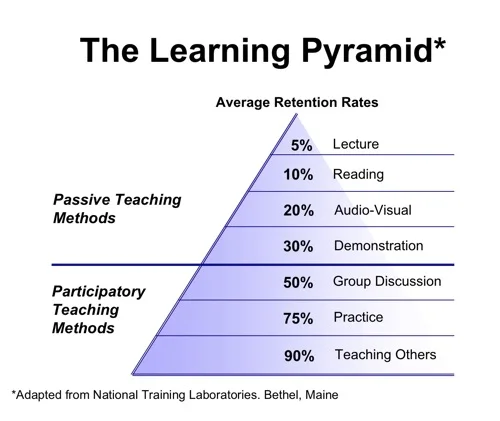
Hands-on Lectures play an important role in training but lectures seldom change professional practice. Consider the following diagram:
The-Learning-Pyramid.jpg

Reflect on the diagram for a movement. If the majority of your training is lecture-based then the majority of your training is lost, it is not affecting classroom practice.

Practice changes practice. There is a place for lecture, e.g., providing important background knowledge or explaining the rationale for the training but only hands-on-practice will change how teachers teach. Accordingly, the dominate form of training should the practice of new skills and concepts.

The best illustration I can give is technology training because we have all experienced bad technology training. The typical training involves a group assembled in front of a computer instructor. He or she demonstrates on the screen how to do "x." We watch, take notes, and perhaps fiddle with our computers. But, if we do not quickly start practicing what we have been taught we will forget. Remember, there is a difference between being taught and learning. Practice produces learning.

If, on the other hand, a short presentation of a technique is shown and ample time is provided for practicing the new skill, then we begin to understand and use it. The more time we have to practice the more likely we are to incorporate the skill into our work.

Here is a good rule of thumb; a ratio of 1:3 should be used for training. For each hour of training 15 minutes should be lecture or demonstration and the remaining 45 minutes for hands-on work. Doesn't this sound like good classroom teaching? If this is good classroom teaching it is good professional development.

Add Accountability

The adage, "what gets measured gets done" applies to teacher training. Because change is hard we need help and accountability. It is seldom enough to provide the rationale for change or even to practice new skills. If there is no consistent and transparent accountability for implementing new concepts and skills in the classroom there will be little change.

It is easy to make accountability a part of your professional development program. Revise your teacher evaluation instrument to include an assessment of the training provided. For example, if you provide training on techniques for teaching writing skills, add those techniques to the evaluation instrument so that they are assessed as part of the evaluation process.

Professional development can be effective and enjoyable. But is must not be ad hoc or an annual *de jour* experience. Good professional development is strategically aligned, is focused, sustained and scaffolded over several years. It is also hands-on with high levels of accountability for applying the training.

When these six elements of professional development are consistently practiced by school leaders, teachers are more likely to emerge from training declaring, "that was helpful, I can do that!"

Google

Re-Defining Best Practices: A Disciplined Approach to Christian School Development

Guest Article by By Zach Clark

The latter half of my childhood, I lived in Arkansas, half a mile from an immense wetland called “The Black Swamp.” This vast stretch of thousands of acres of ancient timber springs out of thick mud and the deep floodwaters of a local network of rivers. Growing up boating around the Black Swamp, hunting and fishing, I learned the hard way how difficult it is to reach a destination without getting lost. One of the key principles of navigating any vast territory of trees and water is simple: you have to know where you are going and how to get there.

Common sense, right? But what does this have to do with Christian school advancement, what most people call “development” or “fundraising”?

I believe it is time to redefine best practices for development in the Christian school. This could be framed as a call to go “back to basics,” but I find that rather than going back, we need to move forward with a clearer approach that demands disciplined action. For the school leader interested in advancing the organization and securing the resources needed to fund vision, it is crucial to know where we are going and how to get there.

So what is the destination of advancement? I believe that Christian school development is simply the process of helping others see what God is doing in the lives of students and families we serve and enabling them to have an impact through giving. The actual end goal of advancement should be:

Every potential donor engaged face to face in a consistent manner as they develop their vision for having an impact on the future of the Christian school.

Now here is the problem: for most Christian schools, this destination is virtually impossible to reach. How could we ever have the human resources to engage every potential donor face to face? While this goal may never be completely achievable, I find it important to keep it before us at all times.

Now that we have clarified our destination, we need to know how to get there. Dr. Byrle Kynerd, chancellor of Briarwood Christian School, impressed one of my core values upon me. I have often heard Dr. Kynerd say,

“How we do what we do is what God uses to bring about change in the lives of people.”

In Christian school development, how we do what we do is critically important and matters to God.

Unfortunately, many of the so-called “best practices” applied at Christian schools are simply the typical methods and programs every other organization uses, ministry or not. While there is no need to reinvent tactics for their own sake, I believe the time has come to apply a new set of best practices that keep in mind the destination of engaging every person face to face.

Allow me to present several redefined “best practices” that we are working hard to implement. Each concept is followed by a list of implications resulting from this approach. Each has been defined through our own process of thinking through practices that advance us toward the right destination.

Perpetuate an organizational distaste for programs.

Instead, apply a disciplined approach to engaging people. If you resist programmatic approaches to raising funds, it helps keep the focus on people.

Implications:

  1. Reduce the number of, or eliminate, any events that have fundraising as the goal. Keep only those events that result in engaging people in a stronger understanding of your Christian school. For instance, we now hold only one fundraising event, a golf tournament. Our tournament has a proven track record of strengthening community among some of our strongest supporters while enabling them to engage new and increasing numbers of individuals to learn more about the school. If your event does not accomplish a personal connection and engagement to the mission of the school, get rid of it.

  2. Instead of launching new fundraising events, turn the focus of development toward the events and community builders your Christian school already has in place. Do not use these events as fundraisers. Instead, seek opportunities to make them even more mission-appropriate. Make each event a place for people to engage more fully in the mission, vision, and values of your school.

Meet people where they are.

Most of us, when trying to raise money, put goals, needs, or programs in place that we expect will bring people into lockstep with our opportunities to give. The problem is that even as you cast a vision for the future, you still have to meet people where they are today. Think of it this way: it is virtually impossible to convince someone to drive you from Alabama to California when they are not convinced they like you enough to buy gas for a trip to the nearest corner, especially if they are already paying tuition for the pleasure of having you in their car.

Implications:

  1. We do something completely different. Instead of telling people where we want to go, we start asking them how to get there. We ask questions. We get input. We do surveys. We do interviews. And when we think we have done enough, we find we still have people who have not had the opportunity to give their input, so we keep asking.

  2. We pay attention to where they are already engaged in the school. What events do they attend? What do they give toward? What programs are their children involved in? What are they passionate about? It is hard to meet someone where they are if you do not know the answers to these questions.

  3. We start providing people with opportunities to impact the Christian school where their heart may be stirred. Will someone give to help you buy a computer when they are really interested in growing your financial aid? They might give to a degree, but will it be giving fueled by a passion for your mission?

Each individual is on his or her own road toward the vision.

This means we stop treating people as if they were all the same. You may have your “groups,” I know. But does it really make sense to have all your 10th grade families grouped together? Do they all share the same interests? Do they have the same commitment level to the school? Can a person really be known and understood just because of the age of their child or the year they graduated?

Implications:

  1. We keep digging deeper in our efforts to organize and communicate with donors, working toward the goal that each individual would own their own vision to impact the Christian school. We group people in the normal ways: giving, not giving, used to give but no longer do. But we also group them according to what they are interested in, when during the calendar year they prefer to give, how they like to be asked, how they like to be thanked, and how they like to receive reports.

  2. Instead of a constant barrage of requests to give, we take steps toward people. If they do not respond to ten different requests, should we not find out why? Move closer: call them, invite them to coffee, or schedule a tour of the school. Do the hard work and connect with the person rather than the name on the mailing list.

  3. Instead of constantly asking, we constantly thank and highlight results. Many people, especially Christian school parents, contribute to the school in ways that go beyond financial giving. We start with the assumption that they are already investors. This means we keep much of our communication focused on thanking people and highlighting the impact of giving. This approach raises awareness of the importance and impact of giving without wearing people out.

  4. We seek creative ways to structure development around the donor rather than our needs. If this sounds impractical, consider the example of scheduling requests to give. If you learn, over time or through dialogue, that a family always does their giving during June, no number of letters sent in July through March will produce a gift. We should time our efforts, our requests, and our follow-up based on what we know about the donor, not what we know about our needs.

There is a difference between doing things the easy way and the right way.

I know I sound like a curmudgeon, but take a moment to consider this. As a Christian school with a major capital campaign underway and annual giving goals in the public eye, we see a great deal of promotional material for seminars and giving programs. Most of the time, these promise “easier, faster, better, cheaper” methods to raise funds. Our Head of School once received a phone call about the “goose that laid the golden egg,” and the caller eagerly shared how our school would see many new funds through this easy approach. In the twenty-first century, it is virtually impossible to calculate all the methods and ideas available as we seek to improve and raise more money. The real challenge is applying organizational discipline that will consistently implement the concept of doing the right things, the right way, treating people rightly.

Implications:

  1. We apply creativity within a clear framework that honors the principles outlined in this article. The challenge is twofold: implementing strategies in a disciplined manner while engaging the creative power of our teams to articulate new tactics and methods.

  2. We study the implications of new technologies and experiment, but we remember that the need to perfect our ability to engage people face to face does not change. If a tool moves us toward the individual person and enables them to grow in their understanding of who we are as a ministry, we will consider it.

  3. Even as the world changes, our calling to love people will never change. If the program or latest idea does not demonstrate that we love people and that we desire to see them involved in what God is doing through the ministry of the Christian school, then it is worthless, at least for us.

How to Get Your Ideas and School Philosophy to Stick with Parents and Donors

Guest Article by Zach Clark

How do we get parents to understand and embrace Christian education? How do we help them grasp what developing a biblical worldview means and why it matters? How do we inspire our staff to catch the vision of what is possible? How do we move more people to give and current donors to give more?

I recently read Made to Stick by Chip and Dan Heath and found it excellent. The authors, one of whom is an educator, outline the essential ingredients for making our ideas stick so that others both understand and act. These principles form the acronym SUCCESS:

S — Simple (a short, compact proverb)

U — Unexpected (break the expected pattern)

C — Concrete (use language connected to everyday life; avoid abstractions)

C — Credibility (appeal to authority and pass the Sinatra Test)

E — Emotions (people act only when they care)

S — Stories (a story provides the context that abstract prose cannot)

An easy way to remember these principles: put your ideas into a "Simple, Unexpected, Concrete, Credentialed, Emotional Story."

This sounds remarkably like the way Jesus taught.

Each chapter explores one of the principles outlined above. The book is informative, well written, and practical. I highly recommend it.