What Drives Word of Mouth at Your School?

What Drives Word of Mouth at Your School?

What parents say about us and our schools are the most important drivers of enrollment and retention. But what drives word of mouth? This guest post by Rick Newberry answers that question.

Guest Post: Rick Newberry

Some of the things I love about Southwest Airlines include their affordability, consistent experience, quality, no-change fees and outstanding service. I really like the numbered line-up process instead of how other airlines invite zones to crowd the front (I especially like it now that I am on their A-list and always get one of the first numbers).

My bags also love that they can fly free!

I am a brand ambassador for Southwest and I enjoy sharing the love. 

Read More

An Affordable Solution for AP Programs

An affordadable AP program image

By Dr. Barrett Mosbacker

Advanced Placement (AP) courses are an important factor for many parents and students who are considering enrolling in a Christian School. AP courses provide the highest achieving students the chance to study college level material. Parents and students see AP courses as an academic challenge, a way to better prepare for college, and an advantage on college applications. Yet many Christian schools trail their public school competitors in AP course offerings. Larger, well-funded public schools have the competitive edge among families with high academic standards because these schools can provide students a broad AP curriculum. How can Christian schools maintain their small class size and value-driven curriculum while competing with public and large private schools that provide a wide range of AP courses? Increasingly, Christian schools are looking online for the solution to this problem.

Online Advanced Placement courses allow Christian schools to easily expand their curriculum. Through online learning, courses can be tailored for the individual student. If you have a student interested in engineering, but your school does not provide an AP calculus course, online learning can be an efficient solution. Instead of losing that student, your school could provide a flexible and affordable online option for that student. Online learning keeps the education within your school. There  is no need to construct complicated relationships with public institutions in order to serve single student needs.

Online AP courses are the most affordable solution for Christian schools in many situations.

Who pays for it? The cost of offering AP courses can be covered through tuition and additional fees paid by families. Schools can provide access to the online course, but students and their families pay the fee. Under some arrangements, the family also pays an extra fee that can help a school pay for administrative overhead and other programs.

What about faith? Online AP courses are now offered to meet the educational goals of a Christian education. As a Christian school you strive to offer all your students a well-rounded and rigorous education. Offering an expanded range of AP courses online helps you achieve that with your most gifted students. You are helping them shine their light in the world.

How will it fit into the student's schedule? Online learning is flexible and allows schools to set their own start and end dates for an AP course. With the AP exam in May, students can start the online course as early as June to prepare for the next yearís exams. The summer months will provide your students ample time to prepare and increases their chance of securing college credit.

A Christian School Educatorís Guide to Online AP courses

AP Online courses put a Christian school on equal footing with its public counterparts without placing additional strain on the school's resources. Learn more about it in our new white paper, ìOnline Opportunities for Christian SchoolsDownload this free resource for Christian educators using the link below.

// <![CDATA[ (function(){ var s='hubspotutk',r,c=((r=new RegExp('(^|; )'+s+'=([^;]*)').exec(document.cookie))?r[2]:''),w=window;w[s]=w[s]||c, hsjs=document.createElement("script"),el=document.getElementById("hs-cta-e2d3fe85-105c-45eb-8430-5b79bb3129fd"); hsjs.type = "text/javascript";hsjs.async = true; hsjs.src = "//cta-service-cms2.hubspot.com/cs/loader.js?pg=e2d3fe85-105c-45eb-8430-5b79bb3129fd&pid=188329&hsutk=" + encodeURIComponent(c); (document.getElementsByTagName("head")[0]||document.getElementsByTagName("body")[0]).appendChild(hsjs); try setTimeout(function() , 2500); })();</p> <p>// ]]</p></div>

Why Sweating the Small Stuff Makes a Big Difference

image

By Dr. Barrett Mosbacker

For years I have been taught not to “sweat the small stuff.” I warmly embraced this notion because it reinforced my natural inclination to focus on big strategic initiatives and to pay less attention to the small details, leaving those to others.

I have changed my mind. I have concluded that small stuff make a big difference.  Small stuff deserve a great deal of our attention!

What Convinced Me

God’s Care for Us and Creation:

If anyone was going to focus on big strategic plans it would be God. As the creator and governor of the physical universe and the affairs of heaven and earth, God certainly is focused on large scale objectives.

Yet, notice the incredible attention to detail exhibited by his rule:

Are not two sparrows sold for a penny? And not one of them will fall to the ground apart from your Father. But even the hairs of your head are all numbered. Fear not, therefore; you are of more value than many sparrows. (Mt 10:29–31)

image

Consider the remarkable detail in God’s creation. Look at how intricately God designed a flower. While God wrote our names in the Book of Life before he laid the foundations of the world and “made from one man every nation of mankind to live yon all the face of the earth, having determined allotted periods and the boundaries of their dwelling place,” (Ac 17:26), he also designed the intricate details of flowers.

And why are you anxious about clothing? Consider the lilies of the‘ field, how they grow: they neither toil nor spin, yet I tell you, even Solomon in all his glory was not arrayed like one of these. (Matt. 6:28-29)

image

Ugly can be beautiful. The head and eyes of a horse-fly may not be “beautiful” in the classical sense yet the incredible creativity, detail, and symmetry is a beautiful reflection of God’s attention to detail and a nearly incomprehensible marriage of function and form.

Few things are more ethereal and ephemeral than a snow flake-especially in the U.S. South! Yet, even with something so fragile and short-lived, the variety, symmetry and beauty of a snow flake is a testament to God “sweating the small stuff.”

Not only does God’s creation “work,” it is beautiful and awe inspiring—and to the attentive soul—soul ennobling. Who has not been in the mountains, on a prairie, a beach, or a lake--and not been enthralled and enriched by the beauty made possible by God’s attention to the smallest details of his creation?

Steve Jobs:

It may seem odd to include Steve Jobs in a list with God. I do so because as an image bearer of his creator Job’s attention to detail imaged that of his creator—whether he chose to acknowledge it or not.  Jobs was fanatical about every detail of Apple’s products--even the unseen innards:

From his father Jobs had learned that a hallmark of passionate craftsmanship is making sure that even the aspects that will remain hidden are done beautifully. One of the most extreme—and telling—implementations of that philosophy came when he scrutinized the printed circuit board that would hold the chips and other components deep inside the Macintosh.

No consumer would ever see it, but Jobs began critiquing it on aesthetic grounds. “That part’s really pretty,” he said. “But look at the memory chips. That’s ugly. The lines are too close together.” One of the new engineers interrupted and asked why it mattered. “The only thing that’s important is how well it works. Nobody is going to see the PC board.”

Jobs reacted typically. “I want it to be as beautiful as possible, even if it’s inside the box. A great carpenter isn’t going to use lousy wood for the back of a cabinet, even though nobody’s going to see it.”

For Jobs, designing and manufacturing electronics was craftsmanship, not merely an economic activity.  He was fanatical about design and detail, even in product packaging because he learned that people DO judge a book by its cover:

“You should never start a company with the goal of getting rich. Your goal should be making something you believe in and making a company that will last.” Markkula wrote his principles in a one-page paper titled “The Apple Marketing Philosophy” that stressed three points.

  • The first was empathy, an intimate connection with the feelings of the customer: “We will truly understand their needs better than any other company.”

  • The second was focus: “In order to do a good job of those things that we decide to do, we must eliminate all of the unimportant opportunities.”

  • The third and equally important principle, awkwardly named, was impute. It emphasized that people form an opinion about a company or product based on the signals that it conveys. “People DO judge a book by its cover,” he wrote. “We may have the best product, the highest quality, the most useful software etc.; if we present them in a slipshod manner, they will be perceived as slipshod; if we present them in a creative, professional manner, we will impute the desired qualities.

Application to Our Leadership and Schools

Perception is important.  How we “present” our product is important.  We may have wonderful teachers and programs but unless we present them with excellence would-be and current parents may perceive our schools as second-rate.  The good news is that “good packaging” doesn’t have to be expensive, it just needs to reflect attention to detail.

Like the cover on a book or your first impression of someone you meet, perceptions are formed almost immediately.  The first impression that parents get is from a phone call to the school, the website, or a visit to the campus.

Facilities

It is easy to become “blind.”  We are like the proverbial frog in the kettle, we have grown so accustomed to our surroundings that we no longer see what a visitor sees.  Everything looks fine to us.

Take one hour and walk through your buildings with a notebook.  Write down everything that is not perfect.  Note every time you see chipped paint, scuff marks, dirty carpet, smudges on glass doors, paper/trash on the floor or in the parking lot, shrubs needing trimmed, bare patches in the grass, book bags lying around, handwritten student or school messages/signs/posters (I’m not reviewing to student projects-I’m referring to announcements, directions, etc.), messy offices and desks, stuff out of place, pictures ajar in the reception area, etc....  You may be surprised just how disheveled things can become.

Phone Calls

How are your phones answered?  Do people reach an electronic message system with a labyrinth of options or a warm professional receptionist?  I have been lobbied for years to install an automated answering system.  It is “more efficient” is the reason given.  I have refused because such a system, though more “efficient” does not reflect the warm nurturing culture of our school.  Besides, people hate electronic answering systems, don’t you?

I call a lot of schools.  I am often dismayed by the poor phone skills of those who answer the phones.  Too often I am greeted with a sweet but unprofessional receptionist (poor grammar or too casual), or a very professional but “cold” individual.  In contrast, whenever I have called Apple headquarters or Apple support, I am greeted by a cheery, pleasant professional who always proves helpful. I am always left with a good impression.

Try this.  Call your school with new ears.  Use a phone that cannot be identified as you.  Was the impression you received that of a well educated, professional, happy individual or one who was harried and poorly spoken?  If you were calling the school for the first time, what impression did you get within the first 30 seconds?

Website

Was your website custom designed by a professional or was it created using a template and/or by a volunteer?  If the latter, it will look like it and the first impressions, while perhaps not “bad,” will not be superb.  Following my own advice, we are completely redesigning our website (not yet up).

When you review your website, look for the following:

•    Simple design, uncluttered •    Easy to navigate •    Warm and friendly •    Professional (drop the apples, crayons, etc.)

Remember, people will not spend a great deal of time reading material on your website.  The website should be designed to give a positive impression of the school, highlight important information, and provide easy navigation on where to obtain more information.

I recommend that you not put the photographs of your staff on the website’s staff directory unless they are unusually and universally photogenic.  A few well chosen photographs of staff and students on your site is very effective, but a directory with staff photos is not.  Most of us are not particularly photogenic so there is little to be gained by plastering our faces on the school’s website.

Staff Appearance

The way you and your staff dress creates a powerful impression. Although dress should be appropriate for the job, overly casual attire or poorly worn clothing does not create an impression of quality.  Walk around your school; discretely notice how your teachers and staff are dressed.  Are men’s ties tied properly?  Are the collars on men’s shirts crisp or wrinkled?  Are shoes polished?  Do some of your staff look “frumpy?” Designer cloths are not necessary, but being professionally dressed in contemporary styles is.

Your Presentations

Your presentations communicate a lot about you and the school!  Every presentation you make is enhancing or diminishing the “customer’s” (students, current and prospective parents, staff) perception of the school.

Are your presentations professional and warm?  Just as being professionally “cold” is to be avoided, so too is overly folksy. Here are some “small things” to sweat about.

•    Start and end on time.  It is unprofessional and inconsiderate of those who arrived on time to start any meeting late.  Do so also “trains” people to come late, after all, the “meeting will not really start until 10 after...” •    Make sure the venue, including the stage area, is neat and clean. •    Less is more--too much information given for too long is counter-productive.  It is best to keep things simple and short and then to provide backup information.

Review your PowerPoint/Keynote slides.  Over the last several years I have read several books on presentation design.  I have radically changed how I design and use slides. I cringe when I review past presentations!

•    Your content should not be on the slides; slides are only used to illustrate or solicit interest. •    Speak as “spontaneously” as possible.  Know what you have to say well enough that you only occasionally glance at notes.  Steve Jobs famously quipped, “People who know what they’re talking about don’t need PowerPoint.” There is a place for slides, but they are never to be your notes! •    It is important to maintain eye contact with your audience--do not turn to look at slides. •    Less is more on slides--few words, large font, great photos and illustrations.  No clipart! Few if any bullet points. Here is an example of how I have changed my slides and presentations.

Old Style:

image

New Style:

image

There are many other areas of the school-especially in classrooms-where we need to be “sweating the small stuff.”  While we need to focus on long-term strategic initiatives, we must pull the clippers out to ensure that every “blade of grass” in the school reflects the quality that we assure parents is true of our schools.

“Small” stuff matters to God and it should matter to us.  Remember, Jesus said, “He who is faithful in little will be faithful in much.”

God is the master craftsman.  Steve Job insisted on craftsmanship in the products Apple designed.  Do our schools reflect craftsmanship?

Full Loyalty, No Negativity? What Can Our Schools Learn from Apple?

By Dr. Barrett Mosbacker

Wouldn’t it be wonderful if someone could write an article describing our schools titled “Full Loyalty, No Negativity?” I am a recent convert from a Windows PC to the Mac computing environment. That is a story for another day but what I want to share with you are some observations from my experiences in Apple stores  and how those observations can be applied to move more of our students, parents, and employees closer to Full Loyalty with No Negativity.

Apple_Logo_2

If you have been in an Apple Store recently (if you haven’t I encourage you to do so as an observant leader--but you may want to leave your wallet at home!) you will discover that they are almost always filled with highly engaged customers, attentive staff, and great customer service. At least, that has been my experience every time I have visited an Apple store. Moreover, whenever Apple introduces a new product or an upgrade to an existing product line, customers will line up for hours and blocks, even camping out overnight, to be first in line to buy Apple products.  Loyal Apple customers even have a nickname: “Apple Evangelists.”  That speaks volumes!  Wouldn’t it be wonderful if our parents were so enthusiastic about our schools that they would line up for hours and blocks and be tagged with the nickname “XYZChristian school evangelists?”

How do we get students, parents, and prospective parents to exhibit the same level of enthusiasm for enrolling their children in our schools and paying tuition as Apple customers do for Apple products?  Without stretching the illustration too far, I think it would be wonderful if when parents and vendors visited our schools they sensed the same type of engagement, enthusiasm, and customer service that one experiences in an Apple store.

Consider some of the observations from a recent Wall Street Journal article; Secrets From Apple's Genius Bar: Full Loyalty, No Negativity.   Below is a summary of the key observations of this article.  Beneath each summary point I have added some possible applications for our schools and for our leadership.

•    Apple goes to great lengths to train its employees at its popular retail stores, tightly managing what feels like a casual consumer experience.  A look at confidential training manuals, a recording of a store meeting and interviews with more than a dozen current and former employees reveal some of Apple's store secrets. They include: intensive control of how employees interact with customers, scripted training for on-site tech support and consideration of every store detail down to the pre-loaded photos and music on demo devices.

APPLICATION:  Our schools could benefit from systematic training in customer service. Such training would include all school personnel from administrators to groundskeepers. Everyone would understand that they are customer service agents with the mission of ensuring that students, parents, and visitors have wonderful experiences in the classroom and with every interaction with school staff.

Additionally, everyone should devote attention to quality throughout the school.  Every detail of the school should reflect quality, attentiveness, and care.  School grounds should be well kept, hallways free of clutter and book bags, walls adorned with well designed posters and student work, school communications should be warm, clear, and professional, the school’s website should be modern and easy to navigate, and all points of contact between students and parents should communicate that “we care.”

•    With their airy interiors and attractive lighting, Apple's stores project a carefree and casual atmosphere. Yet Apple keeps a tight lid on how they operate. Employees are ordered to not discuss rumors about products, technicians are forbidden from prematurely acknowledging widespread glitches and anyone caught writing about the Cupertino, Calif., company on the Internet is fired, according to current and former employees.

APPLICATION:   This is a tricky one.  Although we would not want to go to the extent described above in how we deal with our employees, nevertheless, the focus on “airy Interiors and attractive lighting in a carefree and casual atmosphere” does have relevance for our schools.

Some of our schools and employees are too uptight.  We can improve student achievement and their enjoyment of school–and thus parent satisfaction and enthusiasm for our schools–if our classrooms are characterized by an open, airy, more casual environment in which students are actively engaged in learning, who feel free to be themselves and to ask “politically incorrect questions,” and to make mistakes.  In other words, although school is a serious business it does not have to feel like a strait jacket. Schools should be a place in which the emphasis is not on what is wrong  or what not to do.  Instead, we should champion what students can do and cast a compelling vision for the future.

•    Apple is considered a pioneer in many aspects of customer service and store design. According to several employees and training manuals, sales associates are taught an unusual sales philosophy: not to sell, but rather to help customers solve problems. "Your job is to understand all of your customers' needs—some of which they may not even realize they have," one training manual says. To that end, employees receive no sales commissions and have no sales quotas.

"You were never trying to close a sale. It was about finding solutions for a customer and finding their pain points," said David Ambrose, 26 years old, who worked at an Apple store in Arlington, Va., until 2007.

APPLICATION: there are two very important principles contained in the description above. The first is the focus on innovation and the second is the focus on meeting needs. Our schools, and more importantly our students and our parents, will benefit immensely if we place an energetic and consistent emphasis on innovative teaching, innovative programs, innovative training, and innovative ways of serving our students and our parents.

Moreover, rather than focusing on our policies and procedures,  we should spend more time focusing on good customer service for both students and parents in an effort to alleviate, insofar as possible, things that produce spiritual, emotional, social, or academic pain. We should focus on finding solutions for our students and parents and less on policies and rules.

image

That is not to say that we compromise our standards, rather it is simply to say that if we devote far more attention to making our students’ and parents’ experiences with each person and situation as enjoyable as possible we will go a long way to increasing their satisfaction and deep loyalty to the school.  In effect this is nothing more than applying the Golden Rule, “As you wish that others would do to you, do so to them.” (Luke 6:31, ESV)  The result will be higher retention rates and the enthusiastic endorsement and recommendation of the school to others.  Our parents will become our school “evangelists.”

•    Apple lays out its "steps of service" in the acronym APPLE: Approach customers with a personalized warm welcome Probe politely to understand all the customer's needs Present a solution for the customer to take home today Listen for and resolve any issues or concerns, and End with a fond farewell and an invitation to return

image

APPLICATION:  What a wonderful model for our staff to follow! In fact, with a little tweaking this acronym can be readily applied to our schools. In many ways it reflects biblical servanthood, “as you wish that others would do to you, do so to them,” and  “go the extra mile.” Here is the same acronym revised to reflect a Christian school environment.

Approach every student at the beginning of the day and in the halls with a personalized warm welcome.  Greet every parent and school visitor in like manner.

Probe politely to understand student needs--spiritual, emotional, and academic.  Probe politely to understand parents’ needs.

Present solutions for students and parents to take home with them.

Listen for and resolve issues and concerns following James’ instruction, “be quick to hear and slow to speak.” (James 1:19)

End each class period and parent conference with a fond farewell, letting students know that you look forward to seeing them tomorrow and inviting parents to see you again if they continue to have concerns.

•    Apple's control of the customer experience extends down to the minutest details. The store's confidential training manual tells in-store technicians exactly what to say to customers it describes as emotional: "Listen and limit your responses to simple reassurances that you are doing so. 'Uh-huh' 'I understand,' etc."

APPLICATION: Our first impulse when confronted with someone who is angry is to get angry and our second inclination is to seek to be understood and to defend our actions or those of the school. As a consequence, we often fail to comprehend the real nature of the problem being described by the student or the parent.   We can also come across as not listening and defensive.

I have learned over the years that it is better to spend far more time listening than talking and I have also discovered that “less is more.”  Over-explaining and providing more details than necessary often exasperates rather than solves problems.  Sometimes we simply talk too much.

Moreover, it is often better to take time to thoroughly understand the nature of a problem than too quickly jumping to defend one’s actions or those of the school or to arrive at an immediate solution. It is wiser to listen and then to postpone a suggested solution until one has had time to gather all the facts and to pray for wisdom in seeking a proper response.

Accordingly, getting back to a student or a parent a day or so later may actually reflect better service than to attempt to solve a problem that has not been adequately considered or prayed about.

•    Apple employees who are six minutes late in their shifts three times in six months may be let go.

APPLICATION:  Do we hold our teachers to the same standards of punctuality and work that our teachers hold their students to? Do our teachers show up for faculty meetings or chapel services late? If so, what is the consequence? What is the consequence for a student who habitually shows up late for classes? In other words, do we model as administrators and teachers what we expect of our students?

Another way of looking at this is to ask “are our standards of service for each other, our students, and our parents as high as or lower than the standards that Apple requires of its employees who sell computer hardware and software?” Which is more important? If we are to “do everything as unto Christ,” would we show up late for one of his classes?

•    Working for an Apple store can be a competitive process usually requiring at least two rounds of interviews. Applicants are questioned about their leadership and problem-solving skills, as well as their enthusiasm for Apple products, say several current and former Apple store employees. While most retailers have to seek out staff, retail experts say many Apple stores are flooded with applicants.

APPLICATION: How intensive is your recruiting and hiring process? Do you take prospective employees through multiple interviews accompanied by rigorous questions designed not only to ascertain the applicant’s commitment to Christ and to Christian education but his or her enthusiasm for teaching, love for students, creativity and innovation in teaching and assessing students, and willingness to learn?  Or, are you too quick to settle fearing that you will not be able to hire someone to fill a need, in part, because salaries are so low? In the long run, taking shortcuts in hiring will ultimately harm students, negatively impact the school’s reputation and consequently negatively affect student retention, enrollments, and school finances.

•    Once hired, employees are trained extensively. Recruits are drilled in classes that apply Apple's principles of customer service. Back on the sales floor, new hires must shadow more experienced colleagues and aren't allowed to interact with customers on their own until they're deemed ready. That can be a couple of weeks or even longer.

APPLICATION:  How we use your mentoring program? Do you have seasoned teachers who have been given time to work in the classrooms periodically with new hires? Have you given veteran teachers the opportunity to formally and informally mentor new teachers? Or, is it more often the case that new teachers are placed in classrooms with little formal or informal mentoring beyond new staff orientation and standard in-service training programs?  Do we had students to teachers before the teachers are ready?

•    What hasn't changed is Mr. Jobs's interest in the stores. He has provided input on details down to the type of security cables used to keep products leashed to the tables, according to a person familiar with the matter. When the CEO grappled with a liver transplant two years ago, a person who visited him at the time said Mr. Jobs was poring over blueprints for future Apple stores.

image

APPLICATION:   The description above reflects three things on the part of Steve Jobs: 1. A love for Apple, 2. A focus on his mission rather than on himself, and 3. Attention to detail. Does our leadership consistently demonstrate the same characteristics as we serve our students and parents under the Lordship of Christ and for his glory?

While  we may never eliminate negativity, we can do much to foster deep loyalty to our schools and reduce the negativity that as fallen human beings we are so prone to. Although a computer company is not a school, nevertheless, we can learn a great deal from successful companies and leaders who place a focus on quality, training, and customer service.

As Christian school leaders we should be at least as devoted to these things as the CEO of Apple is to selling hardware and software, after all, we are the stewards of souls.

How to Turn Parents Into Raving Fans

By Dr. Barrett Mosbacker

Sometimes the blogging “gods” smile upon you!  For years now I have promoted the concept, that I first heard from Dr. Kynerd, that it is best to Under Promise and Over Deliver when dealing with our parents and employees.  Although I often promoted this approach as essential for building good will, I had never heard or read others promoting this approach—until now.

While reading the Wall Street Journal I stumbled upon following article.  Although written for business leaders and owners. it has direct applicability to our schools—after all, our parents and students ARE CUSTOMERS.

How to Turn Customers Into Loyal, Raving Fans, By MIKE MICHALOWICZ-WSJ

Do you want satisfied customers or do you want customers who are so thrilled with your company they become loyal, raving fans? I'll take option No.2. Satisfied customers may come back a second or third time; they may even become regulars. But unless you exceed expectations, your satisfied customers could just as easily become your competitors' satisfied customers.

If you want customers who are so loyal that they would never think of going to anyone else, and if you want customers who are so thrilled with your business that they tell everyone how amazing you are, then you're going to have to move the goal line beyond mere "satisfaction." You're going to have to wow everyone who walks through your door.

Now, I'm sure you could come up with loads of ideas that would dazzle your customers, but there's actually a simple shortcut to knocking their socks off every single time – and it won't cost you a dime. It's the "under-promise, over-deliver" (UPOD) method.

When we talk about "customer satisfaction," we strive to deliver on our promises. Complete the market study by Friday, as promised. Deliver the new couch in July, as promised. Provide two valet attendants, as promised. When you do exactly as you said you would, you end up with satisfied customers. But when you give them something more than they expect -- faster service, extra help, more options, early delivery and so on -- you end up with the loyal, raving fans you need to propel your business into the stratosphere.

The idea behind UPOD is that people are most favorably influenced by great service they don't expect, rather than great service they do expect. And they expect it because you promise it. If you tell customers they will get their new shoes the next day, and the shoes arrive the next day, those customers will be satisfied, maybe even happy. But if you tell customers they will get their new shoes in five days, and the footwear arrives the next day, your customers will be amazed and thrilled.

Here's the trick with UPOD: It's not about doing things faster or throwing in "extras." It's about building the "under-promise" part into the equation from the start. If Friday is the earliest you can complete a study, then promise to have it done the following Wednesday. "Surprise! We finished early." If you know you will deliver a couch in July, promise to have it there by August. "Great news! We wanted you to have it as soon as possible!" Build a business model in which you have enough income to cover three valet attendants, promise two, and the day of the party, send over three. "We just thought you could use the extra help. No extra charge."

Most businesses know UPOD is a good practice, but few adhere to it because people think they have to change their operation to wow customers. Just take this very simple shortcut: Change your promise.

Using UPOD will also help you avoid mistakes that inevitably occur when people rush to meet deadlines. It will enable you to respond positively to last-minute requests and help you stay calm, cool and collected as you work surprisingly reasonable hours. Most importantly, when you under-promise and over-deliver, you will inspire satisfied customers to become devoted customers – and that's money in the bank.

Take a few minutes to reflect upon this article and then jot down ways in which you can apply the UPOD principle to your leadership or your classroom.  Also reflect upon how UPOD is consistent with Jesus’ command that we are to:

You have heard that it was said,  An eye for an eye and a tooth for a tooth. But I say to you, Do not resist the one who is evil. But if anyone slaps you on the right cheek, turn to him the other also.  And if anyone would sue you and take your tunic, let him have your cloak as well. And if anyone forces you to go one mile, go with him two miles. Give to the one who begs from you, and do not refuse the one who would borrow from you. (Mt 5:38-42)

Leading Your School In Uncertain Economic Times: Practical Suggestions

[Selloff]

By Dr. Barrett Mosbacker

Many experts predict that we are headed for a recession.  A recession in and of itself is not particularly worrisome.  Like breathing, expansions and retractions in the economy are normal and keep the economy healthy and vibrant over the long-term. What is of concern is that this recession may be deep and long.  According to the Wall Street Journal:

The bailout plan was needed but more needs to be done to fix things, and we're not even sure a rate cut will be enough," a trader at GFT Global Markets says. To many Wall Street veterans, a painful, long recession unlike anything the U.S. has suffered in decades seems increasingly likely.  (WSJ: Today's Markets, Oct. 6, 2008)

Given the turmoil on Wall Street and words like "crisis", "recession", "bank failure" and "depression" circulating in the media, it is not surprising that consumers have dramatically cut back on spending, The New York Times reports that:

[Big Discounts Fail to Lure Shoppers]

Cowed by the financial crisis, American consumers are pulling back on their spending, all but guaranteeing that the economic situation will get worse before it gets better ... But in recent weeks, as the financial crisis reverberated from Wall Street to Washington, consumers appear to have cut back sharply ... Recent figures from companies, and interviews across the country, show that automobile sales are plummeting, airline traffic is dropping, restaurant chains are struggling to fill tables, customers are sparse in stores.  Graph from the WSJ Business Section, Oct. 6, 2008-click on the graph to go to the article.

Whether the predictions of gloom and doom come true or not, it seems clear that we are in an extended economic slowdown, which may affect many of our schools. As school leaders, it is our responsibility to assess the situation and then to provide prayerful, faithful, and steady leadership. 

My good friend Zach Clark, Westminster Christian School (St. Louis), put it this way:

  1. We should have an attitude of gratefulness for the strengths we have as a Christian school like increased enrollment and strong budgets, freedom to make changes, talented staff, etc.

  2. Be steady during this time when everyone is looking for a reaction. Be realistic but confident in our ability to act.

  3. Be sure that our focus is on keeping our attitudes positive, and encourage each other to stir each other up to love and good deeds.

  4. Look for opportunities to be effective and efficient NOW.

  5. Become an expert in engaging and developing others, especially volunteers to improve our stewardship of resources and human resources.

  6. This is an opportunity to turn people’s focus to the substance of our work. To not only allow, but also enable others to determine the value of a Christian education.

  7. Wait and watch what the Lord will do, trusting in His faithfulness.

Preparing Our Students and Our Schools

So how do we prepare our schools for economic turndown, or even a possible prolonged recession?  The role of the leader is not to react but to respond prayerfully and strategically. If the economy spirals into a long recession it will affect our families and in turn, our schools.

I offer the following series of possible contingent responses for your prayerful consideration if, as seems inevitable, there is a sharp economic downturn.  Obviously, every school and local market is different, but perhaps one of these suggestions will be helpful.

1. Pray faithfully for your families and for your school ministry.  As I indicated in a previous post, I do not encourage prayer because it is the expected thing to say or because it is the politically correct preamble to a real solution. I say pray because in the final analysis it is the Lord who grants wisdom and who will provide for our needs.  Remember, your school ministry is the Lord's!

2. I refer you to my article Economic Crisis, Globalization, our Students, and our Mission (Era of U.S. financial dominance at an end: Germany) on possible ways to prepare your students for an economic downturn.

Budget_Finance_Calculator

3. As much as possible, move toward zero-based budgeting or at least look at your budget from that perspective.  Investopedia defines zero-based budgeting is "a method of budgeting in which all expenses must be justified for each new period. Zero-based budgeting starts from a "zero base" and every function within an organization is analyzed for its needs and costs."

This contrasts from the usual method of simply adding a percentage increase to existing budget categories or departments.  This requires a strategic approach to school leadership.  For more information, see my previous post: Are You Spread Too Thin? How to Thrive and Not Merely Survive as a Christian School.

4. Smaller schools need to assess the number of students per class to ensure that each class is at break-even on a contiguous basis.  Depending on the school's expenses and tuition levels, break-even is usually 16-18 students/full-time teacher.  If you have classes that are not at break-even you have built financial losses into the school's budget, which is never a good practice but is particularly problematic in during an economic downturn. 

If you are losing money in any class consider how you can consolidate classes.  For example, if you have two third grade classes, both of which are not at break-even, consider combining them and then hiring a full-time teacher and a full-time academic aide (and laying off the other teacher or making him/her the academic aide but at a lower salary (I know this is hard, but it may be the right thing to do).

Doing so will permit a larger financially viable class without sacrificing academic quality while reducing cost IF the teacher and academic aide are experienced and very effective.  Obviously, this could present some PR issues so great prudence must be exercised.  But if you have classes of say 13 each, combining them into a single class of 26 with a teacher and academic aide will cut cost without negatively affecting academic quality.

5. Increase financial aid.  This is, of course, easier said than done, but increasing financial aid may be essential. There are several ways to increase financial aid; 1) allocate/earmark a certain dollar amount from tuition specifically for financial aid.  For example, $50/student x's 300 students produces $15,000 in additional financial aid.  2) Approach parents with financial resources to contribute specifically to the financial aid fund.  3) If your school is a church ministry, ask the church in contribute (or increase contributions) for financial aid.

Moneycoinswealth.jpg

Money coins wealth

6. Stay on top of your accounts receivables.  This is one of those areas that is hard but ESSENTIAL.  Do not allow parents to keep their children in the school if they are not keeping their accounts current.  I would not, however, dismiss a student mid-year if avoidable as this can be harmful to the student.  However, re-enrollment should not be extended unless and until accounts are current. If the family has a history of slow payment, require at least a half-year of paid tuition before permitting re-enrollment.

Be patient, understanding, and creative in working with parents.  "Do unto them as you would have them do to you." This does not mean that you are obligated to provide them a free education.  You have no ethical obligation to do so.  Doing so jeopardizes the long-term viability of your school (which is poor stewardship) and is unethical because tuition paying parents are subsidizing the non-paying parents.  Schools are not banks.

7. Think of ways to expand your market.  For example, consider running a bus to "outlying" neighborhoods to increase enrollment.  Keep in mind that you need parents with the financial means to pay tuition so target neighborhoods accordingly.

8. Work on your retention rates!  It is far easier to keep students than to recruit new ones.  The key to retention is value, which is a function of price and quality

Remember, if your community (market place) is blessed with a large number of high quality public and private schools, parents have a smorgasbord of quality educational options.

If parents perceive the local public schools to be safe, high quality learning environments, they are more likely to consider enrollment in the Christian school to be a discretionary “luxury” purchase. THIS IS PARTICULARLY TRUE DURING AN ECONOMIC DOWNTURN!

Only the most diehard adherents to a Christian philosophy of education will consider enrollment in the Christian school a necessity. We can make all of the theological and philosophical arguments about why Christian parents should have their children in a Christian school but this will affect the decision-making of only a small group of Christian parents.

The Archdiocese of Chicago provides a compelling example of this principle. Faced with declining enrollments and a school deficit of $20 million, the Archdiocese commissioned a study to determine how to boost school enrollment. Boffetti (n.d.) reports that researchers discovered that:

Struggling schools, at the very least, needed to fill every available seat with tuition-paying students. Surprisingly, many inner-city parents, both Catholic and non-Catholic alike, did not know that Catholic education would only cost them $1,000 a year, with the diocese picking up the rest of the tab. When they learned the facts, many said they would eagerly pay to get their children out of the awful and dangerous public schools they were in.

Choice Decide

Suburban parents were more sanguine. Parents who believed in the importance of Catholic education already sent their children to Catholic schools. The rest of the parents did not think it would be worth the added expense because they felt that their suburban public school system was at least equal to, if not better than, the Catholic schools in terms of academics and amenities [emphasis added]. In other words, the “Catholic” in Catholic education was not worth an extra $1,000 per year to them. (pp. 7-8)

Increase the value of your school by improving quality (teachers are most important here), adding high-impact courses/programs, leveraging technology, reducing costs, and moderating tuition increases.

9. Consider merging with other Christian schools.  This poses theological and philosophical challenges.  However, merging Christian schools can reflect very wise stewardship through economies of scale, the ability to pay higher salaries, cutting costs, consolidating programs, and building larger fine-arts and sports programs, to name a few.  Unless there are mutually exclusive theological and philosophical principles at stake, it makes little sense to have several small, struggling schools within a few miles of each other, particularly in a harsh economic environment.

Before considering a merger, keep the following in mind:

  • You may need to create a transportation system.  Convenience and cost (given current gas prices) are two high values for parents.  If one school merges with another, one school will lose some students.  This loss can be reduced by providing a transportation service for parents whose school closed.

  • Emphasize the advantages the merger will create for students.

  • Differences in preferences can be overcome and the schools can merge.  However, fundamentally incompatible differences in theology or philosophy cannot and should not be compromised (e.g. a protestant school combining with a catholic school would reflect an unbiblical compromise, or the proposed merger of a fundamentalist school with a school committed to a reformed theology would be inherently incompatible theologically, culturally, and practically).  Be careful to distinguish between policy and pedagogical preferences and fundamental theological differences.  They are not the same but are often confused.  The challenge is to determine what is preference versus what are genuine theological and philosophical differences and core tenets.

  • One school must take over the other--a house divided cannot stand.  One school board and administration must be taken over by the other.  Seldom should board members or administrators be absorbed into the new school.  More often than not this will be a recipe for conflict and failure.  However, the personnel (administrators, support staff, and teachers) of the school that is being merged/absorbed by another should be carefully interviewed and given priority for hiring provided they meet the absorbing school's standards.  This is fair and just but the absorbing school is not ethically obligated to hire the staff of the merged school.  Likewise, where there are redundancies in staff resulting from the merger, and there will be, only the best staff of either school should be retained.  This seems harsh, I know, especially for Christian leaders. However, as leaders it is our responsibility to staff our schools with the best available personnel, which may mean in a merger that some staff from either school may be let go. If so, generous and fair severance packages should be provided and good staff who are laid off due to redundancies should be rehired if positions become available.

  • Pride must be crucified!  There is great pride of "ownership" by the leadership and founders of any organization, including Christian schools.  However, our schools belong to the Lord--not to us!  It is His glory and His kingdom that matters--not the sweat equity that we have invested in the schools we lead.  Since the schools we lead belong to the Lord there should be no pride of "ownership" and no shame if one school must be merged with another.  The merger may simply reflect faithfulness and wise stewardship for God's glory and the advancement of His kingdom.  Pride should never prevent two weak struggling schools from combining if doing so ultimately benefits students by creating a stronger and more stable Christian school.

10.  If you are a Covenantal school (a school that only enrolls children born to at least one confessing parent (1 Cor. 7:14), consider enrolling the children of non-believers.  If the  school's founding charter or theology/philosophy is covenantal, this will be controversial for leadership and for some parents.  More so if your school is sponsored by a church, in which case approval by church leadership will probably be required. 

I started out in Christian education as an ardent advocate for the covenantal model of Christian schooling but I have modified my position based upon theological considerations and personal experience (I have been founder and head of a covenantal school (Covenant Day School) and head of two non-covenantal schools, including my current school, Briarwood Christian School.

Great prudence and much prayer must accompany any discussion of this decision.  The goal is to clearly discern the Lord's will in this matter.  He has called some school ministries to serve only the Covenant community.  Other school leaders and churches believe the Lord has called them to minister to BOTH the believing and non-believing communities.  It could be that the Lord will direct you to change your ministry focus.  Only prayer, study of God's word, and wise counsel will help you discern His will in this critically important matter.

Here are some things to consider as you prayerfully ponder this possibility. 

(NOTE: This blog article is already too long so I cannot go into all of the details of why I suggest this possibility.  If you have questions please contact me directly and I will be happy to speak with you.)

  • I believe the decision as to whether the school is Covenantal or non-covenantal is a matter of Christian liberty.  There is room for disagreement here based on the leadership's sense of God's calling, but I believe either model can be biblical, can advance the kingdom, and can glorify our Lord.

  • I have been surprised to find that when a school is well-run with good leadership that there are no more problems in the non-covenantal school than in the covenantal school.  This was counter intuitive to me until I gave this more thought.  The short version of my thinking is this: non-believing parents who choose to send their children to a Christian school tend, by common grace, to share the same high standards for external behavior and academic achievement as many Christians (provided the school does not have a reputation as a reform [small r] school for troubled students).  I find many Christians, on the other hand, to be antinomians (at least when it comes to their children) who, when confronted with a disciplinary matter, respond "I thought this was a Christian school--where is the grace!"  Translation, grace means "no or only mild discipline, at least for my children."

  • The admissions process is essential for ensuring a healthy school culture.  I have found that having a "pooled" admissions process for grades 7-12, in which NEW prospective students are enrolled ONLY after they have interviewed with an admissions committee, is a very effective way to protect the school because only students who are deemed as good fits are enrolled.  Frankly, sometimes the children of non-believers can be better fits then the children of some believers.

  • The school must have strong caring school leaders who wisely and consistently enforce policies.  When this is the case, I have found that enrolling the children of non-believes creates no more problems than those found in covenantal schools.  On the other hand, when the school does not have good policies or when leadership fails to wisely and consistently enforce them, there will be problems resulting in an unhealthy school culture in both covenantal and non-covenantal schools.

  • As a practical matter, the non-covenantal model greatly expands the school's marketplace.  This has several advantages including larger enrollments and stronger finances.  Under wise leadership, this translates into higher teacher salaries, improved instruction, expanded and higher quality programs, higher retention rates, and financial stability. This in and of itself is NOT sufficient reason to move from a covenantal to a non-covenantal model but if school/church leadership believe that either model, when done properly, can be biblical and that the Lord is leading them in that direction, then this model offers significant practical and financial advantages.

We may be facing difficult years ahead.  Now is the time to prayerfully plan ahead.  How are you going to position your school to not only survive, but thrive in uncertain times?

One of my favorite verses refers to King David's leadership:

For David, after he had served the purpose of God in his own generation... (Act 13:36, ESV)

Lighthouse

We are called to serve the purpose of God in our generation, which includes providing godly, biblically informed, steady, and strong leadership for our schools during times of uncertainty.  May the Lord grant us the grace to be beacons of light and steadfastness for our brothers and sisters and before a frantic and watching world.

Technorati Tags:

Recession

,

depression

,

Christian school

,

economic

,

economic crisis

,

Wall Street

,

Main Street

,

Merger

,

Covenantal

,

non-convenantal

,

enrollment

,

zero-based

,

faithfulness

,

admissions

,

leadership

,

stewardship

,

salary

,

salaries

,

leverage

They Are Coming After Your Students and Said So!

Dr. Barrett Mosbacker, PublisherAt a recent Executive Symposium on Distance Education that I attended a public school superintendent, not knowing I was from a private school, said to the group (to paraphrase), "we are developing a robust online program and we fully expect to recapture students from home schooling families and private schools."

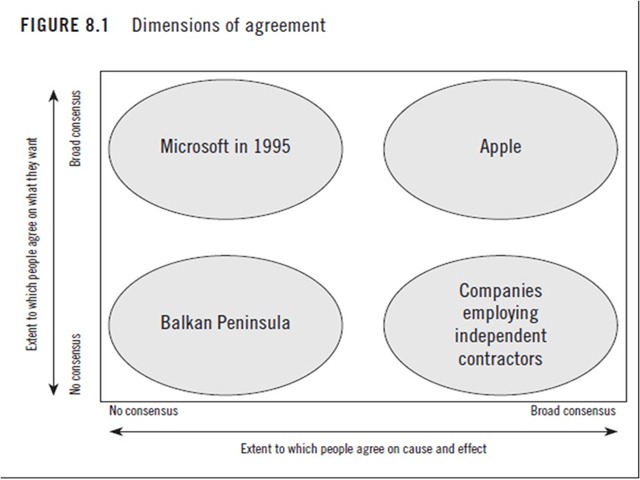
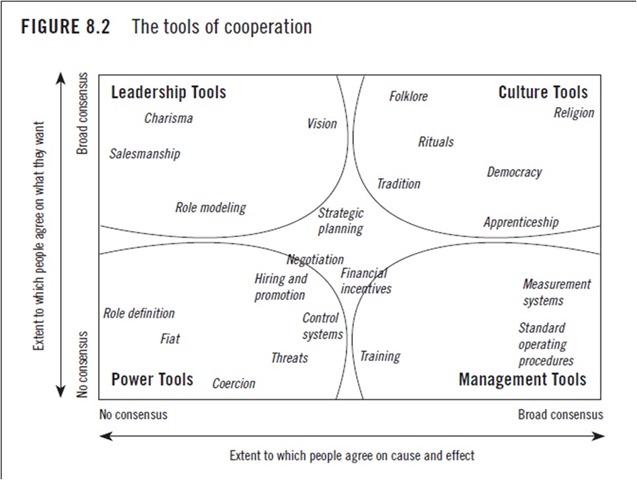
I just reread portions of Christensen's excellent book, "Disrupting Class".  I am particularly interested by his analysis of the "Dimensions of Agreement" and the "Tools of Cooperation".  I have attached graphics depicting the concepts.  These are particularly important to me because it can be difficult to get staff to accept change--I find this particularly problematic among conservative Christians, whom by definition, are "conservative."  :-)  In my estimation, moving forward, carefully and thoughtfully, with distance learning programs in imperative but it is not an easy task--the learning curve is steep, creating a feasible business plan is critical, and getting buy in can be tough.  But, Christensen argues, refreshingly, that consensus is not necessarily the goal--cooperation is!  I find that a refreshing approach given the emphasis on consensus building over the last several decades in the management literature.  I was also surprised by his observation that change is most difficult when there is wide agreement on the goals and processes currently in place.  Generally, one would think that this is a good thing. Upon reflection, however, it is easy to see why change in an organization can be very difficult when the organization is in the upper right quadrant of the dimensions of agreement chart.  This means that one of our challenges is to challenge the consensus on the goals and/or processes currently in place, which is all the more difficult when the organization is successful.  In other words, success can actually work against us, as in "good is the enemy of great."  It is what I'm calling the "Hobbit Effect."

In the Lord of the Rings, the Hobbits went merrily about their lives oblivious to the fact that Mordor was rising and threatening them.  Only a few saw the danger and acted.  I wonder if distance learning and charter schools aren't the "Mordors" of Christian education.  While we argue about uniforms, dress codes, and tuition discounts, the public system is installing a robust distance learning infrastructure and charters are multiplying.  Will we wake up in 10 years and wonder what happened to our market?’

Christensen (2008), Disrupting the classroom, p. 187

Dimensions of Agreement Christensen 

Tools of Cooperation Christensen

I am so impressed with Christensen's book that I've ordered two more:
The Innovator's Dilemma: The Revolutionary Book that Will Change the Way You Do

The Innovator's Solution: Creating and Sustaining Successful Growth

Let’s Get Creative! How Could You Use This?

By Dr. Barrett Mosbacker

Take a moment to read the article below (Reposted from Duct Tape Marketing.) Now, give this some thought and then ask yourself, “How Could We Use Twitter to Promote Our School and/or Serve our Stakeholders?”

After giving this some thought, post your ideas as a comment to this blog article to share with others!

17 Ways to Use Twitter for Business and Some Not

More and more small business folks are giving in to what seems like an insurmountable mountain of hype and jumping on the twitter bandwagon.

But, some people still look at twitter on the surface and conclude that it’s one big waste of time. I can’t say I disagree completely, however, like all social media and marketing tactics, before you can determine if something makes sense you need to analyze your objectives. So, instead of asking why you would use it, ask how it might help you achieve some other already stated objectives.

1) Would you like a way to connect and network with others in your industry or others who share you views? It’s a good a tool for that.

2) Would you like a way to get instant access to what’s being said, this minute, about your organization, people, products, competitors or brand? It’s a good tool for that.

3) Would you like a steady stream of ideas, content, links, resources, and tips focused on your area of expertise or interest? It’s a good tool for that.

4) Would you like to monitor what’s being said about your customers to help them protect their brands? It’s a good tool for that.

5) Would you like to extend the reach of your thought leadership – blog posts and other content? It can be a good tool for that.

6) Would like a way to quickly find vendors, partners, tech help, even employees for your organization? I can be a good tool for that.

7) Would you like to promote your products and services directly to a target audience? Not such a good tool for that, but it can light a path back to your web site!

Now, if that weren’t enough, the open nature of the twitter platform is spawning uses far beyond what was ever imagined or what many people can grasp - and this use of the technology will only get bigger.

Here are few things you may have never considered

8) Publish your Flickr photos on twitter - Visit twittergram and set-up an account and then just upload to Flickr but tag your photo twitter and it goes into your twitter stream.

9) If you use online todo list Remember the Milk - you can set it up to flow into twitter - this might be a way to assign todos to remote teams

10) Using strawpoll you can create mini polls into your twitter stream - great for flash feedback

11) Use twitter to keep up on traffic jams with commuterfeed

12) Have twitter alert you when you have a meeting with timer

13) Get and fill current job openings with tweetajob

14) Track FedEx, UPS and DHL shipments with TrackThis

15) Get help quitting smoking

16) Keep a diet journal

17) Get a tweet when your plants need water - - okay this one would be way cooler if it simply tweeted you when the plant watered itself.

Share ideas on how our schools could use Twitter by submitting a comment with your ideas.

How Facebook Can Affect Your Enrollment, Marketing, and Communication

By Dr. Barrett Mosbacker

According to Sharon Gaudin of Computerworld, a recent study shows that social networks for middle-agers (that’s most of us reading this article) are now a more popular form of communication than email.

I remember that just a few years ago many Christians, including Christian school administrators and teachers, viewed social networks as the exclusive domain of teenagers or were immoral, or both and therefore should or could be ignored.  Such a perspective was a mistake then and is a mistake now.  Social networks are a form of communication and social interaction.  Social networks are neither inherently good nor inherently evil.  HOW they are used determines their value.

According to a report by Nielsen Online (download PDF), social networks are used by two-thirds of all worldwide online users.  Social networks and blogs have become the fourth most popular online products.  The report lists e-mail as No. 5 on the list of users' favorite online tools. Search tools, portals and PC software topped the list.

Other highlights of the report include:

  • Putting the growth of social networks – popularity and engagement – into context

  • How the audience to social networks is changing

  • The challenges facing advertisers on social networks

  • What advertisers can do to find the magic formula for advertising in social networks

  • Factors contributing to the Facebook phenomenon

  • Why localization has won the day in many countries

  • Where mobile social networking has taken the greatest hold

  • What ‘traditional’ publishers can do in the face of the social network phenomenon

Mind Share

“Of the social networking sites out there, Twitter and Facebook seem to have the lion's share of the mind share these days. And Facebook has the lion's share of the market share, as well. In January, online researcher comScore Inc. reported that Facebook, once thought of as the up-and-coming social network, had overshadowed rival MySpace, with nearly 222 million unique visitors in December compared to 125 million for MySpace.

To back up comScore's numbers, Facebook CEO Mark Zuckerberg noted in a January blog post that the social networking site had hit a big milestone -- 150 million active users, nearly half of whom use the network daily.”

Neilson’s report also shows the significant increase in the time spent on Facebook: In all the markets that the company tracks, Facebook is visited monthly by three of every 10 people online.

Our Parents and Prospective Parents are on Facebook

THE MOST SURPRISING FINDING OF THE REPORT is that Facebook’s greatest growth in global audience numbers has come from people aged 35-49!  Social networks aren’t just for the teenage set anymore.

This is the prime child rearing, school selecting age of the population!

Should We Use Facebook and Other Social Networks to Connect with Parents?

Frankly, I don’t know the answer to that question but I am researching the issue because I believe we should try.  Here are some of the issues to consider.

Our Mindset/Mental Model Must Change

Traditional advertising is one-way communication—the message is pushed or placed in front of the intended customer.

Social networks by definition are SOCIAL and therefore the “advertising” must be a conversation.  According to Nielson, “the point that social network members are co-creators of content and, therefore, have a sense of ownership within the site means advertising should be about participating in a relevant conversation with consumers rather than simply pushing ads on them. After all, it is social media. Advertising shouldn’t be about interrupting or invading the social network experience, it should be part of this conversation.”

This two-way conversation presents opportunities and problems.

Positively, it provides a framework for engaging in authentic conversations about education, Christian education, and our schools.  Facebook, for example, is a wonderful way to provide helpful information to current and prospective parents.

Negatively, we run the risk of false accusations and unjustified negative comments being made by disgruntled individuals.  The social network, if not managed well, could also foster gossip and slander.

In other words, promoting our schools through social networks can be a two-edged sword.

“Messaging within advertising should come from a more authentic, candid and humble perspective.

Social media has, once again, brought word of mouth to the fore as the ultimate form of advertising at a time when traditional advertising is suffering from a major lack of trust.

Nielsen’s analysis of social media conversations back in 2007 and again in December 2008 showed that ‘false’ was the term most closely associated with “advertising”.
Social media has fanned the flames of consumer distrust about advertisers claims. However, at the same time social media has provided the motive, opportunity
and means for advertisers to engage consumers in a more open and honest way.”

Building Trust and Friendships with Parents?

The report goes on to note that “social networks are ultimately about friendships, where members add value to each other’s lives through interaction.  Therefore, advertising should follow the same philosophy of adding value through interaction and consultation. Fan sites or sponsored groups are, perhaps, one of the ore successful examples of social network marketing that touch on the principles of interactivity and adding value …

However, the challenge for advertisers is that discussions within these groups won’t necessarily align itself with the brand-designed messaging. Much like a friendship, marketing on social networks requires continual investment – in terms of time and effort as opposed to financial – to be of value to both parties.”

In other words, some of the conversation on a Facebook fan page for our school will not reflect the message that we are trying to communicate.  Some of the comments posted by participants may be blatantly false. Although this presents a significant problem, it also presents an opportunity—an opportunity to correct false information, rumors, and gossip and to share positively the philosophy and impact of Christian schooling.  Doing so of course requires that someone from the school be fully engaged with the Facebook site.

What Do You Think?

  • Does your school have a Facebook presence?  If so, why?  If not, why not?

  • If your school has a Facebook presence, how has it worked?  Has it been a net positive experience or a negative one?

Technorati Tags: Facebook,Social Networking,Social Network,Advertising,Christian,Schhool,Education,Christian School,Christian Education

Are You Spread Too Thin? How to Thrive and Not Merely Survive as a Christian School

By Dr. Barrett Mosbacker

(Reposted from Google Blogger)

I recently read an interesting article by the CEO of Yahoo! titled The Peanut Butter Manifesto. Click here to read the memo. I highly recommend it to you.

For the purposes of this blog article I want to focus on the following statement from the memo because it is instructive for us as school leaders.

"We lack a focused, cohesive vision for our company. We want to do everything and be
everything -- to everyone. We've known this for years, talk about it incessantly, but do nothing to fundamentally address it. We are scared to be left out. We are reactive instead of charting an unwavering course. We are separated into silos that far too frequently don't talk to each other. And when we do talk, it isn't to collaborate on a clearly focused strategy, but rather to argue and fight about ownership, strategies and tactics ...

I've heard our strategy described as spreading peanut butter across the myriad opportunities that continue to evolve in the online world. The result: a thin layer of investment spread across everything we do and thus we focus on nothing in particular."

Spread Too Thin: Strategic Allocation of Limited Resources

The Christian school movement is not particularly healthy. Based on recent statistics that I have seen, the number of Christian schools and overall school enrollments are stagnant or declining.

Although there are external forces beyond our control that affect our schools, many of our problems are self-inflicted. One of our self-inflicted wounds is similar to that articulated by the CEO of Yahoo!--we are often not strategic in the allocation of our tangible and intangible resources and as a consequence we are not offering a substantial marginal value to our current and potential clients. I am referring to our parents a clients because notwithstanding our missions as Christian schools, our parents are essentially paying clients who make economic calculations in deciding whether to enroll or re-enroll their children in our schools.

School Finance 101

If there is one unalterable truth about school resource management, it is this: the laws of economics do not discriminate. The laws of economics apply equally to both religious and non-religious institutions, regardless of their mission. The laws of economics are not religious.

Economic laws, like physical laws, apply universally to all regardless of one’s religion, one’s motives, or one’s hopes and dreams. Economic laws can no more be circumvented than the law of gravity because the laws of economics are as much a creation of God as the laws of physics.

The laws of economics are the laws of God. They are in the same way that the laws of physics are the laws of God … They are the laws of God because it is He that decrees the existence of the entities whose nature it is to obey those laws: had He wanted other laws He would have had to create other things ….Like physical laws they are necessary but only hypothetically necessary. They work positis ponendis. In other words, these laws are formulated in terms of “if then” statements. Economic laws do not tell us what human beings will or will not do, how they will behave, [nor how they ought to be behave]. They tell us rather what will happen if human beings behave in certain ways.... [Emphasis added] (Sadowsky, 2005, p. 3)

Assuming that God will suspend the laws of economics because the school is a ministry, too many Christian school leaders believe they can violate those laws with impunity. With the best of intentions, usually with the goal of making Christian education affordable for everyone, many administrators and boards establish financial policies that violate basic economic principles, good business practices, and common sense.

School leaders have a responsibility to understand and to apply economic laws and sound financial practices to the management of their schools. Failure to do so is a failure to apply the very biblical worldview to school management that is its raison d'être.

The Cost of Excellence

A basic law of economics is that for an organization to survive, let alone thrive, its revenue must equal or exceed its costs. This is just as true for “Pearly Gates Christian School” as it is for IBM. Common sense enough but it is surprising how many intelligent people violate this basic axiom of economics when filling a leadership role in the Christian school. Motivated by the laudable desire to provide a Christian education to as many children as possible, many school leaders abandon common sense. Sadly, such well-meaning intentions threaten the survival of the very ministry they so earnestly believe in.

Artificially low tuition is one example of violating basic economic law. Yet many administrators and boards routinely establish tuition rates below the actual cost to educate and compound the problem by providing multi-child and vocationally-based tuition discounts regardless of parents’ ability to pay. With inadequate revenue, programs are often under funded, limited, and of mediocre quality. Shallow fine arts programs, out-dated and/or underutilized technology, limited foreign language offerings, and limited or non-existent programs for gifted and special needs students are common.

Providing a world-class Christian education cannot be done on the cheap, it is expensive. According to the NCES (2004a), expenditures for public and private education were estimated at $866 billion for 2003–04. Expenditures for elementary and secondary schools alone were estimated to total $514 billion.

Public school per pupil expenditures for the 2001-02 school year averaged $8,259. By comparison, tuition per pupil in ACSI member schools in the same year averaged $4,642, a difference of $3,617/student .

This 44% differential is “funded” by paying below market compensation, through fundraising and/or church subsidies, by offering programs of limited scope and marginal quality, and/or by incurring debt.

Many Christian schoolteachers bear the burden of subsidizing below cost tuition rates through low salaries and poor benefits. Sixty-eight percent of teachers employed in ACSI member schools with at least 10 years of experience earn less than $30,000 per year, (Association of Christian Schools International, 2005). By contrast, statistics from the NCES (2002) show that the average starting salary for teachers with no experience in public charter schools that used a salary schedule was $26,977, compared with $25,888 for public school districts.

Education is a labor-intensive enterprise with labor costs typically representing 65 to 80 percent of a school’s entire operating costs, (William J. Fowler & Monk, 2001). The combination of below cost tuition and high labor costs results in artificially depressed salary levels making staffing the school with highly trained and competent teachers throughout the program difficult, especially at the secondary level.

Low salaries and poor benefits often produce high staff turnover creating discontinuity in the academic program. The applicant pool is small, forcing the administrator to hire the “best available” from a pool of relatively mediocre teachers. The result is poor to average instructional and academic quality, the loss of parental confidence, low student retention rates, especially at the upper school level, and a reputation for mediocre quality.

Many Christian leaders find themselves caught in a vicious and self-defeating cycle. Under funding produces poor quality, which in turn restricts enrollment levels and school revenue. To increase revenue, school leadership needs to raise tuition rates but many current and prospective parents do not believe that the school’s quality justifies the higher cost. Parents choose to leave or not to enroll their children in the school in the first place. In a desperate attempt to stem the loss of students or to stimulate enrollment, tuition continues to be set below actual cost thus perpetuating the cycle.

Supply and Demand

The theory of supply and demand is one of the most basic in economics. Simply stated, supply is the amount of product or service that a business or organization is willing or able to provide at a specified price. Demand is the amount of product or service that a consumer is willing to buy at a specified price, (International Society for Complexity Information and Design, n.d.). Modifying this definition for the Christian school market, the definition may read as follows; supply is the quality of education that a Christian school can provide at a specified tuition level while demand is the amount of tuition that parents are willing to pay for the perceived value of the education provided.  Everything else being equal, demand (enrollment) will be strong when the market (parents) believe that the school provides a quality of education valued at equal to or above the tuition charged. If enrollment is stagnant or declining this is a sign that the market does not perceive the value offered to be equal to the tuition charged.

Common sense enough, but things are a bit more complex than the foregoing definition implies. To grasp more fully the economics of Christian schooling, two other economic principles need to be considered; price elasticity of demand and marginal value. Relax; this is not as bad as it sounds!

Elasticity refers to market sensitivity to price changes. Demand for very price elastic products or services will vary significantly based on price. Relatively small increases or decreases in price will have a significant impact on demand. On the other hand, demand for products and services that are price inelastic is relatively stable even with relatively wide swings in price. For example, farmers face a relatively inelastic market; modest increases or decreases in groceries have only a modest affect on consumer demand for staples. However, airfares are elastic; even slight price increases or decreases in airfare can dramatically affect ticket sales.

There are several factors that affect elasticity of demand (QuickMBA, 2004):

· Availability of substitutes, the more possible substitutes, the greater the elasticity,

· Degree of necessity or luxury: luxury products tend to have greater elasticity. Some products that initially have a low degree of necessity are habit forming and can become "necessities" to some consumers, e.g., the microwave and the cell phone.

· Proportion of the purchaser's budget consumed by the item: products that consume a large portion of the purchaser's budget tend to have greater elasticity.

For the Christian school this means that, other factors being constant, the availability of schooling options in the community will affect the administration’s ability to increase enrollments and what can be charged for tuition. The more options, the more elastic tuition rates will be. Likewise, the fewer alternatives that parents have, the less elastic tuition will be.

The quality of alternative educational options will also affect tuition elasticity. If area public and private schools are considered poor relative to the local Christian school, enrollment in the Christian school may be perceived as more of a necessity than it will be if the community is blessed with a large number of high quality public and private schools. In the latter case, parents have a smorgasbord of quality educational options. If parents perceive the local public schools to be safe, high quality learning environments, they are more likely to consider enrollment in the Christian school to be a discretionary “luxury” purchase. Only the most diehard adherents to a Christian philosophy of education will consider enrollment in the Christian school a necessity. If on the other hand, local schools are perceived to be unsafe and of poor quality, “purchasing” a Christian education is more likely to be considered a necessity, making tuition levels less elastic.

The Archdiocese of Chicago provides a compelling example of this principle. Faced with declining enrollments and a school deficit of $20 million, the Archdiocese commissioned a study to determine how to boost school enrollment. Boffetti (n.d.) reports that researchers discovered that:

Struggling schools, at the very least, needed to fill every available seat with tuition-paying students. Surprisingly, many inner-city parents, both Catholic and non-Catholic alike, did not know that Catholic education would only cost them $1,000 a year, with the diocese picking up the rest of the tab. When they learned the facts, many said they would eagerly pay to get their children out of the awful and dangerous public schools they were in.

 Suburban parents were more sanguine. Parents who believed in the importance of Catholic education already sent their children to Catholic schools. The rest of the parents did not think it would be worth the added expense because they felt that their suburban public school system was at least equal to, if not better than, the Catholic schools in terms of academics and amenities [emphasis added]. In other words, the “Catholic” in Catholic education was not worth an extra $1,000 per year to them. (pp. 7-8)

Marginal Value

A closely related concept to elasticity is marginal value. Simply stated, marginal value is the amount of benefit perceived by purchasing an additional “unit” of a product or service in terms of other goods or services. Several factors influence marginal value: price and perceived value being among the most important. Brimley and Garfield (2002) define the marginal dollar (a way of understanding marginal value) as the dollar that would be better spent for some other good or service. In other words, as applied to the Christian school, marginal value or the marginal dollar can be understood as the calculation that parents make that an incremental increase in tuition, either at the school their children currently attend or at competing schools, is worth more than say a nicer home, car, or vacation. That is, as tuition increases, parents make a calculation that the added cost is or is not producing an incremental value equal to or greater than the increase in cost relative to other educational options and other purchases. If parents do not perceive the quality of education provided to be of more value than other options, parents will choose those options.

The impact of marginal value calculations made by parents is seen in the typical attrition rate from junior to senior high common in many Christian schools. Many parents conclude that the added cost of four years of Christian schooling is not justified relative to the breadth of programs offered by local high schools.

The reflex response by many school leaders is to assume that the way to increase the marginal value of their schools is to keep tuition low. This is certainly an important element in maintaining value. Another approach, however, is to increase the incremental value of the education provided relative to tuition charged by improving quality, expanding programs, hiring better teachers, and enhancing facilities. In other words, value can be increased by giving parents more for their tuition dollars. The balance between quality and cost produces a perceived value; it is perceived value relative to other educational options and other purchases that determines the willingness of parents to purchase a “Pearly Gates Christian School” education for their children.

Strategic Budgeting for Marginal Value

There are many ways to increase a Christian school’s marginal value: three of the most important are:

  • Hiring superior teachers,

  • Effective integration of technology, and

  • Careful stewardship of existing funds.

To accomplish these goals school leadership should engage in strategic budgeting in contrast to default budgeting. Default budgeting is budgeting based on current realities, existing exigencies, and existing allocations. By contrast, strategic budgeting aligns planned expenditures to strategic initiatives designed to enhance marginal value. Leadership allocates funds based on the school’s strategic plan, not merely on existing spending patterns.

Strategic Budgeting: Personnel

For example, because a school is only as good as its teachers, one of the most powerful ways to increase marginal value is to establish a long-term plan to enhance the school’s ability to recruit, hire, and retain superior teachers by offering competitive salaries and benefits. To accomplish this goal, prayerful, strategic, and sometimes hard decisions have to be made concerning the existing allocation of resources. Are there personnel who need to be let go? Are there curriculum offerings that need to be dropped? Are there programs that need to be eliminated or reduced?

Suppose the school offers a home economics course. The administration may have established this course several decades ago because it met a need at the time. This course is assigned a teacher and allocated resources. However, there are only 30 students enrolled out of a total of 500 high school students. Given cultural changes, marginal value would be increased by eliminating this class and allocating the funds for a media literacy or graphics design course. Such a course would serve a greater number of students and would increase the value parents are receiving for their tuition dollar.

Reevaluating the standard salary scale is another example of strategic budgeting. The basic idea is to create salary ranges designed to differentiate pay based on market supply and demand. Under such a plan there may be different compensation ranges for different classifications of teachers, e.g., for scarce specialty teachers and personnel such as advanced math and science teachers or technology specialists.

The idea of creating differentiated salary ranges whereby certain teacher classifications are paid more than others is counterintuitive for most educators. Educated and trained in a system in which teacher salaries are based on experience and credentials, regardless of competence and market conditions, is deeply ingrained in the psychology of school leadership and in the structure of schooling.

However, to put differentiated pay into a larger context, it is helpful to note the following research findings as reported by the Educational Research Service’s report, Teacher Compensation and Teacher Quality (Goldhaber & Eide, 2003).

Current teacher quality and staffing issues have affected some subject areas more than others. For example, studies have shown that teachers of math and science have some of the highest levels of attrition among all teachers. Additionally, some schools face teacher quality issues with the math and science teachers who do remain in the classroom….

The fact that teacher shortage and teacher quality issues affect math and science especially severely can be explained with the teacher labor market and the single-salary schedule. Lakdawalla (2000) found that the returns to technical skills have outpaced the returns to teaching skills. Teachers with math and science skills are most likely to be able to have high-paying technical jobs as viable career alternatives. This means that the opportunity cost for math and science teachers has grown more than the opportunity cost for all other teachers….

We find that the shortage for math teachers is greater than that for history teachers, because the wages of teachers are inflexible. Thus, schools will have more difficulty hiring math teachers with an adequate level of training and also face greater levels of attrition in the current math teacher labor force….

Goldhaber highlights the severity of the problem of finding and retaining highly qualified math and science teachers for most schools…

This leaves schools with difficult choices and challenges. They could procure and devote unprecedented amounts of money toward teacher compensation [or] differentiate salaries by teacher skills[emphases added]

It is quite likely that schools will have to raise compensation for math and science teachers in order to compete with the private sector and attract individuals with technical expertise in those areas. The above point suggests a need to restructure teacher compensation and move away from the single-salary schedule…and should include concepts such as the supply and demand for particular teacher skills. (pp. 38-52)

When assessing teacher compensation, it must be borne in mind that money is not the primary motivator for teachers. If it were, many would have chosen a different profession. Hiring teachers intrinsically and passionately committed to the ministry of Christian education is critically important to ensuring that teachers are kingdom rather than self focused.

Nevertheless, the “workman is worthy of his hire.” Creating differentiated pay ranges has the benefit of positioning the school to recruit and retain the finest faculty available while not requiring the uniform and universal raising of all salaries. The result is that the school is able to attract advanced science and math teachers while simultaneously avoiding the large tuition increases that would result from adjusting the entire salary scale upward. It also enhances the marginal value of the school by increasing quality and minimizing tuition increases.

Strategic Budgeting: Technology Integration

Leadership can significantly enhance marginal value by enriching the academic program through integrated instructional technology. The key concept is integrated. The vast majority of both ACSI and CSI member schools offer computer classes. Very few integrate the technology into daily instruction.

Technology integration means that technology is an instructional tool, not merely a subject of instruction. Integrated technology is the seamless infusion of technology in both instruction and learning so that technology becomes a ambiguous tool used by both students and teachers. It goes beyond computer labs to the natural incorporation of technology into teaching and learning as naturally as a white board and notebook. Using technology for the sake of using technology is not the objective. The objective is to use technology to enhance teaching and learning when it is the most effective way to teach and to learn. Technology is not the end; it is the means.

The following abridged example of technology integration for a high school class illustrates the concept. Although designed for high school, this lesson could be easily modified for junior high students.

Lesson objective: Students will deepen their understanding of the relationships between social and human capital and the creation of wealth in a first and third world country.

Lesson Content and Assignment:

· The teacher will provide background reading and lectures on social and human capital, biblical concepts of economic justice, fundamental principles of economics, and the impact of educational attainment on the creation of individual and national wealth.

· Students are to use library and Internet-based resources to research economic, demographic, and educational data for both a first and third world country using resources just as the CIA Fact Book, the Library of Congress, the U.S. Census, the World Bank, International Monetary Fund, etc.

· Data is to be collected using an Access database. Students will export the data to an Excel spreadsheet. Graphs are to be created depicting important data. Working with the math department, students will run a simple correlation analysis using Excel or a program such as SPSS.

· Students will use Word to write an eight-page research report. The report is to include embedded Excel charts and graphs. The report is to be in MLA format using Endnote for the citation of references and the creation of the reference section. This written report is to provide a discussion of biblical principles of social justice, a summary of research findings, and conclusions regarding the relationship between social and human capital to the creation of wealth in a first and third world country. Students are then to answer the following question: “What does this mean to me?”

· Students will use PowerPoint to present a five-minute summary of their findings.

Assessment:

· Students will be assessed using both a traditional assessment (test) and an authentic assessment. The authentic assessment is the quality of the research, the quality of the written report, the quality of technology use and integration, and the quality of their presentations. The teacher will use a rubric to evaluate the authentic assessment.

A useful middle school example is Was It Murder? The Death of King Tutankhamun: The Boy King. This lesson can be found at the following Internet site: http://www.pekin.net/pekin108/wash/webquest/.

Unfortunately, there is little evidence that Christian schools are integrating technology in a manner even close to the lessons described above. In a national study designed to assess the current level of technology access and integration, defined as Technology Level, in CSI and ACSI schools, Mosbacker (2005) found that the majority of CSI and ACSI schools are not characterized by the level of technology integration required to prepare students with the 21st century skills needed in an information-rich, global economy.

The majority of the schools are at a relatively low technology level as measured by the CEO STaR Chart definitions. The STaR Chart is one of the most comprehensive categorizations of schools based on their level and use of the technological resources. The CEO Forum’s STaR Chart identifies and defines four school profiles ranging from the school with “Early Technology” to the “Target Technology” school characterized by integrated technology throughout the curriculum. The STaR Chart also matches potential educational outcomes — the potential benefits — to the level of technology and integration in each profile category. Based on technology presence and integration throughout the curriculum, the STaR Chart provides a technology snapshot of a school in each of the profile categories.

Most CSI and ACSI schools provide access to technology, there is little curricular integration.

Consequently, the majority of the schools are at a relatively low technology level with 77% of the schools defined as Low to Mid Technology. Twenty two percent of the schools are classified as High/Advanced Technology schools and only one school is classified as a Target Technology school.

Many parents will immediately perceive an increase in marginal value through the addition of integrated technologies. For this to become a reality, leaders will need to develop strategic budgets that fund the necessary hardware, software, and staff training, the latter being particularly important. Simply adding the funds for technology development without a strategic review of the existing budget may increase total cost unnecessarily. Realizing increases in marginal value will require reassessing current budget allocations and may require eliminating or reducing other expenditures in order to fund technology development without adding significantly to tuition. A combination of strategic budgeting and fundraising for technology purchases can make technology affordable while improving marginal value to parents.

Strategic Budgeting: Strategic Allocations

An important way to increase marginal value is to control cost by the prayerful and careful use of the resources entrusted to our care—stewardship. Jim Collins (2001) provides a poignant example of stewardship from the corporate world.

When we interviewed Ken Iverson, he told us that nearly 100 percent of the success of Nucor was due to its ability to translate its simple concept into disciplined action consistent with the concept. It grew into a $3.5 billion Fortune 500 company with only four layers of management and a corporate staff of fewer than twenty-five people—executive, financial, secretarial, the whole shebang—crammed into a rented office the size of a small dental practice. Cheap veneer furniture adorned the lobby…instead of a corporate dining room, executives hosted visiting dignitaries at Phil’s Diner, a strip mall sandwich shop across the street [emphasis added]. (p. 136)

Twenty-five members of a corporate staff to run a $3.5 billion dollar company is, by any measure, good stewardship! Look around. Has the school incrementally added more and more staff as it has grown? Is it necessary to have such a large staff? Can things be done more efficiently, for example, by utilizing administrative computing system more effectively and through better staff training? One method to assess staffing levels is to compute the total number FTE (full-time equivalent) employees to students. If that ratio is consistently increasing, it may indicate excessive staffing levels.

Being cheap is not equivalent to wise stewardship. Increased value and marginal return on the investment are the marks of wise stewardship. Being “cheap” does not promote excellence nor does it add marginal value. The wise use of resources through the strategic allocation of scarce resources does both. Excellence is promoted by allocating funds to strategic initiatives designed to enhance value and expand programs, e.g., hiring better teachers and/or developing integrated technologies.

Strategic allocation is no more complex than seeking the “biggest bang for the buck.” What will produce the greatest educational return on investment for the dollar spent? The concept of marginal return complements the concepts of marginal utility and marginal value.

Although a financial concept, marginal return, as applied to the present context, can be thought of as the return or impact on the school that is realized for the dollars invested.

For example, if a school has been given an undesignated gift of $50,000, the question is; where will that $50,000 dollars produce the greatest results? Should it be spent on new textbooks? Will buying new computers or science equipment produce a higher educational return for parents than spending the funds for a new bus or designating the funds for financial aid?

It is notoriously difficult to quantify the marginal return in the educational context. Nevertheless, carefully aligning expenditures to a strategic plan will increase the impact (return) for every dollar invested. The problem is that pressing short-term needs or pressure from parents often trumpets the strategic allocation of tuition revenue and financial gifts. Rather than allocating the funds based upon a strategic plan or upon a careful assessment of what will add the most marginal value for parents, many leaders spend the funds to cover short-term needs or to placate the loudest constituency.

Stewardship

If our schools are to survive, much less thrive, we must stop "spreading the peanut butter too thin." We need to think far more strategically. Where should we place our resources? What is the basis for our decision? What programs should we eliminate? What programs should we add? The the marginal value of our schools been stagnant or declining?

These are important questions that we must answer with ruthless honesty.

Technorati Tags: Economics,Marginal Value,Private School,Christian School,Christian School Enrollment,Technology Integration,Staff Pay,Staff Compensation,Teacher Pay,Value,ROI,Excellence,Survive,Thrive