Lost in the Noise: How to Get People to Open and Read Your Email

Lost in the Noise: How to Get People to Open and Read Your Email

t is hard to get people’s attention. Inboxes overflow with emails. Social media feeds compete for attention. Voice messages wait impatiently for a return call. Schedules are packed.

In all of the noise your emails can get lost or ignored. Here are a few simple things you can do to increase the odds of your emails being opened.

Read More

How to Turn a Difficult Meeting into a Positive Experience

How to Turn a Difficult Meeting into a Positive Experience

s school leaders, we have all been there. We receive an email something like this:

“Dear Dr. Mosbacker, I would like to request a meeting this Tuesday. This meeting is regarding a series of concerning events that have happened with “name.” I am now asking for your involvement because I believe “name’s” actions have created harm by ….. I will be sending details to you prior to this meeting for you to review … I would like to meet before sending a letter to the school board….”

Receiving emails of this sort is never pleasant. The prospect of meeting with a disgruntled and sometimes angry parent is stressful.

The good news is that such meetings can be a positive experience—if handled well. Over the years I have found the following practices to result in positive outcomes more often than not.

Read More

8 Important Words to Use as a Leader

Communication Talk

By Dr. Barrett Mosbacker

The pen is mightier than the sword. Edward Bulwer-Lytton

My life was unalterably changed by a few words. I was, at the time, an average student. I did what was necessary to get by but my academic ambitions and motivation were limited.

None of my family had attended college and some had not graduated from high school. I never recall hearing the word college in my home. In fact, education was so undervalued in my home that I recall a time when my mother scolded me for using “big words” when I returned home during a college break.

Something remarkable had happened several years before this sad episode with my mother. As I recall, I was a ninth grade student standing in the lunch line when a student tapped me on the shoulder and pronounced, “You would make a great attorney.” The unexpected compliment arose from my performance in English class as the defense attorney defending Brutus’s participation in the assassination of Julius Caesar. Was Brutus a patriot or traitor? I argued that his actions were noble, animated by his desire to protect the Roman Republic from dictatorship. A jury of ninth grade English students acquitted him.

Those few words, “You would make a great attorney,” caused me to think about college for the first time in my life. From that point forward I applied myself to my studies and went on to earn a doctorate. My life would have been dramatically different but for those few words of encouragement.

The moral of this story is that words are powerful—they can change a life or a school for good or bad. The start of a new school year is a good time to consider the words we use as leaders. It is a good time to unsheathe your most powerful leadership tool—your words.

These words or communication traits will make you a wiser person and more effective leader.

Empathy

Strive to put yourself in the other person’s shoes no matter how obnoxious their words or actions may be. This will give you a better perspective. As Becky Gaylord points out: “empathy leads to rational, thoughtful solutions.” Empathy has a calming and a rational impact on any conversation and is consistent with these two biblical principles:

So whatever you wish that others would do to you, do also to them, for this is the Law and the Prophets. Mat. 7:12

Let each of you look not only to his own interests, but also to the interests of others. Phil. 2:4

Employ the Wise Use of Humor

Appropriate humor reduces tension and can put all parties at ease in a difficult situation. Humor also makes for a more enjoyable workplace and is a great way to start a presentation. Interlacing appropriate and well timed humor into any conversation or presentation will increase effectiveness and help you connect with others.

Yes

No one likes to hear “no.” Although sometimes “no” is necessary, it is probably less necessary than you think. Sometimes we say “no” not because it is necessary but because it is easier. “Yes,” can create more work or complications for us. While saying yes may produce more work in the short-term, remember that a history of wise “yes” responses makes the necessary “nos” more palatable and leads to long-term positive relationships and school culture.

Please

No matter how exalted your position, “please” is almost always appropriate. Hopefully you learned this as a young child. Saying please is not only polite, it has the benefit of making it easier for people to accept a directive. While compliance may not be optional, saying please demonstrates courtesy and humility. Saying please makes it easier for others to comply willingly.

Thank you

Thankfulness is a constant theme in the Bible. We are admonished to be thankful and to express thankfulness. Never miss an opportunity to thank students, parents, employees, or vendors.

Listen, Really Listen

Our natural tendency is to talk. It is far wiser to follow the biblical command to “be quick to hear, slow to speak” (James 1:19), which was paraphrased by Steven Covey who said, “seek first to understand and then to be understood.” Listening leads to understanding, empathy, and better decisions and relationships. Click here for tips on how to actively listen.

Trust

While a leader must avoid being uniformed or naive, start with trust. This is the position that great leaders start from when dealing with others. Assume the best, give the judgment of charity, for Paul writes:

Love is patient, love is kind. It does not envy, it does not boast, it is not proud. It is not rude, it is not self-seeking, it is not easily angered, it keeps no record of wrongs. Love does not delight in evil but rejoices with the truth. It always protects, always trusts, always hopes, always perseveres. 1 Cor. 13:4–7

I am Sorry

Saying I'm sorry is the handmaiden of humility. If we are humble we will quickly acknowledge our mistakes and sins and readily apologize. Pride does not say I am sorry.Becky Gaylord is correct when she asserts, “This word has prevented lawsuits, mended friendships and almost surely avoided wars. Too many bosses don’t use it — or know the magic it can create. Great leaders know it, and use it.”

Your words are the most powerful leadership tool you have. Use them wisely.

Do We Talk Too Much? "How to Speak More Strategically"

By Dr. Barrett Mosbacker

As school leaders this is problematic for several reasons:

  • It places the focus on us rather than on others or organizational initiatives

  • It raise questions about our motivations

  • It may discourage input and candor from others

  • Sharing more information than needed may create problems or complicate existing ones

  • It may cause us to miss critical information because we are so focused on what we want to say , which can lead to misunderstanding and/or bad decisions

For these reasons and more, the Bible gives simple, straightforward advice:

  • Know this, my beloved brothers: let every person be quick to hear, slow to speak, slow to anger… (James 1:19)

  • When words are many, transgression is not lacking, but whoever restrains his lips is prudent. (Proverbs: 10:19)

  • Do you see a man who is hasty in his words? There is more hope for a fool than for him. (Proverbs 29:20)

Because I'm convinced that we often talk too much, I found this article by Mr. Bregman to be relevant and insightful.   This is a guest post by Mr. Peter Bregman and is posted with permission.   The article was originally published in Harvard Business Review," click here.

NewImage.png

Peter Bregmanis the CEO of Bregman Partners, Inc., a global management consulting firm which advises CEOs and their leadership teams. He speaks, writes, and consults about how to lead and how to live. He is the author, most recently, of 18 Minutes: Find Your Focus, Master Distraction, and Get the Right Things Done, winner of the Gold medal from the Axiom Business Book awards, named the best business book of  the year on NPR, and selected by Publisher’s Weekly and the New York Post as a top 10 business book. He is also the author of Point B: A Short Guide to Leading a Big Change and co-author of five other books. Featured on PBS, ABC and CNN, Peter is a regular contributor to Harvard Business Review, Fast Company, Forbes, National Public Radio (NPR), Psychology Today, and CNN.  Peter can be reached at www.peterbregman.com.

How to Speak More Strategically

It had been three weeks since my throat started to feel sore, and it wasn't getting better. The pain was most acute when I spoke. So I decided to spend a few days speaking as little as possible. Every time I had the urge to say something, I paused for a moment to question whether it was worth irritating my throat.

This made me acutely aware of when and how I use my voice. Which led me to a surprising discovery: I spend considerable energy working against my own best interests. And if my experience listening to others is any indication, so do you.  In my observations, we speak for three main reasons:

  • To help ourselves

  • To help others

  • To connect with each other

That's not surprising. All three of those objectives are legitimate and worthwhile.

What is surprising though is how frequently we fool ourselves into thinking we're achieving those objectives when, in reality, we're thwarting them. The more I listened, the more I noticed how we undermine our own interests.

Frequently, I had the urge to gossip about someone else. I realized that I did this to help myself (I will feel better if I think I'm better than that person) and to connect with the other gossipers. But clearly that would distance me from the people about whom I was gossiping. In fact, it would probably even distance me from my fellow gossipers too; who could trust someone who talked behind other people's back? My attempt to strengthen relationships was, instead, hurting them.

I also had the urge to share information when I thought it would be helpful to someone. That's a productive reason to speak. But several times I had the urge to say something simply to show that I knew the answer. Or to get attention. Or to increase my power in the group. It became clear to me that my urge to speak in those moments came from my desire to feel special. I wanted people to like me and to think highly of me. But who likes the guy trying to show off?

Sometimes I wanted to help myself by getting the answer to a question, or making sure I was counted in a decision. That's useful. But other times, I just wanted to make sure my voice was heard over the din of the other voices. I caught myself wanting to speak over someone in a meeting. Or arguing a point to get others to agree with me so I'd feel more confident in my own opinion (which I'm hearing a lot this political season). Is that really helping someone else?

In fact, I was amazed at how often I wanted to speak simply to assure myself that I was here. I had a role. I was noticed.

As I sat silently, trying to preserve my voice, I had the opportunity to notice how and when other people spoke as well. And I noticed all the same tendencies.

If I were to reduce our counter-productive speaking to a single motivation, it would be this: We often speak to make ourselves feel better in the short-term.

But life and relationships are long-term. And when we gossip, raise our voices, speak behind other people's backs, offer unsolicited opinions, or make jokes at other people's expense we're isolating ourselves over time.

There was some good news in my experience of talking less: I listened more. And listening, it turned out, was a much more productive way to achieve my speaking objectives than speaking.

When I listened, I helped myself, helped others and built relationships at least as effectively as I did speaking and with much less collateral damage.

I'm obviously not suggesting we stop speaking; we can't achieve our three objectives unless we do. We need ask for things. We need to share information. And there are a number of ways — like offering compliments and rephrasing what we're hearing — we can build relationships through speech.

I am, however, suggesting that we think ahead — long term — when we're about to say something in the moment. And that, before speaking, we ask ourselves one simple question: Is what I'm about to say going to detract from one of the three reasons I speak? If the answer is yes, consider saving your voice.

My throat is better now and I can speak as much as I want. Which left me feeling a little nervous; now that I know how easy it is to be self-defeating, will I keep myself on the productive side of the speaking equation?

Thankfully, the sore throat left me with a gift: the memory of a sore throat.

These past few days, when I get the urge to talk, I find myself doing a little calculation in my head: If I only have so much speaking I can do in a day, is this thing I'm about to say a worthwhile use of my voice?

What's amazing is that most of the time I immediately know.

How to Design & Deliver High Impact Presentations: Before & After Examples

By Dr. Barrett Mosbacker

Leaders make presentations. Transformative leaders deliver inspirational, informative, and persuasive presentations.

Good presentations are hard to design and deliver, which is why we have suffered through so many poorly delivered seminars and workshops. Although I like to think of myself as a decent speaker and presenter, the truth is that I’ve given my share of poor keynotes and boring seminars.

Fortunately for those who must listen to me (my staff) and those who will do so voluntarily during conferences, graduate classes, and workshops, I’m improving. My growth in giving higher impact presentations is the result of reading articles and books, the critique of others, and trial and error. I offer the following tips with the hope that you can benefit from my reading and experience.

image

PREPARATION

Preparation Time

The amount of time that you spend on your presentation will vary based on the subject and context but in general, a 30-60 minute high impact presentation will require 36-90 hours of preparation. You read that right; a quality one hour presentation = 36-90 hours of preparation.

Presentation authority Nancy Duarte, author of the book Slideology and principal at Duarte Design (clients include Apple, Cisco, and Al Gore among many others), puts it this way; “The amount of time required to develop a presentation is directly proportional to how high the stakes are.” Duarte goes on to provide this guidance:

  • 6-20 Hours Research and collect input from the web, colleagues, and the industry

  • 1 hour Build an audience-needs map

  • 2 hours Generate ideas via sticky notes

  • 1 hour Organize the ideas

  • 1 hour Have colleagues critique or collaborate around the impact the ideas will have on the audience

  • 2 hours Sketch a structure and/or a storyboard

  • 20-60 hours Build the slides in a presentation application

  • 3 hours Rehearse, rehearse, rehearse (in the shower, on the treadmill, or during your commute)

Total Time: 36-90 hours

Is that accurate? Thirty six to ninety hours for a one hour presentation given all that I have to do? For what it is worth, that has been my experience lately. It takes a long time to prepare a good presentation. I have spent hours over several weeks preparing and designing presentations.

You are a steward not only of your time but of your audience’s time as well. Don’t waste your time or theirs by giving a poorly designed and delivered presentation. Don’t abuse your audience with a mediocre presentation.

I recommend that you schedule time throughout the week for several weeks to prepare your presentation. Your preparation time will be more efficient if you work on it in small, frequent chunks over an extended period of time.

Know your Audience

Your presentation is not about you; it is about your audience and what they need to hear, learn, and/or do. Your presentation is a service to them.

To serve your audience well you need to know them and their perceived as well as real needs. If I am speaking to an outside group I make it a habit to ask my host the following questions:

  • How many will be in attendance?

  • What is the average age?

  • What is the average educational level?

  • What will be the gender mix: balanced, mostly women, mostly men?

  • If this is a school audience, are most in attendance teachers, administrators, board members? If all three, in what proportion?

  • What are the primary areas of interest or concern of this audience regarding this topic? What are some of their likely questions?

Tailor your presentation to your audience. The stories you tell, the examples used, and the graphics employed should match the demographics and needs of your audience. Otherwise your presentation will be largely irrelevant.

Know the Venue

To prepare properly you need to know the venue and to request things that you may need. I typically ask:

  • What type of room/auditorium will I be in?

  • What type of sound and video equipment will be available?

  • Will I be controlling my slides or will you have an AV tech. assisting?

  • Will there be a podium mic? May I use a lapel mic.? (I prefer a lapel or head mic so that I am not restricted to standing behind a podium.)

  • I am using a Mac/Windows PC, can I load my PowerPoint/Keynote presentation on the local computer or do I need to have my computer on the platform?

SLIDE DESIGN-Less is MORE!

Less is MUCH MORE! This is probably the most important lesson I have learned from my reading and my experience. Keep it simple, clean, and elegant. Remove everything that is not absolutely necessary on your slides and charts.

Less is more-fewer slides, fewer points, less text, and less time.

This is harder than it seems! We want to add information, not eliminate it. When designing your slides keep the following in mind:

  • You want to talk to your audience and you want them to listen and watch you. You do not want them reading slides!

  • Slides are NOT a teleprompter! Do not design and use slides as an outline of your talk.

  • Slides are used to illustrate key points. They should be simple, clear, and uncluttered.

  • Eliminate most transition effects--they distract from your presentation.

  • Have few to no bullet points.

  • You should seldom have more than six to eight words on a slide.

  • Use large easy to read font.

  • Use consistent font styles and colors.

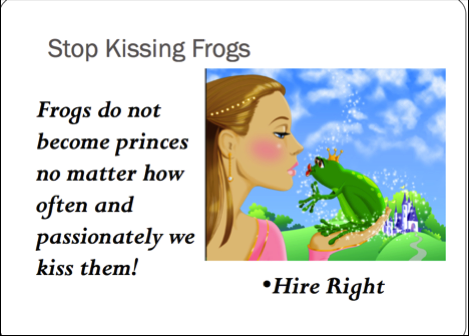
  • Do not use clip art! It is cheesy and unprofessional. Find good photographs or graphics.

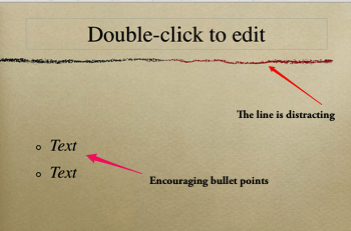
You should seldom use template designs for the same reason--they are distracting. Here is an example of a distracting verses a good slide template:

Distracting Template:

image

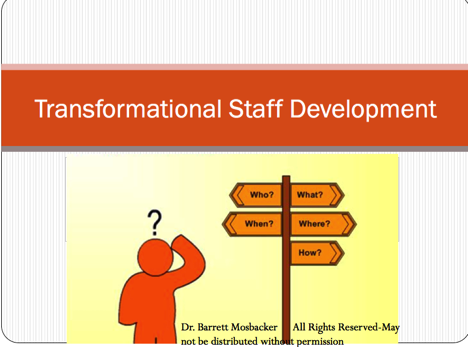
Good, Clean Template:

image

Good and Bad Examples

Assuming that a “picture is worth a thousand words,” here are some examples of before and after designs. Many of these are slides that I have produced--both good and bad and a few are provided from other sources as examples. My slides are indicated by the initials BLM.

THE BAD

image

BLM (Cheesy clipart, poor color selection, distracting text)

image

BLM (Boring with no graphics or illustration, small font, too many bullet points)

image

BLM (This one is so bad it is just embarrassing. There is nothing good about this slide. The graphics are terrible. Too many bullet points. Font too small. Poor color selection.)

image

BLM (The slide has too much text, which is too small. The illustration is poorly done and the overall impact of the slide is boring and distracting.)

image

BLM (The slide has too much text and cheesy clip art.)

THE BETTER

Here is the same topic being covered with a redesigned slide from the one above.

image

BLM (This one has no clipart and no text. A high quality photo covering the entire slide is used. The photo speaks for itself. It is much more impactful than the one before with the same point to make.)

image

BLM (This title slide is affective because the professional photo reinforces the title, which is very short and to the point. The photo also matches the audience, this presentation was given in Canada in the winter.)

image

BLM (One word with a photo matching the key concept.)

image

BLM (Transition slide to next topic--simple text on solid background)

image

BLM (This is a playful slide using a professional photo but with a font matching the playful mood. This slide was designed to communicate with and encourage elementary teachers thus the colors and playfulness, which are characteristic of elementary programs.)

The following five slides tell a story and reinforce each other.

  • Slide 1 acknowledges how many feel when faced with significant change.

  • Slide 2 encourages the audience to laugh and relax because we will provide time and resources to ensure their success.

  • Slide 3 reassures that we are confident that they will be successful as a team.

  • Slide 4 reassures that we are confident of success because….

  • Slide 5 communicates that we will deal with big change in small bites.

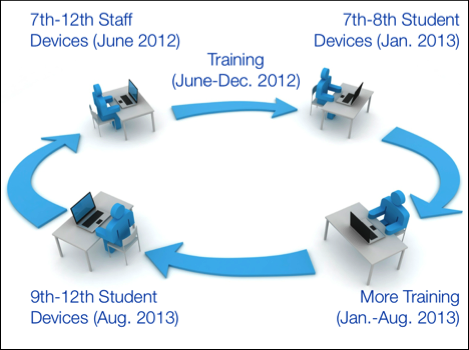
  • Slide 6 illustrates why they will be successful--a slow, deliberate training and implementation cycle.

image

BLM Slide 1

image

BLM Slide 2

image

BLM Slide 3

image

BLM Slide 4

image

BLM Slide 5

image

BLM Slide 6 This slide has animations so that each date appears and disappears in sequence.

A Word About Charts and Numbers

Charts can be very helpful in a presentation but just like your slides they need to be simple with all distracting and unnecessary elements deleted.

Numbers are usually confusing to the audience. Use as few as possible and allow extra time for the audience to do the math. Numbers should never be ultra precise: “Anticipated revenues of $660,101.83” looks silly. Are your numbers that accurate? Just say $660 thousand.

image

This is a busy, hard to read and understand chart with too many words and numbers.

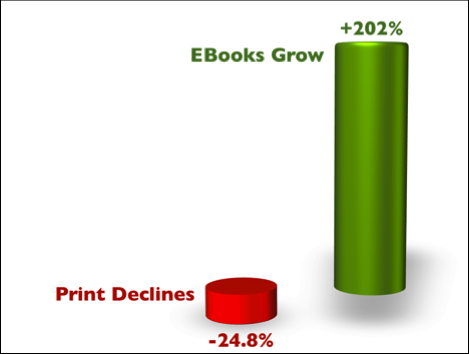
image

BLM This chart is much better. Easy to understand, clean with no distracting elements, e.g., grid lines, unnecessary numbers, and text.

DELIVERY

Arrive Early and Test Everything!

It is stressful and embarrassing to stand up to deliver a presentation only to discover that something is not working. Worse, it is distracting to your audience and immediately reduces your credibility and impact.

You only have about 1 minute to make a first impression. Don’t make it with you trying to get your computer to work or your slides to show up on the screen.

Plan for Murphy to show up. He always does. Plan for the worst case scenario. What will you do if the computer crashes and burns, the video system goes out, or the sound system does not work? Prepare for the unexpected. When you do, you can go with the flow and not skip a beat.

Have your presentation so well rehearsed that you do not need slides as prompts (more on this later). You should be able to speak spontaneously. If you can’t, you don’t know your subject well enough.

If you must have notes, have a printed copy readily available.

Have electronic backup copies of your slides on a thumb drive (for use on a local computer if yours crashes) and your online for immediate download if needed. I use an iPad for this purpose.

Have copies of your notes and slides available for distribution or access online.

Talk to Your Audience, Do Not Read!

Whatever you do do NOT look at your slides and read from them! Keep your eyes on your audience. Make eye contact with individual audience members.

Remember, your slides are to illustrate key ideas, concepts, trends, and facts. Do not use your PowerPoint or Keynote presentation as a teleprompter.

Presentation Style Tips

Remember, your audience will form a first impression within 60 seconds or less! Make that first minute count!

  • Dress appropriately for your audience. It is best to “dress up” rather than “down” if in doubt.

  • Tell real life stories that reinforce your topic.

  • Turn off your cell phone.

  • Jump right in and get to the point.

  • Give your rehearsed opening statement; don't improvise at the last moment.

  • Use the opening to catch the interest and attention of the audience.

  • Briefly state the problem or topic you will be discussing.

  • Talk at a natural, moderate rate of speech.

  • Project your voice.

  • Speak clearly and distinctly.

  • Speak with enthusiasm.

  • Use appropriate well timed humor but not jokes.

  • Pause briefly to give your audience time to digest the information on each new slide.

  • Keep your eyes on the audience.

  • Use natural gestures.

  • Don’t turn your back to the audience.

  • Don’t hide behind the lectern. As much as possible don’t use a podium at all but if you must or the host site has it there for other speakers, move in front or to the side.

  • Avoid looking at your notes. Only use them as reference points to keep you on track. Talk, don’t read.

Length

  • To end on time, you must PRACTICE!

  • The audience will love you if you end short of your time. Never go over! Remember, less is MORE.

  • As a rule of thumb, plan to use 80% of your allotted time.

Demeanor

Show enthusiasm. Nobody wants to listen to a dull presentation. On the other hand, don’t overdo it. Nobody talks and gestures like a maniac in real life. How would you explain your ideas to a friend?

Recommended Reading

All truth is God’s truth. We can learn from unbelievers because by God’s common grace he reveals truth to believers and unbelievers alike. Although I do not endorse everything in the following books (e.g., some have Buddhist and Zen philosophy embedded in them), nevertheless, some of the principles are true and can help anyone design and deliver better presentations.

Why Sweating the Small Stuff Makes a Big Difference

image

By Dr. Barrett Mosbacker

For years I have been taught not to “sweat the small stuff.” I warmly embraced this notion because it reinforced my natural inclination to focus on big strategic initiatives and to pay less attention to the small details, leaving those to others.

I have changed my mind. I have concluded that small stuff make a big difference.  Small stuff deserve a great deal of our attention!

What Convinced Me

God’s Care for Us and Creation:

If anyone was going to focus on big strategic plans it would be God. As the creator and governor of the physical universe and the affairs of heaven and earth, God certainly is focused on large scale objectives.

Yet, notice the incredible attention to detail exhibited by his rule:

Are not two sparrows sold for a penny? And not one of them will fall to the ground apart from your Father. But even the hairs of your head are all numbered. Fear not, therefore; you are of more value than many sparrows. (Mt 10:29–31)

image

Consider the remarkable detail in God’s creation. Look at how intricately God designed a flower. While God wrote our names in the Book of Life before he laid the foundations of the world and “made from one man every nation of mankind to live yon all the face of the earth, having determined allotted periods and the boundaries of their dwelling place,” (Ac 17:26), he also designed the intricate details of flowers.

And why are you anxious about clothing? Consider the lilies of the‘ field, how they grow: they neither toil nor spin, yet I tell you, even Solomon in all his glory was not arrayed like one of these. (Matt. 6:28-29)

image

Ugly can be beautiful. The head and eyes of a horse-fly may not be “beautiful” in the classical sense yet the incredible creativity, detail, and symmetry is a beautiful reflection of God’s attention to detail and a nearly incomprehensible marriage of function and form.

Few things are more ethereal and ephemeral than a snow flake-especially in the U.S. South! Yet, even with something so fragile and short-lived, the variety, symmetry and beauty of a snow flake is a testament to God “sweating the small stuff.”

Not only does God’s creation “work,” it is beautiful and awe inspiring—and to the attentive soul—soul ennobling. Who has not been in the mountains, on a prairie, a beach, or a lake--and not been enthralled and enriched by the beauty made possible by God’s attention to the smallest details of his creation?

Steve Jobs:

It may seem odd to include Steve Jobs in a list with God. I do so because as an image bearer of his creator Job’s attention to detail imaged that of his creator—whether he chose to acknowledge it or not.  Jobs was fanatical about every detail of Apple’s products--even the unseen innards:

From his father Jobs had learned that a hallmark of passionate craftsmanship is making sure that even the aspects that will remain hidden are done beautifully. One of the most extreme—and telling—implementations of that philosophy came when he scrutinized the printed circuit board that would hold the chips and other components deep inside the Macintosh.

No consumer would ever see it, but Jobs began critiquing it on aesthetic grounds. “That part’s really pretty,” he said. “But look at the memory chips. That’s ugly. The lines are too close together.” One of the new engineers interrupted and asked why it mattered. “The only thing that’s important is how well it works. Nobody is going to see the PC board.”

Jobs reacted typically. “I want it to be as beautiful as possible, even if it’s inside the box. A great carpenter isn’t going to use lousy wood for the back of a cabinet, even though nobody’s going to see it.”

For Jobs, designing and manufacturing electronics was craftsmanship, not merely an economic activity.  He was fanatical about design and detail, even in product packaging because he learned that people DO judge a book by its cover:

“You should never start a company with the goal of getting rich. Your goal should be making something you believe in and making a company that will last.” Markkula wrote his principles in a one-page paper titled “The Apple Marketing Philosophy” that stressed three points.

  • The first was empathy, an intimate connection with the feelings of the customer: “We will truly understand their needs better than any other company.”

  • The second was focus: “In order to do a good job of those things that we decide to do, we must eliminate all of the unimportant opportunities.”

  • The third and equally important principle, awkwardly named, was impute. It emphasized that people form an opinion about a company or product based on the signals that it conveys. “People DO judge a book by its cover,” he wrote. “We may have the best product, the highest quality, the most useful software etc.; if we present them in a slipshod manner, they will be perceived as slipshod; if we present them in a creative, professional manner, we will impute the desired qualities.

Application to Our Leadership and Schools

Perception is important.  How we “present” our product is important.  We may have wonderful teachers and programs but unless we present them with excellence would-be and current parents may perceive our schools as second-rate.  The good news is that “good packaging” doesn’t have to be expensive, it just needs to reflect attention to detail.

Like the cover on a book or your first impression of someone you meet, perceptions are formed almost immediately.  The first impression that parents get is from a phone call to the school, the website, or a visit to the campus.

Facilities

It is easy to become “blind.”  We are like the proverbial frog in the kettle, we have grown so accustomed to our surroundings that we no longer see what a visitor sees.  Everything looks fine to us.

Take one hour and walk through your buildings with a notebook.  Write down everything that is not perfect.  Note every time you see chipped paint, scuff marks, dirty carpet, smudges on glass doors, paper/trash on the floor or in the parking lot, shrubs needing trimmed, bare patches in the grass, book bags lying around, handwritten student or school messages/signs/posters (I’m not reviewing to student projects-I’m referring to announcements, directions, etc.), messy offices and desks, stuff out of place, pictures ajar in the reception area, etc....  You may be surprised just how disheveled things can become.

Phone Calls

How are your phones answered?  Do people reach an electronic message system with a labyrinth of options or a warm professional receptionist?  I have been lobbied for years to install an automated answering system.  It is “more efficient” is the reason given.  I have refused because such a system, though more “efficient” does not reflect the warm nurturing culture of our school.  Besides, people hate electronic answering systems, don’t you?

I call a lot of schools.  I am often dismayed by the poor phone skills of those who answer the phones.  Too often I am greeted with a sweet but unprofessional receptionist (poor grammar or too casual), or a very professional but “cold” individual.  In contrast, whenever I have called Apple headquarters or Apple support, I am greeted by a cheery, pleasant professional who always proves helpful. I am always left with a good impression.

Try this.  Call your school with new ears.  Use a phone that cannot be identified as you.  Was the impression you received that of a well educated, professional, happy individual or one who was harried and poorly spoken?  If you were calling the school for the first time, what impression did you get within the first 30 seconds?

Website

Was your website custom designed by a professional or was it created using a template and/or by a volunteer?  If the latter, it will look like it and the first impressions, while perhaps not “bad,” will not be superb.  Following my own advice, we are completely redesigning our website (not yet up).

When you review your website, look for the following:

•    Simple design, uncluttered •    Easy to navigate •    Warm and friendly •    Professional (drop the apples, crayons, etc.)

Remember, people will not spend a great deal of time reading material on your website.  The website should be designed to give a positive impression of the school, highlight important information, and provide easy navigation on where to obtain more information.

I recommend that you not put the photographs of your staff on the website’s staff directory unless they are unusually and universally photogenic.  A few well chosen photographs of staff and students on your site is very effective, but a directory with staff photos is not.  Most of us are not particularly photogenic so there is little to be gained by plastering our faces on the school’s website.

Staff Appearance

The way you and your staff dress creates a powerful impression. Although dress should be appropriate for the job, overly casual attire or poorly worn clothing does not create an impression of quality.  Walk around your school; discretely notice how your teachers and staff are dressed.  Are men’s ties tied properly?  Are the collars on men’s shirts crisp or wrinkled?  Are shoes polished?  Do some of your staff look “frumpy?” Designer cloths are not necessary, but being professionally dressed in contemporary styles is.

Your Presentations

Your presentations communicate a lot about you and the school!  Every presentation you make is enhancing or diminishing the “customer’s” (students, current and prospective parents, staff) perception of the school.

Are your presentations professional and warm?  Just as being professionally “cold” is to be avoided, so too is overly folksy. Here are some “small things” to sweat about.

•    Start and end on time.  It is unprofessional and inconsiderate of those who arrived on time to start any meeting late.  Do so also “trains” people to come late, after all, the “meeting will not really start until 10 after...” •    Make sure the venue, including the stage area, is neat and clean. •    Less is more--too much information given for too long is counter-productive.  It is best to keep things simple and short and then to provide backup information.

Review your PowerPoint/Keynote slides.  Over the last several years I have read several books on presentation design.  I have radically changed how I design and use slides. I cringe when I review past presentations!

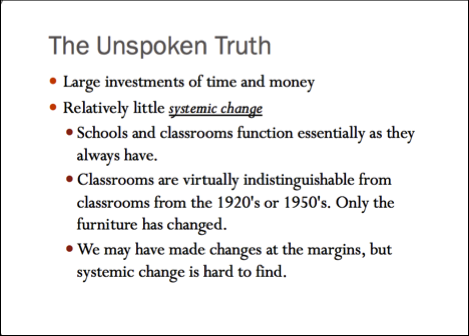
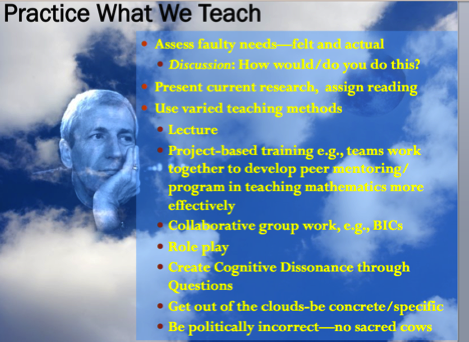
•    Your content should not be on the slides; slides are only used to illustrate or solicit interest. •    Speak as “spontaneously” as possible.  Know what you have to say well enough that you only occasionally glance at notes.  Steve Jobs famously quipped, “People who know what they’re talking about don’t need PowerPoint.” There is a place for slides, but they are never to be your notes! •    It is important to maintain eye contact with your audience--do not turn to look at slides. •    Less is more on slides--few words, large font, great photos and illustrations.  No clipart! Few if any bullet points. Here is an example of how I have changed my slides and presentations.

Old Style:

image

New Style:

image

There are many other areas of the school-especially in classrooms-where we need to be “sweating the small stuff.”  While we need to focus on long-term strategic initiatives, we must pull the clippers out to ensure that every “blade of grass” in the school reflects the quality that we assure parents is true of our schools.

“Small” stuff matters to God and it should matter to us.  Remember, Jesus said, “He who is faithful in little will be faithful in much.”

God is the master craftsman.  Steve Job insisted on craftsmanship in the products Apple designed.  Do our schools reflect craftsmanship?

Remarkable Times, Remarkable Blessings

photo-9Remarkable Times, Remarkable Blessings

by Zach Clark, Westminster Christian Academy, St. Louis

There is always a non-voodoo explanation.
From the TV series, Monk

In January of 2009, news began to spread that our nation and world truly was suffering the “worst economic crisis since the Great Depression”. The first week of January I was on the phone with Barrett Mosbacker, and I said to him, “I believe 2009 is going to be a remarkable year!” Barrett asked, “Remarkable in what way?” And I replied, “That’s what I like about that word…remarkable…I’m going to be right whether things get worse than anyone imagines or better than anyone dares hope for.”

2009 has been truly remarkable, and it’s not over yet. At the Christian school (grades 7-12) where I serve we faced the threats of major shifts in our region and world. From what I hear, it is possible that every Christian school in America faced some unique challenges this year, and many are struggling. At Westminster Christian Academy, we have been greatly encouraged by how God is leading us through these challenges. We are trying to determine what we are doing right (so we can keep doing it) and what we need to change or improve in the future (so we can stay strong).

I’m hopeful that some of my personal thoughts on the threats, strategies, blessings, and challenges that we have faced might be helpful to you.

We began the 2008-09 year having experienced the following in previous years:

  1. Ongoing enrollment growth.
  2. Ongoing income growth and record levels of giving.
  3. Constant programmatic improvements and reputation for increasing quality.
  4. The beginning of a capital campaign calling for transformational facility expansion, an entirely new campus.
  5. A projection for another year of enrollment growth in 2009-10.

Only six months later, by February, we realized reality had changed:

  1. A tuition increase was in place, although lower than in most recent years at 5%, it was still noticeable and felt by parents.
  2. Shifts in our inquiries for admissions data suggested that enrollment would most likely hold steady, and more re-enrolling families than ever before would be requesting financial aid for the first time.
  3. Unrestricted giving providing important dollars for the budget was the lowest in seven years. We projected our budget giving would be as much as 20% off of our budget.
  4. Resistance to making any long-term campaign commitments was overwhelming.
  5. A region-wide culture of fear and strong reactions was in place as we received constant advice on planning for such things as a possible 30% decrease in enrollment and 40-50% decreases in giving.

Another six months later, in August 2009, we started this school year with some amazing news of God’s provision through these difficult times.

  1. Record enrollment, surpassing even our pre-economic crisis projections.
  2. Record giving, and only a 10% drop in budget giving.
  3. No significant cuts to people or programs that impact students and families.

Above I’ve provided a very general and high-level view of some of the key economic health indicators of a Christian school, and how dramatically they shifted. Perhaps your circumstances were more challenging or less so.

What I want to focus on in this piece is how we responded and the steps that we took because I believe they are instructive and helpful. Even though some may say the “crisis is behind us,” the basic steps we’ve taken and how we continue to move forward are based on core values and principles of effectiveness that should be helpful and transformative at any time. Our school leadership continues to discuss these, analyze these, and seeks to understand what is happening.

The aforementioned shifts literally seemed to occur overnight and our heads were spinning. There is no reason to pretend that we all “knew what to do.” Every person I talked to at the beginning of 2009 seem dumbfounded and awed by the changes that were occurring. I kept hearing people say, “I’ve never seen anything like it.” But, we took a deep breath, we prayed, we asked a lot of people for advice, and we tried to be steady and strong as we outlined how we intended to move forward during these strange times.

Firstly, we recognized that this is an overwhelming difficult time for so many people. Husbands and wives are facing fears and tests of faith they have never experienced before. Fathers and mothers are enduring major adjustments to their careers and lifestyles. Children are dealing with questions and uncertainty unique to this moment in history.

Secondly, we began by asking the question found in Ezekiel 33: “How should we then live?” We are finding strength in a renewed sense of our dependence upon God as we remember His faithfulness.

Thirdly, we made a conscious decision not to go into what we called a “hunker-down” mode. We wanted to be willing to make tough decisions but be proactive and not simply reactive.

Fourthly, we committed to communicate in an encouraging but straightforward manner.

Lastly, and maybe most importantly, we asked the Lord to help us discover ways to make decisions with the right priorities in mind. We believed this is a time where we could make significant statements about who we really are as a school community. We prayed that we could seize opportunities to live out the truth that God, in His unchanging love through Jesus Christ, is the faithful, merciful, and compassionate Provider and Savior of the world.

One of the things I personally learned is that all of the above is really easy to talk about. It’s taking the time to establish priorities and then make tough decisions to back it up that is the truly hard and sometimes painful part.

So, we recognized reality, asked questions, prayed, resisted the urge to hit the panic button, prepared to communicate, and established priorities to guide our decision making...and I mean all of this in the most literal sense possible.

Here are the priorities we established, put in writing, and communicated.

Priority #1: Today and Every Day

Today and every day, we will hold to our mission and vision to see young men and women equipped to engage the world and change it for Jesus Christ. Our core values will never change. We will keep the main thing, the main thing: the Christian education of the individual student. We continue to strive to hire and keep the best teachers, coaches, and staff members. We constantly improve, offering better value to students and families through the years, always working to become better than we once were.

Priority #2: Stronger Tomorrow

We are making the tough decisions that help us stay financially strong over the long haul. We are holding fast to the families we serve, enrolling new students, and we will serve families in good times and bad. We are pushing forward on difficult decisions that pave the way for our future sustainability, ensuring a strong Westminster in the future. We will also introduce new technologies and programs that best equip our students for their future, not our past. We will not compromise the quality of today for tomorrow’s dreams, but neither will we make decisions that are so shortsighted that they compromise the financial stability of our future.

Priority #3: Moving Ever Forward

We will continue to implement our strategic plan and communicate our vision for the future, providing opportunities for people to make a difference and make decisions that move us ever forward as a Christian school. Planning will continue to be a dynamic part of our culture. We pray that God will move the hearts of people to give in order to keep Westminster strong and improving, and we will continue to wait upon the Lord for the sale of our current campus and provision of our future dreams.

It is usually easy to establish priorities, the challenging part is making decisions on a daily basis that honor your priorities.

Then, we took it a step further. We articulated, in very specific terms, the types of disciplined actions we would be taking to reflect those priorities. I’ve underlined here the key principles.

  • Implement conservative spending and aggressive fund-raising, making some tough decisions along the way in our annual budgets.
  • Support creativity and innovation among teachers.
  • Continue to go the extra mile for students who struggle socially or academically.
  • Promote even more personal involvement of teachers and coaches in the lives of students and families, as many will face unusual challenges.
  • Respond to the unique economic problems that may be faced by our parents and teachers to the very best of our ability.
  • Improve our processes and communications with parents, utilizing non-paper methods to improve speed and lower costs.
  • Leap forward in technology integration at the classroom level and 21st Century learning for students.

And then, we started moving forward on all these actions in very tangible ways. I won’t go into every action, but here are some:

  • We communicated like crazy, even asking families to respond to a “Share Your Heart” survey so they could tell us privately how the economy was really affecting them and give us advice.
  • We put our campaign on a short-term hold, because Priority 2 said, “we will not compromise the quality of today for tomorrow’s dreams.”
  • We froze faculty/staff salaries.
  • We increased our total financial aid budget to respond to many re-enrolling families experiencing dramatic economic difficulty.
  • We asked teachers and staff to give us their ideas on how to save money without reducing quality.
  • We looked for key ways to add value to families without adding cost.
  • We made significant shifts in our costs of paper and printing.
  • Every administrator became personally responsible for helping teachers, staff, and even volunteers focus on student retention and new family enrollment.
  • We increased our focus and energies on improving the school through changes, innovations, improvements, and efficiencies. And, we continued to focus on the implementation our Strategic Plan.
  • We made our most significant and visible investment in technology for teachers ever, with every teacher receiving a new Macbook.

Ultimately, it is God’s mercies and provision, by His grace, that sustains us. But, I also know that God works through people, their decisions, and their strengths and weaknesses. Many schools are facing far more difficult times than we have. We do not pretend to fully understand all of what has happened or what is happening now. But, I do challenge you to join us in the day-to-day discipline of asking questions and digging deeper down and climbing higher up in the understanding of this calling of serving in a Christian school in today’s times.

2009 is indeed a remarkable year, and remarkable times remain ahead. Let us go forward together.

Let’s Get Creative! How Could You Use This?

By Dr. Barrett Mosbacker

Take a moment to read the article below (Reposted from Duct Tape Marketing.) Now, give this some thought and then ask yourself, “How Could We Use Twitter to Promote Our School and/or Serve our Stakeholders?”

After giving this some thought, post your ideas as a comment to this blog article to share with others!

17 Ways to Use Twitter for Business and Some Not

More and more small business folks are giving in to what seems like an insurmountable mountain of hype and jumping on the twitter bandwagon.

But, some people still look at twitter on the surface and conclude that it’s one big waste of time. I can’t say I disagree completely, however, like all social media and marketing tactics, before you can determine if something makes sense you need to analyze your objectives. So, instead of asking why you would use it, ask how it might help you achieve some other already stated objectives.

1) Would you like a way to connect and network with others in your industry or others who share you views? It’s a good a tool for that.

2) Would you like a way to get instant access to what’s being said, this minute, about your organization, people, products, competitors or brand? It’s a good tool for that.

3) Would you like a steady stream of ideas, content, links, resources, and tips focused on your area of expertise or interest? It’s a good tool for that.

4) Would you like to monitor what’s being said about your customers to help them protect their brands? It’s a good tool for that.

5) Would you like to extend the reach of your thought leadership – blog posts and other content? It can be a good tool for that.

6) Would like a way to quickly find vendors, partners, tech help, even employees for your organization? I can be a good tool for that.

7) Would you like to promote your products and services directly to a target audience? Not such a good tool for that, but it can light a path back to your web site!

Now, if that weren’t enough, the open nature of the twitter platform is spawning uses far beyond what was ever imagined or what many people can grasp - and this use of the technology will only get bigger.

Here are few things you may have never considered

8) Publish your Flickr photos on twitter - Visit twittergram and set-up an account and then just upload to Flickr but tag your photo twitter and it goes into your twitter stream.

9) If you use online todo list Remember the Milk - you can set it up to flow into twitter - this might be a way to assign todos to remote teams

10) Using strawpoll you can create mini polls into your twitter stream - great for flash feedback

11) Use twitter to keep up on traffic jams with commuterfeed

12) Have twitter alert you when you have a meeting with timer

13) Get and fill current job openings with tweetajob

14) Track FedEx, UPS and DHL shipments with TrackThis

15) Get help quitting smoking

16) Keep a diet journal

17) Get a tweet when your plants need water - - okay this one would be way cooler if it simply tweeted you when the plant watered itself.

Share ideas on how our schools could use Twitter by submitting a comment with your ideas.

How Facebook Can Affect Your Enrollment, Marketing, and Communication

By Dr. Barrett Mosbacker

According to Sharon Gaudin of Computerworld, a recent study shows that social networks for middle-agers (that’s most of us reading this article) are now a more popular form of communication than email.

I remember that just a few years ago many Christians, including Christian school administrators and teachers, viewed social networks as the exclusive domain of teenagers or were immoral, or both and therefore should or could be ignored.  Such a perspective was a mistake then and is a mistake now.  Social networks are a form of communication and social interaction.  Social networks are neither inherently good nor inherently evil.  HOW they are used determines their value.

According to a report by Nielsen Online (download PDF), social networks are used by two-thirds of all worldwide online users.  Social networks and blogs have become the fourth most popular online products.  The report lists e-mail as No. 5 on the list of users' favorite online tools. Search tools, portals and PC software topped the list.

Other highlights of the report include:

  • Putting the growth of social networks – popularity and engagement – into context

  • How the audience to social networks is changing

  • The challenges facing advertisers on social networks

  • What advertisers can do to find the magic formula for advertising in social networks

  • Factors contributing to the Facebook phenomenon

  • Why localization has won the day in many countries

  • Where mobile social networking has taken the greatest hold

  • What ‘traditional’ publishers can do in the face of the social network phenomenon

Mind Share

“Of the social networking sites out there, Twitter and Facebook seem to have the lion's share of the mind share these days. And Facebook has the lion's share of the market share, as well. In January, online researcher comScore Inc. reported that Facebook, once thought of as the up-and-coming social network, had overshadowed rival MySpace, with nearly 222 million unique visitors in December compared to 125 million for MySpace.

To back up comScore's numbers, Facebook CEO Mark Zuckerberg noted in a January blog post that the social networking site had hit a big milestone -- 150 million active users, nearly half of whom use the network daily.”

Neilson’s report also shows the significant increase in the time spent on Facebook: In all the markets that the company tracks, Facebook is visited monthly by three of every 10 people online.

Our Parents and Prospective Parents are on Facebook

THE MOST SURPRISING FINDING OF THE REPORT is that Facebook’s greatest growth in global audience numbers has come from people aged 35-49!  Social networks aren’t just for the teenage set anymore.

This is the prime child rearing, school selecting age of the population!

Should We Use Facebook and Other Social Networks to Connect with Parents?

Frankly, I don’t know the answer to that question but I am researching the issue because I believe we should try.  Here are some of the issues to consider.

Our Mindset/Mental Model Must Change

Traditional advertising is one-way communication—the message is pushed or placed in front of the intended customer.

Social networks by definition are SOCIAL and therefore the “advertising” must be a conversation.  According to Nielson, “the point that social network members are co-creators of content and, therefore, have a sense of ownership within the site means advertising should be about participating in a relevant conversation with consumers rather than simply pushing ads on them. After all, it is social media. Advertising shouldn’t be about interrupting or invading the social network experience, it should be part of this conversation.”

This two-way conversation presents opportunities and problems.

Positively, it provides a framework for engaging in authentic conversations about education, Christian education, and our schools.  Facebook, for example, is a wonderful way to provide helpful information to current and prospective parents.

Negatively, we run the risk of false accusations and unjustified negative comments being made by disgruntled individuals.  The social network, if not managed well, could also foster gossip and slander.

In other words, promoting our schools through social networks can be a two-edged sword.

“Messaging within advertising should come from a more authentic, candid and humble perspective.

Social media has, once again, brought word of mouth to the fore as the ultimate form of advertising at a time when traditional advertising is suffering from a major lack of trust.

Nielsen’s analysis of social media conversations back in 2007 and again in December 2008 showed that ‘false’ was the term most closely associated with “advertising”.
Social media has fanned the flames of consumer distrust about advertisers claims. However, at the same time social media has provided the motive, opportunity
and means for advertisers to engage consumers in a more open and honest way.”

Building Trust and Friendships with Parents?

The report goes on to note that “social networks are ultimately about friendships, where members add value to each other’s lives through interaction.  Therefore, advertising should follow the same philosophy of adding value through interaction and consultation. Fan sites or sponsored groups are, perhaps, one of the ore successful examples of social network marketing that touch on the principles of interactivity and adding value …

However, the challenge for advertisers is that discussions within these groups won’t necessarily align itself with the brand-designed messaging. Much like a friendship, marketing on social networks requires continual investment – in terms of time and effort as opposed to financial – to be of value to both parties.”

In other words, some of the conversation on a Facebook fan page for our school will not reflect the message that we are trying to communicate.  Some of the comments posted by participants may be blatantly false. Although this presents a significant problem, it also presents an opportunity—an opportunity to correct false information, rumors, and gossip and to share positively the philosophy and impact of Christian schooling.  Doing so of course requires that someone from the school be fully engaged with the Facebook site.

What Do You Think?

  • Does your school have a Facebook presence?  If so, why?  If not, why not?

  • If your school has a Facebook presence, how has it worked?  Has it been a net positive experience or a negative one?

Technorati Tags: Facebook,Social Networking,Social Network,Advertising,Christian,Schhool,Education,Christian School,Christian Education