An Affordable Solution for AP Programs

An affordadable AP program image

By Dr. Barrett Mosbacker

Advanced Placement (AP) courses are an important factor for many parents and students who are considering enrolling in a Christian School. AP courses provide the highest achieving students the chance to study college level material. Parents and students see AP courses as an academic challenge, a way to better prepare for college, and an advantage on college applications. Yet many Christian schools trail their public school competitors in AP course offerings. Larger, well-funded public schools have the competitive edge among families with high academic standards because these schools can provide students a broad AP curriculum. How can Christian schools maintain their small class size and value-driven curriculum while competing with public and large private schools that provide a wide range of AP courses? Increasingly, Christian schools are looking online for the solution to this problem.

Online Advanced Placement courses allow Christian schools to easily expand their curriculum. Through online learning, courses can be tailored for the individual student. If you have a student interested in engineering, but your school does not provide an AP calculus course, online learning can be an efficient solution. Instead of losing that student, your school could provide a flexible and affordable online option for that student. Online learning keeps the education within your school. There  is no need to construct complicated relationships with public institutions in order to serve single student needs.

Online AP courses are the most affordable solution for Christian schools in many situations.

Who pays for it? The cost of offering AP courses can be covered through tuition and additional fees paid by families. Schools can provide access to the online course, but students and their families pay the fee. Under some arrangements, the family also pays an extra fee that can help a school pay for administrative overhead and other programs.

What about faith? Online AP courses are now offered to meet the educational goals of a Christian education. As a Christian school you strive to offer all your students a well-rounded and rigorous education. Offering an expanded range of AP courses online helps you achieve that with your most gifted students. You are helping them shine their light in the world.

How will it fit into the student's schedule? Online learning is flexible and allows schools to set their own start and end dates for an AP course. With the AP exam in May, students can start the online course as early as June to prepare for the next yearís exams. The summer months will provide your students ample time to prepare and increases their chance of securing college credit.

A Christian School Educatorís Guide to Online AP courses

AP Online courses put a Christian school on equal footing with its public counterparts without placing additional strain on the school's resources. Learn more about it in our new white paper, ìOnline Opportunities for Christian SchoolsDownload this free resource for Christian educators using the link below.

// <![CDATA[ (function(){ var s='hubspotutk',r,c=((r=new RegExp('(^|; )'+s+'=([^;]*)').exec(document.cookie))?r[2]:''),w=window;w[s]=w[s]||c, hsjs=document.createElement("script"),el=document.getElementById("hs-cta-e2d3fe85-105c-45eb-8430-5b79bb3129fd"); hsjs.type = "text/javascript";hsjs.async = true; hsjs.src = "//cta-service-cms2.hubspot.com/cs/loader.js?pg=e2d3fe85-105c-45eb-8430-5b79bb3129fd&pid=188329&hsutk=" + encodeURIComponent(c); (document.getElementsByTagName("head")[0]||document.getElementsByTagName("body")[0]).appendChild(hsjs); try setTimeout(function() , 2500); })();</p> <p>// ]]</p></div>

You Have to Watch Out for the Pork on Thursdays!

By Mark Kennedy, ACSI Canada

Head_in_Sand_Denial_IgnoreMy childhood friend Bill grew up to be a respected and successful bank executive- a man who occasionally helps financial institutions beyond our borders. A few years ago while consulting for a bank in Dublin he made his temporary GHQ in a small hotel that boasted a dining room for its guests. On a Thursday evening he ambled down to this quaint eatery for a taste of Celtic cuisine not suspecting the violent conflict that would arise later in his stomach.

“I was sick all last night after eating in your restaurant!” He told the manager the next morning.

“Well what did you have for dinner?”

“Roast pork!” said Bill.

“Ah yes,” replied the manager philosophically in a lilting Irish brogue, “You have to watch out for the pork on Thursdays.”

You can imagine the questions in my friend’s mind when his initial shock wore off. Maybe foremost was

“Why didn’t someone tell me?!?”

Sheltering someone from reality can be dangerous. And sometimes the consequences can be much more serious than a minor case of food poisoning.

Consider the effects of an education that intentionally shelters students from the most important realities about life and living- a secular education where the daily presence of the living God is ignored and the authority and guidance of scripture is dismissed- an education that edits out the creator and sustainer of the real world.

Paul warns about a day when:

Men will not put up with sound doctrine. Instead to suit their own desires, they will gather around them a great number of teachers to say what their itching ears want to hear. They will turn away from truth and turn aside to myths.” 2 Tim 4: 3 & 4. That time sounds uncomfortably familiar.

It’s not that a secular education necessarily speaks out against the God of the Bible or openly denies the authority of the scriptures. It simply remains silent about them. And that’s the problem. If a student from a Christian family receives a consistently secular education how surprising can it be if he comes to think that God can’t be very important? ‘After all they never talk about Him at school’ he might reasonably say to himself- and his logic would be pretty hard to refute. He got the silent message.

Robert Louis Stephenson expressed it plainly,

“The cruelest lies are often told in silence.”

So when important, even vital truths are kept from people who desperately need to hear them, Stephenson says it is a cruel deception.

The silence in secular education has implications for the way children learn, believe, think and face life’s challenges. When students are sheltered from God’s reality they are prime candidates to be “taken captive through hollow and deceptive philosophy which depends on human tradition and the basic principles of this world rather than on Christ.” 2Col 2:8. Philosophies produce actions, and actions produce consequences. So it should be no surprise that sex education that ignores biblical standards produces ever growing rates of sexually transmitted diseases, abortions and accompanying psychological problems; that a purely mechanistic and evolutionary view of humanity convinces some students they are worthless genetic accidents so that suicide becomes a reasonable option; and that when personal troubles for which secular minds have no real answers overwhelm students they turn to illicit drugs in an attempt to escape. The world of drug and alcohol abuse and promiscuous or perverse sexuality is so often a false refuge for people who have not been equipped to deal with the real world.

In Christian schooling we don’t shelter students from reality. We prepare students by telling them the whole truth about the real world and by honoring the presence of the source of all truth and by teaching future generations about his standards for living. As the Psalmist says,

We will not hide them from their children; We will tell the next generation the praiseworthy deeds of the Lord, his power and the wonders he has done. Psalm 78:4

In the early 1990s after Russian Communism collapsed I found myself on a team of North Americans instructing hundreds of Russian educators about how to teach the Bible to Russian public school students. Evgenity Kurkin of the Russian Ministry of Education explained why we had been invited to do that,

Seventy years ago we closed Him (God) out of our country and it has caused so many problems in our society we cannot count them…..We must put God back into our country and we must begin with our children.

One evening as I walked with some of our Russian hosts down a snowy street in St. Petersburg, a translator told me about his life in Chernobyl after the nuclear accident – the one that killed and crippled thousands.

“For three years after the accident nobody told us what had happened, all we knew was that our children were getting sick. We finally learned about it through BBC radio.” Those people in Chernobyl knew the cost of being sheltered from reality – and it was far too high.

And what about the future cost for students who have been sheltered from the realities that matter most for living now and for the life yet to come?

We shy away from sounding a warning to families in our churches. “Try to focus on the positive aspects of Christian schooling and don’t offend anyone” we tell ourselves. But maybe the time has come to tell the whole story to Christian families for the sake of their children and the future of the church in North America.

I Hate to Say It, But Told You So! :-)

By Dr. Barrett Mosbacker

The title is a bit tongue in cheek but I want to update you on a major trend that I believe will have a significant impact on our schools—the rapid development, growth, and acceptance of e-publishing and e-book readers.  The textbook and library as we know them may disappear or at minimum be radically transformed. 

A few months ago I wrote Welcome to the Library. Say Goodbye to the Books:

Things are changing!  For many years e-books have resided in the back waters of publishing.  Early adopters and gadget freaks have read them but the vast majority of the population were either unaware of them or didn’t care.  The lowly status of the e-book may be about to change—and radically.

Consider the latest developments:

The US Kindle Catalog is has surpassed 400,000 Books.  On Saturday (Dec. 26) Amazon issued a press release announcing that on Christmas Day, for the first time ever, customers purchased more Kindle books than physical books." That's exciting and seemingly newsworthy, although it is natural that this would have happened with hundreds of thousands of new Kindle owners opening their Kindles and finding nothing to read on them but a snappy welcome letter from Jeff Bezos. But that's not to say it is not a big deal.

It is the latest in a steady flow of data points suggesting not only that Amazon is dominating both the hardware and content markets of the e-book sector but also that the e-book revolution itself is moving with stunning alacrity from its inflection point this past September to a tipping point that should occur, at the latest, in 2014.

In a separate article, Mr. Bezos, CEO of Amazon makes this statement (emphasis added):

Our vision for Kindle is to have every book ever printed, in every language, available in 60 seconds from anywhere on earth. We have worked with publishers to get the most popular books you want to read. The Kindle Store currently has more than 390,000 titles and we are adding more every day. Whether you prefer biographies, classics, investment guides, thrillers, or sci-fi, thousands of your favorite books are available. The Kindle Store offers 101 of 112 books currently found on the New York Times® Best Seller list. New York Times Best Sellers and most new releases are $9.99, and you'll find many books for less.

In yet another news story:

Amazon.com said Monday that its Kindle e-reader has become the most gifted item in the company's history…The online retail giant also noted that its customers purchased more Kindle e-books than physical books on Christmas Day -- a first for the company. However, not everyone buying e-books from Amazon this holiday season will be reading them on dedicated Kindle devices.

Amazon has unleashed a Kindle app for the iPhone and iPod touch that users in 60 countries can download from Apple's App Store. Moreover, in November the online retailer released a free Kindle for PC application that enables customers to read Kindle books on notebooks PCs….The new strategy makes sense in light of Forrester's projection that e-book sales will top $500 million in 2010. "This is still small compared to the overall book market, but it's growing quickly," Rotman Epps observed.

The potential for selling content that's never been consumed digitally before is huge and helps to explain why Barnes & Noble recently launched its nook e-reader at the aggressive price of $259, Rotman Epps noted. Barnes & Noble's long-term strategy is "to profit not so much off device sales as off of e-book content sales," she explained.

My Personal Experience

I confess, I am  now the proud owner of a Kindle 2.  My wonderful wife, with wise advice from my daughters, bought me the Kindle 2 Global Edition for Christmas.  Below is a picture of my Kindle on my desk in my study with full bookshelves in the background.

After using it now for several weeks, here is my take on it; it is fantastic and not because I like technology.  Simply put, it is better than a physical book.  Here are some of the reasons why I like the Kindle better than traditional books.

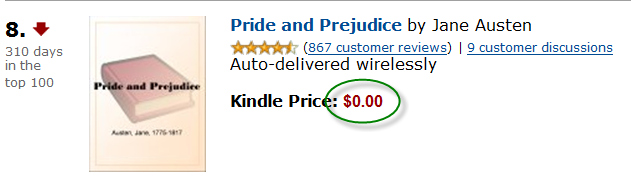
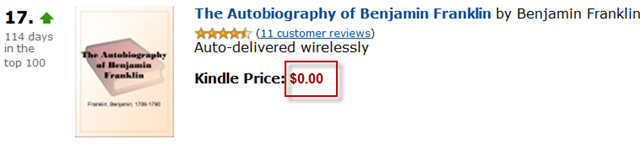
  • I now have access to a million (yes, a million) FREE books, letters, and essays that I can download in 60 seconds.  That alone is enough to justify buying the Kindle. Here are a couple of examples:

image

image

image

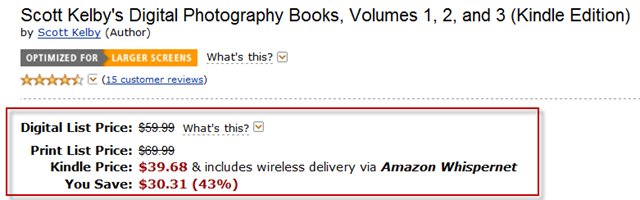
  • Virtually all Kindled edition books are cheaper than the printed versions.  For example, I purchased three volumes of a photography book.  I saved more than shown because I purchased each volume separately for only $9.99 each! I paid 29.97 for all three volumes compared to the normal price of $69.99, a savings of $40 or (57%).  Not even counting the free books, the Kindle pays for itself very quickly.

image

  • My library is full.  I have no more room for books and can’t afford new expensive bookshelves even if I had room.  However, I can store 1,500 books on the Kindle.  When I fill it, I can archive the one’s I’ve read on Amazon and download more books.  I can move books back and forth between the Kindle and Amazon, which means I’ll never be out of room.

  • I can read the books on my iPhone, my laptop, and the Kindle and they all sync.  That means if I read something on my iPhone and later open the same book or article on the Kindle, the Kindle version starts where I left off reading on my iPhone.

  • The books are archived safely on Amazon's servers. I don't have to worry about losing my books if the house burns down!

  • The new e-ink technology makes the Kindle read just like printed material.  It is not backlit there is no eye strain like there is when reading on a computer monitor.  It also means that the battery lasts much longer.

  • I can literally carry my entire library in my hand. I can read any book, essay, newspaper, magazine or blog—any place, any time, any where.  Great for the doctor’s office, on planes, etc.

  • I can highlight and annotate material and access my notes, annotations, clippings on my computer for using in articles, presentations, or for sharing with others.

  • Newspaper, magazines, and blog subscriptions are downloaded to my Kindle at night, while I sleep and before they are online or on newsstands.  When I get up to have my coffee, I can have my devotions and read the newspaper before the start of the workday.

  • I have free broadband 3g coverage via Sprint on the Kindle.  This means I can browse the web on my Kindle.  The browser is not great, but usable.

  • I can have a sample of any book or newspaper sent to my Kindle prior to buying.  This saves me from making expensive purchase mistakes.

  • I can search any book or my entire library on my Kindle by key word(s).

  • I have immediate seamless access to a built in dictionary and Wikipedia.  I can lookup anything without looking my place in the Kindle.

  • I have an always available “built-in” book light in on Kindle case (light and case sold separately).  I don’t have to find the book light.  It is always available with my Kindle.  This is great for reading in bed or on flights when I don’t want to disturb my seat mates.

Those are just a few reasons by I prefer the Kindle.  There are a few downsides:

  • Even though the Kindle can go two weeks without recharging (with wireless off), it still has to be charged.  Print books do not have to be recharged.

  • The Kindle is a computer with software, which means there will be occasional technical issues.  I’ve never had a technical problem with a book.  :-)

  • Although within limits you can share your Kindle account with other Kindle users (meaning you can share books with each other, e.g., family members), it is limited and requires that they have a Kindle. There is no restriction on sharing printed books.

  •   Some will argue that e-readers like Kindles don’t give the pleasure of holding a book in your hand.  Although I understand this concern, I believe it is over-stated.  First, there is nothing particularly pleasurable about holding a paperback.  Obviously, holding a nice leather bound book provides a certain pleasure, but who can afford many leather bound books?  Second, as indicated above, with a good leather cover on the Kindle, it feels like you are holding a good leather bound book.

  • A library in one’s study is beautiful, Kindles are not. I would not want to see a room full of Kindles.  :-) 

What are the implications for our schools?

  • It the trends are any indication, textbooks, newspapers, magazines, blogs, etc., will migrate to electronic versions.  The price point should be lower, saving schools money. 

  • We may finally be able to eliminate the heavy book bags that our students carry.

  • Lockers may no longer be necessary.

  • Curriculum can be updated more frequently, which is particularly important for science textbooks.

  • Students and teachers could have access to textbooks and other readings on cell phones, computers, and Kindles (or other e-book readers) simultaneously.

  • There may be a convergence of this technology into one handheld device.  It is rumored, for example, that Apple is working on an iSlate and Microsoft on a similar device.

  • Students can have access to the world’s best literature and historical documents—for free.

  • We can reduce the size of our libraries making room for more classrooms.

What are your thoughts about these developments?

Given the anticipated explosion in e-books and e-readers, what are your thoughts about the implications for our schools?  Would you promote the use of e-readers and e-textbooks as substitutes for printed textbooks and the traditional school library?  Do you see any intrinsic advantage or disadvantage to the move to electronic reading and publishing?

You Should Sign the Manhattan Declaration-But Be Careful!

ManhattanDeclaration_Logo

By Dr. Barrett Mosbacker

If you have not read the Manhattan Declaration, I urge you to do so.  You can click this link The Manhattan Declaration to download a PDF version to read.  It is only nine pages long but well worth reading.  Click here to access the web site for more information and to sign the declaration.  Click here for a very informative FAQ document.

I urge you to sign the Declaration.  However, pray and think through this first.  It is very possible that by signing this Declaration you will increase the likelihood of personally, or the institution you represent, becoming the focus of verbal or legal harassment in the future.  Remember, what is posted on the Internet can ultimately become public.

Before you sign the Declaration, ask yourself this question, “Am I, by God’s grace, willing to pay a possible personal, family, or ministry price for publically supporting the principles outlined in the Declaration?” 

My prayer is that you will prayerfully sign the Declaration.  I also encourage you to pass this information on to others.

Finally, I believe you should consider having this document systematically discussed and analyzed in selected high school classes.  What a wonderful teaching opportunity—that deals with the Christian mind, heart, and will!

Educational Leadership, Relationships, and the Eternal Value of Christian Schooling

The following is an excellent book review on imageSchools as Communities: Educational Leadership, Relationships, and the Eternal Value of Christian Schooling.”  Click on the image to see the book on Amazon.
This is a book that you should seriously consider reading.  (Disclaimer: I am a contributor author, Barrett Mosbacker).

The review was published in The ICCTE Journal. 

Reviewed by Dr. David W. Robinson, Adjunct Professor, D.Mgt. program, George Fox University.

“Where there is no vision, the people perish…” Proverbs 29:18a (KJV)

Anyone who has engaged in the calling of Christian education knows that it can be — and usually is — one of the most exciting, delightful, fulfilling, and joyous ministries that a believer can know. Its golden days are a real “foretaste of glory divine,” its opportunities for those who truly love the possibilities of the mind and heart of Christ in the lives of our students are the very aroma of the Lord in our work. Lives are changed; parents are supportive; administrators are helpful; the board is productive. Sacrifices are engaged willingly, trials are gladly borne. We go home at the end of the day, and can hardly wait to return in the morning…

And anyone who has engaged in the calling of Christian education also knows that it can be — and usually is — one of the most daunting, exhausting, demoralizing, and frustrating ministries that same believer can know. Golden days can morph into drabness from one year to the next, or even overnight; its opportunities can suddenly vanish, with the mind and heart of Christ being trampled underfoot by institutional change, upheavals in leadership, financial uncertainty, or divisions and offenses within the school community…and suddenly, the aroma of Christ is seemingly nowhere to be found. Lives are no longer transformed; parents are arguing among themselves or sniping the administration/board; administrators run for the bomb shelter; the board seems unable to resolve the issues. Sacrifices now seem imposed, with trials producing grumbling, not grace. We go home at the end of the day, and are tempted to circulate our résumés…

Strange to say, this roller coaster ride is well known to all too many Christian school teachers, administrators, parents, students, and board members. The shift can happen over time, or even overnight. The results are commonly tragic (and predictable) if resolution and healing are not accomplished in time: high rates of teacher turnover; a loss of students and their families; the demoralization of the remaining students, faculty and staff; friction between boards and administrative leadership that leads to recriminations, or even terminations; and so on.

And so the question is: How can Christian schools resolve the chasm between the experiences of the first and second paragraphs above, prevent the sort of divisions and offenses within the educational body that the scriptures warn about, embody healthy and continuous educational improvement, and become the dwelling places of shalom and agapé that will transform the lives of all who are touched by that community?

This is a daunting question, cutting to the heart of what every generation of Christian educators and academic leaders must face, ready or not. In the case of Schools as Communities, it is addressed by James L. Drexler and the excellent group of nearly two dozen scholar-practitioners that he assembled for this volume. As the title states, the main theme of the work is that of community. All eighteen of the essays are represent separate explorations of particular subsets of the main challenge of fostering koinonia within the imperative for continuous school improvement in the service of Christ and our students. This is a worthy but highly ambitious task; frankly, as I read it, I wondered how well Drexler and his collaborators would carry it off.

Drexler and company proceeded by dividing the task into four main sections:

  • “Building Community: Foundational Principles”
  • “Building Community Among Faculty and Staff”
  • “Building Community for Students”; and
  • “Building Community with Others.”

Drexler doesn’t leave community without conceptual support, however; he explicitly adds supportive themes of grace, scriptural priority (“the weightier issues of the Law,” prophetically stated by the Lord in Matthew 23:23), and cultural relevance/engagement to the content of the book (xiv-xviii). Nor is the work merely theoretical; each chapter concludes with a call to praxis entitled “Now What? Application to Practice”. Its purpose is to help the reader understand how the contents of each chapter might be used in their school setting and their own ministry of leadership. Finally, each chapter has a references section that provides useful sources and online links for the reader to extend his or her ongoing exploration of educational leadership and community.

In Part One, foundational principles are explored in essays examining the primacy of grace in Christian school settings (Bruce Hekman); mercy, justice and social change as imperatives of transformational Christian education (Vernard T. Gant); the life of the leader and his or her grace-filled life as an embodiment of the Lord’s grace (Jeff Hall); and godly risk taking on the part of the school leader (Stephen R. Kaufmann and Kevin J. Eames).

Hekman encourages the Christian school to embody true grace to its students, eschewing both “sloppy grace” and formal legalism as it becomes a real community in pursuit of a profoundly Christian educational mission. In Gant’s contribution, the Christian school is viewed from the vantage point of God’s call to mercy and justice. Rather than harboring bias or prejudice, for example with respect to lower SES students and their families, our schools ought to be seeking opportunities to reform all aspects of their operations — from their curriculum to their service programs to the “habits of the heart.” As we seek to serve the Lord in our schools, we should turn away from the all-too-prevalent paternalism within our educational work, from the majoring-on-minors that so easily entangles us, and strive for a deeply Christ-like way of life (cf. Galatians 3:26-28). Faithful educational leadership will seek real community with all people, and not merely those within comfortable shouting distance.

Hall’s article shifts the focus to the educational leader, to the very life and calling of the one who shepherds a school. The love of Christ must compel leaders to love those who are collaborators in their school community, so that they are effective models of His grace to those who work in that setting. The first section rounds out with Kaufmann and Eames’ very interesting chapter on educational leadership and risk taking. Christ’s call to His people often involves radical, transformational living; a Christian school that seeks to follow Him faithfully will find itself pressing against social conventions and embedded attitudes among its own constituencies. The authors argue that Christian school leaders should look for opportunities “to engage students in culturally relevant ideas and activities,” even when they involve the risk of controversy and discomfort (76).

Part Two shifts focus to the question of community building with the faculty and staff. Gordon Brown addresses the important question of leadership models and decision making. His survey covers an impressive amount of ground in short order, with discussions of models that concentrate on the leader, models that emphasize the instructional enterprise, and models that focus on community transformation. Kevin J. Eames then shifts our gaze to organizational theory, and the ironic fact that organizations do not organize themselves. Eames draws our attention to the fact that older hierarchical, top-down, and linear organizational models have been supplanted in recent decades by approaches based on systems theory. He builds a convincing case for a biblical basis for systems theory in Christian education; all that I need point out is that anyone who links Herman Dooyeweerd’s extraordinarily important framework of domains, modalities, and sphere sovereignty to organizational theory and praxis is on the trail of something big. Really big. (Yes, that is your warm invitation to further study.)

Neil Neilson then introduces us to the notion that tensions within Christian educational enterprises are common, inescapable in this age, and actually should be “welcomed as friends” (cf. James 1:2-8), since these “liberating dichotomies” actually spur our growth and development, both personally and institutionally. He lists six provocative oppositions, and makes a good case for their role in stirring up our leadership and vision in response. Jack Beckman then takes up the baton, looking at the vital issue of professional development as a means of community building within our schools. I view such work as a vital outworking of “the equipping of the saints” (Ephesians 4:11-13), one that Beckman clearly advocates for school leaders.

In Part Three, Drexler’s team moves to the central question of community formation with and for our students. Barrett Mosbacker summarizes the challenges facing our schools in a very informative chapter on strategic stewardship. I found myself agreeing strongly with his comments about the need for an understanding of the economic underpinnings of stewardship and development work in our Christian schools, an area that is regularly bedeviled with sentiment, pietism, and even presumption masquerading as “faith.” Mosbacker’s essay is a call to arms, a medicine that can bring healing in such things; our school community will be strengthened as its leadership adopts a more focused approach in its strategic financial vision. Derek J. Keenan then shifts our attention to the question of curricular leadership. His essay calls us to consider curricular formation to be a wonderful opportunity for gathering all the stakeholders in our educational community around the challenge of creating a dynamic, holistic, Christ-honoring course system for our students. Our curriculum ought to be a profound expression of our deeply-held values, our commitments to the Lord, the world, and each other; Keenan encourages us to act on these beliefs, and to make them real in our schools.

From this platform, it is a natural progression to shift from reaching inwards — building community at home — to reaching outwards. Daphne Wharton Haddad and Susan Schneider Hasseler follow Keenan’s essay by discussing the need to construct culturally inclusive communities in Christian education. For far too long, our “outreach” to our world has reflected a paternalistic “tolerance” (“I put up with you because it makes me feel good.”) rather than a truly transformational way of living. (“We are one in the Lord, and we all have things to teach and learn from each other.” Romans 1:11-12; Galatians 3:26-28; and Romans 12:2…enough said!) Haddad and Hasseler’s call is to reform all aspects of our school community, from relationships to curriculum to classroom practice, to produce a true model of the Lord’s kingdom.

In chapter twelve, Matthew Lucas gives a framework for the very important — and very misunderstood — process of assessment. Too many in Christian school leadership map “assessment” to standardized testing alone. Lucas posits that we must move to a much broader, multi-modal approach to truly assess the effectiveness of what we are doing in our schools. All of this must be done in a way that reflects a Christian worldview in all aspects; a willy-nilly adoption of the techniques of the world without deep reflection on the values of the Lord’s kingdom will actually harm our work, giving us a “form of godliness, but denying the power thereof” (2 Timothy 3:5a; KJV). James L. Drexler follows Lucas by addressing the question of discipline and community building within our Christian schools. Drexler points out the plethora of books on this topic, and then espouses a biblical approach for the development of godly discipline. A proper anthropology allows us to avoid mere sentimentality, and also to avoid a purely legalistic/punitive view of school discipline. The scriptures do provide us with guidelines for a redemptive approach to such matters — 2 Timothy 3:16-17 comes to mind immediately, as an example — and Drexler advocates such a stance. In a community that “cares enough to confront,” many discipline issues can be prevented entirely, or can be dealt with locally and privately, as the Lord instructed us in Matthew 18. For the balance of issues, the agapé community can escalate properly through a sequence of corrective steps, always seeking to give a student the opportunity to truly repent and experience restoration to the community.

Part Three concludes with David L. Roth and Jon Keith’s examination of changing the culture in Christian schools. Anyone familiar with Christian education is aware of the problem; as the traditional Spanish proverb put it quite succinctly, “Que no haya novedad.” Or in modern English, “Let no new thing arise.” (Even more loosely: “All change is bad.”) Resistance to change, regardless of how faithful or promising it is, is a fact of organizational life. Educational leaders who assume that their vision of new opportunities will automatically be accepted by their constituencies is cruising for a bruising; a reading of the life of Moses alone would cure any romanticism on this topic. Roth and Keith advance Jesus Christ as the model for generating change in our schools, and advocate that school leaders take key elements of His leadership as a template for their own practice.

Schools as Communities concludes with Part Four, a survey of our relationships with others. Whether we know it or not, the constituencies that a Christian school addresses include those who may be far outside of our immediate school setting. In chapter fifteen, Bruce Young makes the case for collaboration in Christian education. No community can exist without working together to achieve common goals and a mission shared by all. Drawing on Urie Bronfenbrenner’s ecological model, Young usefully restructures that multi-level model (once again, via Dooyeweerd’s pioneering schema) to produce a biblical framework for envisioning the larger perspectives of our work within the kingdom of God, and under his sovereign reign.

James C. Marsh then moves to the very significant question of the relationship between the educational leader and his or her board. Any leader who doesn’t realize fully the critical nature of this connection is a leader who will probably not last very long in that position. Marsh points out that statistics bear out the fact that there is trouble in paradise: according to a 2005 study, some 70% of all school leaders are fired, and do not leave voluntarily. There is no optimistic reading of this number; clearly “churn and burn” has become the model for many Christian schools. The author surveys the three main models of Christian school governance, and then outlines a number of recommendations for a redemptive, rewarding relationship between school leadership and its board. Only in this way, says Marsh, can we have any hope of reversing the current dreary attrition in Christian school administration.

Scot Headley and Stephen Cathers follow Marsh in their essay on continual school improvement. Drawing an important distinction between assessment and evaluation, Headley and Cathers seek to enhance educational community by the creation of a culture of quality, reflection, and ongoing reformation involving all members of a school. Their school evaluation cycle (Planning, Action, Assessment, and Reflection, 350) is a concise and very useful model for practicing excellence in all realms while simultaneously maintaining close relationships throughout the process. I see this as a very well-focused embodiment of the biblical principle that the apostle Paul stated when he advised Timothy, “Be diligent in these matters; give yourself wholly to them, so that everyone may see your progress. Watch your life and doctrine closely. Persevere in them, because if you do, you will save [that is, ‘benefit and bless’] both yourself and your hearers.” (I Timothy 4:15-16, NIV) In other words, our schools can only progress towards the standards of our Lord in these things if it constantly watches its life and teaching, thus blessing all the members of its community.

In the final chapter, Brian Fikkert reminds us that our schools should be places of shalom, seeking to produce students who fully and radically embody a biblical world and life view. To do this, they will need to be lovingly and wisely trained in how to engage every dimension of the world around them in the name of the Lord’s kingdom. There are significant challenges to every aspect of traditional Christian school operations here, but also prospects for very significant blessings in the lives of every member of a Christian school community as a result. James L. Drexler then concludes quite fittingly on how all these things, wisely and lovingly accomplished in our school communities, can redound to the glory of God, and the praise of Jesus Christ our Lord.

Early in this review, I mentioned the fact that I was curious to see how well Drexler and company delivered on the ambitious promise of the full title of Schools as Communities. I don’t think that anyone could be more sympathetic to their stated aim, but I also have seen enough of educational tomes to be a bit skeptical of whether or not this volume would delight more than it would disappoint. I am pleased to say that my doubts were unjustified, and that my hopes were fulfilled. Schools as Communities does a fine job of treating its subject from a number of vectors, giving its reader a well-balanced view of the challenges and possibilities for leaders in Christian school community building. Even those new to this world — for example, prospective Christian board members, or parents, or staff members — will find this book to be very useful as a guide to the issues and possible answers that they face.

Christian colleges and universities will also find it to be useful as a candidate textbook for undergraduate studies in education, and as an adjunctive textbook (at least) in graduate schools. Certainly graduate and doctoral programs will use this as a survey-level point of departure for further studies, but Schools as Communities will function quite well in that application. The resources listed are a treasure trove for the student, and will provide the researcher with a number of leads for improving their own professional library — always a good thing!

In conclusion, Schools as Communities turned out to be a genuine delight: a pleasure to read, well grounded in scriptural principle, current theory and practice, and embodying the very sort of Christian community that it advocates. What could be better? Consider this to be an enthusiastic recommendation by a person who is not usually impressed by many educational books, even those done in the name of the Lord….

When Change is Bad

I found this article articulates what many teachers feel—in public and Christian schools.  Too often, with the best of intentions, we throw a hodgepodge of ideas at our staff, what I call du jour training/idea of the year.  See my previous post: Rethinking Staff Development: “This Too Shall Pass.”

Solutions Are the Problem in Education

By Mary Kennedy

There used to be a saying that if you were not part of the solution, you were part of the problem. The implication was that we all, collectively, were creating the problem, and that the solution required all of us to change together.

But in education, solutions are a big part of our problem. School people are swamped by a deluge of solutions. They suffer from reform fatigue.

A few years ago, I visited teachers in several districts spread across the nation. I was struck by the variety of interruptions they experienced in their classrooms, and by how many of these had begun as good intentions. Here’s one example: A science teacher took part in a National Geographic Society project that gave his students a chance to collect samples from a local waterway and contribute them to a national database. Sounds like a great idea, right? His class got to participate in a national science study. But the timing of the project caused the teacher to interrupt his ongoing science unit. When the project was finished, students had forgotten where they were in their regular curriculum.

National Geographic is hardly alone in wanting to help educators. The number of associations, institutions, government agencies, and volunteers of all kind who want to solve educational problems has grown so large that teachers are now surrounded by helpful voices and besieged by ideas too numerous to attend to. Instead of strengthening teaching, this multitude of innovations and reforms distracts both teachers and students from their central tasks, making it difficult to concentrate, to stay on task, and to sustain a coherent direction.

Moreover, these improvements often contradict one another. Consider two ideas currently on the table for evaluating teaching practice. On one hand, we have lesson study, a highly structured undertaking that requires months of collective effort and careful thought. On the other, we have walk-throughs, quick and unstructured events that can be conducted by one person in under five minutes. These ideas seem to make entirely different assumptions about how we can learn about teaching, yet they are both popular right now.

There have always been zealous education reformers, of course. But the number and variety of helpful ideas is now so great that the solutions themselves have become a problem.

It is easy to brainstorm about alternatives in education, but hard to anticipate their unintended consequences. Take, for instance, pullout programs. These well-intentioned entitlement programs, introduced in the 1960s, pull students out of their regular classrooms for special instruction. The timing of the pullout has to fit the pullout teacher’s schedule, which means that the original teacher must adjust her instructional schedule to accommodate this movement. Since both teachers may be teaching similar content, they also need to coordinate their instruction, something that takes time. And that is not all: Every time a student is pulled from a regular classroom, and every time that student returns to the regular classroom, the ongoing instruction is interrupted. Students are distracted, and so is the teacher. Lesson continuity and coherence are at risk.

Pullout programs are one of many helpful ideas introduced to improve education. Every test, every assembly, and every public-address announcement is a helpful addition that ultimately disrupts instructional continuity. Every change of schedule, from hourly to block scheduling and back to hourly, requires teachers to revise their routines and strategies. Every new policy, from zero tolerance to team-teaching, pulls teachers’ attention away from their teaching and toward solving a logistical problem. Instead of thinking about how to engage students with curriculum content, they must think about how to revise their procedures, schedules, and strategies to accommodate the newest helpful idea.

Remember when we decided that teachers should have telephones in their rooms? The idea was to “professionalize” the job. Well, now that teachers have telephones, parents can call up at any time to leave messages for their children. So when students are struggling with the difference between ¼ and ½, or debating the merits of the Bill of Rights, the phone rings. And it is right there, in the middle of the classroom and in the middle of every lesson.

The problem is this: Both teaching and learning require sustained attention. Not only do students need opportunities to think, but so do their teachers. More than anything, teachers need time to compose their thoughts and make sure that, when they approach a new unit or a new lesson, they have a clear idea of what they want to accomplish.

Students are even more vulnerable to distractions. In my conversations with teachers, I have found that they care more about maintaining the momentum of the lesson than anything else. The central challenge of teaching is finding enough uninterrupted time to get students’ minds wrapped around an idea, and keeping it there until the idea makes sense to them. Disruptions don’t merely take a few moments of class time: After them, teachers often feel that they need to rewind the entire lesson and begin anew.

Yet we live in a time when reforms and fads have become so commonplace that every new board member or superintendent feels a need to make a personal mark on his or her district by introducing something new. As these policymakers come and go, teachers are buffeted by the raft of competing new ideas they leave behind. So routine turnovers in leadership reignite this continuing series of distractions, further reducing teachers’ chances of finding time for reflection and maintaining a stable environment for intellectual work.

No wonder that when the new superintendant comes to town, and the new professional-development program is brought in, teachers go into their classrooms and quietly shut their doors.

Every American teacher feels some level of reform fatigue. If you think you are part of the solution, check again. You may be part of the problem.

Mary Kennedy is a professor in the department of teacher education at Michigan State University, in East Lansing, Mich.  Vol. 28, Issue 37

The Global Schoolhouse: Cultivating Inquiry Across the Curriculum

The voices of religious minority groups in America are getting louder. The needs of impoverished and war-torn people in many countries are increasing, not decreasing. Also pressing in are the morals involved in conducting business globally, the ethics of medical research and eradication of disease, and the need for relevance in effective communication across cultures. Worldwide, and in our own communities, as some boundaries and walls are coming down, others are going up.

How do we prepare our students to understand and engage people, cultures, and contexts? How do we address the diverse voices of the interfaith world? What do we mean when we tell our students that Christianity is unique and true? To authentically teach and learn as Christians in today’s world, we must not fear the hard questions that lead to critical inquiry, but persistently ask them and seek answers.

Read More

Doing A Great Job on the Wrong Things?

By: Scott Mayo

I had the distinct pleasure of reading Dr. Donovan Graham’s Teaching Redemptively: Bringing Grace and Truth Into Your Classroom in manuscript form during my Master’s program at Covenant College. It was subsequently published by Purposeful Design and is now a required reading for ACSI teacher certification. By definition, then, it is getting a wide reading in Christian school circles. That being said, I am having a hard time believing that there hasn’t been a great outcry, in that I found it to be a very troubling book on several fronts. His central premise is that the Gospel, the central element of the Christian Faith, does not permeate our schools in a manner commensurate with our profession of its importance. Sadly, our Christian schools seem to rival our secular counterparts in the area of focusing on the temporal, superficial, and measurable. In fact, because we have great kids and wonderful teachers, we tend to produce even better results, albeit results measured on the same secular yardstick.

What to do then? Well, I asked Dr. Graham that very question over lunch one day in the cafeteria. His good-natured response was that the working out of his thesis was “our job” as Christian school administrators and teachers. That answer was more profound than I originally understood. The outworking of the Gospel into daily life, including school life, does not lend itself to a recipe-like approach. The seasoning of grace will produce as many flavors as it finds sinful, hurting, difficult situations. Once I began to grasp that I didn’t have to figure out how to bring grace and truth into every classroom in every school, that freed me up to start to discern how to bring the Gospel to bear on our little school with our unique set of dreams and aspirations hindered and clouded by the site specific effects of the Fall.

Initial implementation began in the conventional way; we read the book as a faculty and then discussed sections of it throughout the year during in-services. The content of those discussions varied widely, but the structure stayed very consistent. We were always finding ourselves at “Yes, but…” moments. The “yes” was in reference to the claims of the Gospel and the necessity for all our actions to be guided and covered by grace. The “but” was the pragmatic, mundane reason why we couldn’t accommodate the Gospel in a particular school situation. Instead of acting as a conjunction, we had turned the “but” into an eraser, effectively eviscerating our “yes” to the Gospel of any real meaning. It was evident that we had good intentions, a great desire to make positive changes, and a long way to go!

We are now completing our second year of school-wide attempts to move from a place where our students derive their worth from their performance and instead find it in Christ. This has involved changes in content and process. We still teach, test, discipline, perform service projects, and field athletic teams. It’s just that we are striving to have God’s grace make a difference in each of those elements of school life. Those efforts have not always been understood, especially by the parents. We’ve been accused of giving our students a license to sin (behaviorally) and fail (academically). While not claiming to be infallible in our efforts, it is noteworthy that we had never been accused of granting license before. As Paul made clear in Romans 6:1, grace will always be misunderstood by those who measure ultimate worth and merit by performance (especially outwardly visible performance). Interestingly enough, most of the consternation was not voiced by parents concerning their own students, but was centered on how our actions with other students was somehow not “fair” to their students. During those conversations, Christ’s parable of the workers in the vineyard from Matthew 20 always echoed in my mind. It’s easy to want grace for ourselves. It’s also easy to resent grace when other receive it.

We truly believe that the image of God in our students coupled with the power of God’s grace can be used to roll back the effects of the Fall in a way unattainable by behavioristic, manipulative methods, methods that often seem to produce desirable results in the short term. In the face of all the difficulties, we are still convinced of and committed to the ideas delineated in Teaching Redemptively. To continue to make this the reality at our school, several things working together are needed. First, we must model this as well as teach it. So many times schools try to plant something at the classroom level that is choked out by the overall school atmosphere. For instance, as an administrator it makes no sense for me to expect the faculty to discipline in a relational way while I treat the teachers bureaucratically. Next, we need to continue to research, instruct, and experiment. While grace-based instruction should be situational and should never be enacted mechanically from a checklist, that certainly doesn’t mean we can’t learn great things from other schools. For instance, in Dr. Gene Frost’s Learning from the Best: Growing Greatness in the Christian School, his chapter describing the approach to discipline enacted by Lutheran High School North in Macomb, Michigan was both inspiring and useful. So much of what they are attempting to do in moving from Law to Grace is transferable in essence to any school.

Finally, as leaders we must constantly paint the big picture for those on the front lines. Sometimes that takes the form of visionary speeches. At other times, we just need to take the small, teachable moments to show how a philosophy can inform practice. Recently, I began our morning meeting by reading Luke 14:12-14 aloud. This passage is where Jesus instructs those giving a feast to invite the poor, the crippled, and the blind, i.e. those who couldn’t pay them back. I then distributed an assignment. The teachers were to reread the passage. Then, to drive home the point, I required a few written paragraphs within a week reflecting on how this story applied to their classrooms. The twist was that they had to name names in the reflection. I wanted them to realize how easy it is to reward those who are rewarding but to only tolerate those who aren’t. It’s an even greater leap to love those students who are needy in an academic or behavioral sense. It’s easy to admit that in general. It can be painful to admit that when there is a face attached.

The results were wonderful. In their written responses, the teachers were very honest about how theory and practice diverge on a daily basis. When they would mention Little Johnny by name, describe how they normally reacted to him, and then record how he should be the object of their love especially because he had less to “offer” them compared to his peers, it was evident that the desire to be gracious was making a tangible difference. For closure, I read aloud excerpts of the reflections in our morning meeting the following week. That was helpful in that various teachers identified varying ways in which teaching particular students exhibited that lack of inherent reward along with heartfelt regret for not pursuing more diligently those same students in love. If nothing else, we intentionally took time to examine our practice in light of the Gospel. While no one-shot panacea, I do believe exercises like this can aid in the process of changing the culture of a school.