What Lessons can a Christian School Learn from J.C. Penney?

What Lessons can a Christian School Learn from J.C. Penney?

The unusual comparison of a retailer and an educational institution may seem to be a bit strange.

However, they have a lot in common and there are some clear corollaries which can be instructive considering the challenges and changes facing both sectors.  Mission, Culture, and Leadership will be discussed in this article with a free article available at the end.

STRENGTH OF MISSION

“Do unto others as you would have others do unto you” is the mission statement that guided J.C. Penney and his company when he was actively involved. Changing consumer behaviors, challenging employee hiring, Wall Street profit pressures, and a dramatic increase in competition from e-commerce challenged the commitment to that mission and to profits. People are shopping elsewhere—many online.

Many of these same factors are creating tremendous pressure on Christian schools who were founded to provide a Christ centered, biblically-directed education. Parents have ever increasing choices. The NCES says conservative Christian School enrollment has decreased 29% in the last 10 years. Charter schools, for profit schools, online schools, home schools, and classical Christian schools have experienced significant growth at the expense of the traditional Christian school ... 

Read More

Implementing Online Learning to Create New Revenue Streams

SevenStar Academy

Implementing Online Learning to Create New Revenue Streams

As a Christian school administrator you understand the importance of being a good financial steward. Every decision made in your school must be balanced against a budget. And as a private school, you don’t have access to the same state resources as your public competitors. Often, raising tuition is just not an option—your school families are working within tight budgets, as well. Large donations are also hard to come by. That is why it is so important the keep your eye out for new sources of revenue.

One emerging opportunity for Christian schools to create new revenue streams is online christian learning. Schools that implement online learning programs can charge tuition for their courses, offer online courses to students outside the school, and even launch an entire school online. Online learning programs allow a school to cater to students well outside of their geographic limits, expanding their reach to the entire world.

Charging Tuition for Online Courses

Most Christian schools cannot afford to go it alone when they decide to offer online courses. Typically, schools choose to partner with an online learning provider that delivers the course content online and often facilitates the courses with its own teachers. This provides a high level of flexibility for students and schools. Students can start courses at any time and complete them at their own pace, while schools can scale courses easily to fit any class size.

Schools can choose to charge no tuition to attend their online courses, they can choose to charge just enough to cover their costs, or, if they are in search of new revenue streams, they can charge a reasonable amount above their costs. Many parents are willing to pay these fees in exchange for allowing their children to have access to a deep course catalog and a flexible learning schedule.

Reaching Students Outside Your School

Homeschoolers and Christian students who attend public schools need not be considered lost opportunities for revenue. Sometimes, these students (or their parents) are in search of just one or two course options to either:

  • Supplement their homeschooling.

  • Add a Christian element to their public school education.

Your school’s online courses could be the answer to either of these needs. Outside students do not need to arrange transportation or find time during school hours to attend online courses, yet, with the right Christian online learning provider, they will still receive high-quality, accredited courses integrated with the Christian message.

Online courses also offer a great opportunity to impress homeschool or public school families with your school’s dedication to academic rigor and Christian values, potentially inspiring them to start thinking about enrolling their children at your school full time.

Starting an Online School

Once Christian schools realize the revenue advantages for offering classes online, they often decide to take it to the next level and build out an online Christian school, giving students across the country and around the world the opportunity to attend their high-quality, Christ-focused classes for a complete course of education. With the right online learning partners, this is possible, too. At the higher levels of partnership, Christian online learning providers will work with Christian schools to customize courses, train teachers, create branded marketing material, and anything else required to translate their educational expertise, experience, and spiritual commitment into the online domain.

Discover what many Christian schools already know: online learning is the way to grow your school and its revenue while maintaining Christian values and expanding course offerings. Download our free white paper for Christian school educators, “How to Thrive Financially: Christian Schools, Finance and Online Courses Guide," to learn more.

For more information on Sevenstar Academy, click here.

Google

An Affordable Solution for AP Programs

An affordadable AP program image

By Dr. Barrett Mosbacker

Advanced Placement (AP) courses are an important factor for many parents and students who are considering enrolling in a Christian School. AP courses provide the highest achieving students the chance to study college level material. Parents and students see AP courses as an academic challenge, a way to better prepare for college, and an advantage on college applications. Yet many Christian schools trail their public school competitors in AP course offerings. Larger, well-funded public schools have the competitive edge among families with high academic standards because these schools can provide students a broad AP curriculum. How can Christian schools maintain their small class size and value-driven curriculum while competing with public and large private schools that provide a wide range of AP courses? Increasingly, Christian schools are looking online for the solution to this problem.

Online Advanced Placement courses allow Christian schools to easily expand their curriculum. Through online learning, courses can be tailored for the individual student. If you have a student interested in engineering, but your school does not provide an AP calculus course, online learning can be an efficient solution. Instead of losing that student, your school could provide a flexible and affordable online option for that student. Online learning keeps the education within your school. There  is no need to construct complicated relationships with public institutions in order to serve single student needs.

Online AP courses are the most affordable solution for Christian schools in many situations.

Who pays for it? The cost of offering AP courses can be covered through tuition and additional fees paid by families. Schools can provide access to the online course, but students and their families pay the fee. Under some arrangements, the family also pays an extra fee that can help a school pay for administrative overhead and other programs.

What about faith? Online AP courses are now offered to meet the educational goals of a Christian education. As a Christian school you strive to offer all your students a well-rounded and rigorous education. Offering an expanded range of AP courses online helps you achieve that with your most gifted students. You are helping them shine their light in the world.

How will it fit into the student's schedule? Online learning is flexible and allows schools to set their own start and end dates for an AP course. With the AP exam in May, students can start the online course as early as June to prepare for the next yearís exams. The summer months will provide your students ample time to prepare and increases their chance of securing college credit.

A Christian School Educatorís Guide to Online AP courses

AP Online courses put a Christian school on equal footing with its public counterparts without placing additional strain on the school's resources. Learn more about it in our new white paper, ìOnline Opportunities for Christian SchoolsDownload this free resource for Christian educators using the link below.

// <![CDATA[ (function(){ var s='hubspotutk',r,c=((r=new RegExp('(^|; )'+s+'=([^;]*)').exec(document.cookie))?r[2]:''),w=window;w[s]=w[s]||c, hsjs=document.createElement("script"),el=document.getElementById("hs-cta-e2d3fe85-105c-45eb-8430-5b79bb3129fd"); hsjs.type = "text/javascript";hsjs.async = true; hsjs.src = "//cta-service-cms2.hubspot.com/cs/loader.js?pg=e2d3fe85-105c-45eb-8430-5b79bb3129fd&pid=188329&hsutk=" + encodeURIComponent(c); (document.getElementsByTagName("head")[0]||document.getElementsByTagName("body")[0]).appendChild(hsjs); try setTimeout(function() , 2500); })();</p> <p>// ]]</p></div>

I Just Returned from the Future

clip_image001

By Dr. Barrett Mosbacker

I just returned from the future.

In one of the strangest experiences I have had in a while, I lived the future as I read about it! I did not realize it for a while but then it struck me suddenly over dinner—”I am what I’m reading!”

Let me explain.

As I write this I am nearing the end of my annual Think Week (you can read details about Think Week in these two articles: How to Reduce Stress While Getting More Done; and in How To Find Time to Focus, Think, and Work). During my Think Week my primary focus is prayer and reading. On this trip I took several books with me including Humility (Andrew Murray), The Culture Code (Clotaire Rapaille), Think: The Life of the Mind and the Love of God (John Piper), Derailed(Tim Irwin), Death by Meeting (Patrick Lencioni), and Generous Justice (Tim Keller).

I also took Anywhere: How Global Connectivity is Revolutionizing the Way We Do Business (Emily Nagle Green). This is the book I was reading when I realized that I was living the future. I will summarize some of the key points of this book and their implications for our schools in a subsequent post but for now let me simply state the theme of the book;

Within the next ten years the global ubiquitous digital network will connect most of the world’s people, places, information, and things, which will fundamentally alter the way we live, work, teach, and learn.

The author, Emily Green, knows what she is talking about. She is the President and CEO of the Yankee Group—one of the world’s premier research firms on the impact of the global connectivity revolution with operations in North America, Europe, the Middle East, Africa, Latin America and Asia-Pacific.

One of the most fascinating parts of the book is her description of five consumer segments: Analogs, Technophytes, Digital Shut-ins, Outlet Jockeys, and Actualized Anywheres (AA’s). As I was enjoying my dinner and reading it suddenly dawned on me just how much I was exhibiting the characteristics of the Actualized Anywheres. The short description of AA’s is that they “bring the concept of a ubiquitously connected consumer to life.” This is when it struck me—-I was literally living the future she was describing!

Here is how I know. I wrote down how I was handling my recreational and work related tasks during Think Week. Here is a short list.

  • All of my books, newspapers, and magazines are on my iPad. I read, highlight, annotate, and share my reading content electronically.

  • I downloaded a book immediately onto my iPad based on a recommendation from the book I was reading at the time.

  • I held a video-call with my daughter and grand daughter using FaceTime on my iPhone.

  • I sent an email through Facebook to some friends and family. I accepted a connection request with a professional colleague on LinkedIn.

  • I used the Yelp application on my iPhone to find restaurants and read reviews before choosing a place to have dinner. I also wrote my own review on Yelp for the benefit of others.

  • I used my Garmin GPS to guide me to the restaurant.

  • While driving and while dinning, I used an iPhone application called SoundHound to identify and order songs to download. I liked the songs but could not remember the titles. SoundHound solved that problem.

  • I used an application called NoteSelf on my iPad to take notes using a stylus, including notes for this blog article. No paper or pen needed.

  • I used the Evernote application to send clippings from the books I was reading to my administrative assistant for her to type so that the information could be put into my Endnote program for future reference and citation.

  • I used Logos Bible Software on my computer to study and write a devotional for my faculty.

  • I used Adobe Acrobat to print the devotional as a PDF. I uploaded it to Box.net (cloud storage and collaboration) so it could be shared with our parents with a hyperlink in an email, and then I emailed it to all school staff using Outlook.

  • I used LoseIt on my iPhone to track my calories and my running.

  • One of the books I was reading referenced a 2004 NYT article on how Apple Outflanked Sony in music players (this had to do with Disruptive Innovation). I went to the NYT website and downloaded the article.

  • I am using my laptop to type this article using Live Writer, which I will then post to my blog using the same program.

Now, before you react with something like “are you crazy?!” let me highlight the key point. I am using mobile devices connected to a global digital network everywhere I go to get things done and to enhance and enrich my life. I have a seminary’s worth of books in my Logos Bible program. I have an entire library on my iPad for reading. I have a huge music library of beautiful music in my pocket. I can find and read reviews on local restaurants before deciding where to eat. And I was able to speak with AND see my granddaughter even though I am hours away in a hotel.

Some of my readers, perhaps many of them, have no intention or interest in using technology in the ways I describe above. That is okay. They are most likely Analogs. Most people are. All of us fall into one of the consumer segments that Emily Green describes in her book.

What does this have to do with our schools? Plenty! What I just described is how most of our younger parents and our students will conduct their personal and professional lives.

As school leaders we must understand that our younger parents (those born in the mid to late seventies) and certainly our current students and our future parents DO CARE. They will live and work much as I have described above. Mobile computing and connectivity will be a given—it will be woven into their lives. Their expectations are, and will increasingly be, that our classrooms and school-to-home communication reflect the realities of the new Anywhere Global Connectively.

This is a sea change. It is as evitable as the sun rising tomorrow.

Are we preparing our school infrastructures for this change? Are we preparing and training our faculty? Are we preparing our students for the new work world of tomorrow? Are we providing a biblical framework for understanding and using technology for God’s glory? Are we modeling the use of technology for our teachers and other administrators?

This is one of my favorite quotes from the book:

New things are an easy target for those who lack imagination … Years ago, no one understood why e-mail was worthwhile. Now, no one thinks twice about it—but they’re busy talking about why Twitter is stupid. Bob Metcalfe

Let’s put our sanctified imaginations to work—let’s travel to the future and then return to our schools to get ready!

Fast Facts About Online Learning: I Do The Research So You Don't Have To

By Dr. Barrett Mosbacker

I have been reviewing a substantial body of research and attending national conferences as I formulate the theological, technological, financial, and marketing framework for a distance learning program at Briarwood Christian School.

I like to share the fruits of my labor with my readers.  Here is a summary of some of the research on distance learning that you may useful.

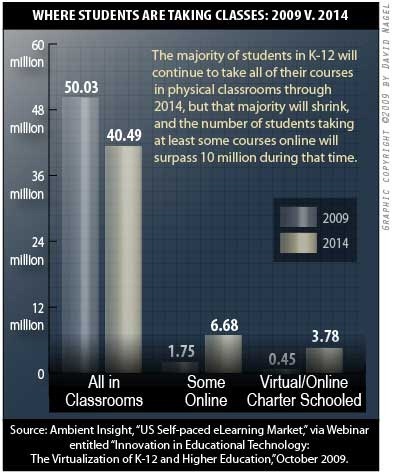
It has been said that “a picture is worth a thousand words.”  With that in mind, I am providing several charts that provide a useful snapshot of the status of distance learning in the U.S.

This is important information because as I noted in previous articles (They Are Coming After Your Students and Said So! and Can We Keep Up with the Competition?) it is imperative that we work through the theological and pedagogical implications of distance learning as we position our schools for the realities of a dramatically changing educational landscape.

The Evergreen Education Group is the source (Evergreen Education Group. (2009). of Keeping Pace with K-12 Online Learning: An Annual Review of State-Level Policy and Practice. Evergreen, CO: Evergreen Education Group.) from which the graphics below are taken.

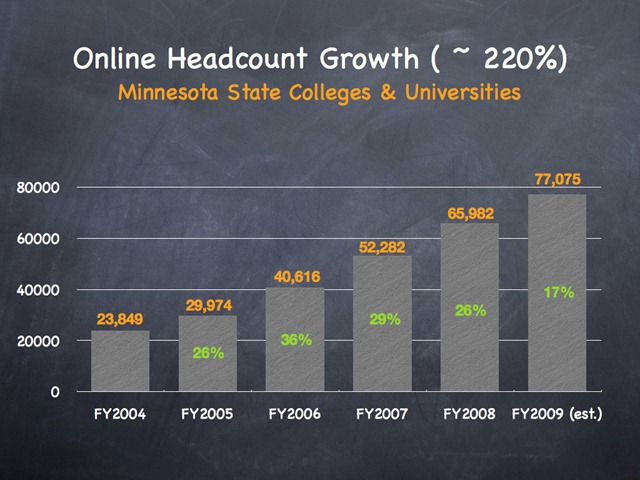
Growth of online learning charts

Where Students are Taking Online Classes

online education growth chart

Research, Trends and Statistics

K-12 Online Learning and Virtual Schools: Expanding Options

  • K-12 online learning is a new field consisting of an estimated $300 million market, which is growing at an estimated annual pace of 30% annually.

  • 45 of the 50 states, plus Washington D.C., have a state virtual school or online initiative, full-time online schools, or both.i

  • 24 states, as well as Washington, DC, have statewide full-time online schools.ii

  • Many virtual schools show annual growth rates between 20 and 45%.ii

  • 35 states have state virtual schools or state-led online programs. iii

  • As of January 2007, there were 173 virtual charter schools serving 92,235 students in 18 states.iv

  • 57% of public secondary schools in the U.S. provide access to students for online learning.v

  • 72% of school districts with distance education programs planned to expand online offerings in the coming year.vi

  • 14.2 million computers were available for classroom use in the nation’s schools as of the 2005-2006 school year. That works out to one computer for every four students.vii

Online learning in K-12 schools is growing explosively

  • There are an estimated 320,000 course enrollments in state virtual schools and 75,00 full-time students in full-time online schools in the U.S.ii

  • In 2000, there were 40,000-50,000 enrollments in K-12 online education.viii

  • Eduventures estimated 300,000 students participated in virtual learning in the 2002-2003 school year in the United States.ix

  • Alberta Online Consortium in Canada reported 4,766 enrollments in 2002-2003. In 2002-2003, NCES reported 328,000 distance education enrollments in K-12 public school districts.x

  • In 2008, Sloan Consortium reports that there are approximately 4 million college students are currently enrolled in fully online courses.xi

  • In 2006, the Sloan Consortium reported 700,000 enrollments in K-12 online learning. to read: According to the Sloan Consortium, the overall number of K-12 students engaged in online courses in 2007-2008, is estimated at 1,030,000. This represents a 47% increase since 2005-2006.xii

  • In 2006, Sloan Consortium reported there were 3.2 million postsecondary students in the United States that took at least one online course; this represents a 25% increase over the previous year.

  • In April 2006, Michigan became the 1 st state to require online learning for high school graduation. In 2008, Alabama added a high school graduation distance/online learning requirement ,as well. 80% of K-12 school districts cited “the course was otherwise unavailable” as the number one reason for offering courses at a distance. xiii

  • According to the 2009 Sloan Consortium report, K-12 school district administrators cited “offering courses not otherwise available at the school,” “meeting the needs of specific groups of students,” and “offering Advanced Placement or college-level courses” as the top three reasons they perceive online and blended courses to be important.xiv

  • Enrollment province-wide in British Columbia climbed from 17,000 students in 2006 to 33,000 students in 2007, according to Canada’s Ministry of Education statistics

  • When considering online education for students in rural communities who have either “access to only a limited number of course offerings in their public schools” or advanced students interested in taking courses for college credit, the public expresses considerable support. In these two instances, over 60 percent of respondents support public funding for online education.xv

Research Reports “As Good or Better”: Effective

According to NCREL Synthesis of New Research on K-12 Online Learning: xvi

  • Online Learning Expands Options: “The first impetus to the growth of K-12 distance education was an interest in expanding educational options and providing equal opportunities for all learners.” (p.7)

  • Online Learning Is Rapidly Growing: “Recent surveys show that K-12 online learning is a rapidly growing phenomenon.” (p.4)

  • Online Learning Is Effective: “Equal or Better”: “One conclusion seems clear: On average, students seem to perform equally well or better academically in online learning.” (p. 17)

  • Online Learning Training Improves Teaching: Teachers who teach online reported positive improvements in face-to-face, too. “Of those who reported teaching face-to-face while teaching online or subsequently, three in four reported a positive impact on their face-to-face teaching.” (p. 25)

Today’s Students

  • The Pew Internet Project reports “the Internet is an important element in the overall educational experience of many teenagers”:xvii

  • 87% of all youth between the ages of 12 and 17 use the Internet (21 million people).

  • 86% percent of teens, 88% of online teens, and 80% of all parents believe that the Internet helps teenagers to do better in school.

  • 85% of 17 year olds have gone online to get information about a college, university, or other school they were thinking about attending.

High School Reform and Redesign

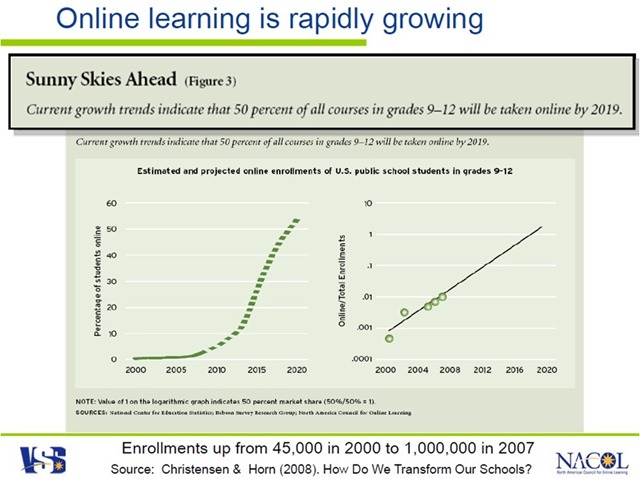
  • Data suggest that in about six years 10 percent of all courses will be computer-based, and by 2019 about 50 percent of courses will be delivered online.xxi

  • 90% of the fastest growing jobs in the economy require a college degree.xxii

  • Over 40% of our nation’s high schools do not offer any AP courses. Many of these schools serve predominantly low-income and minority students.xxii

  • Virtual schools and online programs provide AP courses.

  • While only 44% of U.S. high school students studied a foreign language in 2002, learning a second or third foreign language is compulsory for students in the European Union and elsewhere.xxii

  • Virtual schools offer foreign language courses online that allow interactive communication and collaboration with students and teachers across state and national boundaries for 21st century learning.

  • 52% of middle school and 15% of high school mathematics teachers did not have a major or minor in mathematics and 40% of middle school and 11% of high school science teachers did not have a major or minor in science.xxiii

  • Virtual schools and online programs provide a range of courses such as science, math, foreign languages, electives and remedial courses with highly qualified teachers.

  • According to the Manhattan Institute, 70% of all students in public high schools graduate, and only 32% of all students leave high school qualified to attend four-year colleges.xiv

  • The high school graduation rate in the United States is 70%. High school drop-out rates in urban areas average 50%.xxv

  • Only 51% of all black students and 52% of all Hispanic students graduate, and only 20% of all black students and 16% of all Hispanic students leave high school college-ready.

  • According to recent research from the Silent Epidemic study, 47% said a major reason for dropping out was that “classes were not interesting” and they were “bored”; 88% of drop outs had passing grades.xxvi

  • The National Education Technology Plan recommended that every student have access to e-learning opportunities and every teacher have access to e-learning training.xxvii

  • Virtual schools and online learning can help provide equal access to rigorous courses for all students, reducing inequities that exist across the educational system.

  • Today 6,000 talented young people will drop out of school. xxvii

  • Today only 11 states require credits in a foreign language for students to graduate.xxvii

  • Today two-thirds of high school students will be bored in at least one class.xxvi

  • Today African American students are 14 percent of those in school, but only 7 percent of those taking Advanced Placement exams.xxvii

  • Today 15 million students who need mentors do not have them. Xxviii

  • 69 percent of the public say that they “would be willing to have a child [of theirs] go through high school taking some academic courses over the Internet.xxix

References

iNACOL. (2009). Fast facts about online learning. Washington DC: International Association for K-12 Online Learning (iNACOL).

i Keeping Pace with K-12 Online Learning 2009, Evergreen Consulting; www.KPK12.com

ii Keeping Pace with K-12 Online Learning 2009, Evergreen Consulting; www.KPK12.com

iii Keeping Pace with K-12 Online Learning 2009, Evergreen Consulting; www.KPK12.com

iv Center for Education Reform. (Note: There are 173 virtual charter schools with 92,235 students, up from 147 schools serving 65,354 students in 18 states in 2005-2006; 86 such schools with 31,000 students in 13 states in 2004-05; 60 schools in 13 states in 2002-03).

v Internet Access in U.S. Public Schools and Classrooms: 1994–2005, 2007. U.S. Department of Education. Washington, DC: National Center for Education Statistics. www.nces.gov.

vi Distance Education in Elementary and Secondary Public School Districts, 2005, U.S. Department of Education National Center for Educational Statistics. www.nces.ed.gov

vii Upcoming Statistical Abstract of the United States: 2009, Table 252 http://www.census.gov/compendia/statab/

viii Virtual Schools, 2001, Tom Clark/WestEd.

ix In 2002-2003, 4,766 students in Alberta, Canada were enrolled in online learning programs; up 1,000 from the previous year’s 3,810 students.

x Distance Education in Elementary and Secondary Public School Districts, 2005, U.S. Department of Education National Center for Educational Statistics. www.nces.ed.gov.

xi Staying the Course: Online Education in the United States, The Sloan Consortium, 2008. http://www.sloanc.org/publications/survey/pdf/staying_the_course.pdf

xii K–12 Online Learning: A 2008 Follow-up of the Survey of U.S. School District Administrators, Sloan Consortium, January 2009, http://www.sloan-c.org/publications/survey/pdf/k-12_online_learning_2008.pdf.

xiii Distance Education in Elementary and Secondary Public School Districts, 2005, U.S. Department of Education National Center for Educational Statistics. www.nces.ed.gov.

xiv K–12 Online Learning: A 2008 Follow-up of the Survey of U.S. School District Administrators, Sloan Consortium, January 2009, http://www.sloan-c.org/publications/survey/pdf/k-12_online_learning_2008.pdf.

xv “The 2008 Education Next-PEPG Survey of Public Opinion,” Fall 2008, (vol. 8, no. 4), http://www.hoover.org/publications/ednext/26380034.html.

xvi NCREL Synthesis of New Research on K-12 Online Learning, 2005, North Central Regional Education Laboratory/Learning Point Associates. www.ncrel.org/tech/synthesis/.

xvii The Internet at School, 2005, Pew Internet Study. www.pewinternet.org.

xviii Rates of Computer and Internet Use by Children in Nursery School and Students in Kindergarten Through Twelfth Grade, 2003, National Center for Educational Statistics, U.S. Department of Education. http://nces.ed.gov/programs/quarterly/vol_7/1_2/4_4.asp.

xix Internet Access in U.S. Public Schools and Classrooms: 1994–2005, 2007. U.S. Department of Education. Washington, DC: National Center for Education Statistics. www.nces.gov.

xx Internet Access in U.S. Public Schools and Classrooms: 1994–2005, 2007. U.S. Department of Education. Washington, DC: National Center for Education Statistics. www.nces.gov.

xxi How Do We Transform Our Schools?, Education Next, Christensen, Clayton M. and Michael B. Horn, Summer 2008 (vol. 8, no. 3), http://www.hoover.org/publications/ednext/18575969.html.

xxii Expanding the Advanced Placement Incentive Program, U.S. Department of Education. http://www.ed.gov/about/inits/ed/competitiveness/expanding-apip.html.

xxiii Schools and Staffing Survey: 1999-2000, U.S. Department of Education. www.ed.gov.

xxiv Public High School Graduation and College Readiness Rates in the United States, 2003, from the Manhattan Institute. www.manhattan-institute.org.

xxv Public High School Graduation and College Readiness Rates in the United States, 2003, from the Manhattan Institute. www.manhattan-institute.org.

xxvi The Silent Epidemic: Perspectives on High School Dropouts, 2006, Bill and Melinda Gates Foundation. www.gatesfoundation.org.

xxvii Toward A New Golden Age In American Education: How the Internet, the Law and Today’s Students Are Revolutionizing Expectations: National Education Technology Plan, 2005, U.S. Department of Education Office of Educational Technology.

xxviii The Association for Supervision and Curriculum Development: The Whole Child. www.wholechildeducation.org.

xxix “The 2008 Education Next-PEPG Survey of Public Opinion,” Fall 2008, (vol. 8, no. 4), http://www.hoover.org/publications/.

How and Why to Create a Word Cloud to Get Your Message Across

By Dr. Barrett Mosbacker

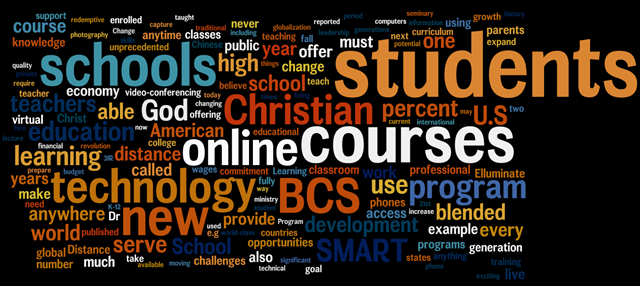
I may be way behind but I just recently discovered that I could create a word cloud to present a visual representation of written material.  Having just written an important memo to my staff on our new distance learning initiative, I decided to create a word cloud using the text of my memo.  Below is the result.

image

The size of a word in the visualization is proportional to the number of times the word appears in my memo.  What is interesting, and encouraging, is that “Student” is the most prominent word, reflecting the focus on the benefits to students of our new distance learning initiative.  

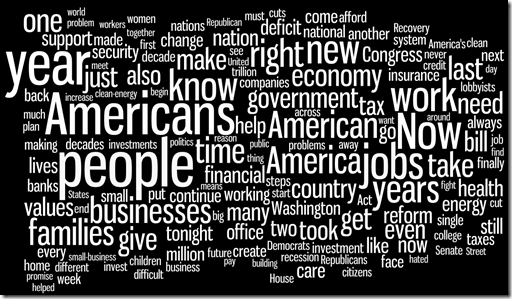
I used Wordle to create my word cloud.  Wordle has a public gallery of word clouds.  Here is one I created from President Obama’s State of the Union speech.

image

Here is a word cloud I created from President George Washington’s first Stat of the Union speech.

image

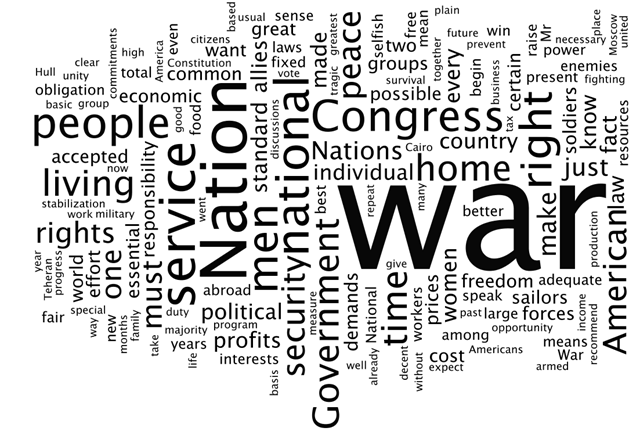
Finally, here is a word cloud I created from President Franklin Roosevelt's 1944 State of the Union speech.

image

Beyond being merely fun and interesting, which it is, it also has real educational value.  For example, as illustrated above, a history teacher could use word clouds to compare historical documents as a way of illustrating the primary focus of concern.  A literature teacher could compare two pieces of literature dealing with similar themes.  Or, you could analyze your presentations to determine if the word frequency matches your intended emphasis.  Obviously, frequency is but one indicator, but useful.

image

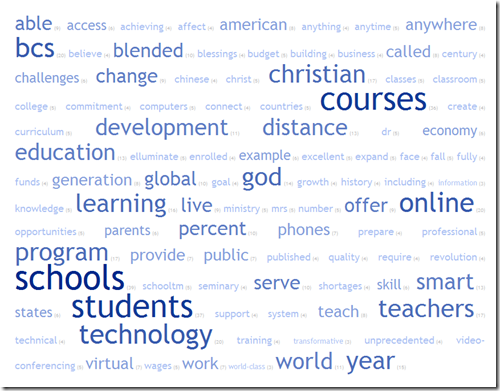
Whereas Wordle provides the flexibility to change the layout, font, color, etc., of your cloud, tagcrowd provides more options in handling the actual text, e.g., the number of words displayed, word grouping (similar words), etc.  This can be useful because you can group words that should be combined to better illustrate frequency, e.g., learned, learns, learning=learning.  The word cloud below was created from my distance learning memo using tagcrowd.

Helpful Tips

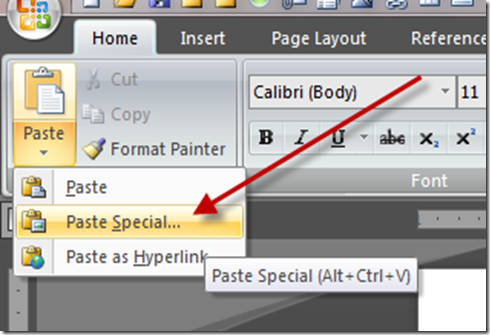
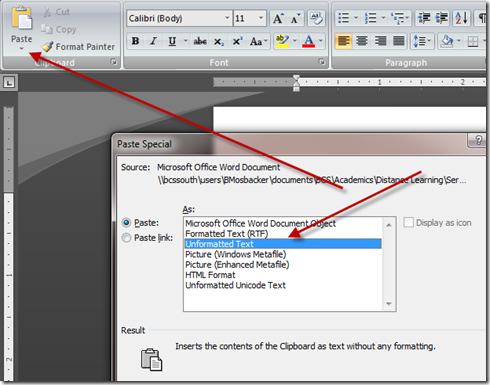
It is best to paste your text in the Wordle or Tagcrowd textbox in unformatted text format without paragraph marks, bullet points, etc.  The easiest way to do this in MS Word is to copy your text and then paste in in a new Word document as unformatted text.

image

image

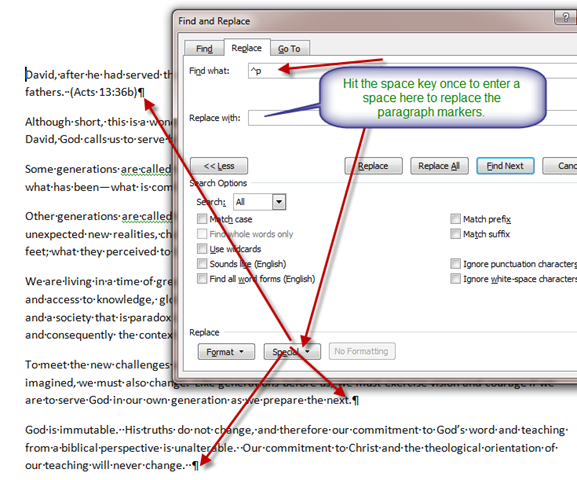
Then,  using the Fine/Replace tool in Word, replace paragraph marks, etc, with a space.

image

Copy and paste the resulting text in Wordle or Tagcrowd to create your new word cloud.

They Are Coming After Your Students and Said So!

Dr. Barrett Mosbacker, PublisherAt a recent Executive Symposium on Distance Education that I attended a public school superintendent, not knowing I was from a private school, said to the group (to paraphrase), "we are developing a robust online program and we fully expect to recapture students from home schooling families and private schools."

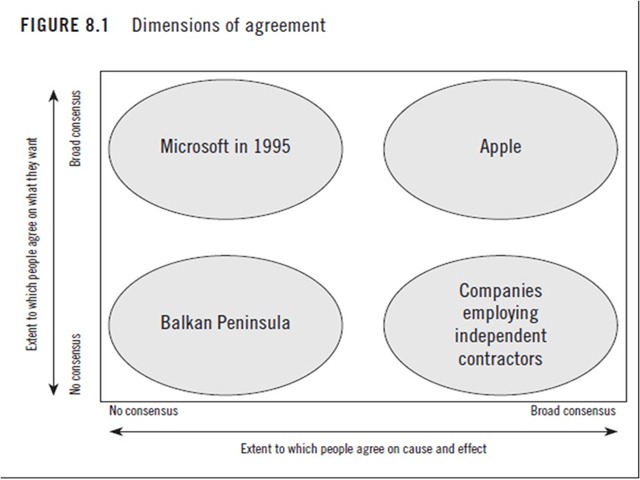
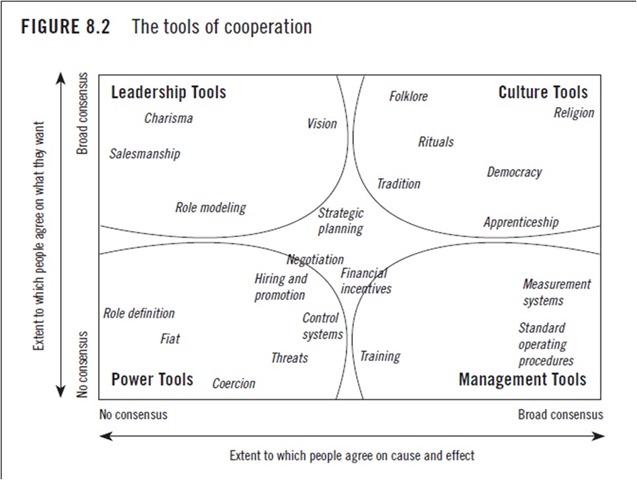
I just reread portions of Christensen's excellent book, "Disrupting Class".  I am particularly interested by his analysis of the "Dimensions of Agreement" and the "Tools of Cooperation".  I have attached graphics depicting the concepts.  These are particularly important to me because it can be difficult to get staff to accept change--I find this particularly problematic among conservative Christians, whom by definition, are "conservative."  :-)  In my estimation, moving forward, carefully and thoughtfully, with distance learning programs in imperative but it is not an easy task--the learning curve is steep, creating a feasible business plan is critical, and getting buy in can be tough.  But, Christensen argues, refreshingly, that consensus is not necessarily the goal--cooperation is!  I find that a refreshing approach given the emphasis on consensus building over the last several decades in the management literature.  I was also surprised by his observation that change is most difficult when there is wide agreement on the goals and processes currently in place.  Generally, one would think that this is a good thing. Upon reflection, however, it is easy to see why change in an organization can be very difficult when the organization is in the upper right quadrant of the dimensions of agreement chart.  This means that one of our challenges is to challenge the consensus on the goals and/or processes currently in place, which is all the more difficult when the organization is successful.  In other words, success can actually work against us, as in "good is the enemy of great."  It is what I'm calling the "Hobbit Effect."

In the Lord of the Rings, the Hobbits went merrily about their lives oblivious to the fact that Mordor was rising and threatening them.  Only a few saw the danger and acted.  I wonder if distance learning and charter schools aren't the "Mordors" of Christian education.  While we argue about uniforms, dress codes, and tuition discounts, the public system is installing a robust distance learning infrastructure and charters are multiplying.  Will we wake up in 10 years and wonder what happened to our market?’

Christensen (2008), Disrupting the classroom, p. 187

Dimensions of Agreement Christensen 

Tools of Cooperation Christensen

I am so impressed with Christensen's book that I've ordered two more:
The Innovator's Dilemma: The Revolutionary Book that Will Change the Way You Do

The Innovator's Solution: Creating and Sustaining Successful Growth

Do Our Schools Need to Become Less Uptight?

WARNING: this article is provocative.  I am posting this article not because I agree with everything asserted (I don’t) but because it provokes thought and has relevance for how we are leading our schools during a time when the landscape of education is changing-perhaps dramatically.  At the end of this article I pose some questions for your consideration.

WSJ: September 29, 2009

By Gary Hamel

In most  organizations, change comes in only two flavors:  trivial and traumatic.  Review the history of the average organization and you’ll discover long periods of incremental fiddling  punctuated by occasional bouts of frantic, crisis-driven change.  The dynamic is not unlike that of  arteriosclerosis:  after years of  relative inactivity, the slow accretion of arterial plaque is suddenly  revealed by the business equivalent of a myocardial infarction. The only  option at that juncture is a quadruple bypass:  excise the leadership team, slash head  count, dump “non-core” assets and overhaul the balance sheet.

Why does  change have to happen this way?   Why does a company have to frustrate its shareholders, infuriate its  customers and squander much of its legacy before it can reinvent itself?   It’s easy to blame leaders  who’ve fallen prey to denial and nostalgia, but the problem goes deeper than  that.  Organizations by their very  nature are inertial.  Like a  fast-spinning gyroscope that can’t be easily unbalanced, successful  organizations spin around the axis of unshakeable beliefs and well-rehearsed  routines—and it typically takes a dramatic outside force to destabilize the  self-reinforcing system of policies and practices.

Let me  return, for a moment, to the topic of my last post, organized religion.   What are some of the inertial forces that have prevented churches from  reinventing themselves in ways that might make them more relevant to a  post-modern world?  A partial list  would include:

–Long-serving denominational leaders  who have little experience with non-traditional models of worship and  outreach.

–A matrix of top-down policies that  limits the scope for local experimentation.

–Training programs (seminaries) that  perpetuate a traditional view of religious observance and ministerial  roles.

–Promotion criteria for church pastors  that reward conformance to traditional practices.

–And a straightjacket of implicit  beliefs around how you “do church.”   For example:

  • Church  happens in church.
  • Preaching is the most effective way of imparting religious  wisdom.
  • Pastors lead in church while parishioners remain (mostly)  passive.
  • The  church service follows a strict template:  greet, sing, read, pray, preach,  bless, dismiss (repeat weekly).
  • Believers, rather than curious skeptics, are the church’s primary  constituency.
  • Going  to church is the primary manifestation of a spiritual life.
  • Church  is a lecture not a discussion.

If organized  religion has become less relevant, it’s not because churches have held fast to  their creedal beliefs—it’s because they’ve held fast to their conventional  structures, programs, roles and routines.  The problem with organized religion  isn’t religion, but organization.    In the first and second centuries, the Christian church was communal,  organic and unstructured—a lot like the Web is today.  It commanded little power (it couldn’t  raise an army or depose a monarch), but had enormous influence.  (The Christian church grew from a handful of believers in AD 40 to 31 million adherents by AD 350, roughly half the population of the Roman empire. ) Today many mainline denominations  are institutionally powerful, but spiritually moribund—at least in the  U.S.

What’s true  for churches is true for other institutions:  the older and more organized they get,  the less adaptable they become.   That’s why the most resilient things in our world—biological life,  stock markets, the Internet—are loosely organized. 

To thrive in  turbulent times, organizations must become a bit more disorganized—less buttoned down, less  uptight, less compulsive, less anal.

As a start,  you’ll need to become more alert to the things that reflexively favor the  status quo in your own organization.   While no one’s going to stand up  and say, “I’m on the side of inertia,” they may nevertheless defend management  processes that reflexively favor the status quo.

All of the  things that allow little organizations to grow into big ones—scale, learning  effects, and accumulated expertise—are products of repetition.  When the environment changes, however,  the returns to repetition start to diminish.  Problem is, old habits die hard,  particularly when they’ve been hardwired into a company’s management  processes. 

–Hiring criteria that over-value  “expertise” and under-value diverse life experiences.

–A planning process that  institutionalizes orthodox thinking by using industry standard definitions of  customer segments and product categories

–Decision-making bodies that are  comprised mostly of long-serving industry veterans who tend to discount new  views.

–Highly conservative budgeting criteria  that starve unconventional projects of resources by demanding near certain  returns, even when the funds involved are modest.

–A single approval track for new  projects, where every new idea has to go up the chain of command.

–Large, monolithic organizational units built around a single, dominant, business model.

–A highly optimized but inflexible IT  infrastructure.

Large  organizations don’t worship shareholders or customers, they worship the  past.  If it were otherwise, it  wouldn’t take a crisis to set a company on a new path.

The most  extreme version of organizational inertia comes when those within a company  are no longer able to distinguish between form and function—when their  instinctual loyalty is to the “how” rather than the “what.”

If one  didn’t know better, it would be easy to believe that a lot of newspaper  publishers have been more committed to producing broadsheets than to  delivering the news in a convenient form, or making it easy for advertisers to  connect with customers.

Until  recently, music companies seem to have been more committed to stamping out  plastic discs than to giving their customers easy access to their favorite  tunes.

Many drug  companies seem a lot more interested in peddling temporary palliatives for  chronic conditions than in eradicating disease.

For years,  Kodak seemed more focused on making film than on leveraging new digital  technologies that would make photography simpler and cheaper.

Alzheimer’s,  arteriosclerosis and arthritis—these seem to be the inevitable byproducts of  old age.  But must organizational  maturity bring a similar set of maladies?  I don’t think so.  Despite all the evidence to the  contrary, I think a company can truly be “Forever 21.”

Questions:

  • Is your school too “button down”, to wedded to tradition?
  • Does the administration, faculty, board members, or parents confuse form with function, preference with principle, or truth with tradition?
  • Has inertia set in at your school?  If so, how can you overcome it?
  • How would you apply the arguments / principles in the above article to addressing 21st century skills, distance learning, technology integration, recent discoveries in cognitive science, and other innovative developments in education to your school?

Can We Keep Up with the Competition?

(Reposted from Goggle Blogger)

Scan books

We are in danger of becoming increasingly irrelevant and non-competitive. If we do, we will lose students.

Historically, our competition has come from free public schools, charter schools, and homeschooling. Our new competition is coming from technology enabled courses offered by public schools, colleges and universities, and virtual schools, including virtual Christian schools. This development is changing the educational landscape and the school market. The current recession is likely to accelerate this change.

Public schools are adopting interactive technology and distance learning (D.L.) at an accelerating pace. Moreover, there is an increasing number of online virtual schools in higher education and in K-12 education. These options make virtually (pun intended) any course available to any student anytime, anywhere. Students and their parents are no longer restricted to brick and mortar traditional schools to have access to high quality fully accredited courses.

The Explosion in Distance Learning

Alabama, not historically known for innovation or high quality education, is leading the nation in connecting every public school in the state to online asynchronous courses and synchronous courses offered through video conferencing and other interactive technologies. Every student in the state now has access to a wide range of courses, including honors and AP courses that have historically been only offered to students in larger schools in wealthier school districts. The image below shows some of the courses offered through Alabama's Access Program.

Al Access Banner 2

Distance Learning Course List

FOX News.comTo view a short news clip from Fox News about the Access program, click here.

As reflected in the Alabama Access Program, distance learning is exploding. According to Drs. Horn and Christensen (authors of Disrupting Class1) of the Harvard Business School, public education enrollments in online classes have skyrocketed from 45,000 in 2000 to roughly 1 million today. It is projected that by 2020 over 50% of high school classes will be available online1.

The Florida Virtual School (FLVS) reflects this explosion in D.L. Founded in 1997, FLVS currently enrolls 63,675 students in grades 6-12. Enrollment is open to public, private, and home school students.

FLVS offers more than 90 courses—including core subjects, world languages, electives, honors, and over 10 Advanced Placement courses. FLVS courses are accepted for credit and are transferable. Florida Virtual School is accredited by the Southern Association of Colleges and Schools and courses are NCAA approved. FLVS also offers AP Exam reviews in April, even for students who did not take the course through FLVS.

Online growth trend chart

Drs. Horn and Christensen outline four reasons why distance learning will continue to grow:

  1. Distance learning technologies will keep improving.

  2. Distance learning provides the ability of teachers, students, and parents to select right learning pathways for differentiated learning thus customizing the education to the learning preferences and needs of each child.

  3. The looming teacher shortage caused by the retirement of baby boomers will propel schools to move to distance learning to gain access to hard to hire teachers in math, science, and other subjects.

  4. The cost of distance learning will fall significantly.

Distance Learning Is and Will Disrupt the Traditional Classroom and School

I highly recommend Disrupting Class: How Disruptive Innovation Will Change the Way the World Learns by Drs. Christensen, Horn, and Johnson. For a good overview, click on the play button below to watch a video podcast interview with the author, which runs approximately four minutes.

The short video below from Harvard Business School provides useful background context to Dr. Christensen's book. A key concept in this video is winning not by doing it better but doing it differently.

The key concepts in the video sound very familiar in our schools.

The Stimulus Plan is to Include $1 Billion for Ed Tech in Public Schools

According to Edweek2, the Obama Administration plans to spend $1 Billion for Ed Tech. The House Democrats' "American Recovery and Reinvestment" plan includes "$1 billion for 21st century classrooms, including computer and science labs and teacher technology training."

The House Democrats' plan overall includes $41 billion to local school districts, including $1 billion made available through the Enhancing Education Through Technology (E2T2) program, which last year was just $263 million. From the House Democrat's proposal:

We will put people to work building 21st century classrooms, labs, and libraries to help our kids compete with any worker in the world.

Such developments have the potential to make public schools more competitive with Christian schools.

Competition from an Unexpected Source-Virtual Christian Schools

I can already hear the rejoinder "but we provide a Christian education in a Christian environment. This type of education cannot be replicated by technology."

It is true that neither distance learning nor any other technology can perfectly replicate the experience of community that one finds in a brick and mortar school. Warm human interactions, prayer in the classroom, chapel services, the excitement and lessons learned through athletics and fine arts are life changing and life enriching experiences that can only occur through face-to-face human interaction.

However, it is naive to assume that these rapidly developing technologies do not pose real challenges to our schools--and real opportunities.

The Challenges

1. The number of parents theologically and philosophically committed to Christian education is relatively small. Given the growing shallowness of Christianity in the U.S. and the evangelical church in particular, this number is likely to grow smaller.

As I noted in a previous post, for many parents, the "Christian" in education is not as important as "quality" in education. Many of our parents enroll their children in our schools for reasons other than the development of a biblical worldview, which frankly, most of our parents do not understand because their entire educational experience was secular, not Christian. They may have a Christian heart but most have a secular mind.

Once having experienced the benefits of Christian education, some of our parents come to a deeper understanding of and commitment to the philosophy of Christian education. Most, however, do not start with this understanding and many never acquire it.

Based on formal and informal surveys that I have conducted with parents over the years, I find that parents enroll their children in our schools for the reasons outlined below. Although survey results vary, in general the order provided below reflects the priorities of parents when deciding to enroll their children in a Christian school.

  • A sense of security and safety
  • Christian atmosphere (meaning good values, nurture, and protection from the "world")
  • Academic quality
  • Relatively small sizes
  • Christian worldview

The essential question for us is "can distance learning replicate the above benefits of Christian education?" I believe that it can--at least partially and most importantly--well-enough for many of our parents. I believe this will become increasingly true for several reasons:

  • Younger parents will be much more knowledgeable and comfortable with online learning (many will experience it first hand in college). Online learning will not have the stigma that it does for many of our current parents, administrators, and teachers.

  • The notion of community is changing due to social networking sites like Facebook.

  • Rising tuition may make Christian education increasingly unattainable for many.

  • Technology will continue to improve resulting in enhanced synchronous interaction through high speed embedded video-conferencing technologies like Wimba.

Moreover, it is interesting to reflect upon how many of the reasons cited by parents for enrolling their children in a Christian school can be at least partially met through online classes.

  • Security and safety is provided when students are at home with parents taking coursework online.
  • Christian students interacting live with a Christian teacher does provide a Christian atmosphere, albeit in a more limited fashion. Moreover, our students view social interactions differently than we typically do. For them, interaction through social networks and other technologies IS social interaction and quite natural. As evidence, all you have to do is watch a group of teenagers together. They spend as much time texting their friends as they do interacting with those directly in front of them.
  • Academic quality can be maintained when highly qualified teachers are teaching using interactive asynchronous and synchronous technology such as video-conferencing, chat rooms, Skype and similar programs. In fact, sometimes the quality can be better! It is now possible and relatively inexpensive for students to take online courses from instructors with Masters and Ph.D.'s, e.g., from India. For an example, click here.

To put this into perspective, consider the following information provided by one online provider of tutoring services.

Tutoring Quality

Tutors Profile

  • The small class size speaks for itself.
  • A Christian worldview can be taught by using Christian teachers and Christian material. Sitting in a traditional classroom is not necessarily required. For example, Reformed Theological Seminary offers theological degrees through distance learning. As I was researching material for this article I discovered a video that I did not know existed by my own pastor outlining the benefits of distance learning for theological training.

To the extent that parents believe that they can provide their children most of what is available in a traditional Christian school by combining distance learning, homeschooling, and extra-curricular programs through community programs, we run the risk of experiencing enrollment declines. As technology improves, our younger more technology savvy parents may choose options other than the local Christian school. They will make a cost benefit assessment something like this: "I am willing to get 80% of the benefits of a traditional Christian school for 50% of the cost." The graphic below, which I developed for a workshop I recently conducted, illustrates the calculation being made by parents.

Choosing Food school graphic

This leads to the next development in the market--the Virtual Christian School.

2. There are a growing number of Christian Virtual Schools such as Sevenstar Christian Academy. Schools such as Sevenstar offer online classes taught by Christian teachers, primarily to students of Christian parents. This is a new development that adds another player in the Christian school market.

As an experiment, I did a simple Google search for "Christian school distance learning". Here is what came up (note there are more than 10 pages of search results):

Google Search Graphic

3. The recession is creating significant challenges for our parents. These challenges may affect parents' decisions regarding the enrollment of their children in a Christian school.

  • Many of our families will experience job losses for one or both spouses.
  • Many families will receive little or no pay increases, some will experience reductions. On the other hand, most of our schools will raise tuition.
  • Employers are shifting health insurance premiums to employees and increasing co-pays thus reducing family disposable income.
  • Families have lost wealth making paying for college more difficult or impossible. Some parents will decide to forego paying K-12 tuition to save money for college.
  • Families are worried about retirement. Some may reallocate tuition to retirement accounts.
  • Grandparents may have less disposable income to assist with tuition.
  • Many families will focus on reducing debt and saving money.

4. The availability of high quality academic courses through both Christian and public schools, along with the recession, may encourage more parents to homeschool their children.

The Opportunities

Distance Learning Graphic Although the explosion in distance learning poses challenges, it also presents a significant opportunity. Consider the potential benefits of D.L. for our schools:

  • Distance learning provides a vehicle for extending our school ministries by enabling our schools to offer Christian education to students who do not have access to quality Christian schools or whose parents cannot afford it. Distance learning provides the opportunity to expand the Christian school market in ways hitherto not possible.
  • We have the opportunity to form strategic alliances to offer courses to our students that we otherwise could not afford to offer as individuals schools, e.g., Chinese, astronomy, etc.
  • A new revenue stream is created by enrolling new students but without the added cost of new facilities and auxiliary services.
  • Extending our educational ministry impact to international students along with the opportunity to connect our classrooms with classrooms in other countries thus fostering cross-cultural understanding and deepening our students' interest in world affairs and missions.

These are just a few of the potential benefits of this revolution in technology and learning. The question is "how are we going to respond?" As I see it we have three options:

1. The proverbial ostrich approach--deny the reality of what is already occurring. Adopting a smug, but in my humble opinion misplaced, confidence that D.L. is a fad or at most a niche phenomenon that will not materially affect the educational marketplace or our schools.

2. Adopt a theological superiority complex that in effect relegates distance learning to a sub-Christian status because it lacks the traditional definition of community. I call this the "Christian Luddite Syndrome" or CLS.

3. Prayerfully and creativity determine how we can redeem this new technology for God's glory, the advancement of His kingdom, and for the benefit of our schools and students. In short, we Baby in Tub don't have to throw out the baby with the bath water. Whatever the shortcoming of D.L., we can and should work to redeem the technology to make it all that it can be in service to the mission of Christian education.

Can we keep up with our competition and should we care? I believe the answer to both questions is an emphatic YES. We face both a challenge and an opportunity. Our response will determine which it will be for our schools.

An African Proverb provides an insightful summary of where we may find ourselves as Christian schools:

Every morning in Africa, a gazelle wakes up.
It knows it must run faster than the fastest lion or it will be killed.
Every morning a lion wakes up.
It knows it must outrun the slowest gazelle or it will starve to death.
It doesn’t matter whether you are a lion or a gazelle.
When the sun comes up, you better start running.

You Are Invited

I am currently working on a major distance learning initiative that will involved several Christian schools in the U.S. and overseas. If you would like to learn more about this initiative and your possible involvement, please email me (christianschooljournalblog@gmail.com) for more information.

References

1. Christensen, C., Horn, M., and Johnson, C., Disrupting class (2008): How disruptive innovations will change the way the world learns, McGrawHill, p. 91

2. Source: http://blogs.edweek.org/edweek/DigitalEducation/2009/01/1_billion_for_ed_tech_in_house.html

Technorati Tags: Distance Learning,market,Christian school,Christian education,Technology,Ed Tech,Educational technology,innovation,disruptive technology,disrupting class,educational reform,enrollment