An Affordable Solution for AP Programs

An affordadable AP program image

By Dr. Barrett Mosbacker

Advanced Placement (AP) courses are an important factor for many parents and students who are considering enrolling in a Christian School. AP courses provide the highest achieving students the chance to study college level material. Parents and students see AP courses as an academic challenge, a way to better prepare for college, and an advantage on college applications. Yet many Christian schools trail their public school competitors in AP course offerings. Larger, well-funded public schools have the competitive edge among families with high academic standards because these schools can provide students a broad AP curriculum. How can Christian schools maintain their small class size and value-driven curriculum while competing with public and large private schools that provide a wide range of AP courses? Increasingly, Christian schools are looking online for the solution to this problem.

Online Advanced Placement courses allow Christian schools to easily expand their curriculum. Through online learning, courses can be tailored for the individual student. If you have a student interested in engineering, but your school does not provide an AP calculus course, online learning can be an efficient solution. Instead of losing that student, your school could provide a flexible and affordable online option for that student. Online learning keeps the education within your school. There  is no need to construct complicated relationships with public institutions in order to serve single student needs.

Online AP courses are the most affordable solution for Christian schools in many situations.

Who pays for it? The cost of offering AP courses can be covered through tuition and additional fees paid by families. Schools can provide access to the online course, but students and their families pay the fee. Under some arrangements, the family also pays an extra fee that can help a school pay for administrative overhead and other programs.

What about faith? Online AP courses are now offered to meet the educational goals of a Christian education. As a Christian school you strive to offer all your students a well-rounded and rigorous education. Offering an expanded range of AP courses online helps you achieve that with your most gifted students. You are helping them shine their light in the world.

How will it fit into the student's schedule? Online learning is flexible and allows schools to set their own start and end dates for an AP course. With the AP exam in May, students can start the online course as early as June to prepare for the next yearís exams. The summer months will provide your students ample time to prepare and increases their chance of securing college credit.

A Christian School Educatorís Guide to Online AP courses

AP Online courses put a Christian school on equal footing with its public counterparts without placing additional strain on the school's resources. Learn more about it in our new white paper, ìOnline Opportunities for Christian SchoolsDownload this free resource for Christian educators using the link below.

// <![CDATA[ (function(){ var s='hubspotutk',r,c=((r=new RegExp('(^|; )'+s+'=([^;]*)').exec(document.cookie))?r[2]:''),w=window;w[s]=w[s]||c, hsjs=document.createElement("script"),el=document.getElementById("hs-cta-e2d3fe85-105c-45eb-8430-5b79bb3129fd"); hsjs.type = "text/javascript";hsjs.async = true; hsjs.src = "//cta-service-cms2.hubspot.com/cs/loader.js?pg=e2d3fe85-105c-45eb-8430-5b79bb3129fd&pid=188329&hsutk=" + encodeURIComponent(c); (document.getElementsByTagName("head")[0]||document.getElementsByTagName("body")[0]).appendChild(hsjs); try setTimeout(function() , 2500); })();</p> <p>// ]]</p></div>

How to Make Your "Pig" Fly

How to Make Your "Pig" Fly

Pig fly.jpg

By Dr. Barrett Mosbacker

Have you ever had an idea for the future of your school but others aren't buying it?  I hope so.  Leaders who are leading and not merely managing focus on the future, asking "what should we be doing to prepare our students for their futures, not our present?"  Leaders do not maintain the status quo, they create a new normal.

Thinking carefully about what is and what might be requires attention to the present and to emerging trends.  It requires an open and agile mind.  It requires the ability to hold fast to our first principles and worthy traditions while having the courage to innovate.  Harvard Business School Dean Nitin Nohria recently challenged faculty and alumni to embrace both tradition and innovation:

We must have the conviction to hold fast to the many traditions that have defined us for so many years: the case method, our residential campus, our focus on a transformational learning experience. At the same time, we must have the courage to innovate. Because today's traditions were, in fact, innovations in their time.1

Your idea may look like an eagle to you.  To others it may look like a pig.  What do you when you are having a hard time getting the "pig" aloft, when you "pig" is stuck on the runway?  What do you do when others do not embrace your ideas for change?  

Here are a few practical suggestions that will help you maintain your vision while bringing others along.   I have borrowed some of these ideas (in quotations) from Krippendorff's excellent article "How To Stick With It When Your Ideas Are Ahead Of Their Time." 2

  • Be prayerful.  One of my favorite verses is Proverbs 16:9: "The heart of man plans his way, but the LORD establishes his steps."   We should plan and work hard to see our plans realized but God is sovereign.  He may redirect us to an entirely different end or may direct us to the same end but along a different and unexpected path.

  • Guard your motive.  Be sure that your motive is holy.  We must remember that we were created for one primary purpose, to glorify God.  Everything else, no matter how worthy, is secondary.  Make sure that your ideas are not about you or your school but rather how others may "see your good works and glorify your father in heaven." (Matt. 5:16)

  • Listen.  Not all of our ideas are good.  Good ideas often need modification.  Even if our ideas are excellent, we need to listen as a matter of respect to others and to understand their fears and concerns.  One of Steven Covey's Habits of Highly Successful People is to "seek first to understand and then to be understood."  This is a derivative of the biblical injunction, "be quick to hear and slow to speak."

  • Keep it simple. "Usually when an innovator sees the world is going to change, the logic behind the change is obvious … The world changes all the time. It’s easy to see it is going to happen. What distinguishes innovators from the rest of us is not that they see farther into the future; it’s that they take action. While “experts” bring up complicated logic to explain why things will not unfold as the innovator thinks, the innovator just starts moving. Jeff Bezos saw that the Internet was going to change retail, so he left his job at the high-tech investment bank D.E. Shaw, and started selling books online … So don’t over think...outthink. When your logic is complicated it means you don’t understand. Think until your logic becomes simple, then act."

  • Keep believing. "Remember that an innovative vision is usually inconsistent with prevailing logic and beliefs (otherwise it is probably not that innovative). It may be inconsistent with practices and rules … Steve Jobs, for example, knew it just made sense for record labels to distribute content digitally, so the iPod and iTunes became the natural net to capture this future." It seems so obvious now, now that digital music is common. But it was not obvious before Steve Jobs pushed ahead with innovation. It takes time for other to catch up. Many "will not get it" until after the fact. So, don't give up-keep believing, keep pushing forward. "Albert Einstein once said, “It’s not that I’m so smart, it’s just that I stay with problems longer.” Great innovators stay with their visions longer while others get distracted or disillusioned."

Do you have any "pigs" sitting on the runway?  They can fly!  It just takes prayer, humility, handwork, and patience.  Don't give up--keep innovating.  Our students' futures depend on it!

References

1. Nohria, N. (2012, January 1). Priorities. hbs.edu. Boston. Retrieved October 27, 2012, from http://www.hbs.edu/dean/priorities/

2. Krippendorff, K. (2012, May 31). How to stick with it when your ideas are ahead of their time. fastcompany.com. Retrieved October 27, 2012, from http://www.fastcompany.com/1838871/how-stick-it-when-your-ideas-are-ahead-their-time

How to Enhance Teaching and Learning at No Extra Cost

By Dr. Barrett Mosbacker

Change is hard, even dangerous.   Attempts to change the behavior of others or an organization's deeply entrenched practices will run headlong into active and passive resistance, if not outright hostility.

Acutely aware of the difficulty but confident in the rightness of the cause, we embarked on changing the school's traditional schedule.

This was no small undertaking.  The schedule had been in place since the school's founding.  Various school constituencies had a stake in the current schedule.  The prevailing consensus was, "If it isn't broke, don't fix it."  And arguably, it was not broken; "We were doing just fine, thank you very much."  Classes were full.  Faculty and student retention rates routinely stood at 94-95%.  We had a 100% college admission rate.  The senior class was routinely awarded millions of dollars in college scholarships and our ACT/SAT scores were high and rising across all tested disciplines.  Complicating the problem was a lurking skepticism about school "reform."  In the U.S., too many educational fads had come and gone, creating a "this too shall pass" cynicism.  This was particularly true concerning "block scheduling," which carried with it negative connotations, mostly deserved.

So why mess with a good thing?  Because, as Jim Collin's points out, "Good is the enemy of great."  We were good but we were convinced we could do better.  The choice before us was clear; we could rest competent and content or press toward our goal of creating a Christ-honoring world-class program that propelled teachers and students to higher levels of achievement.  We chose the latter.

I am happy, and frankly relieved, to share that the new schedule has exceeded our expectations.  It is an Extended Period (EP) schedule, not a block schedule.  This is an important distinction.

What Is an Extended Period Schedule?

The Extended Period Schedule is a hybrid of a traditional schedule with features of block scheduling, but without the drawbacks.  Teachers start at 7:30 each day.  This new schedule has three components:

  • Traditional seven period days on Mondays, Tuesdays, and Fridays

  • Two days of Extended Period Instruction (EPI) and

  • A late start on Thursdays.

Monday  (traditional schedule)                 8:00 a.m.     3:00

Tuesday  (traditional schedule)                 8:00 a.m.     3:00

Wednesday  (EPI)                                           8:00 a.m.     3:00

Thursday late start & (EPI)                         9:00 a.m.      3:00

Friday  (traditional schedule)                    8:00 a.m.      3:00

Why the Change Was Made

We changed the schedule to provide students with more hands-on, active, engaging, and collaborative learning opportunities.  Extended periods provide more time for practicing writing and editing skills (essential for college success), for interactive science labs, for learning how to work on collaborative projects (also an essential skill for college and work), and for integrating technology into teaching and learning.  Extended periods provide time for more variety, more creative instruction, and more practice resulting in richer learning experiences and deeper learning.  In short, extended periods enhance teaching and learning by giving teachers and students time to think, not merely digest information.  Students move about and work in teams.  And, as our Learning Unleashed program (1:1 computing iPad program) is rolled out, students move from learning to use technology to using technology to learn.

The Extended Period Schedule also includes a late start Thursday.  The Thursday late start provides time to train teachers to work in teams to create integrated, creative, and engaging lessons that include the appropriate use of technology.  Teachers are also engaged in technology and pedagogical training on Thursday mornings.  The late start on Thursday also provides extra time for students to complete homework assignments, work on projects, and study for exams.

How the Change Was Made

Change is hard but not impossible.  To increase the likelihood of success and to ensure that the change was systemic and enduring but not cosmetic, we implemented a four-pronged strategy: Education, Communication, Training, and Accountability.

Education

Our first task was to break through a comfortable mindset rooted in academic and geographic isolation.  Too often administrators and teachers are isolated from developments in the world.  This is particularly problematic for Christian schools where staff and students can be culturally isolated, existing in a marginalized Christian bubble.  We may catch a glimpse of world affairs through the news but understanding the deeper implications for our students requires more information and deeper analysis.  It requires constant exposure gleaned by "being in the world."

We began several years ago to heighten the awareness of our faculty about how the world has changed and the implications of those changes for our students.  We demonstrated through reviewing international test scores, movies such as Two Million Minutes and quotes from leading industrialists, technologists, and economists that our students now compete against the best students in the best schools anywhere in the world.   Here is but one example:

 With the ability to make anything anywhere in the world and sell it anywhere else in the world, business firms can ‘cherry pick’ the skilled...wherever they exist in the world. Some third world countries are now making massive investment in basic education. American firms don’t have to hire an American high school graduate if that graduate is not world-class. His or her educational defects are not their problem. Investing to give the necessary market skills to a well-educated Chinese high school graduate may well look like a much more attractive investment (less costly) than having to retrain...a poorly trained American high school graduate.1  (Neef, 1998)

This was not a one time presentation. Multiple presentations in a variety of venues were made over several years.  This "set the table" or "set the mindset" for further discussion.

Communication

Communication was sustained, accurate, and careful.  The communication that occurred over several years was intentional and followed a logical path.  The communication did not start with the end in mind (e.g., Extended Periods), it began with deepening understanding of the fundamentals of Christian education, the place of the Christian school in culture, a deeper understanding of what it means to think Christianly, the shifting context in which our school operates (a globalized, technological, always connected world), an increasingly diverse and competitive educational marketplace (traditional public schools, charter schools, private schools, Christian schools, homeschooling, and online schools), the rise of Asia, and the fall of the U.S. from the top-tier of academic performance relative to the rest of the world to the middle or lower tier relative to the industrialized world.

Language was also important.  We made a decisive distinction between being "world-class" and being “worldly.”  We differentiated between being excellent and being elitist.  And, we used terminology that was accurate yet benign.  For example, we realized early that many of our teachers and parents would confuse our new schedule with block scheduling.  Although the EP schedule had a few elements common with a block schedule, it was not a block in the traditional sense.  It was also more than a traditional schedule.  What to call it was the question.  Although not creative, we choose to call it an "Extended Period" Schedule because that is what it is; it extends the period from approximately 50 minutes to nearly 90 minutes, extending the time teachers have to engage students in deep learning and collaboration.  Language is important.  It must be accurate while avoiding negative connotations.  Because the language we use is important, it must be planned and intentional.

 Training and Accountability

Our greatest fear was that teachers would lecture to students for 90 minutes.  We knew that if that happened our students would be bored to death, our academic goals would be undercut, and our parents frustrated.

We also knew that habits die hard.  The only way to ensure that extended period teaching was more than an elongated lecture, we provided practical training coupled with constant supervision and accountability.  We began the training process two years ago by approaching the matter indirectly.  With a desire to improve student learning and anticipating an extended period schedule, we devoted two years of training to how the brain learns.  The training included books (e.g., How the Brain Learns and teacher written responses to the contents of what they read.  We also hired outside experts to train our teachers on the science of how the brain learns AND on how to teach based on this science.

In addition to this foundational training, we also hired four Christian professionals with extensive experience teaching in extended periods from two other Christian schools.  They spent two days with our teachers showing them how to create lesson plans and how to teach the effectively in extended periods.  This practical "hands-on" training was just "what the doctor ordered."  While the training on brain research laid the pedagogical foundation, this practical "how to" training is what finally created the "mind shift" we were looking for.  We noticed a discernible level of "buy in" and even enthusiasm after this training.  The theoretical was married with the practical and a new perspective on teaching was conceived. We started out with worldview, the goal of developing a world-class school, and the study of cognitive science and ended up with the creation of actionable lesson plans.  We moved from theory to practice, from presentation to application, from "this too shall pass" to "I can and want to do this."

Training, however, in the absence of accountability is a bit like throwing jello against the wall and hoping it sticks.  Notwithstanding initial enthusiasm, most of it slides off to the floor.  Training is the same way.  To put teachers through a day or even a week of presentations is unfair to them and does not change practice.  Practice changes practice.   This means that teachers must practice what they are being taught at the time they are being taught and from that point forward.  There is no going back.  The application of training to teaching is not an option, it is an expectation, a requirement.

This means that teachers must be held accountable to incorporate the training in the classroom.  The only way this can be done is through direct observation, the requirement of artifacts to demonstrate application, and through evaluations that measure consistent classroom application of training.  Anything short of these measures will result in minimal, spotty change, if any.  Without this level of accountability, we foster the "this too shall pass" attitude that plagues so many schools.

On the observation side, the junior and senior high principals and the Director of Curriculum and Instruction (DOCI) spend most of the day on Wednesdays and Thursdays reviewing EP lesson plans and observing every classroom.  They offer help and advice but also look for compliance. It has been said that "what gets measured gets done."  While we would love to think that everyone is intrinsically motivated to do what is asked, the truth is that all of us need accountability, administrators no less than teachers and students.  If something is worth investing time and money in, it is worth monitoring and evaluating.

The Cost

Some change can be expensive but most change costs very little in money but a great deal in thought, hard work, and even courage.  Aside from the purchase of books and honorariums for our trainers, there is little cost associated with our change to extended periods.  But, there is a potentially huge payoff in student engagement and learning.  Low cost combined with significant gains in the quality of teaching and learning creates a high Educational Return on Investment (EROI) and increased marginal value for our parents.  Everyone benefits.

The Results

Although it is too early to have data to measure the results, I can share that all of the anecdotal feedback from students, parents, principals, and teachers has been positive, in fact, more positive than we expected at this early stage.  This is a tribute to professional, gracious, and hardworking teachers who deeply care about students and about doing a superior job.  It is also attributable to extensive Education, Communication, Training, and Accountability.

Change is hard and risky but it is not impossible.  With vision, planning, and hard work, undergirded by prayerfulness and a love for staff and students, we can create change that changes the lives of our students.

What have you changed lately?


Reference: Neef, D. (1998). The knowledge economy. Boston: Butterworth-Heinemann.

You Can Do This!

Girl_computer_success_good_news_winYou Can Do This!

By Zach Clark

A recent post by Barrett Mosbacker entitled, “I Just Returned From the Future” has certainly sparked some dialogue among those we’ve shared it with. Responses have ranged from frustration and despair to enthusiastic choruses of “let’s do this!”

The post certainly challenged my own thinking and I thought I would share my notes after praying and thinking about this issue of leading our Christian school leaders and teachers to understand where all this may be headed for our students.

1. It is true that great teaching isn't defined by technology.

But, teaching (great or otherwise) that fails to help students demonstrate subject mastery using contemporary technology tools will produce students who lack the skills to integrate their knowledge and wisdom into contemporary mediums. Are we successful if we graduate students who can think deeply and critically, who are well written problem-solvers but don’t have a clue how to utilize contemporary tools in relation to others?

The basics of great learning and the utilization of contemporary tools and mediums are not divorced. But, for some reason we school folks treat them like they are.

We would never teach the principles of great writing and then have students get out a stone tablet and chisel. But, nowadays, we have students still print out their papers for peer editing and teacher editing. There are few excellent companies in America today that would utilize that approach to collaborative editing and final editing. The lack of productivity would be unacceptable. We must be focused on growing top tier teachers who understand that their jobs now utilize different tools today because students will be utilizing different tools in their future.

2. Dear reader, don’t get frustrated with me, but I still hear too much talk about teaching PowerPoint, Word, Excel, video editing, and other so-called technology skills.

We should be talking instead about expecting students to communicate visually, with integrated communications tools. We should be helping students use contemporary technology to unleash the power of groups in projects, collaborate over long-distances, and dialogue with peers across the hall or across the globe. My face flushed hot with embarrassment for a teacher in a high school classroom I visited in another Christian school this week to see that students had been producing fourth grade elementary-style crafts projects to demonstrate their knowledge of biblical integration concepts. Unbelievable! Unacceptable! I know I’m not as good an educator as you, but I’ll take bets on how much better some teams from your local businesses could help students actually learn to utilize today’s technologies in how they work together, communicate, and demonstrate mastery.

When I think about the skills that some Christian school educators believe are “technology skills” I shudder. Students, get out your three-ring binder notebooks! Let’s not use Evernote or OneNote. Students write in your planners! Don’t use your iPhone calendar or Google calendars. Students take this essay question home and write me your answer! Don’t text me your answer. Don’t email me your answer. Don’t post your answer. Students, please turn in your drafts! Don’t upload them for my comments and edits. Students, please help me pass out the thirty copies I printed this morning of our sheets! Don’t ask me to post in online and review it with you on the projector screen, so you can access it from home later. Students, please add to the class discussion! Don’t upload an audio comment on what you actually think. We are dealing with a generation of teachers/leaders who think that technology is a “thing” an “add-on” rather than a change in the tools we use to actually live and work.

3. If educators keep talking to other educators about what education-technology is supposed to be, they are going to stay behind the curve.

We’ll never get there. Planning for curriculum integration of technology needs to include people [parents?] who have jobs that actually depend on their mastery of technology. I once sat in the audience while a leading curriculum and technology integration expert shared his brilliant content and wisdom. His ideas and thinking were impressive, but his personal use of technology was antiquated, unorganized, lacking mastery, and most educators wouldn’t even notice because it’s so far beyond them. He sure didn’t notice. He won’t be invited to speak at Apple, Inc. headquarters anytime soon.

What’s that ancient quote? “In the kingdom of the blind, the one-eyed man is king.”

We are talking to the wrong people. We need to keep throwing our passion and energies behind teachers who are hungry to learn about this. We are on the right track by supporting those passionate teachers who really are pushing this direction, but we need to expose them to people in our community who know how to make technology hum. We need to build strategic partnerships that support our teachers’ learning and stop expecting them to just learn from other teachers.

4. Our leaders and teachers should be modeling this.

This shouldn’t be a suggestion, but an expectation. The more we shy away from pushing this expectation, the more we perpetuate the reality that schools are one of the few places that don’t have to utilize technology effectively. Twitter and social networking are being grappled with in any industry. Also, one of the unique challenges we have is that although we do have teachers who are “early adopters” of technology, these folks aren’t always the best teachers of others because it comes so easy for them. They scare people.

A leader or teacher who struggles and conquers technology challenges is a far more effective example and teacher to other teachers. I once heard Mark Miller, Vice President for Leadership Training and Development at Chick-fil-A tell a story about Dan Cathy, their CEO building his own website back when the web was exploding. Couldn’t Mr. Cathy have easily hired someone to do that for him? Of course, but, he wanted to struggle, conquer, so he could be the example to those that would struggle after him.

5. Video technology is key, especially for leaders.

Video is such a key part of where the web is now and where it is going. Almost every teacher and certainly every leader should be pushing the envelope on this. I know many leaders are camera shy. Get over it. Push through it, work at it, practice it, keep doing it until you get better. A video message from a principal or head of school will go farther than any email ever could. If we want to personally engage today’s culture, video is a great way to do it. Our FIRST question, anytime anybody wants to communicate anything should be, “should we use video?” The answer will not always be yes, but it should be our very first communication question.

6. A practical suggestion: every teacher and leader should select a student mentor.

Each teacher and leader should seek out a student who is exceptionally gifted at some aspect of technology: web tech, mobile tech, video tech, social networking, or other and ask the student to mentor the teacher/leader on how to develop mastery of these tools. They should schedule a one to one visit with a student, at least twice a month, just to talk with the student about how they are using technology. I dare you to do this.

Here are a few questions for leaders and teachers to ponder and discuss.

Is this important? If so, please show each other your calendar so we can see how this is actually reflected in how you use your time.

How much time have you invested in the past week, month, year, decade in learning and mastering new technology?

Who are you learning from? Who challenges you on this?

I Just Returned from the Future

clip_image001

By Dr. Barrett Mosbacker

I just returned from the future.

In one of the strangest experiences I have had in a while, I lived the future as I read about it! I did not realize it for a while but then it struck me suddenly over dinner—”I am what I’m reading!”

Let me explain.

As I write this I am nearing the end of my annual Think Week (you can read details about Think Week in these two articles: How to Reduce Stress While Getting More Done; and in How To Find Time to Focus, Think, and Work). During my Think Week my primary focus is prayer and reading. On this trip I took several books with me including Humility (Andrew Murray), The Culture Code (Clotaire Rapaille), Think: The Life of the Mind and the Love of God (John Piper), Derailed(Tim Irwin), Death by Meeting (Patrick Lencioni), and Generous Justice (Tim Keller).

I also took Anywhere: How Global Connectivity is Revolutionizing the Way We Do Business (Emily Nagle Green). This is the book I was reading when I realized that I was living the future. I will summarize some of the key points of this book and their implications for our schools in a subsequent post but for now let me simply state the theme of the book;

Within the next ten years the global ubiquitous digital network will connect most of the world’s people, places, information, and things, which will fundamentally alter the way we live, work, teach, and learn.

The author, Emily Green, knows what she is talking about. She is the President and CEO of the Yankee Group—one of the world’s premier research firms on the impact of the global connectivity revolution with operations in North America, Europe, the Middle East, Africa, Latin America and Asia-Pacific.

One of the most fascinating parts of the book is her description of five consumer segments: Analogs, Technophytes, Digital Shut-ins, Outlet Jockeys, and Actualized Anywheres (AA’s). As I was enjoying my dinner and reading it suddenly dawned on me just how much I was exhibiting the characteristics of the Actualized Anywheres. The short description of AA’s is that they “bring the concept of a ubiquitously connected consumer to life.” This is when it struck me—-I was literally living the future she was describing!

Here is how I know. I wrote down how I was handling my recreational and work related tasks during Think Week. Here is a short list.

  • All of my books, newspapers, and magazines are on my iPad. I read, highlight, annotate, and share my reading content electronically.

  • I downloaded a book immediately onto my iPad based on a recommendation from the book I was reading at the time.

  • I held a video-call with my daughter and grand daughter using FaceTime on my iPhone.

  • I sent an email through Facebook to some friends and family. I accepted a connection request with a professional colleague on LinkedIn.

  • I used the Yelp application on my iPhone to find restaurants and read reviews before choosing a place to have dinner. I also wrote my own review on Yelp for the benefit of others.

  • I used my Garmin GPS to guide me to the restaurant.

  • While driving and while dinning, I used an iPhone application called SoundHound to identify and order songs to download. I liked the songs but could not remember the titles. SoundHound solved that problem.

  • I used an application called NoteSelf on my iPad to take notes using a stylus, including notes for this blog article. No paper or pen needed.

  • I used the Evernote application to send clippings from the books I was reading to my administrative assistant for her to type so that the information could be put into my Endnote program for future reference and citation.

  • I used Logos Bible Software on my computer to study and write a devotional for my faculty.

  • I used Adobe Acrobat to print the devotional as a PDF. I uploaded it to Box.net (cloud storage and collaboration) so it could be shared with our parents with a hyperlink in an email, and then I emailed it to all school staff using Outlook.

  • I used LoseIt on my iPhone to track my calories and my running.

  • One of the books I was reading referenced a 2004 NYT article on how Apple Outflanked Sony in music players (this had to do with Disruptive Innovation). I went to the NYT website and downloaded the article.

  • I am using my laptop to type this article using Live Writer, which I will then post to my blog using the same program.

Now, before you react with something like “are you crazy?!” let me highlight the key point. I am using mobile devices connected to a global digital network everywhere I go to get things done and to enhance and enrich my life. I have a seminary’s worth of books in my Logos Bible program. I have an entire library on my iPad for reading. I have a huge music library of beautiful music in my pocket. I can find and read reviews on local restaurants before deciding where to eat. And I was able to speak with AND see my granddaughter even though I am hours away in a hotel.

Some of my readers, perhaps many of them, have no intention or interest in using technology in the ways I describe above. That is okay. They are most likely Analogs. Most people are. All of us fall into one of the consumer segments that Emily Green describes in her book.

What does this have to do with our schools? Plenty! What I just described is how most of our younger parents and our students will conduct their personal and professional lives.

As school leaders we must understand that our younger parents (those born in the mid to late seventies) and certainly our current students and our future parents DO CARE. They will live and work much as I have described above. Mobile computing and connectivity will be a given—it will be woven into their lives. Their expectations are, and will increasingly be, that our classrooms and school-to-home communication reflect the realities of the new Anywhere Global Connectively.

This is a sea change. It is as evitable as the sun rising tomorrow.

Are we preparing our school infrastructures for this change? Are we preparing and training our faculty? Are we preparing our students for the new work world of tomorrow? Are we providing a biblical framework for understanding and using technology for God’s glory? Are we modeling the use of technology for our teachers and other administrators?

This is one of my favorite quotes from the book:

New things are an easy target for those who lack imagination … Years ago, no one understood why e-mail was worthwhile. Now, no one thinks twice about it—but they’re busy talking about why Twitter is stupid. Bob Metcalfe

Let’s put our sanctified imaginations to work—let’s travel to the future and then return to our schools to get ready!

Should Teachers Text, Facebook, or Twitter Students?

Texting_Ariana_Cell_Phone_text

By Dr. Barrett Mosbacker

Do you think electronic communication between teachers and students should be forbidden or restricted? What are the benefits and risks of texting with students? How have you used texting and/or social networking as an educational tool.

What about Facebook?  Twitter?

Share your thoughts with the hundreds of educators who read this blog.

How To Find Time to Focus, Think, and Work

Future_plan_Strategy_telescope

By Dr. Barrett Mosbacker

It is hard to find it hard to find time to focus, think, and work on important projects.  We are constantly interrupted and distracted.  The immediate crowds out the important. 

In his excellent article Who Else Needs More Mental Focus?, Michael Hyatt, Chairman and CEO of Thomas Nelson Publishers, the world's largest Christian publisher, offers very helpful tips for improving one’s focus. (see a short excerpt and link to his article below)

I have used many of the same practices for years.  In addition to Mr. Hyatt’s recommendations, I also do the following to carve out time for focus, thinking, and working on critical projects.

  • I schedule several hours every Friday morning off campus to focus and think.  I do not come into the office.  I can be reached by cell phone in an emergency but my administrative assistant has been instructed that I am not to be interrupted.  This is some of the most productive time in my week.

  • Each year I take several days for a “Think Week.”  I got this idea from Bill Gates who pulled away each year for an extended time of research, reading, and reflection.  I have adopted this practice.  I spend these days praying, reading, reflecting, and writing.  I take a substantial amount of reading material with me.  Because I use my iPad exclusively for reading I am able to carry an entire library of books and research articles with me.  I read and reflect from morning to evening only interrupting my reading for eating, running, and showering.  It is usually during Think Week that I come up with long-range initiative such as our BCS SMART SCHOOL program.

Click here to read Mr. Hyatt’s article, Who Else Needs More Mental Focus?

A few weeks ago, I had to prepare for a board meeting. I really needed an extended period of time to review the material and prepare my presentation. In doing this, I realized that I go through a similar pattern whenever I need to increase my mental focus and get a lot of work done in a short period of time.  Here are ten tactics I use that may help you…

What do you do to improve your focus and creativity as you lead your school?

Is It Christian or Worldly to be World-Class?

By Dr. Barrett Mosbacker

I had the privilege of traveling to Australia and to China this summer. My trip to China was to develop relationships with school and government officials for establishing an academic and cultural connection between a Chinese high school and our new online Chinese class. The trip was also designed to lay the foundation for a possible student and/or faculty exchange program. The trip exceeded my expectations resulting in a partnership with a large Chinese high school and bringing a Chinese student to BCS to complete his last two years of high school.

I was also invited to Australia to speak to a Christian School Conference on the topic of “Building World Class Christian Schools.” This was timely because I have touched upon the subject from time-to-time in previous presentations and writings.

As I considered this topic, several questions came to mind:

  • What is world-class? Is it a cliché?

  • Should Christian schools strive to be world-class or are we merely accommodating the world?

  • Is seeking to be world-class elitist and prideful or can it be honoring to the Lord?

  • What would a world-class, Christ-honoring, Christian school look like?

These are important questions. On the one hand, we must always be vigilant not to mimic the world or adopt unbiblical values and perspectives. On the other hand, we are called as stewards to prepare our students to serve Christ in a global, technologically rich, interconnected world.

I believe we should and can build Christ-honoring world-class Christian schools but only if we carefully define what we mean by world-class. And I believe that this can be achieved by small and large Christian schools alike.

The dictionary defines world-class as “ranked among the best or most prominent in the world; of the highest order.” I offer for consideration a definition that significantly alters and expands the traditional definition of world-class making it far more biblical and practical.

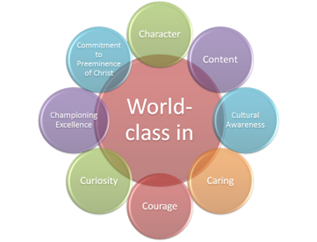
A world-class Christian school is one that is used by Christ to change lives, its community, and its culture by virtue of its commitment to the preeminence of Christ as reflected in the development of the Christian mind and character of its students and in its establishment of superior standards in teaching and learning so that the school is a model of best practices throughout the world.[1]

image

A world-class, Christ-honoring, Christian school requires a combination of traits and practices that are so unique, so “otherlyworldly” that they are in a class by themselves—not by virtue of what we are against but by what we are for and by virtue of a quality that transcends the normal.

There are eight traits that we should cultivate in the pursuit of world-class quality. We should strive to be world-class in:

  • Character

  • The Content and Quality of our Instruction

  • Being Culturally Relevant

  • Our Caring

  • Our Courage

  • Fostering Curiosity

  • Our Being Champions of Excellence, and

  • Our Commitment to the Preeminence of Christ.

World-Class Character

Ideas have consequences. One of the best ways to promote Christian ideas—biblical truth—is to get students and others to ask questions. People ask questions when they are curious. People are curious when they are seeking closure—trying to connect dots.

People ask questions because they are curious or in an effort to bring harmony to emotional, spiritual, or what psychologists call cognitive dissonance. There is a tension and people seek answers and closure to relieve the tension.

Peter admonishes us to “always be prepared to make a defense to anyone who asks you for a reason for the hope that is in you.” But, we often take this verse out of context. Whywas the question being asked in the first place?

It is because the Christians, who were suffering under Nero, were responding in a very peculiar way—instead of whining and feeling sorry for themselves, they were simultaneously grieving yet “rejoicing.”

(6) In this you rejoice, though now for a little while, if necessary, you have been grieved by various trials … (8) Though you have not seen him, you love him. Though you do not now see him, you believe in him and rejoice with joy that is inexpressible and filled with glory. (I Peter 1)

This was very unusual—they were not acting like everyone else—they were “otherly worldly”. They were able to rejoice even in the midst of dreadful circumstances—they could rejoice while crying. They, like Paul, could sing hymns while chained to Roman guards.

Those around them wanted to know “How can this be?” “How can these Christians respond this way when they are losing their jobs, their property, when they are being made fun of and slandered—even tortured and killed?

It was the uniqueness, the quality, the transcendent nature of the believers’ character and behavior—under great distress and duress—that prompted the questions and the openness to the Gospel. In other words, they were different and in being different—in being a peculiar people—they made a difference.

That is our call and our challenge. We will not change the lives of our students or the lives of our parents, let alone the community and world around us, unless we are fundamentally different—not legalists, not separatists, not kill joys—but different in our response to the issues of life—both the good and the bad.

The greatest lessons we ever teach are not spoken—they are lived. Ideas matter. Ideas have consequences but it is the character of our lives that open the door for a discussion of the ideas—of truth.

Go back for a moment in your mind’s eye. Jesus tells a small group of men standing on the hillside that they are the salt and light to the world. Most of these men were not great men of learning; they were not professors or teachers. In fact, it is quite possible that many of them did not do particularly well in school, which may explain why some of them are fishermen and tax collectors!

So how is it that they would be the Lights of the World? Obviously the direct application has to do with sharing the Gospel but there is actually a broader definition at work.

If you examine the full context of Jesus’ sermon, you realize that they were to be the light of the world—not merely because of what they would teach and preach-but because of what they would become by God’s grace. Consider the before and after context:

Before his statement about them being the Light of the World, he preached The Beatitudes (Mat 5:3-11):

(3) "Blessed are the poorin spirit, for theirs is the kingdom of heaven.

(4) "Blessed are those who mourn, for they shall be comforted.

(5) "Blessed are the meek, for they shall inherit the earth.

(6) "Blessed are those who hunger and thirst for righteousness, for they shall be satisfied.

(7) "Blessed are the merciful, for they shall receive mercy.

(8) "Blessed are the pure in heart, for they shall see God.

(9) "Blessed are the peacemakers, for they shall be called sons of God.

(10) "Blessed are those who are persecuted for righteousness' sake, for theirs is the kingdom of heaven.

(11) "Blessed are you when others revile you and persecute you and utter all kinds of evil against you falsely on my account.

After telling them that they were to be the light and salt of the world, he describes how (Mat 5:21-48):

(21) "You have heard that it was said to those of old, 'You shall not murder; and whoever murders will be liable to judgment.' (22) But I say to you that everyone who is angry with his brother will be liable to judgment …

(27) "You have heard that it was said, 'You shall not commit adultery.' (28) But I say to you that everyone who looks at a woman with lustful intent has already committed adultery with her in his heart.

(33) "Again you have heard that it was said to those of old, 'You shall not swear falsely, but shall perform to the Lord what you have sworn.' (34) But I say to you, Do not take an oath at all … (37) Let what you say be simply 'Yes' or 'No'; anything more than this comes from evil.

(38) "You have heard that it was said, 'An eye for an eye and a tooth for a tooth.' (39) But I say to you, Do not resist the one who is evil. But if anyone slaps you on the right cheek, turn to him the other also.

(43) "You have heard that it was said, 'You shall love your neighbor and hate your enemy.' (44) But I say to you, Love your enemies and pray for those who persecute you, (45)

And so on……

This demonstration of Godly character is counter-cultural, this is a much higher standard—this in a sense is world-class—in a class by itself—transcending cultural norms and cultural expectations.

We reflect this character in how we deal with personal challenges—physical, family, and financial. It is reflected in how we respond to an angry email or to the apathetic student.

It is our character that makes our message believable, that gives it credibility.

To be a Christian world-class school means that our character sets us apart from the pack; to be among best in world: ranked among the best or most prominent in the world, of the highest order—World-Class character.

World-Class Content, Curriculum, Instruction, and Standards

This leads to the second point, to be world-class means that we are to be fully committed to truth.

In one way—only Christian schools can be truly world-class because—if we are faithful to god’s word and to careful Christian scholarship—we are the only ones who teach the whole truth.

Don’t misunderstand—many unbelievers have, by common grace, much truth. And, many Christian are wrong about a great many things. But, Christians who are careful with God’s word and are careful students and teachers are able to be the light of the world because they have the whole truth—not mere fragments or distortions of it.

Psalm 19 declares:

(2) Day to day pours out speech, and night to night reveals knowledge. (3) There is no speech, or are there words, whose voice is not heard. (4) Their voice goes out through all the earth, and their words to the end of the world. In them he has set a tent for the sun … (Natural Revelation)

(7) The law of the LORD is perfect, reviving the soul; the testimony of the LORD is sure, making wise the simple; (8) the precepts of the LORD are right, rejoicing the heart; the commandment of the LORD is pure, enlightening the eyes; (Special Revelation)

Ultimately—the Word and the World are united in Christ in whom “we live and move and have our being.” To quote Dr. Poythress (Harvard Mathematician, Professor of NT, Westminster):

All scientists-including agnostics and atheists-believe in God. They have to in order to do their work … A Hindu philosopher may say that the world is an illusion. But he does not casually walk into the street in front of an oncoming bus. Sue, a radical relativist, may say that there is no truth. But she travels calmly at 30,000 feet on a plane whose safe flight depends on the unchangeable truths of aerodynamics and structural mechanics … scientists describe the regularities in God’s word governing the world.

So-called natural law is really the law of God or word of God, imperfectly and approximately described by human investigations … let us remember that we are speaking of real laws, not merely our human guesses and approximations. The real laws are in fact the word of God, specifying how the world of creatures is to function. So-called “law” is simply God speaking, God acting, God manifesting himself in time and space [Day-to-day pours forth speech]… what people call “scientific law’ is divine. We are speaking of God himself and his revelation of himself through his governance of the world … in thinking about law, scientists are thinking God’s thoughts after him.[2]

God has an opinion about everything…we are to seek to think about the world as God does. Let me give you an example. Francis Collins, —a world-class Christian scientist who takes both natural and spiritual revelation seriously—and whose Godly character has prompted many atheists to seek Christ because of his Christian response to his daughter’s rape, proclaimed in a speech to the world on the steps of the White House:

The human genome consists of all the DNA of our species, the hereditary code of life. This newly revealed text was 3 billion letters long, and written in a strange and cryptographic four-letter code. Such is the amazing complexity of the information carried within each cell of the human body, that a live reading of that code at a rate of one letter per second would take thirty-one years, even if reading continued day and night. Printing these letters out in regular font size on normal bond paper and binding them all together would result in a tower the height of the Washington Monument. For the first time on a warm summer day six months into the new millennium, this amazing script, carrying within it all of the instructions for building a human being, was available to the world …

Notice his words here:

… Without a doubt, this is the most important, most wondrous map ever produced by humankind…we are learning the language in which God created life. We are gaining ever more awe for the complexity, the beauty, and the wonder of God’s most divine and sacred gift …

… It’s a happy day for the world. It is humbling for me, and awe-inspiring, to realize that we have caught the first glimpse of our own instruction book, previously known only to God”[3]

Now that is being a light to the world. That is a reflection of the proper relationship of science and theology. That is a world-class Christian scientist! That reflects our spiritual and academic aspirations for our students!

World Class-Cultural Awareness and Relevance

David, after he had served the purpose of God in his own generation, fell asleep and was laid with his fathers. (Acts 13:36b)

Of Issachar, men who had understanding of the times, to know what Israel ought to do. (1Chron. 12:32a)

These passages make a point of emphasizing that godly leaders, those that God uses to shape their institutions, schools, communities and countries, understand their times—they are relevant and contemporary and they knew how to lead and to apply biblical principles to the contemporary context.

A world-class Christian school is relevant—its teachers and administrators are current, aware, globally informed and may I even suggest, “Withit”?

To borrow a phrase from someone else, we cannot have Flintstone schools in a Jetson world.

We are entering the second decade of the 21st century. We must understand our times and cultures if we are to effectively prepare our students to serve Christ.

In many ways, it is the tale of two cities—the best of times and the worst of times—at once an unprecedented time of progress and an unprecedented time of distress.

Progress

  • The WSJ recently heralded a potential new era in biology, scientists for the first time have created a synthetic cell, completely controlled by man-made genetic instructions.

  • We are in the midst of a third industrial revolution: Microelectronics, Computers, Robotics, Human Genome, Biotechnology, New materials, and Telecommunications.

  • The top 10 in-demand jobs in 2010 did not exist in 2004.

  • More than 3000 books are published every day.

  • In 2008, the amount of new technical information was doubling every two years. This year, 2010, it is projected to double every 72 hours!

  • Immediate access to vast amounts of information and communication: we carry a world of knowledge in our pockets!

  • There has been some progress in some cultures dealing with racial, political, and socio-economic discrimination.

  • The human race is more productive than at any time in human history.

  • More people have access to better health care than at any time in history.

  • Generally speaking, we are far more sensitive to environmental concerns than in past generations.

  • The educational opportunities available in the world are advancing rapidly enable giving more people greater access to education and a better future.

Distress

  • We live in a very violent time. More people were killed by war and their governments in the 20th century than in all human history combined. Local, regional, and international wars continue to increase.

  • Fanaticism of all sorts too often results in the killing of innocent men and women.

  • Many of the world’s economies are sinking under unsustainable debt.

  • It is increasingly difficult for the undereducated to find permanent employment to care for themselves and their families.

  • The deviate and perverted are celebrated as good while the natural and holy are condemned as evil.

Woe to those who call evil good and good evil, who put darkness for light and light for darkness, who put bitter for sweet and sweet for bitter! (Isa 5:20)

  • Materialism and sensuality are rampant.

  • Relativism and post-modernism are the reigning worldviews of our time.

These are our times-this is the world that our students are entering and in which they must provide leadership. It is a world of unprecedented opportunities and challenges!

We cannot do business as usual. We must engage with how things are, not how they were or how we wish them to be.

There is great value in tradition; there is great value in our heritage as Christians, and as Americans. But the value is not in the traditions themselves-it is in the principles and lessons learned that can be applied in new and creative ways to our contemporary context so that like the men of Issachar, men who had “understanding of the times to know what Israel ought to do,” we understand our times and know what do to—how to teach and how to lead.

I want to emphasize that while our methods may and often must change, e.g., through the application of neuroscience, technology, creative assessment techniques, and so forth, our commitment to God’s word is immutable.

World-Class Caring

We cannot and will not meet the challenges of the 21st century and of our students unless we care. We cannot be a city on the hill; we cannot be the light of the world, unless we love our neighbors as ourselves, unless we sacrifice ourselves for our students and our parents, even or especially the ones that we find it hard to like.

One of the primary ways we let our light shine is through our good works, a reflection of our love and concern for others: “let your light shine before others, so that they may see your good works and give glory to your Father.”

  • Have this mind among yourselves, which is yours in Christ Jesus, who, though he was in the form of God, did not count equality with God a thing to be grasped, but made himself nothing, taking the form of a servant, being born in the likeness of men. And being found in human form, he humbled himself by becoming obedient to the point of death, even death on a cross. (Php 2:5-8)

  • You call me Teacher and Lord, and you are right, for so I am. If I then, your Lord and Teacher, have washed your feet, you also ought to wash one another's feet. For I have given you an example, that you also should do just as I have done to you. Truly, truly, I say to you, a servant is not greater than his master, nor is a messenger greater than the one who sent him. If you know these things, blessed are you if you do them. (Joh 13:13-17)

  • A new commandment I give to you, that you love one another: just as I have loved you, you also are to love one another. By this all people will know that you are my disciples, if you have love for one another." (Joh 13:34-35)

In other words, people are more important than tasks. Administrators lead people not employees, teachers teach students, not subjects!

To be world-class Christian schools means that we love and serve our students, we do not merely teach them. Sometimes this requires tough love but it always requires love. Paul makes the point as powerfully as it can be made: “If I speak in the tongues of men and of angels, but have not love, I am a noisy gong or a clanging cymbal.” (I Cor. 13:1)

To be world-class our love, our devotion, and our sacrifice for and service to our students must be ranked among best in world: ranked among the best or most prominent in the world—of the highest order.

There should never be an instance when an unbelieving teacher, administrator, or coach is more caring, more loving, and more sacrificial in the care and teaching of his or her students than a believer!

World-Class in Courage

To be world-class takes courage.

  • It takes courage to speak the truth.

  • It takes courage to insist and to model excellence—it takes courage to refuse the mass current of mediocrity—to swim against the current.

  • It takes courage to give an honest, rather than a safe grade.

  • It takes courage to tell a parent that his/her son is not doing well, is not working hard.

  • It takes courage to tell a teacher that he/she is coasting.

  • It takes courage to tell an administrator that he or she is not providing visionary, strategic, effective leadership.

  • It takes courage to try new things, to experiment, to get beyond our comfort zones and our routines.

  • It takes courage to go beyond tradition and beyond what we have always done.

Without the courage to speak the truth in love, without the courage to experiment, without the courage to break out of the ordinary and to help our students do likewise, we cannot be world-class.

World-Class in Curiosity

We cannot shine if we are dull. We cannot be lights to our students if we have stopped learning. We cannot ignite a heart and mind of curiosity if we have lost ours—the student will be like his teacher—we cannot give what we do not possess.

Are we reading outside our professional field? Are we learning about new discoveries? Do we read those with whom we disagree? Are we learning new skills? Is there any venturesomeness about us? Or have we become stale, provincial, sheltered, and comfortable? Are we routine?

Curiosity is the very essence of Christian education because it is embedded in us as image bearers, it is the catalyst for the cultural mandate—to exercise dominion and stewardship over creation—and is it what propels us to investigate and to learn, to develop new tools and new methods.

Paul Marshall, in his wonderful book titled: Heaven in Not My Home[4], writes:

Many of those who denounce technology have no real desire to live in some primitive civilization. Instead, many of them sit amidst the fruits of technical progress all the while denouncing the technology that brought them. Technology, properly used, is a gift from God.

The topic of technique and technology preoccupies today’s world. Technique refers to “how to” do something—it is the science of “how.” It encompasses all that we can do—from going to the moon to public speaking, from designing nuclear bombs to making love, from serving a hungry neighbor to writing books. All of these are included when we talk about technique.

Along with technique comes technology, which is the made, created, embodied structure of technique. Technology includes, in one form or another, all those things that do not naturally occur, all those things that we shape and reshape. Technology infuses art as much as physics, families as much as engineering. To talk about technique and technology is to talk in one particular way about all of human life, as all of human life has some technical aspect. Responsible technical skill is both a gift and a calling. It is the human task of reshaping the materials of God’s world in new ways. It is imagination and skill in the service of usefulness.

Nor is our task in the world simply following the clear rules that God has set down, though we must certainly follow God’s commandments and learn from the creation itself. We have a creative task in the world. We must shape things in ways for which there is sometimes no clear direction. This is why imagination is not just a feature of the arts; it is a feature of human life itself. Without imagination, without experimentation, without openness to new questions and new possibilities, there can be no science and no technology. We are not challenging God when we do this, at least not when we do it in humility and faith. We are not stealing fire from the gods. We are taking up our responsibility before God to shape what he has placed in our hands.

Christian education is the exploration of God’s mind as revealed in creation! Christian education is preparing students to use their skills, their imaginations, and their curiosity to shape the world and to build God honoring culture. That is a wondrously beautiful and infinitely deep mission!

On a building at Harvard is the following inscription: “Students explore the mind of God for the art of life.” Let that sink in. “Students explore the mind of God for the art of life.” I often include this quote in my email signature line because I believe that if one takes time to mediate on it that it has profound implications for Christian education. The Psalmist writes:

Great are the works of the Lord; they are studied by all who delight in them.(Psalm 111:2)

  • When our students look into a microscope, they are peering into the mind of God.

  • When they gaze through a telescope, they are encountering the creation of an incomprehensible, infinite intelligence.

  • When they listen to music, they are experiencing the beauty and harmony of God’s character.

  • When they study mathematics, they are, to quote Edward Everett, a former president of Harvard:

Contemplating truths, which existed in the divine mind before the morning stars sang together, and which will continue to exist there, when the last of the radiant host shall have fallen from heaven.” Mathematics reflects the sustaining power of the Word of God.

  • In the study of history they are investigating the sovereignty and providence of God as worked out in time and space:

And x[God] made from one man every nation of mankind to live yon all the face of the earth, zhaving determined allotted periods and athe boundaries of their dwelling place, 27bthat they should seek God, in the hope that cthey might feel their way toward him and find him. dYet he is actually not far from each one of us, [5]

This is inexhaustible! Do we FEEL the wonder in what we teach and why we lead? Are we passionate about plunging into the depths of God’s infinite, beautiful mind as we explore this world and the universe?

Is that what you are experiencing? Is this what our students are experiencing in our classrooms? Do they leave our classrooms awestruck at who God is and what he has done? Do they leave Chemistry class a better person for having encountered Christ in chemistry?

Fostering curiosity like this will produce world-class teachers, students, and schools!

World-Class Champions of Excellence

We are to be champions in the quality of our own work and in our work-ethic. Champions, by definition, are world-class. I immediately think of Olympic champions or the World-Cup. These athletes are the best in the world.

As Christian school teachers and leaders, we should seek to be the best in the world, to have the best schools in the world—not for our glory but that men may see our “good works” and glorify our father in heaven.

This is not a matter of pride. Since we are to “do everything as unto Christ” and since Christ is the King of Kings and Lord of Lords, and since one day we must give an account for our work on this earth, how can we strive for anything less?

  • How can we serve up a warmed over lesson plan? Would you serve Christ leftovers if he came over for dinner? Why then would we serve his children left-over lessons or left-over leadership? Jesus said “as you did it to one of the least of these dmy brothers,6 you did it to me.”

  • How can school administrators provide mediocre leadership?

  • How can we fail to walk that extra mile for a student or parent (even the ones we don’t particularly like) when Jesus tells us to willingly walk an extra-mile for a Roman soldier who has occupied your country, steals your wealth through unfair taxation, who may be the very soldier who will crucify Jesus, and who may serve Nero in torturing Christians to death? How can we do less for our students and parents? How can we do less for each other?

  • How can we be satisfied to provide our students an education, that while ranking high in the U.S., may in fact be in the middle of the pack or lower when measured against international standards?

We are to be the beacon of light on the hill of excellence—drawing unbelievers to our schools to learn from us!

We are to be Champions in the quality of everything that we do: ranked among best in world: ranked among the best or most prominent in the world, of an international standard of excellence; of the highest order—not for our glory but the glory and honor of Christ.

World-Class Commitment to the Preeminence of Christ

This work is not about us. The work we do in our Christian schools is about the Kingdom of God—it is that simple and that profound. Jesus is The Alpha and the Omega of Creation and he is the Alpha and Omega of our work and our schools!

Being a world-class Christian school is a POSITIVE mission:

  • It is not about withdrawal, not about protecting, and not about sheltering; our call is about providing a positive imaginative, engaging vision of personal and cultural redemption and transformation under the Lordship of Christ.

  • It is not about what we are against as much as what we are for, what we are called to do as creative, relational, rational, redeemed image bearers.

Paul Marshall[6] makes the following observation and goes on to quote C.S. Lewis:

The major patterns of our culture and society are being shaped with almost no Christian presence. We live in a “subculture,” on our own island, increasingly far from shore.

And when we do seek influence, we often only react to someone else’s proposals. If the Disney Company puts out movies that trivialize or demonize the Christian faith, we boycott them. But this simply pulls us farther into our own shell. We have no alternative to put forward, no movies that undercut Disney because they’re better. A familiar proverb says, “The fool curses the darkness, but the wise man lights a candle.” We “curse” a lot but have few candles, and so the darkness deepens …

If Christian faith produces good families, good businesses, good art, good books, and good politics, then people will notice, and they will be intrigued. In American society, where people think they know all they want to know about Christianity, this is especially important. As usual, C. S. Lewis said it well:

I believe that any Christian who is qualified to write a good popular book on any science may do much more by that than by any directly apologetic (evangelistic) work…We can make people (often) attend to the Christian point of view for half an hour or so; but the moment they have gone away from our lecture or laid down our article, they are plunged back into a world where the opposite position is taken for granted…What we want is not more little books about Christianity, but more little books by Christians on other subjects—with their Christianity latent. You can see this most easily if you look at it the other way round. Our Faith is not very likely to be shaken by any book on Hinduism. But if whenever we read an elementary book on Geology, Botany, Politics, or Astronomy, we found that its implications were Hindu, that would shake us. It is not the books written in direct defense of Materialism that make the modern man a materialist; it is the materialistic assumptions in all the other books. In the same way, it is not books on Christianity that will really trouble him. But he would be troubled if, whenever he wanted a cheap popular introduction to some science, the best work on the market was always by a Christian.

  • It is about being empowered by God’s Spirit that God’s will be done on earth as it is in heaven. It is about leading, serving, changing, and creating under the Lord of Jesus Christ-our King and our Savior!

  • It is about being a city on the hill—a city of educational excellence that draws believer and unbeliever alike to our schools as models of character, caring, of contemporary instruction and learning, of curiosity as we explore the wonder of God’s world.

  • It is about the exaltation of Christ as He is seen and known in the Scriptures and in creation.

Conclusion—A Vision for the Future—Where in The World Are We Going?

We live in one of the most challenges times in human history and a time of nearly unparalleled opportunity. On the one hand, the world faces great challenges and threats; we live in a time when one small miscalculation, e.g., on the Korean Peninsula or in dealing with Iran, can erupt into a regional or world war with devastating consequences.

On the other hand, we live in a time when we are able to access and to disseminate information with unprecedented speed and ease. We can carry whole libraries in our pockets. With leadership, vision and the right tools, we can make our lessons available to most people on this planet!

There has seldom been a time when the light of God’s word was more needed or a time when there have been more competing false lights in the world.

As Christian school teachers and leaders, we are called to be lights on the hill, beacons of truth.

  • We must lead not follow, as individual Christian professionals and as a school!

  • We must set the standard, not rest with mediocrity the easy the familiar, the comfortable. We are called to be world-class—to rise above the norm—by being world-class in our Character, the Content of our Curriculum and Quality of our Instruction, Caring, Courage, Curiosity, in being Champions of Excellence, in our Commitment to the Preeminence of Christ.

Right Now Counts Forever

“Then I saw a new heaven and a new earth, for the first heaven and the first earth had passed away, and the sea was no more. (2) And I saw the holy city, new Jerusalem, coming down out of heaven from God, prepared as a bride adorned for her husband. (3) And I heard a loud voice from the throne saying, "Behold, the dwelling place of God is with man. He will dwell with them, and they will be his people, and God himself will be with them as their God. (4) He will wipe away every tear from their eyes, and death shall be no more, neither shall there be mourning, nor crying, nor pain anymore, for the former things have passed away." (5) And he who was seated on the throne said, "Behold, I am making all things new." Also he said, "Write this down, for these words are trustworthy and true." (6) And he said to me, "It is done! I am the Alpha and the Omega, the beginning and the end. To the thirsty I will give from the spring of the water of life without payment. (7) The one who conquers will have this heritage, and I will be his God and he will be my son … (22) And I saw no temple in the city, for its temple is the Lord God the Almighty and the Lamb. (23) And the city has no need of sun or moon to shine on it, for the glory of God gives it light, and its lamp is the Lamb. (24) By its light will the nations walk, and the kings of the earth will bring their glory into it, (25) and its gates will never be shut by day--and there will be no night there. (26) They will bring into it the glory and the honor of the nations.” (Rev 21:1-7; 22-26)

That is our future—that is the future that we are preparing our students to inherent—a new heaven and a new earth in which men from every tribe, nation, and tongue build a new culture and a new civilization. The work begins now—with our students, in our classrooms, in our Christian schools! This is the end for which we work! This is world-class Christian education!

[1] © Copyrighted Barrett Mosbacker 2010

[2] Poythress, V. S. (2006). Redeeming science: A God-centered approach. Wheaton, IL: Crossway Books.

[3] Dr. Francis Collins, A scientist presents evidence for belief: The language of God, (Free Press, New York), 2006, pp. 2-3

[4] Marshall, P. (1998). Heaven is not my home: Learning to live in God's creation

xx [Gen. 3:20; Mal. 2:10]

yy Gen. 11:8; Luke 21:35

zz [Job 12:23; 14:5]

aa Deut. 32:8; [Ps. 74:17]

bb [ch. 15:17]

cc [Job 23:3, 8, 9]

dd [Deut. 4:7; Ps. 145:18; Jer. 23:23, 24]; See ch. 14:17

[5]The Holy Bible : English standard version. 2001 (Ac 17:25–27). Wheaton: Standard Bible Society.

dd ch. 28:10; John 20:17; Rom. 8:29; Heb. 2:11; [ch. 12:50]

66 Or brothers and sisters

[6] Marshall, P. (1998). Heaven is not my home: Learning to live in God's creation

What is CCEI and Why Should You Care?

image

By Mitchell Salerno with Jon Keith

CCEI is the Interim Programs and The Christian Coalition for Educational Innovation. 

Do you currently conduct an interim program such as J-Term or Winterim?  Are you interested in beginning an interim program in the coming years?  A group of schools that currently operates interim programs or that are interested in interim programs recently organized to form a coalition for the purpose of collaborating, partnering, and advancing interim programs.

In October 2009, several school leaders expressed interest in working together and wondered if there were other schools that wanted to do the same.  An initial email invitation was made to schools that were known to conduct interim programs and seventeen schools responded.  Excited by this initial response, all agreed to meet via conference call in November 2009.  This meeting was so successful that it became apparent that the group needed to meet in person to explore the possibilities.  To that end, fourteen schools traveled to Orlando, Florida to meet at The Master's Academy in January 2010.  This initial meeting was extremely fruitful and encouraging to all involved and the Christian Coalition for Educational Innovation (CCEI) was born.

Currently, CCEI is in the process of creating a charter and seeks to find other Christian schools that have a passion for innovation.  In particular, CCEI is interested in bringing together Christian schools that are interested in interim programs.  Member schools do not need to operate a particular form of interim program, but, rather, should be interested in interim programs in general.  Additionally, schools that desire to build relationships centered on innovation should consider membership.

If you are interested in finding out more about membership in CCEI or about interim programs, please contact Mitchell Salerno at MitchellSalerno@MastersAcademy.org or Jon Keith at JonKeith@WheatonAcademy.org

You can also download the Brochure

They Are Coming After Your Students and Said So!

Dr. Barrett Mosbacker, PublisherAt a recent Executive Symposium on Distance Education that I attended a public school superintendent, not knowing I was from a private school, said to the group (to paraphrase), "we are developing a robust online program and we fully expect to recapture students from home schooling families and private schools."

I just reread portions of Christensen's excellent book, "Disrupting Class".  I am particularly interested by his analysis of the "Dimensions of Agreement" and the "Tools of Cooperation".  I have attached graphics depicting the concepts.  These are particularly important to me because it can be difficult to get staff to accept change--I find this particularly problematic among conservative Christians, whom by definition, are "conservative."  :-)  In my estimation, moving forward, carefully and thoughtfully, with distance learning programs in imperative but it is not an easy task--the learning curve is steep, creating a feasible business plan is critical, and getting buy in can be tough.  But, Christensen argues, refreshingly, that consensus is not necessarily the goal--cooperation is!  I find that a refreshing approach given the emphasis on consensus building over the last several decades in the management literature.  I was also surprised by his observation that change is most difficult when there is wide agreement on the goals and processes currently in place.  Generally, one would think that this is a good thing. Upon reflection, however, it is easy to see why change in an organization can be very difficult when the organization is in the upper right quadrant of the dimensions of agreement chart.  This means that one of our challenges is to challenge the consensus on the goals and/or processes currently in place, which is all the more difficult when the organization is successful.  In other words, success can actually work against us, as in "good is the enemy of great."  It is what I'm calling the "Hobbit Effect."

In the Lord of the Rings, the Hobbits went merrily about their lives oblivious to the fact that Mordor was rising and threatening them.  Only a few saw the danger and acted.  I wonder if distance learning and charter schools aren't the "Mordors" of Christian education.  While we argue about uniforms, dress codes, and tuition discounts, the public system is installing a robust distance learning infrastructure and charters are multiplying.  Will we wake up in 10 years and wonder what happened to our market?’

Christensen (2008), Disrupting the classroom, p. 187

Dimensions of Agreement Christensen 

Tools of Cooperation Christensen

I am so impressed with Christensen's book that I've ordered two more:
The Innovator's Dilemma: The Revolutionary Book that Will Change the Way You Do

The Innovator's Solution: Creating and Sustaining Successful Growth