Biblical Integration Lite: Telling it Like It Isn’t

Feather colour panteneGuest Article by Mark Kennedy (ACSI Canada)

When someone tells me that his school’s Christian character “goes without saying” I can’t help thinking, ‘that school may be in trouble’. Too often what goes without saying gradually goes without being, until it is simply and completely gone. It’s so easy for an educational institution to drift from its foundations with hardly anyone noticing. Historically that happened to some of North America’s most prominent universities and independent schools. Although they were once fervently Christian many of them are now completely secular or just superficially religious. They may be wealthy and respected institutions - places like Upper Canada College and Harvard University- but the Christian distinctive that so strongly marked their early years have vanished. A classic example is the entire public school system for the Province of Ontario. Founder Egerton Ryerson once declared that instruction in his public schools would be “but a sounding brass and a tinkling cymbal when not founded upon and sanctified by the undefiled and regenerating religion of Jesus Christ.”* How tragically prophetic.

These days the erosion of a school’s Christian character can start when it abandons the quest for authentic biblical integration and settles for ‘integration lite. On the surface ‘integration lite’ looks just fine. The word “Christian” is in the school’s name. The teachers are all born again and they believe in the inerrancy of Scripture. And when it comes to teaching a Christian worldview, well that’s covered by using Christian school textbooks. But there is a lot more to genuine biblical integration than that.

What’s in a name?” says Juliet in Shakespeare’s famous play “That which we call a rose by any other name would smell as sweet.

Along the same lines (and with apologies to Shakespeare), giving a skunk cabbage a more complimentary name won’t improve its aroma.

So it can be when ‘Christian’ is spliced into a school’s name. In an ‘integration lite’ type school the word ‘Christian’ in its name doesn’t guarantee moral or educational quality or even ethical standards of operation. On the other hand ‘Christian’ in the name of a school that pursues genuine biblical integration means something. It says that the school is trying to follow scriptural principles in every aspect of its ministry, even if doing so drives away potential students or causes loss of income.

Just having Christian teachers doesn’t help either unless their character is exemplary as per Jesus’ assertion in Luke 6:40 “A student is not above his teacher but everyone who is fully trained will be like his teacher.” And Christian school educators need to have the spiritual gift of teaching. In 27 years as a principal I only had to fire 3 teachers in the middle of the academic year. They were all unquestionably believers and two of the three were among the most highly trained educators I’d ever met. But they didn’t have the gift of teaching and they weren’t particularly outstanding role models. I hired them because they were Christians with impressive academic credentials. I missed the things that matter the most.

When it comes to teaching a Christian worldview ‘born again’ teachers can be counter-productive if they have only been trained in secular educational philosophies and practices. Secular teacher training operates upon the assumption that God is irrelevant in learning about the “real world”. And that’s what some Christian teachers with secular worldviews may inadvertently communicate to their students. The regrettable part isn’t that they failed to meet some kind of subjective and artificial spiritual standard. Biblical integration isn’t about twisting reality to fit into a pseudo-religious mold. It is first and foremost about teaching the whole truth on the clear understanding that all truth is God’s truth. That means a teacher has to learn how to give God back his rightful place in the classroom, in the curriculum and in the overall learning process. ‘Integration lite’ educators don’t do that. They presents pretty well all aspects their program in exactly the same way that secular teachers do – with the occasional Bible class tossed in as a mild christianizer. ‘Integration lite’ doesn’t try to present the whole truth. It is satisfied to ‘tell it like it isn’t’.

In the early years of ACSI, co-founding President Dr. Paul Kienel estimated that it took about three years of in-service training for secularly prepared Christian teachers to develop distinctly Christian educational philosophies and practices. Because our society has drifted farther away from any sort of Christian consensus since then, it probably takes longer now. Ongoing in service teacher training is a key in developing authentic biblical integration in the classroom.

Teaching a Christian worldview through biblical integration used to be a hot topic 30 years ago when the Christian school movement in North America was young and vigorous. Back then we devoted significant time and effort to it. Sometimes we got it wrong, shoe horning Bible verses awkwardly into lesson plans where they really didn’t belong or inappropriately transforming simple science lesson into didactic morality tales. But at least we took a whack at it. And we discovered that the development of effective biblical integration was a major project requiring intentional planning, research and goal setting over significant periods of time. Both then and now, even well established schools that have thoroughly explored the topic and implemented specific integration initiatives re-evaluate their program annually. They ask themselves,

“How can our school become more His school in this upcoming year?”

The ‘integration lite’ approach of depending upon Christian school textbooks to provide a biblically integrated curriculum falls short of the mark too. Aside from the fact that the most effective kind of integration, with the greatest potential blessing for students is carried in the hearts and minds of their teachers, textbooks, even Christian ones, sometimes have flaws. They may occasionally have scientific and historical errors. Some Christian academic series may unwittingly promote the view of one specific denomination or political group as ‘the Christian perspective’ even where there is a divergence of opinion among believers. Good teachers challenge students to think critically about what they read both in secular and Christian publications because they want their students to seek truth and because total inerrancy belongs to the Bible alone. Textbooks can be useful tools but they hardly ever change lives. Good teachers do.

As one pundit put it “A little Christianity can be a dangerous thing, especially for Christian schools.”- and ‘integration lite’ is the epitome of a little Christianity. The problem is that Christianity is not a little faith. It’s not just a church thing, not limited to a system of moral regulations and behaviors or religious exercises or private personal beliefs. Jesus compares his kingdom to a mustard seed, the smallest of seeds that ultimately produces a tree in which birds can perch. His kingdom encompasses all aspects of truth – and it is sometimes much bigger than we present to our students. Consequently our mandate is clear. Paul says,

We demolish arguments and every pretension that sets itself up against the knowledge of God, and we take captive every thought to make it obedient to Christ. (2 Cor 10:5)

For Christian schools, that scripture highlights the importance of genuine biblical integration and repudiates the idea of ‘integration lite’. And that does not go without saying.

* “Egerton Ryerson and His Times” by Neil McDonald, MacMillan Canada, 1978

I Just Returned from the Future

clip_image001

By Dr. Barrett Mosbacker

I just returned from the future.

In one of the strangest experiences I have had in a while, I lived the future as I read about it! I did not realize it for a while but then it struck me suddenly over dinner—”I am what I’m reading!”

Let me explain.

As I write this I am nearing the end of my annual Think Week (you can read details about Think Week in these two articles: How to Reduce Stress While Getting More Done; and in How To Find Time to Focus, Think, and Work). During my Think Week my primary focus is prayer and reading. On this trip I took several books with me including Humility (Andrew Murray), The Culture Code (Clotaire Rapaille), Think: The Life of the Mind and the Love of God (John Piper), Derailed(Tim Irwin), Death by Meeting (Patrick Lencioni), and Generous Justice (Tim Keller).

I also took Anywhere: How Global Connectivity is Revolutionizing the Way We Do Business (Emily Nagle Green). This is the book I was reading when I realized that I was living the future. I will summarize some of the key points of this book and their implications for our schools in a subsequent post but for now let me simply state the theme of the book;

Within the next ten years the global ubiquitous digital network will connect most of the world’s people, places, information, and things, which will fundamentally alter the way we live, work, teach, and learn.

The author, Emily Green, knows what she is talking about. She is the President and CEO of the Yankee Group—one of the world’s premier research firms on the impact of the global connectivity revolution with operations in North America, Europe, the Middle East, Africa, Latin America and Asia-Pacific.

One of the most fascinating parts of the book is her description of five consumer segments: Analogs, Technophytes, Digital Shut-ins, Outlet Jockeys, and Actualized Anywheres (AA’s). As I was enjoying my dinner and reading it suddenly dawned on me just how much I was exhibiting the characteristics of the Actualized Anywheres. The short description of AA’s is that they “bring the concept of a ubiquitously connected consumer to life.” This is when it struck me—-I was literally living the future she was describing!

Here is how I know. I wrote down how I was handling my recreational and work related tasks during Think Week. Here is a short list.

  • All of my books, newspapers, and magazines are on my iPad. I read, highlight, annotate, and share my reading content electronically.

  • I downloaded a book immediately onto my iPad based on a recommendation from the book I was reading at the time.

  • I held a video-call with my daughter and grand daughter using FaceTime on my iPhone.

  • I sent an email through Facebook to some friends and family. I accepted a connection request with a professional colleague on LinkedIn.

  • I used the Yelp application on my iPhone to find restaurants and read reviews before choosing a place to have dinner. I also wrote my own review on Yelp for the benefit of others.

  • I used my Garmin GPS to guide me to the restaurant.

  • While driving and while dinning, I used an iPhone application called SoundHound to identify and order songs to download. I liked the songs but could not remember the titles. SoundHound solved that problem.

  • I used an application called NoteSelf on my iPad to take notes using a stylus, including notes for this blog article. No paper or pen needed.

  • I used the Evernote application to send clippings from the books I was reading to my administrative assistant for her to type so that the information could be put into my Endnote program for future reference and citation.

  • I used Logos Bible Software on my computer to study and write a devotional for my faculty.

  • I used Adobe Acrobat to print the devotional as a PDF. I uploaded it to Box.net (cloud storage and collaboration) so it could be shared with our parents with a hyperlink in an email, and then I emailed it to all school staff using Outlook.

  • I used LoseIt on my iPhone to track my calories and my running.

  • One of the books I was reading referenced a 2004 NYT article on how Apple Outflanked Sony in music players (this had to do with Disruptive Innovation). I went to the NYT website and downloaded the article.

  • I am using my laptop to type this article using Live Writer, which I will then post to my blog using the same program.

Now, before you react with something like “are you crazy?!” let me highlight the key point. I am using mobile devices connected to a global digital network everywhere I go to get things done and to enhance and enrich my life. I have a seminary’s worth of books in my Logos Bible program. I have an entire library on my iPad for reading. I have a huge music library of beautiful music in my pocket. I can find and read reviews on local restaurants before deciding where to eat. And I was able to speak with AND see my granddaughter even though I am hours away in a hotel.

Some of my readers, perhaps many of them, have no intention or interest in using technology in the ways I describe above. That is okay. They are most likely Analogs. Most people are. All of us fall into one of the consumer segments that Emily Green describes in her book.

What does this have to do with our schools? Plenty! What I just described is how most of our younger parents and our students will conduct their personal and professional lives.

As school leaders we must understand that our younger parents (those born in the mid to late seventies) and certainly our current students and our future parents DO CARE. They will live and work much as I have described above. Mobile computing and connectivity will be a given—it will be woven into their lives. Their expectations are, and will increasingly be, that our classrooms and school-to-home communication reflect the realities of the new Anywhere Global Connectively.

This is a sea change. It is as evitable as the sun rising tomorrow.

Are we preparing our school infrastructures for this change? Are we preparing and training our faculty? Are we preparing our students for the new work world of tomorrow? Are we providing a biblical framework for understanding and using technology for God’s glory? Are we modeling the use of technology for our teachers and other administrators?

This is one of my favorite quotes from the book:

New things are an easy target for those who lack imagination … Years ago, no one understood why e-mail was worthwhile. Now, no one thinks twice about it—but they’re busy talking about why Twitter is stupid. Bob Metcalfe

Let’s put our sanctified imaginations to work—let’s travel to the future and then return to our schools to get ready!

How to Reduce Stress While Getting More Done

Multitask_Productive_Work_Business

By Dr. Barrett Mosbacker

Too much to do!  Too much stress!  Not enough time!  More expectations!  More demands!  More information!  More interruptions!  People, meetings, calls, emails, documents, events to attend, speaking engagements, budgets, training ….. and the list goes on!

Does that sound familiar?

In today’s world, we are constantly bombarded with information, the urgent, and ever increasing expectations. 

The weight upon us and the pace of our lives often leave us feeling dissatisfied, stressed,and sometimes burned-out.

There must be a better way!  There is!

How I work

Over the years I have worked hard at working smarter. My goal is to increaseeffectiveness and to decreasestress. I make no claim to having arrived—I haven’t. I have learned to juggle the myriad demands paced upon my professional and personal life by developing habits and leveraging technology to help me work smarter.

Below is a brief summary of how I approach my work and responsibilities. If you want more detail or have a question, simply leave a comment and I will respond with more information.

clip_image002

Calendar & Meeting Management

Time of Arrival at the Office

I am usually in my office by 6:00-6:15 AM, sometimes earlier—depending on how often I hit “snooze” on my alarm! This enables me to beat the rush hour traffic, making me less stressed and more efficient. I’m also in a better mood for devotions.

Prayer and Devotions

I start the day with prayer and Bible study. My devotional time is blocked and locked on my calendar. It is not always easy to begin the day with prayer and Bible study. Some days I don’t feel particularly spiritual and don’t feel like praying or reading my Bible. I am tempted to start reading and responding to email.

It doesn’t matter how I feel. I pray and study my Bible anyway. My soul is almost always warmed and enlivened through prayer and Bible study (coffee also helps!) but not always. It does not matter—I pray and study anyway. God never told me to feel like praying or to feel like reading my Bible—he simply commands me to do so.

My prayer is that the “Lord will bless the work of my hands, that he will grant wisdom, that as I plan my way he will direct my steps, and that he will grant me holy rather than selfish ambitions in my work.”

I am currently reading through the Bible using the ESV on the iPad. I leave the computer off and go to another chair in my office to pray and read. This is called “fleeing temptation.” J

Review of Next Action Items and Upcoming Appointments

After devotions, I have 30 minutes set aside to review reports, NEXT ACTION items, the day’s appointments, etc. I am able to do this easily and effectively because I use the Task function in Outlook to manage my To Do list and projects. I am able to see at a glance what is due today and for the week.

clip_image004

clip_image006

Meetings

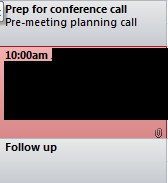
Time is scheduled before and after every meeting for prep, travel, and follow-up. This allows me time to walk into a meeting well prepared with documents gathered. It also ensures that I setup follow-up meetings, write a memo or email, etc., immediately after the meeting so that “balls are not dropped.”

clip_image007

When someone other than a parent or staff member stops by and asks “do you have a minute,” usually a salesperson, if I’m not in a meeting or leaving for one, I will give him or her a little time in order to give a good testimony of the gospel. However, if this is an unscheduled drop-in, I start by meeting him or her at the door. I remain standing. This significantly shortens the unplanned meeting. I will invite the unscheduled guest to sit IF I believe the issue has the potential to benefit the school and if I have time. Otherwise, the meeting will end as a standup meeting or my assistant will schedule a follow-up meeting. In other words, in so far as possible and polite, I attempt to control my time rather than having someone else control it.

I also use lunch for meetings. I have to eat anyway so I might as well make it productive. Very seldom do I eat without meeting with someone.

I normally leave the office at 4:00. I go home and run four miles on the treadmill while catching up on the news—I accomplish two things at once! I shower and eat and then go to any evening meetings or events that I may have.

I am almost always in bed by 10:00 and up at 5:00 the next morning.

Friday mornings are blocked on my calendar for project work—off campus to minimize interruptions. This is an important time each week. I am able to focus on those BIG rocks that can be crowded out by the urgent.

Phone Calls

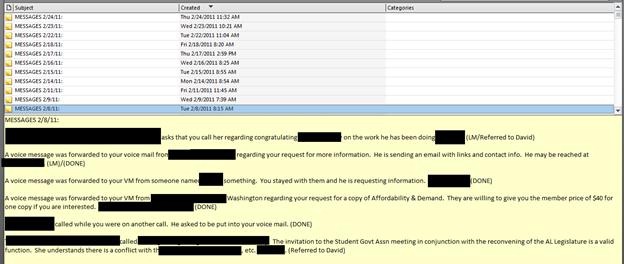
I have the blessing of having a wonderful administrative assistant. I have instructed her to log all phone calls into Outlook’s Notes function. This provides a permanent record of every call. After returning the calls I make quick notes on each log. This ensures that I return calls in a timely fashion and I have a record of my response—which can be as easy as “Returned, Left Message, Referred, etc.

clip_image009

I also return calls in the car using hands-free voice activated dialing. NEVER dial when driving. (That sentence will make my attorney happy!)

Managing Email and Information

email communication overwhelmed

clip_image010

Email management is a challenge—but not impossible! Rather than outline strategies for managing email in this article, I have created a PowerPoint Presentation that you may find useful. At the end of the presentation are links to short Microsoft training videos.

Click HERE to download the PowerPoint Presentation. You may share the PPT with whomever you wish; I only ask that you refer them to this blog.

Think Week

clip_image011

My Think Week is one of the most important practices that I have developed over the years. As I write this, I am preparing to leave for my Think Week. I will be reading 10 books and a stack of research documents—all on my iPad. For more information on Think Week see my previous post: How To Find Time to Focus, Think, and Work.

I got the idea for Think Week from articles I read about Bill Gates and his Think Week. Here are two articles that may interest you: Article 1: Bill Gates in Secret Hideaway, Article 2: Bill Gates Think Week.

Tools I Use

  • I strive to be as paperless as possible. To the extent that I have everything in digital form (which is almost everything) I can have my documents with me anytime and anywhere. They are also searchable and shareable. This is far more productive than keeping up with paper, legal pads, notebooks, post-it notes, etc.

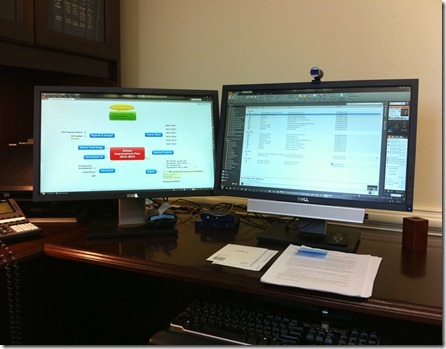
  • I use a Dell laptop on a docking station with two monitors. On the left is my project management/brainstorming software—Mindmanager from Mindjet. The center monitor is used for Outlook and other Microsoft products (Word, etc.)

clip_image012

  • I make extensive use of video-conferencing. I use ooVoo-think Skype on Steroids! Video-conferencing makes phone calls far more personal, there is less temptation to “multitask” while on a phone call, and you can share your desktop and/or files while on the call. Video-conferencing also reduces the number of emails I must process.

· I use the iPad for virtually all of my reading and note taking. There is a very effective and powerful note taking application called “Note Taker HD.” Used with a stylus it is as effective as a legal pad but with the advantage that all of your notes are in one location, searchable, and shareable.

Software I Most Frequently Use

  • Microsoft’s Office 2010

  • Docs-to-Go on my laptop and iPad. This program syncs all of my laptop documents to my iPad so that I have everything with me at all times. Docs-to-Go also enables me to read, create, and edit Microsoft documents-Word, Excel, and PowerPoint.

  • Mindmanager with a Catalyst subscription—for project management, brainstorming, and collaboration. The program tightly integrates with Outlook and Microsoft Office products making it an extremely effective task and project management tool.

  • The new I.E. 9 browser and Google's Chrome. They are fast, secure, full-featured, and customizable.

  • Note Taker HD—replaces a legal pad.

  • Logos Bible Study software—on my laptop and iPad. For in-depth Bible study.

  • Kindle software on the laptop, iPad, and iPhone—I carry my library in my pocket.

  • Skydrive—for online document storage, creation, and collaboration. Skydrive and MS Webapps integrate seamlessly with Microsoft Office.

  • ooVoo for video-conferencing.

  • Twitter—for keeping up with the news.

  • Jott—for leaving myself reminders when I’m in the car.

  • Adobe Acrobat Pro—for PDF creation and electronic forms completion and signing.

  • Loseit-see below.

Personal Health

clip_image014

Staying fit is critical to reducing stress and being efficient and effective. Although it gets tiresome, I count calories (I use a software program called LoseIt on my iPhone) and I track my exercise using the same program.

I run four miles a day six days a week (Sunday off) unless providentially hindered. I maintain my weight within the “ideal range,” for my height and age.

I do NOT like running and I do not like counting calories—but—doing so makes a big difference in how well I sleep at night and how much energy I have each day.

Because I do not like running, I do not sit down when I get home—not even for a minute!! I walk immediately to the closet and change into my exercise cloths and mount the treadmill.

Life is hectic and our jobs are demanding. Learning to thrive rather than merely survive as a leader is a challenge. It can be done. Attention to one’s spiritual and physical health, establishing good practices and habits, and making appropriate use of technology can all, when used in combination, reduce stress while we strive to accomplish more for God’s glory.

What Can the People of Laish and Hobbits Teach Us?

clip_image002

By Dr. Barrett Mosbacker

One of my favorite novels (and movie) is Lord of the Rings, a classic and wonderfully told tale of good versus evil. An interesting sub-plot in the Lord of the Rings is the danger faced by those living in peace and prosperity, oblivious to embedding doom. The Hobbits are peaceful and hardworking, blissfully ignorant of the rise of Mordor[1] and the danger that it poses to them and the inhabitants of Middle-earth.

There is a similar and troubling description in the Bible of another group of people living in peace and prosperity, unaware of their impeding destruction:

Then the five men departed and came to Laish and saw the people who were there, how they lived in security … quiet and unsuspecting, lacking nothing that is in the earth and possessing wealth … and how they … had no dealings with anyone ... But the people of Dan … came to Laish, to a people quiet and unsuspecting, and struck them with the edge of the sword and burn­ed the city with fire. And there was no deliverer because it was far from Sidon, and they had no dealings with anyone... (Jdg. 18:7; 27-28)

Lessons to be Gleaned from Hobbits and the People of Laish

Peace and Prosperity can be Dangerous

When our lives are characterized by peace, tranquility, and prosperity, we are prone to be lulled to sleep. The Hobbits were unaware of the looming danger and were not prepared for Sauron's[2]assault with his armies from Mordor. The people of Laish thought all was fine—their lives were quiet, peaceful, and prosperous. They did not suspect a thing—then, they were attacked and destroyed.

clip_image004

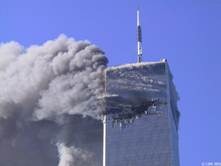
This happened to Americans prior to September 11, 2001. Few suspected that evil men were planning to crash planes into the World Trade Towers and the Pentagon. Evil did strike—unexpected and horribly on a beautiful, peaceful September morning. Many lives were lost and destroyed.

What is true nationally is also true of our souls. Complacency through preoccupation with the material and temporal at the neglect of our souls leads to false security and spiritual danger. We naively assume that everything is fine when in fact we and our students face two mortal dangers.

Danger from Within

We have evil natures

In Genesis we read that Cain was angry when the Lord rejected his offering. God responds by saying to Cain:

If you do well, will you not be accepted? And if you do not do well, sin is crouching at the door. Its desire is for you, but you must rule over it. (Gen. 4:7)

Our sinful natures are always crouching in our hearts—ready to destroy our testimonies, our marriages, our careers, and our students. We must be keenly aware of the sin within us that, like the dark forces of Mordor, seeks to rise from within to devour our lives. This is why Jesus taught us to pray: “And lead us not into temptation, but deliver us from evil.” (Mt. 6:13) He also tells us to: “Watch and pray that you may not enter into temptation. The spirit indeed is willing, but the flesh is weak.” (Mt. 26:41)

Self-deception

Peter was convinced of his loyalty to Jesus—he proclaimed confidently that he was willing to die for Jesus. Jesus knew Peter better than Peter knew himself.

Peter answered him, “Though they all fall away because of you, I will never fall away.” Jesus said to him, “Truly, I tell you, this very night, before the rooster crows, you will deny me three times.”Peter said to him, “Even if I must die with you, I will not deny you!” And all the disciples said the same. (Mt. 26:33-35)

The tendency for us to think more highly of ourselves than we should sets us up for failure. If we think we are strong enough to overcome our own sinful natures in our own strength we are destined to fail and to fall.

Dangers from Without

Satan is a real and active enemy

clip_image006

Satan is not a metaphor—he is real. Satan is the Sauron of our souls. He seeks to destroy us by seducing our evil natures or through various trials and tribulations.

Be sober-minded; be watchful. Your adversary the devil prowls around like a roaring lion, seeking someone to devour. Resist him, firm in your faith, knowing that the same kinds of suffering are being experienced by your brotherhood throughout the world. And after you have suffered a little while, the God of all grace, who has called you to his eternal glory in Christ, will himself restore, confirm, strengthen, and establish you. (1 Pet. 5:8-10)

We must not, therefore, slip into a comfortable complacency. We must in fact be sober-minded and watchful—looking for Satan’s attacks and snares—from within and from without. He is crouching, looking, and ready to rip us and our students apart. He is ready to have us and them for dinner. Only the ignorant and complacent walk about unaware and unguarded.

Our Protection—Christ, His Word, and His Shepherds

In the end, Frodo Baggins, Samwise Gamgee, Meriadoc Brandybuck, and Pippin Took, and their allies saved Middle-earth and the Hobbits. In the end, only Christ, His Word, and His Shepherds will save us from dangers within and without.

Christ Prays for Us

Simon, Simon, behold, Satan demanded to have you,that he might sift you like wheat, but I have prayed for you that your faith may not fail. And when you have turned again, strengthen your brothers. (Lk. 22:31-32)

Who is to condemn? Christ Jesus is the one who died—more than that, who was raised—who is at the right hand of God, who indeed is interceding for us. (Ro. 8:34)

The former priests were many in number, because they were prevented by death from continuing in office, but he holds his priesthood permanently, because he continues forever. Consequently, he is able to save to the uttermost those who draw near to God through him, since he always lives to make intercession for them. (Heb. 7:23-25)

We must pray for each other and our students

Finally, brothers,pray for us, that the word of the Lord may speed ahead and be honored, as happened among you, and that we may be delivered from wicked and evil men. For not all have faith. But the Lord is faithful. He will establish you and guard you against the evil one. And we have confidence in the Lord about you, that you are doing and will do the things that we command. May the Lord direct your hearts to the love of God and to the steadfastness of Christ. (2 Th. 3:1–5).

Christ will finish what he has begun

And I am sure of this, that he who began a good work in you will bring it to completion at the day of Jesus Christ. (1 Thess. 1:3)

We must work as God works in us to both will and to do

Therefore, my beloved, as you have always obeyed, so now, not only as in my presence but much more in my absence, work out your own salvation with fear and trembling, forit is God who works in you, both to will and to work for his good pleasure. (Phil. 2:12-13)

We cannot isolate ourselves from the church

We cannot isolate ourselves spiritually like the people of Laish. The Bible describes them as having no allies, “And there was no deliverer because it was far from Sidon, and they had no dealings with anyone.” We need each other for encouragement and accountability. Attendance at worship and engagement in Christian community are essential. There are no Lone Ranger Christians. We need each other!

What This Means for Our Students

  • They must be taught not to flatter themselves. Contrary to everything they hear from the world, they are not good—they have sinful natures that will lead them astray and destroy them.

  • The world is not neutral nor a friend—the value system in this world is used by Satan to entrap and destroy. They must be alert to the dangers, they cannot be like Hobbits. They must lean on Christ and his word so that they are “not conformed to this world, but transformed by the renewing of their minds.”

  • They must nourish their souls in God’s word and through engagement with God’s people. A malnourished improvised soul is no match for a sinful nature, Satan, or his allies in this world.

[1] Translated Black Land or Land of Shadow and in Chinese “a place where demons are many.”

[2] Tolkien noted that the "angelic" powers of his constructed myth "were capable of many degrees of error and failing,” but by far the worst was "the absolute Satanic rebellion and evil of Morgoth and his satellite Sauron.

You Have to Watch Out for the Pork on Thursdays!

By Mark Kennedy, ACSI Canada

Head_in_Sand_Denial_IgnoreMy childhood friend Bill grew up to be a respected and successful bank executive- a man who occasionally helps financial institutions beyond our borders. A few years ago while consulting for a bank in Dublin he made his temporary GHQ in a small hotel that boasted a dining room for its guests. On a Thursday evening he ambled down to this quaint eatery for a taste of Celtic cuisine not suspecting the violent conflict that would arise later in his stomach.

“I was sick all last night after eating in your restaurant!” He told the manager the next morning.

“Well what did you have for dinner?”

“Roast pork!” said Bill.

“Ah yes,” replied the manager philosophically in a lilting Irish brogue, “You have to watch out for the pork on Thursdays.”

You can imagine the questions in my friend’s mind when his initial shock wore off. Maybe foremost was

“Why didn’t someone tell me?!?”

Sheltering someone from reality can be dangerous. And sometimes the consequences can be much more serious than a minor case of food poisoning.

Consider the effects of an education that intentionally shelters students from the most important realities about life and living- a secular education where the daily presence of the living God is ignored and the authority and guidance of scripture is dismissed- an education that edits out the creator and sustainer of the real world.

Paul warns about a day when:

Men will not put up with sound doctrine. Instead to suit their own desires, they will gather around them a great number of teachers to say what their itching ears want to hear. They will turn away from truth and turn aside to myths.” 2 Tim 4: 3 & 4. That time sounds uncomfortably familiar.

It’s not that a secular education necessarily speaks out against the God of the Bible or openly denies the authority of the scriptures. It simply remains silent about them. And that’s the problem. If a student from a Christian family receives a consistently secular education how surprising can it be if he comes to think that God can’t be very important? ‘After all they never talk about Him at school’ he might reasonably say to himself- and his logic would be pretty hard to refute. He got the silent message.

Robert Louis Stephenson expressed it plainly,

“The cruelest lies are often told in silence.”

So when important, even vital truths are kept from people who desperately need to hear them, Stephenson says it is a cruel deception.

The silence in secular education has implications for the way children learn, believe, think and face life’s challenges. When students are sheltered from God’s reality they are prime candidates to be “taken captive through hollow and deceptive philosophy which depends on human tradition and the basic principles of this world rather than on Christ.” 2Col 2:8. Philosophies produce actions, and actions produce consequences. So it should be no surprise that sex education that ignores biblical standards produces ever growing rates of sexually transmitted diseases, abortions and accompanying psychological problems; that a purely mechanistic and evolutionary view of humanity convinces some students they are worthless genetic accidents so that suicide becomes a reasonable option; and that when personal troubles for which secular minds have no real answers overwhelm students they turn to illicit drugs in an attempt to escape. The world of drug and alcohol abuse and promiscuous or perverse sexuality is so often a false refuge for people who have not been equipped to deal with the real world.

In Christian schooling we don’t shelter students from reality. We prepare students by telling them the whole truth about the real world and by honoring the presence of the source of all truth and by teaching future generations about his standards for living. As the Psalmist says,

We will not hide them from their children; We will tell the next generation the praiseworthy deeds of the Lord, his power and the wonders he has done. Psalm 78:4

In the early 1990s after Russian Communism collapsed I found myself on a team of North Americans instructing hundreds of Russian educators about how to teach the Bible to Russian public school students. Evgenity Kurkin of the Russian Ministry of Education explained why we had been invited to do that,

Seventy years ago we closed Him (God) out of our country and it has caused so many problems in our society we cannot count them…..We must put God back into our country and we must begin with our children.

One evening as I walked with some of our Russian hosts down a snowy street in St. Petersburg, a translator told me about his life in Chernobyl after the nuclear accident – the one that killed and crippled thousands.

“For three years after the accident nobody told us what had happened, all we knew was that our children were getting sick. We finally learned about it through BBC radio.” Those people in Chernobyl knew the cost of being sheltered from reality – and it was far too high.

And what about the future cost for students who have been sheltered from the realities that matter most for living now and for the life yet to come?

We shy away from sounding a warning to families in our churches. “Try to focus on the positive aspects of Christian schooling and don’t offend anyone” we tell ourselves. But maybe the time has come to tell the whole story to Christian families for the sake of their children and the future of the church in North America.

When Times are Difficult Consider Said Musa

Mean_Angry_Call_Phone_Cell_Yell_Conflict

By Dr. Barrett Mosbacker

Leading a school can be a tough business!  I joke with my parents that my job is easy;

I only deal with people’s children, money, and religion!

People can be complainers, inconsiderate, gossips, stubborn, resistant to change, and just downright mean and ornery.   Such people can make our jobs and lives miserable.

Before you and I start feeling sorry for ourselves, consider Said Musa’s situation.  After reading of his plight I believe we will gain a little perspective on our troubles.

Said Musa’s Story

A terrible drama is unfolding in Afghanistan: There are reports that Said Musa, whose

situation I described at Christmas, will soon be executed for the ‘crime’ of choosing to

become a Christian. (For background, see here.)

Musa was one of about 25 Christians arrested on May 31, 2010, after a May 27 Noorin TV

program showed video of a worship service held by indigenous Afghan Christians; he was

arrested as he attempted to seek asylum at the German embassy. He converted to Christianity eight years ago, is the father of six young children, had a leg amputated after he stepped on a landmine while serving in the Afghan Army, and now has a prosthetic leg. His

oldest child is eight and one is disabled (she cannot speak). He worked for the Red Cross/Red Crescent as an adviser to other amputees.

He was forced to appear before a judge without any legal counsel and without knowledge of

the charges against him. “Nobody [wanted to be my] defender before the court. When I said

‘I am a Christian man,’ he [a potential lawyer] immediately spat on me and abused me and

mocked me… . I am alone between 400 [people with] terrible values in the jail, like a sheep.”

He has been beaten, mocked, and subjected to sleep deprivation and sexual abuse while in

prison. No Afghan lawyer will defend him and authorities denied him access to a foreign

lawyer.

Any and every human being who is imprisoned, abused, or tortured for the free and peaceful

expression of their faith deserves our support, but Musa is also a remarkable person and

Christian. In a letter smuggled to the West, he says, “The authority and prisoners in jail did

many bad behavior with me about my faith in the Lord Jesus Christ. For example, they did

sexual things with me, beat me by wood, by hands, by legs, put some things on my head.”

He added a thing much more important to him, that they “mocked me ‘he’s Jesus Christ,’

spat on me, nobody let me for sleep night and day… . Please, please, for the sake of Lord

Jesus Christ help me.” (See the full letter here)

He has also stated that he is willing to give his life for his faith. “Please, please you should

transfer me from this jail to a jail that supervises the believers… . I also agree … to sacrifice

my life in public [where] I will tell [about my] faith in Lord Jesus Christ, son of God, [so]

other believers will take courage and be strong in their faith.”

… The Wall Street Journal reports that “Afghan officials have been unapologetic:

The sentence for a convert is death and there is no exception.

said Jamal Khan, chief of staff at the Ministry of Justice.

They must be sentenced to death to serve as a lesson for others.

Here is Said Musa’s handwritten letter (click on the image to see a larger version).

image

Our Response:

  • Let’s pray consistently for Said Musa and other persecuted Christians.

  • Tell these stories to our students so that they understand the price that many Christians are called to pay to follow Jesus—a price that we and they may be called upon to pay as well.

  • Use this story in Bible classes, chapels, and staff devotions as an antidote to the false prosperity “gospel.”

  • Our struggles are real and they hurt but keep them in perspective.  Said Musa lost a leg, has a disabled daughter, has been imprisoned, beaten, humiliated, spat upon, and abused.  He will likely be executed for being a Christian.  There is no hint of blaming God, claiming God is unfair, etc.  Instead, he is willing to die publically to be a witness for Jesus.  I don’t know about you, but my meager struggles pale in comparison—in fact there is NO comparison.

  • Let us learn to suffer hardship, of whatever sort, for the sake of serving Christ and his kingdom in and through our schools.  May God grant us the grace to joyfully endure hardship and to be counted worthy to suffer for his sake.  May we mirror Said’s commitment to Christ before our students and parents.

Does Success Spoil or Sanctify Our Students?

Spoiled_brat_selfish_parent_child_beg

By Dr. Barrett Mosbacker

By most measures you and I are "successful." We live in a land of freedom and opportunity. Notwithstanding any financial stresses in our lives, we have shelter, clothing, and food. We have family and friends. Most of us are in good health. Compared to most people in this world, you and I are very "successful." We live in relative ease. So do our children!

And therein lies one of our greatest dangers. We and our children are easily spoiled. Success and ease tend to make us self-absorbed, self-sufficient, self-righteous, and self-seeking.

  • We come to believe that "we are owed a life of success and ease."

  • We and our children come to believe that "life is about us."

  • We come to believe that "we produced our success."

We become autonomous, thinking that we do not really need God. We may not say we don't need him but the way we live?a weak prayer life, a weak devotional life, inconsistent worship on the Lord's Day, and the constant compromises we make in disobeying God's clear commands?all reflect what we really believe.

This is the danger facing Israel. They have won great victories and are now preparing to settle down in peace and prosperity. The danger is that their success will spoil rather than sanctify them.

There is a wonderful passage in Joshua following the wars in Canaan. The Israelis have just conquered their enemies and are preparing to settle in the new land flowing with milk and honey. They have been successful and are now preparing to enjoy the fruit of their labor. Matthew Henry describes the scene this way, "The war being ended, and ended gloriously, Joshua, as a prudent general, disbands his army ... and sends them home, to enjoy what they had conquered, and to beat their swords into plough-shares and their spears into pruning-hooks ... And, now ... Joshua publicly and solemnly ... gives them their discharge."

Only be very careful to observe the commandment and the law that Moses the servant of the LORD commanded you, to love the LORD your God, and towalk in all his ways and to keep his commandments and to cling to him and to serve himwith all your heart and with all your soul." (Josh.: 22:5)

Although these are somewhat synonymous for the purpose of emphasis, there is value in considering the particular meaning of each verb: Observe, Love, Walk, Keep, Cling, and Serve.

To Observe

To notice, watch attentively, fulfill and comply with. We are to spend time knowing, understanding, and complying with God's word. How is your Bible study? How is your attendance at worship?

To Love

: to have a great interest and pleasure in something. This exhortation is the essence of the "first and greatest commandment," to love God passionately, with every fiber of one's being (Deut. 6:5; Matt 22:37-38). The primary purpose and chief end of our existence is to glorify God and to enjoy him forever, to take pleasure in God.

Do you enjoy God? Are you more passionate about God or something/someone else?

To Walk

Walking means to order the whole of one's life by God's word and to be filled with his Spirit. When we rise up, walk through the day, and lie down at night, in ALL his ways?even those that are narrow and up-hill, in every particular instance?God's word is to be our compass.

You shall teach them diligently to your children, and shall talk of them when you sit in your house, and when you walk by the way, and when you lie down, and when you rise. You shall bind them as a sign on your hand, and they shall be as frontlets between your eyes. You shall write them on the doorposts of your house and on your gates. (Deut. 6:7-9)

Everyone then who hears these words of mine and does them will be like a wise man who built his house on the rock.And the rain fell, and the floods came, and the winds blew and beat on that house, but it did not fall, because it had been founded on the rock.And everyone who hears these words of mine and does not do them will be likea foolish man who built his house on the sand.And the rain fell, and the floods came, and the winds blew and beat against that house, and it fell, and great was the fall of it." (Matt. 7:24-27)

To Keep

To honor or fulfill, to observe or pay due regard to God's commands. There is no "BUT" in the believer's response to God's commands! Believers are never to say, "I would obey but....." If we love God, we keep his word.

If you love me, you willkeep my commandments.And I will ask the Father, and he will give you anotherHelper, to be with you forever,eventhe Spirit of truth,whom the world cannot receive, because it neither sees him nor knows him ... Whoever has my commandments and keeps them, he it is who loves me. And he who loves mewill be loved by my Father, and I will love him andmanifest myself to him. (Jn.: 14:15ff)

To Cling

To hold tightly to, to be hard to remove from; to adhere to someone, to remain persistently faithful to God and his word. We cling both out of love and need. He is our life! He is our life and our treasure?we grasp him tightly!

"I came that they may have life and have it abundantly." (Jn. 10:10)

To Serve

Life is NOT ABOUT US. Life is about loving and serving God; life is about serving his kingdom.

Share in suffering asa good soldier of Christ Jesus.No soldiergets entangled in civilian pursuits, since his aim is to please the one who enlisted him.An athlete is notcrowned unless he competes according to the rules.It isthe hard-working farmer who ought to have the first share of the crops.Think over what I say, for the Lord will give you understanding in everything. Remember Jesus Christ,risen from the dead, theoffspring of David,as preached in my gospel,for which I am suffering, bound with chains as a criminal. Butthe word of God is not bound!ThereforeI endure everything for the sake of the elect, that they also may obtainthe salvation that is in Christ Jesus witheternal glory.The saying istrustworthy, for: If we have died with him, we will alsolive with him;if we endure, we will also reign with him; if we deny him, he also will deny us;if we are faithless, he remains faithful forhe cannot deny himself. (1 Cor. 9:10)

Our success in this life will either spoil us and our children or it will motivate us to show our gratitude by renewing our commitment to Observe, Love, Walk, Keep, Cling, and Serve!

Should Teachers Text, Facebook, or Twitter Students?

Texting_Ariana_Cell_Phone_text

By Dr. Barrett Mosbacker

Do you think electronic communication between teachers and students should be forbidden or restricted? What are the benefits and risks of texting with students? How have you used texting and/or social networking as an educational tool.

What about Facebook?  Twitter?

Share your thoughts with the hundreds of educators who read this blog.

How To Find Time to Focus, Think, and Work

Future_plan_Strategy_telescope

By Dr. Barrett Mosbacker

It is hard to find it hard to find time to focus, think, and work on important projects.  We are constantly interrupted and distracted.  The immediate crowds out the important. 

In his excellent article Who Else Needs More Mental Focus?, Michael Hyatt, Chairman and CEO of Thomas Nelson Publishers, the world's largest Christian publisher, offers very helpful tips for improving one’s focus. (see a short excerpt and link to his article below)

I have used many of the same practices for years.  In addition to Mr. Hyatt’s recommendations, I also do the following to carve out time for focus, thinking, and working on critical projects.

  • I schedule several hours every Friday morning off campus to focus and think.  I do not come into the office.  I can be reached by cell phone in an emergency but my administrative assistant has been instructed that I am not to be interrupted.  This is some of the most productive time in my week.

  • Each year I take several days for a “Think Week.”  I got this idea from Bill Gates who pulled away each year for an extended time of research, reading, and reflection.  I have adopted this practice.  I spend these days praying, reading, reflecting, and writing.  I take a substantial amount of reading material with me.  Because I use my iPad exclusively for reading I am able to carry an entire library of books and research articles with me.  I read and reflect from morning to evening only interrupting my reading for eating, running, and showering.  It is usually during Think Week that I come up with long-range initiative such as our BCS SMART SCHOOL program.

Click here to read Mr. Hyatt’s article, Who Else Needs More Mental Focus?

A few weeks ago, I had to prepare for a board meeting. I really needed an extended period of time to review the material and prepare my presentation. In doing this, I realized that I go through a similar pattern whenever I need to increase my mental focus and get a lot of work done in a short period of time.  Here are ten tactics I use that may help you…

What do you do to improve your focus and creativity as you lead your school?

Reflections: Revolution, Egypt, and Our Students

By Dr. Barrett Mosbacker

Have you been watching the news lately?  The Arab world is in an uproar, Egypt is in crisis, and journalist and pundits are wringing their hands with anxiety. How should we respond?  Remembering that at the heart of our mission is to teach students to use the Scriptures as the foundation and framework for interpreting events in this world; what should we communicate to our students about the events in the Middle East? 

This is not comprehensive but here are some thoughts for your prayerful consideration.

  • NOTHING happens outside of God’s sovereign decrees and providential care. From the smallest detail of life to monumental events in human history, our Holy, Omnipresent, Omnipotent, Omniscient, loving God is in control. Consider:

  • The smallest of animals are under his care

Rather fear him who can destroy both soul and body in hell. Are not two sparrows sold for a penny? And not one of them will fall to the ground apart from your Father ... Fear not, therefore; you are of more value than many sparrows.  Mt 10:28–31 

  • The smallest details of our lives are under his care

Rather fear him who can destroy both soul and body in hell … even the hairs of your head are all numbered.  Fear not, therefore; you are of more value than many sparrows.  Mt 10:28–31

  • The nations are under his sovereign control and care

So the LORD dispersed them from there over the face of all the earth, and they left off building the city.  Therefore its name was called Babel, because there the LORD confused the language of all the earth. And from there the LORD dispersed them over the face of all the earth.  Gen. 11:8-9

When the Most High gave to the nations their inheritance, when he divided mankind, he fixed the borders of the peoples according to the number of the sons of God. Deuteronomy 32:8

And he made from one man every nation of mankind to live on all the face of the earth, having determined allotted periods and the boundaries of their dwelling place that they should seek God, in the hope that they might feel their way toward him and find him. Yet he is actually not far from each one of us ... Acts 17:26ff

  • We are to pray for the Egyptian Christians being persecuted and killed

Finally, brothers,pray for us, thatthe word of the Lord may speed ahead and be honored, as happened among you, and that we may be delivered from wicked and evil men. For not all have faith.  2 Th 3:1–2

  • Pray for the persecutors

But I say to you, Love your enemies and pray for those who persecute you, so that you may be sons of your Father who is in heaven. For he makes his sun rise on the evil and on the good, and sends rain on the just and on the unjust. For if you love those who love you, what reward do you have? Do not even the tax collectors do the same? And if you greet only your brothers, what more are you doing than others? Do not even the Gentiles do the same? You therefore must be perfect, as your heavenly Father is perfect.  Mt 5:44–48).

  • Use current events as teachable moments in appropriate classes. 

For example, the crisis in Egypt lends itself to teachable moments in history, geography, and Bible.  Discussions of biblical truth, geopolitical issues, implications for U.S. foreign policy, the role of believers in seeking peace, etc., are worthy topics to explore.

  • We are to care

Our sinful natures and everything in our culture screams at us to be self-centered, self-focused, self-absorbed, and narcissistic.  If it doesn’t affect us, we ignore it.  But this is unbiblical.  Jesus said the second greatest commandment was to love our neighbors as ourselves.  He also told us “Blessed are the peacemakers, for they shall be called sons of God.”  Mt 5:9

Our students are being prepared to be leaders.  These means, among other things, that they are to care about what happens in this world, to believers and unbelievers alike and they are to actively work for peace and justice in this world.  They are to be salt and light as they bring the truths of God’s word to bear on contemporary issues, reflecting the character of Issachar:

Of Issachar, men who had understanding of the times, to know what Israel ought to do.  1 Chron. 12:32a