In Memoriam

By Mark Kennedy

2:30.

2:30 a.m., ante meridiem – the 2:30 that’s too early in the morning. It’s a time when babies make their debut on the world’s stage wailing from the shock of fresh air in new lungs.

But at 2:30 a.m. on August 11th one old man, my ‘old man’, was making his final exit, gasping for each remaining breathe. At 2:30 I sat beside my 83 year old father’s bed, held his hand and waited for that slow train that comes for all of us sooner or later.

“All the world’s a stage”, says Shakespeare, “and all the men and women merely players.”

If that’s true, my father’s best performances were given on a stage made of ice.

From 1942 to 1957, he was part of the Toronto Maple Leaf hockey team. Statisticians will tell you that Ted “Teeder” Kennedy played his first Leaf game at age 17, that he was the youngest Maple Leaf captain, that he led 5 Stanley Cup winning teams, that he still holds the record for most Leaf playoff goals and that he received the Hart Trophy in 1955 as the NHL’s most valuable player. But numbers and trophies don’t tell the whole story.

His audience, the people who saw him play, talk about his unflinching courage, his unremitting hard work and his indomitable determination in the face of adversity – character traits that produced the statistics and a lot more.

Where do personal qualities like these come from?

No one is a self-made man. There are no demigods with genetic codes pre-programmed to accomplish great things solely by their own abilities. Events and circumstances enter into it, but more than any other factor, human influences shape character and inspire achievements. Parents, teachers and heroes matter.

“Who was your hero when you were growing up?” I once asked my father, expecting him to name an old time hockey player, like maybe Charlie Conacher.

“My mother.” he said, “The things she did were absolutely unbelievable.” We both sat silent for a while and I thought about that little Irish woman who immigrated to Canada almost 100 years ago. Margaret Burns was a teenager then, full of hopes and dreams for an exciting life in a new land. It was a beautiful fantasy - a song of innocence. Fifteen years later, tragedy was the theme of her song of experience.

She began her new life as a maid in what were wryly dubbed ‘summer cottages’ – American owned mansions on the north shore of Lake Erie in the town of Port Colborne, Ontario. Cooking, cleaning and mending were familiar duties for her and for so many other women of her generation and at least they provided her with a living.

At a community event she met Tom King, a worker at the local cement plant. They fell in love, married and had a son named Joseph. But while Joseph was still a toddler, tragedy struck. Tom King along with more than 20 million other people worldwide died in the flu epidemic of 1918. As a young widow with a little boy to raise she persevered through her grief. A few years later another local man came into her life. She and Gordon Kennedy married and began building a new family. Over the next five years Jessie, Jim and Gordon Jr. joined Joseph, as part of a rollicking, boisterous, happy clan of children.

But tragedy continued to stalk Margaret. At the age of one, little Gordon Jr. tried to climb a ladder, lost his balance and tumbled to his death.

Another heartbreak followed soon after. Weeks before the birth of my father, Gordon Sr. was critically wounded in a hunting accident. It took several agonizing days for him to die in hospital.

Hamlet’s stepfather Claudius said it eloquently, “When sorrows come, they come not as single spies but in battalions.”

How could anyone bare the weight of these accumulated sorrows? Margaret faced a future without any significant work skills or government safety net and with 4 young children to support.

To solve the critical problem of financial survival she turned her home into a restaurant and, in off hours, cleaned floors in local office buildings. In summers she operated a beachside snack bar and for the rest of the year at night she ran the concession booth at the local hockey arena with the help of her children. After all the teams had left her children would lace up their skates and play shinny.

It was a hard and wearing life for Margaret. Her daughter Jessie recalled often hearing her come home weeping in the early hours of the morning. “I’m so tired!” she would cry out, maybe to God. Nonetheless next morning she would be up early for another day of wearying physical labour.

And there it was. She was the personification of unflinching courage, unremitting hard work and indomitable determination in the face of adversity - it’s no wonder my father brought those character traits to the Maple Leaf hockey team. He learned them from his hero and he chose his hero well.

But there was something more, something that carried Margaret far beyond normal human capacities.

The New Testament book of Matthew records an amazing event that took place in the middle of a wind swept sea. Jesus astonishes and terrifies a boat full of his disciples by walking on top of the water toward them! He then challenges his friend Peter to step out of the boat and walk on the water too! And Peter actually does it for a few seconds! When he looks at Jesus he does the seemingly impossible but when he looks down into the tempestuous depths fear replaces faith and he begins to sink. Jesus has to rescue him.

Margaret turned to God in the tragedies that threatened to overwhelm her and her children and He lifted her above them. I know that because I knew her and because I found a remarkable letter in a box of jumbled correspondence and bills. She wrote it to my dad when he was struggling to finalize the purchase of his first home – a pretty minor thing in comparison to her troubles:

“Dec 28- 1948

Dear Theodore,” (She always used his full, formal name) “I am so sorry you have run into so much trouble with the house but dear don’t be discouraged. If you put your trust in God He will help you to overcome all the difficulties you run into. You will realize that as you get older.”

She wrote that after having lived through the deaths of two husbands and a beloved child. She knew what she was talking about. She had lived it.

2:30 August 11th came and went. I would sit up for two more nights with my father before the spirit left his worn out body. Even in those last hours he wouldn’t give up easily. How could he with the heritage of his hero always in his heart.

As I wrote this I couldn’t help thinking about the heroes teaching in some of our Christian schools – the folks who, like my grandmother, work so hard and without ever receiving public celebrity status. Maybe some of them come home late at nights exhausted, maybe sometimes in tears. Maybe in the day to day grind they just don’t see any fruit from their efforts. For them I hope this article is an encouragement. Their work is not in vain. They are heroes for children who may just change our world for the better some day – and chances are many of those future world changers are the children from whom they would least expect it.

Ideas Have Histories: Where Postmodernism Came From-Part I

This is part one of two articles on Postmodernism

By John Stonestreet, Summit Ministries

Postmodernism comes in all kinds of shapes and expressions, and this sort of variety can make it difficult to understand. Further, postmodernism resists categories and distinctions, and this makes it more difficult to nail down as a worldview. There is a larger intellectual history that must be understood in order to grasp the uniqueness and significance of postmodernism as a worldview.


Ideas Have Histories: How We Lost Our Minds…

While dividing history into distinct time periods is not an exact science, there are two major historical transitions that can help us clarify the emergence of postmodernism: (1) the transition towards modernism, typically dated around the 1700s and (2) the transition away from modernism which began in the late 20th century.

The transition from what is often called the pre-modern period into the modern period corresponds with the influence of Enlightenment thinking and the scientific revolution. Prior to the Enlightenment, there was a dominant cultural belief in the existence of the supernatural. This was due in large part to the rise of Christianity and specifically the Roman Catholic church as the most powerful cultural presence in medieval times. This was a world of authority, and authority rested in the hands of traditional institutions, especially the church, since it was entrusted with interpreting and communicating this truth to the common person.

With a belief in God came a strong belief in the concept of revelation, that God not only existed but had revealed Himself and His will in the Bible. This revelation was considered the primary source of truth, and could be trusted to unlock God’s metanarrative (or, “Big Story”) for the world. Believing was the starting point of real knowledge. St. Anselm, typifies a pre-modern perspective on truth: “For I seek not to understand in order that I may believe; but I believe in order that I may understand, for I believe for this reason: that unless I believe, I cannot understand.” This view of revelation and authority did not fare well during the Enlightenment.

The Enlightenment was a movement among European intellectuals in the 17th and 18th centuries. In the decades leading up to this time, the church’s authority had been successfully challenged politically (reactions against corruption), theologically (Luther, Calvin and the Protestant Reformation), philosophically (downfall of scholasticism), and scientifically (Galileo, Copernicus, and Baconian method). There was a growing disillusionment with the traditional educational, political and religious institutions, as well as their authoritative sources.

During the Enlightenment, authority shifted from traditional institutions to human reason. A scientific approach to the world yielded tremendous advances in medicine, technology, and communications and challenged the centrality of theology and religious belief as the paradigm for learning. Free from the restrictive shackles of traditional beliefs (thus, modernism), progress seemed inevitable. Immanuel Kant described this period of time in this way: “Sapere aude! ‘Have the courage to make use of your own mind!’ is thus the slogan of the Enlightenment.”[1]

The modern period had begun. The growing skepticism in regards to anything supernatural was matched by growing faith in human ability to know the world, control it, and reap the inevitable benefits. The “Big Story” of the world was not given by revelation; rather, it was to be discovered and perhaps even determined by science, reason and technology. This major transition was at the heart of the modern period.

However, from our 21st century perspective, it is clear that the predictions of utopia guaranteed in the modern period never materialized. Instead, modernists became disillusioned as military increase brought world wars; failed development policies led to class oppression and colonialism; economic idealism resulted in communism and the Cold War; and our best science created nuclear weapons and the threat of global devastation.

Postmodern writers, beginning with Nietzsche, began to question the integrity of modernism’s metanarrative of progress. In fact, the main casualty of a postmodern perspective is the very idea of a metanarrative. Postmoderns are skeptical of any and all claims to an authoritative comprehensive worldview, absolute truth about reality, and an overarching purpose to the human story.[2] Postmoderns embrace local narratives, not metanarratives; a multitude of stories, not a “Big Story.”

In short, it could be said that religious metanarratives were dismissed by modernism. Man-made ones are dismissed by postmodernism. This is what Myron Penner and others have referred to as “the postmodern turn:”[3] postmodernism is a turn away from the certainty and optimism of modernism. As Jean Francios Lyotard wrote: “Simplifying to the extreme, I define postmodern as incredulity toward metanarratives.”[4]

Answering the Postmodern Challenge

Postmodernism’s impact on Western culture is hotly debated, and various thinkers and writers- including those coming from a Christian worldview- have offered diverging opinions of it. Some see it as a passing fad; others see it as long-lasting paradigm shift. Some decry it as dangerously destructive; others embrace its destruction of the oppressive structures of modernity.

The most helpful contribution of postmodernism is, first, that it has successfully challenged the reigning paradigm of the modern period, which was based largely on naturalistic humanism. Modernism, in seeking to arrive at absolute knowledge through empirical investigation, separated matters of “faith” from matters of objective knowledge about the real world. Postmodernism confronts this dichotomy in ways that are helpful for the Christian worldview.

Second, postmodernism has cast a large shadow of skepticism (and has offered a strong dose of humility) on the modern belief in the efficacy and near inerrancy of human reason. As was seen during the modern period, human reason can be quite productive, especially in the arenas of science, medicine, and technology. However, human reason can also be manipulative and destructive, especially when it produces the totalizing ideologies (e.g. communism, Nazism, colonialism, etc) that characterized the modern period.

Third, postmodernism has demonstrated that objectivity and certainty are not exclusive to the realm of science as was claimed during the modern period. In fact, science is often quite biased and agenda-driven, and is therefore in no place to claim to be the final arbiter on all matters of knowledge. This is especially helpful for Christians, who often feel the burden to play by the rules of modernism and empirically demonstrate every aspect of Christian truth.

Fourth, postmodernism rightly reminds us of the power of our culture, and especially the language of our culture, in creating our frames of reference. The modern period demonstrated that this power can be used to marginalize and oppress others at the personal and the systemic level. For the Christian, then, care should be taken to distinguish Scriptural teaching from our cultural perceptions.

Finally, the emphasis of postmodernism on story and narrative fits (to a limited extent) with the way the Bible presents God’s interaction with the world. The Bible is, on the whole, a narrative through which God gives us the Truth about Himself, humanity and the world. Of course, for the postmodernist, no story is to be considered true in this absolute sense over and above any other story, and propositions from one interpretive community are irrelevant for others.

The Bible does not present a God whose story is one among many, but a God whose story is the story above all others. So, in dealing with the postmodern mind, evangelicals face a difficult situation. For the past several centuries, modernity has relegated Christianity to the category of an unscientific, unrealistic worldview that is simply not believable for thinking people. Some Christians are tempted to settle for having Christianity accepted as a truth rather than face the prospect of being dismissed due to dogmatically claiming to be the truth, and abandoning the concept of worldview seems to be a small price to pay for having at least some claim to “truth.”

Although the dethroning of humanistic scientific reason is attractive to battle-weary Christian intellectuals, the postmodern denial of all objective truth is unacceptable.

Further, it is important to note that none of the positive contributions of postmodernism originated with postmodernism! In fact, the Christian worldview has always attested to the limitations of unaided human reason, the effect of the fall on objectivity and certainty, the tendency of humans towards marginalizing others, and the role the concept of story plays in our experience.

Despite the popularity of postmodernism among many Christians, the Christian worldview and the postmodern worldview cannot co-exist without one capitulating to the other. One could argue that we are chronologically “postmodern;” but ideologically, we cannot become “postmodernists.”


[1] Immanual Kant, “An Answer to the Question ‘What is Enlightenment?’” available online at http://www-personal.ksu.edu/~lyman/ english233/Kant-WIE.htm, accessed 08/30/2009.

[2] David Wells, Above All Earthly Powers: Christ in a Postmodern World (Grand Rapids, Mich: Eerdman’s, 2005), 74–90.

[3] Myron Penner, “Introduction” in Penner, Christianity and the Postmodern Turn: Six Views, 19–28.

[4] Jean Francois Lyotard, The Postmodern Condition: A Report on Knowledge trans. Geoff Bennington and Brian Massumi, in Theory and History of Literature, vol. 10 (Minneapolis: Univ. of Minnesota Press, 1984).

Product or Produce?

By Dr. Barrett Mosbacker

image

I love dessert.  One of my favorites is pecan pie.  When I sit down to enjoy a piece of warm pecan pie Ala Mode there are two things that I am careful to do: 1) I eat slowly savoring each mouth watering morsel and 2) I am very careful not to waste a single crumb.  My dog can lick a plate clean but he has nothing over me when it comes to getting every last morsel of taste off of my plate! (yes that is my dog--like father like son!) 

When it comes to my dessert, I do not waste it!

Are We Wasting Our Lives and Ministry?

Dessert is trivial when compared with one's life and ministry.  One of my fears is that my efforts will be wasted.  I sometimes ask myself, "in the end, will all of my hard work and long hours, the stress in dealing with upset parents and the occasional recalcitrant employee, and the energy expended in creating a world-class Christian school prove to  be for naught?  What if the only thing that I have achieved is the creation of a great product--superior students, excellent staff, and an outstanding school--but I have not borne fruit?  What if I am doing many good things but ultimately not the essential thing?  What if I am building and running a very efficient factory rather than planting and cultivating an orchard?"

If I build a great school and produce great students but those students do not grow to love and obey Christ and if they do not learn to love their neighbors--and if the fault lies with me because I failed to do what was necessary to produce spiritual fruit rather than creating a great product--then I will have ultimately failed in my calling.  I will have wasted the ministry entrusted to my stewardship.  That would be tragic.

Distinguishing Produce from Product: What Does Fruit Look Like?

To ensure that we are cultivating produce and not merely producing a product we need to be clear what produce or fruit is.  What does authentic fruit look like in a Christian school?

In answering this question I would like to expand upon the typical definitions, which include producing students who: Love Christ, evangelize, raise godly families, and who are serving in a local church. All of these are essential evidences of spiritual fruit in the lives of our students.  Unless these things are true we clearly have not produced the desired fruit.

Nevertheless, I would like to offer a broader understanding of the fruit we desire to produce -- an understanding that incorporates and expands upon our typical definitions so that the spiritual completely engulfs the secular.

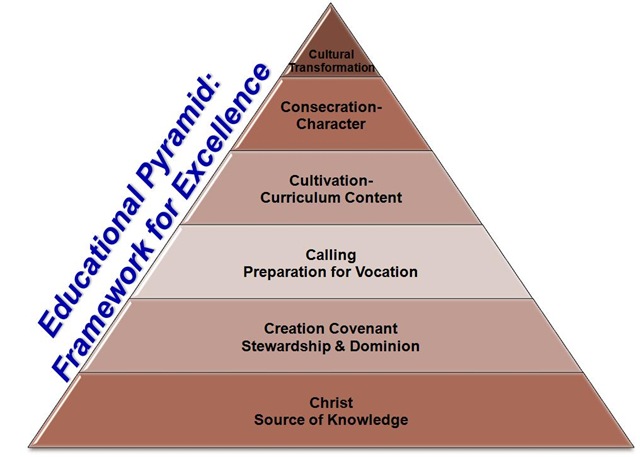
Education Pyramid

Below, for lack of a more creative title, is what I call the "Educational Pyramid" for Christian schooling.  The limitations of a blog article do not permit a comprehensive treatment of each component of the pyramid so a concise summary will have to suffice.

Each block of the Educational Pyramid builds upon the other. Beginning with the foundational understanding that Christ is the source and object of knowledge, the biblical doctrine of mankind's general call to exercise dominion and stewardship over creation is realized through each individual's vocational calling.  (for more information on this subject and the Creation Covenant, click here and see below.1)

Discovering and preparing for one's calling requires the development of a comprehensive course of instruction and co-curricular and extra-curricular programs.  Fulfilling one's calling for God's glory and in fulfillment of the Creation Covenant requires that one's time, talent, and treasure, realized through and arising from one's calling, be consecrated to God and to loving one's neighbor. 

Consecrating one's time, talent, and treasure through the dedication of one's vocation to God's glory and in loving one's neighbor inevitability leads to cultural transformation as Christians function as salt and light in this world.

More specifically, each block of the Educational Pyramid provides a rich framework for an expansive understanding of Christian education and for defining more comprehensively what we mean when we say we are striving to cultivate fruit, not merely create a product.

Christocentric Foundation

Christ is the ultimate source and object of all knowledge.  There is no knowledge, no truth, no harmony, no beauty, no freedom--nothing apart from Christ.  He is quite literally the Alpha and the Omega of existence and therefore of knowledge. 

For from him and through him and to him are all things. To him be glory forever. Amen. (Rom 11:36, ESV)

He has delivered us from the domain of darkness and transferred us to the kingdom of his beloved Son, in whom we have redemption, the forgiveness of sins. He is the image of the invisible God, the firstborn of all creation. For by him all things were created, in heaven and on earth, visible and invisible, whether thrones or dominions or rulers or authorities--all things were created through him and for him. And he is before all things, and in him all things hold together. And he is the head of the body, the church. He is the beginning, the firstborn from the dead, that in everything he might be preeminent. (Col 1:13-18, ESV)

Covenantal Mandate—General Call to Dominion and Stewardship (Gen. 1:27-30, 2:15)

Man has been called to the twin duties of exercising dominion and stewardship over creation. This is the raison d'être of his existence—to glorify God by engaging in creative and redemptive acts of dominion and stewardship over creation under the Lordship of Christ. To subdue and rule implies the sovereign exercise of control—the subjugation of creation to man. Cultivation is a stewardship activity—the process of preserving, nurturing, and improving creation for the purpose of increasing its beauty and benefit to man.

To aid him in this task, man invents tools--some simple like a shovel, some complex like a computer.  Some are cognitive like literature or mathematics.  Some are artistic like sculpture, music, or architecture. 

If the exercise of dominion and stewardship over creation for God's glory is the raison d'êtrefor our existence, then preparing students to use the tools required for doing so must be an important component of the Christian school’s curriculum. Students who graduate from a Christian school lacking fundamental skills and understanding in theology, science and technology, in the humanities, or in the arts will be handicapped in their efforts to glorify God through the redemptive exercise of dominion and stewardship.

Calling—Preparing for Vocation (Exod. 28:3, 31:6)

image

image

The general call (Creation Covenant) is personalized by God’s calling and gifting of individuals for specific vocations.  Our ultimate goal is not to prepare students to be "successful" as defined by Western culture, it is to assist our students in discovering God's gifting and calling in their lives even if  fulfilling that calling means they will make less money and not climb the ladder of "success". For a summary of the definition of vocation as I am using it, click here or see below1).

Cultivation--Curriculum Content

The doctrine of calling provides the theological and practical basis for providing a rich curriculum that encourages and stimulates the cultivation of the varied interests and aptitudes of our students.  This is typically accomplished by offering standard and advanced courses and electives in the sciences, the arts, and the humanities.  Our curriculum must be deep and broad enough to help students discover their interests and gifts (which are usually indicators of calling) and to prepare them to pursue their callings through higher education and work.

Consecration

Our prayer and hope is that our students will consecrate their gifts, knowledge, and skills in service to God and in loving their neighbor.   Paul reminds us that, “whatever we do, whether we eat or drink, we are to do it to the glory of God.”  For most of our students, this is an abstract concept.

Using Our Gifts for God’s Glory: Making the Abstract Concrete

image

To make this concept more concrete for 21st century students and to help them grasp what it means to consecrate themselves, their gifts, and their vocations to God, consider the following questions for class research, discussion, and debate: 

  • How do we use computers and other technology for the glory of God?

  • How does the Christian’s use of such technology differ from the non-Christian’s, or does it?

Similar questions can be asked about most any subject from history to physics.  By answering such questions our students will gain a more concrete and practical understanding of what it means to consecrate one’s work and life to the glory of God.

Using Our Gifts  for Loving our Neighbors

image

Continuing with the technology illustration, consider that computers are great tools for problem solving, communication, modeling, research, and information storage and retrieval. As such, they can be used to aid man’s efforts to fight disease, speed communication, improve engineering designs and safety, make space exploration feasible, improve efficiency in the generation of power, and a whole host of activities too numerous to list here. All of these activities are redemptive in nature, i.e., they contribute to the alleviation of the consequences of the curse and promote the welfare of our community and world. Used in this way, computers become instruments of love.

Again, this same approach can and should be used for every subject we teach.  For example, how can an understanding of history be used to love our neighbors?  How can becoming proficient with a musical instrument be used to love our neighbors?

A Powerful, Living Example

image

One of my favorite quotes comes from Dr. Francis Collins, a committed believer and the father of the Humane Genome Projectand as such one of the world's leading scientists.  Here is the statement he made standing beside President Bill Clinton when the announcement was made that the Humane Genome had been mapped.

image

"The human genome consists of all the DNA of our species, the hereditary code of life. This newly revealed text was 3 billion letters long, and written in a strange and cryptographic four-letter code. Such is the amazing complexity of the information carried within each cell of the human body, that a live reading of that code at a rate of one letter per second would take thirty-one years, even if reading continued day and night. Printing these letters out in regular font size on normal bond paper and binding them all together would result in a tower the height of the Washington Monument."

For the first time on a warm summer day six months into the new millennium, this amazing script, carrying within it all of the instructions for  building a human being, was available to the world …

Without a doubt, this is the most important, most wondrous map ever produced by humankind…we are learning the language in which God created life. We are gaining ever more awe for the complexity, the beauty, and the wonder of God’s most divine and sacred gift …

It’s a happy day for the world. It is humbling for me, and awe-inspiring, to realize that we have caught the first glimpse of our own instruction book (Ps. 139:16?), previously known only to God” (Dr. Francis Collins, A Scientist Presents Evidence for Belief: The Language of God, (Free Press, New York), 2006, pp. 2-3

Is this not how we want our students to fulfill their callings for God's glory and in loving their neighbors?  Does this not represent produce (fruit) and not merely a product?  Is this not for what we strive so diligently?

Cultural Transformation

Just as Francis Collins is doing, our schools should be designed to prepare our students to make positive contributions to their community and culture through personal witnessing and discipleship, scientific and economic progress, the acquisition, and dissemination of knowledge, and the amelioration of human suffering.  As Christian educators we have the opportunity to teach our students to use their learning for the glory of God and the good of our neighbors, not merely as Francis Schaeffer once put it, "for their personal peace and affluence." 

This is why Christian schools are so important--and why we must  bear fruit and not merely produce a product.

Education in general and Christian education in particular can exert a powerful influence on our students and in turn, on the quality of our national life. To be sure, there are other powerful forces shaping our students and culture. The media, technology, and politics, to name a few, but it is the quality of the education received by those who will start families, fill pulpits, develop our technology, create our entertainment, and pass our laws that will shape the character and quality of each individual and in turn the quality of our national life.

Waterdrop

Consequently, few callings allow one to contribute more directly to the shaping of lives and to the welfare of a nation than Christian education. Like raindrops falling into a pond, Christian educators shape lives and “drop” them into communities. Each life creates ripples—some small, some large—that radiate into the community affecting it for good or bad. Like a constant rain, the drops fall year after year all contributing individually and collectively to the national pool of talent and character that ultimately shapes our nation’s character and determines our national destiny.

So How Do We Ensure That We are Cultivating Produce, Not Making a Product?

image

So, with that as background, how do we ensure that we are cultivating fruit and not producing a product?  This may sound simplistic but Jesus provides the answer:

I am the true vine, and my Father is the vinedresser. Every branch of mine that does not bear fruit he takes away, and every branch that does bear fruit he prunes, that it may bear more fruit. Already you are clean because of the word that I have spoken to you. Abide in me, and I in you.  As the branch cannot bear fruit by itself, unless it abides in the vine, neither can you, unless you abide in me. I am the vine; you are the branches. Whoever abides in me and I in him, he it is that bears much fruit, for apart from me you can do nothing. (Joh 15:1-5, ESV)

Without attempting to exegete this passage, let me simply suggest that to abide in Christ so that we may bear much fruit means at least the following:

Prayerfulness

image

I find that I must guard myself against living like a "practical  atheist."  That is, if I am not diligent about prayer I can find myself working harder than I prayIf I do I may be productive but I will not bear fruit! 

Take a moment to read the following wonderful statement on reliance upon God.  As you read through this substitute preacher/preaching for teacher (administrator)/teaching/administrating. (You can download this in PDF format by clicking here or read it online at Christian Classics Ethereal Library.)

The Letter Killeth

During this affliction I was brought to examine my life in relation to eternity closer than I had done when in the enjoyment of health. In this examination relative to the discharge of my duties toward my fellow creatures as a man, a Christian minister, and an officer of the Church, I stood approved by my own conscience; but in relation to my Redeemer and Saviour the result was different. My returns of gratitude and loving obedience bear no proportion to my obligations for redeeming, preserving, and supporting me through the vicissitudes of life from infancy to old age. The coldness of my love to Him who first loved me and has done so much for me overwhelmed and confused me; and to complete my unworthy character, I had not only neglected to improve the grace given to the extent of my duty and privilege, but for want of improvement had, while abounding in perplexing care and labor, declined from first zeal and love. I was confounded, humbled myself, implored mercy, and renewed my covenant to strive and devote myself unreservedly to the Lord.—Bishop McKendree

THE preaching that kills may be, and often is, orthodox—dogmatically, inviolably orthodox. We love orthodoxy. It is good. It is the best. It is the clean, clear-cut teaching of God’s Word, the trophies won by truth in its conflict with error, the levees which faith has raised against the desolating floods of honest or reckless misbelief or unbelief; but orthodoxy, clear and hard as crystal, suspicious and militant, may be but the letter well-shaped, well-named, and well-learned, the letter which kills. Nothing is so dead as a dead orthodoxy, too dead to speculate, too dead to think, to study, or to pray.

The preaching that kills may have insight and grasp of principles, may be scholarly and critical in taste, may have every minutia of the derivation and grammar of the letter, may be able to trim the letter into its perfect pattern, and illume it as Plato and Cicero may be illumined, may study it as a lawyer studies his text-books to form his brief or to defend his case, and yet be like a frost, a killing frost. Letter-preaching may be eloquent, enameled with poetry and rhetoric, sprinkled with prayer spiced with sensation, illumined by genius and yet these be but the massive or chaste, costly mountings, the rare and beautiful flowers which coffin the corpse. The preaching which kills may be without scholarship, unmarked by any freshness of thought or feeling, clothed in tasteless generalities or vapid specialties, with style irregular, slovenly, savoring neither of closet nor of study, graced neither by thought, expression, or prayer. Under such preaching how wide and utter the desolation! how profound the spiritual death!

This letter-preaching deals with the surface and shadow of things, and not the things themselves. It does not penetrate the inner part. It has no deep insight into, no strong grasp of, the hidden life of God’s Word. It is true to the outside, but the outside is the hull which must be broken and penetrated for the kernel. The letter may be dressed so as to attract and be fashionable, but the attraction is not toward God nor is the fashion for heaven. The failure is in the preacher. God has not made him. He has never been in the hands of God like clay in the hands of the potter. He has been busy about the sermon, its thought and finish, its drawing and impressive forces; but the deep things of God have never been sought, studied, fathomed, experienced by him. He has never stood before “the throne high and lifted up,” never heard the seraphim song, never seen the vision nor felt the rush of that awful holiness, and cried out in utter abandon and despair under the sense of weakness and guilt, and had his life renewed, his heart touched, purged, inflamed by the live coal from God’s altar. His ministry may draw people to him, to the Church, to the form and ceremony; but no true drawings to God, no sweet, holy, divine communion induced. The Church has been frescoed but not edified, pleased but not sanctified. Life is suppressed; a chill is on the summer air; the soil is baked. The city of our God becomes the city of the dead; the Church a graveyard, not an embattled army. Praise and prayer are stifled; worship is dead. The preacher and the preaching have helped sin, not holiness; peopled hell, not heaven.

Preaching which kills is prayerless preaching. Without prayer the preacher creates death, and not life. The preacher who is feeble in prayer is feeble in life-giving forces. The preacher who has retired prayer as a conspicuous and largely prevailing element in his own character has shorn his preaching of its distinctive life-giving power. Professional praying there is and will be, but professional praying helps the preaching to its deadly work. Professional praying chills and kills both preaching and praying. Much of the lax devotion and lazy, irreverent attitudes in congregational praying are attributable to professional praying in the pulpit. Long, discursive, dry, and inane are the prayers in many pulpits. Without unction or heart, they fall like a killing frost on all the graces of worship. Death-dealing prayers they are. Every vestige of devotion has perished under their breath. The deader they are the longer they grow. A plea for short praying, live praying, real heart praying, praying by the Holy Spirit—direct, specific, ardent, simple, unctuous in the pulpit—is in order. A school to teach preachers how to pray, as God counts praying, would be more beneficial to true piety, true worship, and true preaching than all theological schools.

Stop! Pause! Consider! Where are we? What are we doing? Preaching to kill? Praying to kill? Praying to God! the great God, the Maker of all worlds, the Judge of all men! What reverence! what simplicity! what sincerity! what truth in the inward parts is demanded! How real we must be! How hearty! Prayer to God the noblest exercise, the loftiest effort of man, the most real thing! Shall we not discard forever accursed preaching that kills and prayer that kills, and do the real thing, the mightiest thing—prayerful praying, life-creating preaching, bring the mightiest force to bear on heaven and earth and draw on God’s exhaustless and open treasure for the need and beggary of man?

A Few Practical Practices

I have a very long way to go in improving my prayer life but by God's grace I have made a habit, not a perfect one but a consistent one, of doing the following, which I offer to you with the hope that these practical suggestions may encourage you in your prayerfulness so that you and I might bear much fruit.

  • Start each day with prayer.  I pray that God will "bless the work of my hands each day."  I take this prayer, believe it or not, from a statement by Satan concerning Job "Have you not put a hedge around him and his house and all that he has, on every side? You have blessed the work of his hands, and his possessions have increased in the land." (Job 1:10, ESV)  My interest in not possessions but God' blessing on my labor. I do not want to labor in vain.

  • Pray at the beginning of each meeting and prior to small and large decisions alike.  By prayer I do NOT mean a formalistic, ritualistic, obligatory prayer said before the start of meetings because this is what is expected.  I do not mean a mere habit.  I mean sincere short prayers that recognize the need for divine wisdom, God's kind providence, and the truth that  "Unless the LORD builds the house, those who build it labor in vain. Unless the LORD watches over the city, the watchman stays awake in vain. (Psa 127:1, ESV)

  • I often receive prayer requests by email.  In order to be faithful to pray, as soon as I read the email I stop to pray for the request.  If I do not pray then I am likely to forget.  Likewise, if someone asks me to pray for them at school or in church, I try to immediately say a silent prayer so that I keep my word that "I will pray for him or her."

  • By God's grace I try to make a habit of continuous, silent, short prayers throughout the day as issues arise, needs become known, opportunities present themselves and decisions have to be made--even in how best to respond to an email.  I sometimes pray before responding to emails in which I am asked for a decision or when frustration is being expressed, "Lord, help me to respond with grace, truth, and in wisdom."  Paul instructs us that we are to "Rejoice always, pray without ceasing, give thanks in all circumstances; for this is the will of God in Christ Jesus for you. Do not quench the Spirit."  (1Th 5:16-19, ESV)

The Study of God's Word

image

It is disingenuous and self-deluding to expect God to grant wisdom if we are not willing to gain the wisdom and understanding that He has already given to us in His Word.  To neglect God's word is to neglect God's primary instrument for our sanctification and the source of divine wisdom and understanding.  Move beyond the five-minute devotional--read and study God's word so that you nourish your own soul and have something to give to others.

Your commandment makes me wiser than my enemies, for it is ever with me. I have more understanding than all my teachers, for your testimonies are my meditation. I understand more than the aged, for I keep your precepts. I hold back my feet from every evil way, in order to keep your word. I do not turn aside from your rules, for you have taught me. How sweet are your words to my taste, sweeter than honey to my mouth! Through your precepts I get understanding; therefore I hate every false way. Your word is a lamp to my feet and a light to my path.  (Psa 119:98-105, ESV)

They are not of the world, just as I am not of the world. Sanctify them in the truth; your word is truth. (Joh 17:16-17, ESV)

Do not be conformed to this world, but be transformed by the renewal of your mind, that by testing you may discern what is the will of God, what is good and acceptable and perfect. (Rom 12:2, ESV)

I do not cease to give thanks for you, remembering you in my prayers, that the God of our Lord Jesus Christ, the Father of glory, may give you a spirit of wisdom and of revelation in the knowledge of him, ... (Eph 1:16-17, ESV)

The Worship of God and the Fellowship of the Saints

image

One cannot grow in wisdom, cannot abide in Christ, and cannot bear fruit apart from the Worship of God and the fellowship of His people.  Just as an ember will grow cold when removed from the flame, so too our souls will grow cold if not nourished through worship and fellowship.

But the hour is coming, and is now here, when the true worshipers will worship the Father in spirit and truth, for the Father is seeking such people to worship him. God is spirit, and those who worship him must worship in spirit and truth." (Joh 4:23-24, ESV)

Not neglecting to meet together, as is the habit of some, but encouraging one another, and all the more as you see the Day drawing near. (Heb 10:25, ESV)

How Are You Doing?

If you are like me you desire to cultivate fruit in the lives of your students, your staff, and your parents.  We do not want to reach the end of our work and our lives and look back and simply see a "product." 

Anyone can create a product.  Look around you--there are many unbelievers who are doing great things-building great products and companies, establishing great schools, making great scientific breakthroughs, exploring space, and curing disease.

The difference is that you and I are called to bear fruit, which transcends product making.  Products of any sort will end with this present world.  Fruit will abide forever.

  • How are you doing in abiding in Christ? 

  • How is your prayer life?

  • Are you studying God's word and not merely having a five-minute devotional?

  • Are you consistent in worship and when you are in church, are you worshipping your Creator and Redeemer or are you attending church?

Don't waste your life building and running a school or teaching a class.  Cultivate an orchard.

Without Christ we cannot bear spiritual fruit.  "As the branch cannot bear fruit by itself, unless it abides in the vine, neither can you, unless you abide in me."

I planted, Apollos watered, but God gave the growth. So neither he who plants nor he who waters is anything, but only God who gives the growth. He who plants and he who waters are one, and each will receive his wages according to his labor. For we are God's fellow workers.

You are God's field, God's building. According to the grace of God given to me, like a skilled master builder I laid a foundation, and someone else is building upon it. Let each one take care how he builds upon it. For no one can lay a foundation other than that which is laid, which is Jesus Christ.

Now if anyone builds on the foundation with gold, silver, precious stones, wood, hay, straw-- each one's work will become manifest, for the Day will disclose it, because it will be revealed by fire, and the fire will test what sort of work each one has done. If the work that anyone has built on the foundation survives, he will receive a reward. If anyone's work is burned up, he will suffer loss, though he himself will be saved, but only as through fire. (1Co 3:6-15, ESV)

______________________________________________________

image

1Vocation Defined, from Wikipedia

Definition

The word "vocation" comes from the Latinvocare, meaning "to call"; however, its usage before the sixteenth century, particularly in the Vulgate, refers to the calling of all humankind to salvation, with its more modern usage of a life-task first employed by Martin Luther.

Concept

The idea of vocation is central to the Christian belief that God has created each person with gifts and talents oriented toward specific purposes and a way of life. Particularly in the Orthodox and Catholic Churches, this idea of vocation is especially associated with a divine call to service to the Church and humanity through particular vocational life commitments such as marriage to a particular person, consecration as a religious, ordination to priestly ministry in the Church and even a holy life as a single person. In the broader sense, Christian vocation includes the use of ones gifts in their profession, family life, church and civic commitments for the sake of the greater common good.

In Religious History

The idea of a vocation or "calling" has been pivotal within Protestantism. Martin Luther taught that each individual was expected to fulfill his God-appointed task in everyday life. Although the Lutheran concept of the calling emphasized vocation, there was no particular emphasis on labor beyond what was required for one's daily bread. Calvinism transformed the idea of the calling by emphasizing relentless, disciplined labor. In the Institutes of the Christian Religion (1536), Calvin defined the role of "The Christian in his vocation." He noted that God has prescribed appointed duties to men and styled such spheres of life vocations or callings. Calvinists distinguished two callings: a general calling to serve God and a particular calling to engage in some employment by which one's usefulness is determined.

The Puritan minister Cotton Mather, in A Christian at his Calling (1701), described the obligations of the personal calling as, "some special business, and some settled business, wherein a Christian should for the most part spend the most of his time; so he may glorify God by doing good for himself." Mather admonished that it wasn't lawful ordinarily to live without some calling, "for men will fall into "horrible snares and infinite sins." This idea has endured throughout the history of Protestantism. Three centuries after John Calvin's death, Thomas Carlyle (1843) would proclaim, "The latest Gospel in this world is, 'know thy work and do it.'"

Technorati Tags:

Abiding

,

Abiding in Christ

,

Fruit Bearing

,

Product

,

Produce

,

Leadership

,

Prayer

,

prayerfulness

,

Bible

,

God's Word

,

Devotion

,

Worship

,

Creation Mandate

,

Creation Covenant

,

Vocation

,

Calling

,

Vocational calling

,

leading

,

Consecration

,

culture

Remarkable Times, Remarkable Blessings
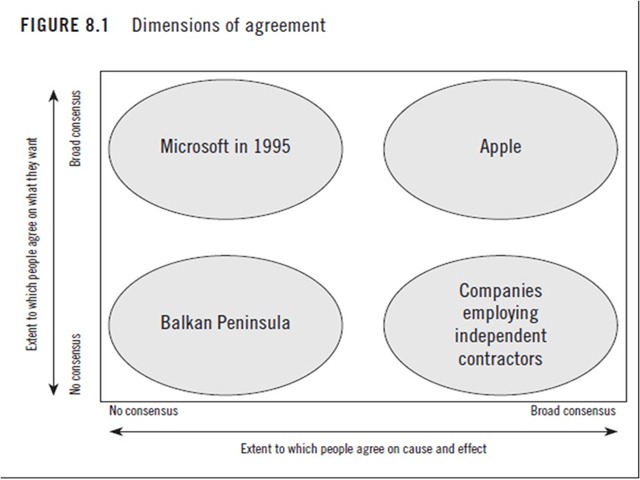
photo-9Remarkable Times, Remarkable Blessings
by Zach Clark, Westminster Christian Academy, St. Louis

There is always a non-voodoo explanation.
From the TV series, Monk

In January of 2009, news began to spread that our nation and world truly was suffering the “worst economic crisis since the Great Depression”. The first week of January I was on the phone with Barrett Mosbacker, and I said to him, “I believe 2009 is going to be a remarkable year!” Barrett asked, “Remarkable in what way?” And I replied, “That’s what I like about that word…remarkable…I’m going to be right whether things get worse than anyone imagines or better than anyone dares hope for.”

2009 has been truly remarkable, and it’s not over yet. At the Christian school (grades 7-12) where I serve we faced the threats of major shifts in our region and world. From what I hear, it is possible that every Christian school in America faced some unique challenges this year, and many are struggling. At Westminster Christian Academy, we have been greatly encouraged by how God is leading us through these challenges. We are trying to determine what we are doing right (so we can keep doing it) and what we need to change or improve in the future (so we can stay strong).

I’m hopeful that some of my personal thoughts on the threats, strategies, blessings, and challenges that we have faced might be helpful to you.

We began the 2008-09 year having experienced the following in previous years:

  1. Ongoing enrollment growth.
  2. Ongoing income growth and record levels of giving.
  3. Constant programmatic improvements and reputation for increasing quality.
  4. The beginning of a capital campaign calling for transformational facility expansion, an entirely new campus.
  5. A projection for another year of enrollment growth in 2009-10.

Only six months later, by February, we realized reality had changed:

  1. A tuition increase was in place, although lower than in most recent years at 5%, it was still noticeable and felt by parents.
  2. Shifts in our inquiries for admissions data suggested that enrollment would most likely hold steady, and more re-enrolling families than ever before would be requesting financial aid for the first time.
  3. Unrestricted giving providing important dollars for the budget was the lowest in seven years. We projected our budget giving would be as much as 20% off of our budget.
  4. Resistance to making any long-term campaign commitments was overwhelming.
  5. A region-wide culture of fear and strong reactions was in place as we received constant advice on planning for such things as a possible 30% decrease in enrollment and 40-50% decreases in giving.

Another six months later, in August 2009, we started this school year with some amazing news of God’s provision through these difficult times.

  1. Record enrollment, surpassing even our pre-economic crisis projections.
  2. Record giving, and only a 10% drop in budget giving.
  3. No significant cuts to people or programs that impact students and families.

Above I’ve provided a very general and high-level view of some of the key economic health indicators of a Christian school, and how dramatically they shifted. Perhaps your circumstances were more challenging or less so.

What I want to focus on in this piece is how we responded and the steps that we took because I believe they are instructive and helpful. Even though some may say the “crisis is behind us,” the basic steps we’ve taken and how we continue to move forward are based on core values and principles of effectiveness that should be helpful and transformative at any time. Our school leadership continues to discuss these, analyze these, and seeks to understand what is happening.

The aforementioned shifts literally seemed to occur overnight and our heads were spinning. There is no reason to pretend that we all “knew what to do.” Every person I talked to at the beginning of 2009 seem dumbfounded and awed by the changes that were occurring. I kept hearing people say, “I’ve never seen anything like it.” But, we took a deep breath, we prayed, we asked a lot of people for advice, and we tried to be steady and strong as we outlined how we intended to move forward during these strange times.

Firstly, we recognized that this is an overwhelming difficult time for so many people. Husbands and wives are facing fears and tests of faith they have never experienced before. Fathers and mothers are enduring major adjustments to their careers and lifestyles. Children are dealing with questions and uncertainty unique to this moment in history.

Secondly, we began by asking the question found in Ezekiel 33: “How should we then live?” We are finding strength in a renewed sense of our dependence upon God as we remember His faithfulness.

Thirdly, we made a conscious decision not to go into what we called a “hunker-down” mode. We wanted to be willing to make tough decisions but be proactive and not simply reactive.

Fourthly, we committed to communicate in an encouraging but straightforward manner.

Lastly, and maybe most importantly, we asked the Lord to help us discover ways to make decisions with the right priorities in mind. We believed this is a time where we could make significant statements about who we really are as a school community. We prayed that we could seize opportunities to live out the truth that God, in His unchanging love through Jesus Christ, is the faithful, merciful, and compassionate Provider and Savior of the world.

One of the things I personally learned is that all of the above is really easy to talk about. It’s taking the time to establish priorities and then make tough decisions to back it up that is the truly hard and sometimes painful part.

So, we recognized reality, asked questions, prayed, resisted the urge to hit the panic button, prepared to communicate, and established priorities to guide our decision making...and I mean all of this in the most literal sense possible.

Here are the priorities we established, put in writing, and communicated.

Priority #1: Today and Every Day

Today and every day, we will hold to our mission and vision to see young men and women equipped to engage the world and change it for Jesus Christ. Our core values will never change. We will keep the main thing, the main thing: the Christian education of the individual student. We continue to strive to hire and keep the best teachers, coaches, and staff members. We constantly improve, offering better value to students and families through the years, always working to become better than we once were.

Priority #2: Stronger Tomorrow

We are making the tough decisions that help us stay financially strong over the long haul. We are holding fast to the families we serve, enrolling new students, and we will serve families in good times and bad. We are pushing forward on difficult decisions that pave the way for our future sustainability, ensuring a strong Westminster in the future. We will also introduce new technologies and programs that best equip our students for their future, not our past. We will not compromise the quality of today for tomorrow’s dreams, but neither will we make decisions that are so shortsighted that they compromise the financial stability of our future.

Priority #3: Moving Ever Forward

We will continue to implement our strategic plan and communicate our vision for the future, providing opportunities for people to make a difference and make decisions that move us ever forward as a Christian school. Planning will continue to be a dynamic part of our culture. We pray that God will move the hearts of people to give in order to keep Westminster strong and improving, and we will continue to wait upon the Lord for the sale of our current campus and provision of our future dreams.

It is usually easy to establish priorities, the challenging part is making decisions on a daily basis that honor your priorities.

Then, we took it a step further. We articulated, in very specific terms, the types of disciplined actions we would be taking to reflect those priorities. I’ve underlined here the key principles.

  • Implement conservative spending and aggressive fund-raising, making some tough decisions along the way in our annual budgets.
  • Support creativity and innovation among teachers.
  • Continue to go the extra mile for students who struggle socially or academically.
  • Promote even more personal involvement of teachers and coaches in the lives of students and families, as many will face unusual challenges.
  • Respond to the unique economic problems that may be faced by our parents and teachers to the very best of our ability.
  • Improve our processes and communications with parents, utilizing non-paper methods to improve speed and lower costs.
  • Leap forward in technology integration at the classroom level and 21st Century learning for students.

And then, we started moving forward on all these actions in very tangible ways. I won’t go into every action, but here are some:

  • We communicated like crazy, even asking families to respond to a “Share Your Heart” survey so they could tell us privately how the economy was really affecting them and give us advice.
  • We put our campaign on a short-term hold, because Priority 2 said, “we will not compromise the quality of today for tomorrow’s dreams.”
  • We froze faculty/staff salaries.
  • We increased our total financial aid budget to respond to many re-enrolling families experiencing dramatic economic difficulty.
  • We asked teachers and staff to give us their ideas on how to save money without reducing quality.
  • We looked for key ways to add value to families without adding cost.
  • We made significant shifts in our costs of paper and printing.
  • Every administrator became personally responsible for helping teachers, staff, and even volunteers focus on student retention and new family enrollment.
  • We increased our focus and energies on improving the school through changes, innovations, improvements, and efficiencies. And, we continued to focus on the implementation our Strategic Plan.
  • We made our most significant and visible investment in technology for teachers ever, with every teacher receiving a new Macbook.

Ultimately, it is God’s mercies and provision, by His grace, that sustains us. But, I also know that God works through people, their decisions, and their strengths and weaknesses. Many schools are facing far more difficult times than we have. We do not pretend to fully understand all of what has happened or what is happening now. But, I do challenge you to join us in the day-to-day discipline of asking questions and digging deeper down and climbing higher up in the understanding of this calling of serving in a Christian school in today’s times.

2009 is indeed a remarkable year, and remarkable times remain ahead. Let us go forward together.

They Are Coming After Your Students and Said So!

Dr. Barrett Mosbacker, PublisherAt a recent Executive Symposium on Distance Education that I attended a public school superintendent, not knowing I was from a private school, said to the group (to paraphrase), "we are developing a robust online program and we fully expect to recapture students from home schooling families and private schools."

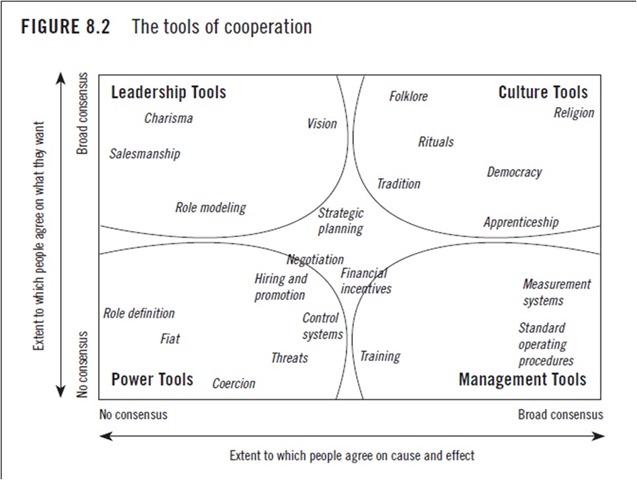
I just reread portions of Christensen's excellent book, "Disrupting Class".  I am particularly interested by his analysis of the "Dimensions of Agreement" and the "Tools of Cooperation".  I have attached graphics depicting the concepts.  These are particularly important to me because it can be difficult to get staff to accept change--I find this particularly problematic among conservative Christians, whom by definition, are "conservative."  :-)  In my estimation, moving forward, carefully and thoughtfully, with distance learning programs in imperative but it is not an easy task--the learning curve is steep, creating a feasible business plan is critical, and getting buy in can be tough.  But, Christensen argues, refreshingly, that consensus is not necessarily the goal--cooperation is!  I find that a refreshing approach given the emphasis on consensus building over the last several decades in the management literature.  I was also surprised by his observation that change is most difficult when there is wide agreement on the goals and processes currently in place.  Generally, one would think that this is a good thing. Upon reflection, however, it is easy to see why change in an organization can be very difficult when the organization is in the upper right quadrant of the dimensions of agreement chart.  This means that one of our challenges is to challenge the consensus on the goals and/or processes currently in place, which is all the more difficult when the organization is successful.  In other words, success can actually work against us, as in "good is the enemy of great."  It is what I'm calling the "Hobbit Effect."

In the Lord of the Rings, the Hobbits went merrily about their lives oblivious to the fact that Mordor was rising and threatening them.  Only a few saw the danger and acted.  I wonder if distance learning and charter schools aren't the "Mordors" of Christian education.  While we argue about uniforms, dress codes, and tuition discounts, the public system is installing a robust distance learning infrastructure and charters are multiplying.  Will we wake up in 10 years and wonder what happened to our market?’

Christensen (2008), Disrupting the classroom, p. 187

Dimensions of Agreement Christensen 

Tools of Cooperation Christensen

I am so impressed with Christensen's book that I've ordered two more:
The Innovator's Dilemma: The Revolutionary Book that Will Change the Way You Do

The Innovator's Solution: Creating and Sustaining Successful Growth

Jesus, Save Us From Your Followers

image

By Jay Matthews

Just had the privilege to view the documentary in selected theaters, "Jesus Save Us From Your Followers." I had an inside source allow me to see a DVD of it and have had some time to view it in sections.

Very clever movie and very impressive in terms of the visual presentation and trendy graphics.

The documentary explores the polarization of American culture over issues of faith and asks a great question: What is wrong? Why is there so much venom over such a beautiful message- the gospel of Jesus Christ?

Dan Merchant presents an excellent exploration of this caustic culture in these important areas.

I found the movie helpful in some points, but too silent on two large aspects of this issue.

First: We have lost civil dialogue in this culture. Disagreement usually means 'war'. Instead of honest debate- we hurl sound bites over the internet or through talking heads. I agree that we have lost humility and love in the message. The section of the movie (inspired by Blue Like Jazz) of Christian confession was very powerful.

Second: We are ignorant of opposing worldviews and uneducated in the trends of mainstream culture. The culture war mantra has made these issue oriented debates instead of human relationships.

I agree with these premises and, sadly, am guilty as charged.

But there are two other major problems in our presentation of the gospel.

1) We need to be more tender to the 'world' - but we have lost accountability inside the church. There is no discernible difference inside the American church and outside the American church today. We are guilty of loving the world. We have the same consumerist tendencies- we have the same divorce rate- we have the same pattern of addiction and cynicism. Our lips love Jesus, but our hearts love the world.

This problem stems from a lack of seeing sin as serious. We have preached the watered down gospel. To quote Niebur,

A God without wrath brought men without sin into a Kingdom without judgment through the ministrations of a Christ without a Cross.

The bad news is not bad... so the good news is not good.

2) We also stand as the most biblically illiterate generation in America. Our reading comprehension slowly dwindles and the light of the Word is dimming. I recently read a handout from C.S. Lewis to my freshman Bible class- when I finished a student said, "I didn't understand a word he said."

The purity of the church is diminishing because God's word is being eclipsed in our midst.

We should be tender to others and tough on ourselves. We need God's Spirit to convict us of sin. We need to stop posing and come clean in our sin- but we also need to move toward repentance and holiness.

One final comment- the Gospel of Christ will be offensive. Granted, it should be the only offensive part of our life as we seek to love, serve, in humility live above reproach. But if we ever think that we will live in harmony with the world.... don't be gullible.

So I come away from the movie conflicted... I want to stand for righteousness and preach forgiveness. That means drawing hard lines which will make me appear intolerant and offensive. I need to love sinners, but I cannot ignore sin.

Sin destroys.. the gospel heals. Help me Lord find the balance- help me walk in the truth. Anyone else seen this documentary? Comments? I won't be offended if you disagree!

What is Google Wave and Why Should You Care?

What is Wave?

Google Wave is an online tool for real-time communication and collaboration. A wave can be both a conversation and a document where people can discuss and work together using richly formatted text, photos, videos, maps, and more.

A wave is equal parts conversation and document. People can communicate and work together with richly formatted text, photos, videos, maps, and more.

A wave is shared. Any participant can reply anywhere in the message, edit the content and add participants at any point in the process. Then playback lets anyone rewind the wave to see who said what and when.

A wave is live. With live transmission as you type, participants on a wave can have faster conversations, see edits and interact with extensions in real-time.

Why Should I Care?

If you you are like many, the rapid unrelenting wave (yes, the pun is intended) of new technologies can be mind numbing, even exhausting.  Who can keep up with it all?  Should we even try?

No, we cannot keep up with all of it but yes, we should try to stay current.  There are several reasons to stay on top of developments like Google Wave:

  • As leaders, we do not want to be caught with our pants down when a new technology explodes on the scene fundamentally changing the way we communicate and interact.  IF it is a efficient and cost effective technology we need to know about it before investing limited resources in outdated technologies, irrelevant training, and misaligned infrastructure.
  • Some technologies have the potential to be game changers—they can change the expectations of parents and students and they can change the educational market, Distance Learning and the concomitant technologies is one example.
  • Your credibility as a leader is affected by your “currency.”  If you don’t know what’s going on today it is hard to convince others that you are equipping your students for tomorrow.
  • Good technologies, effectively used, can increase your productivity.
  • Google Wave may provide additional evidence that Email as we know it no longer rules.  See my related article: “For Good or Bad: Email No Longer Rules".”

Here are three videos that explain Google Wave.  Want to try Wave?  You will need an invitation.  Click here.

The Short Version

The Longer Version

The Really Thorough, Long Version!

Not So Fast: Is Technology Diminishing Our Quality of Life?

By Dr. Barrett Mosbacker

Anyone who has been reading this blog knows that I am an advocate for the appropriate and effective use of technology in our personal lives and in our schools.  I am not a Luddite.

Nevertheless, I also share the conviction that technology, like many good things in our lives, can become an obsession and a cruel master.  Any addiction, even to good things, is harmful and unbiblical whether it is sex, food, work, or technology.

I recently came across a beautifully written article by John Freeman in the Wall Street Journal.  You can read the entire article here.  If the link is broken, you can access the article in PDF format here.

Because the article is copyrighted I will not post it here but I am providing a short excerpt with the hope that you will read the entire article. 

Not So Fast (August 29, 2009) WSJ Online

… We will die, that much is certain; and everyone we have ever loved and cared about will die, too, sometimes—heartbreakingly—before us. Being someone else, traveling the world, making new friends gives us a temporary reprieve from this knowledge, which is spared most of the animal kingdom. Busyness—or the simulated busyness of email addiction—numbs the pain of this awareness, but it can never totally submerge it. Given that our days are limited, our hours precious, we have to decide what we want to do, what we want to say, what and who we care about, and how we want to allocate our time to these things within the limits that do not and cannot change. In short, we need to slow down.

Our society does not often tell us this. Progress, since the dawn of the Industrial Age, is supposed to be a linear upward progression; graphs with upward slopes are a good sign. Process­ing speeds are always getting faster; broadband now makes dial-­up seem like traveling by horse and buggy. Growth is eternal. But only two things grow indefinitely or have indefinite growth firmly ensconced at the heart of their being: cancer and the cor­poration. For everything else, especially in nature, the consum­ing fires eventually come and force a starting over.

The ultimate form of progress, however, is learning to decide what is working and what is not; and working at this pace, emailing at this frantic rate, is pleasing very few of us. It is encroaching on parts of our lives that should be separate or sacred, altering our minds and our ability to know our world, encouraging a further distancing from our bodies and our natures and our communities. We can change this; we have to change it. Of course email is good for many things; that has never been in dispute. But we need to learn to use it far more sparingly, with far less dependency, if we are to gain control of our lives.

In the past two decades, we have witnessed one of the greatest breakdowns of the barrier between our work and per­sonal lives since the notion of leisure time emerged in Victorian Britain as a result of the Industrial Age. It has put us under great physical and mental strain, altering our brain chemistry and daily needs. It has isolated us from the people with whom we live, siphoning us away from real-world places where we gather. It has encouraged flotillas of unnecessary jabbering, making it difficult to tell signal from noise. It has made it more difficult to read slowly and enjoy it, hastening the already declining rates of literacy. It has made it harder to listen and mean it, to be idle and not fidget. This is not a sustainable way to live. This lifestyle of being constantly on causes emotional and physical burnout, work­place meltdowns, and unhappiness. How many of our most joyful memories have been created in front of a screen?

If we are to step off this hurtling machine, we must reassert principles that have been lost in the blur. It is time to launch a manifesto for a slow communication movement, a push back against the machines and the forces that encourage us to remain connected to them. Many of the values of the Internet are social improvements—it can be a great platform for solidarity, it rewards curiosity, it enables convenience. This is not the mani­festo of a Luddite, this is a human manifesto. If the technology is to be used for the betterment of human life, we must reassert that the Internet and its virtual information space is not a world unto itself but a supplement to our existing world, where the following three statements are self-evident …

Remember, click here to read the full article or if the link is broken, you can access the article in PDF format here.