Welcome to the Library. Say Goodbye to the Books

Things are changing!  For many years e-books have resided in the back waters of publishing.  Early adopters and gadget freaks have read them but the vast majority of the population were either unaware of them or didn’t care.

Kindle DX: Amazon's New Addition To the Kindle FamilyThe lowly status of the e-book may be about to change—and radically.  David Weir, in a BNET (a business and management blog) article outlines five reasons why he believes e-book publishing and use is reaching their tipping point--becoming widely accepted and on the way to outpacing printed books in popularity.

1.  Screen reading now rivals paper reading, and for those of us in the over 40 set, screen reading is often easier on the eyes thanks to adjustable font sizing.

2.  Consumer awareness has increased dramatically.  A year ago, consumers were skeptical and resistant to e-books.  Today, consumers are doing a complete 180.  The early adopters have celebrated their Sony Readers, Kindles and iPhones to their friends, and now their friends want in.

3.  The amount of content is increasing.  Free books have served as a gateway drug to many early adopters.

4.  Ebooks are impulse buys.  I met a guy at the Las Vegas airport last month who told me he purchased a Sony Reader so he wouldn’t have to lug around 20 pounds of technical manuals.  Now he finds himself buying more fiction than ever before because it’s so easy and convenient.

5.  Value.  E-books are cheaper.

My Personal Experience

I love books.  My study is wall to wall books and I have spent thousands of dollars on my traditional library.  I love to read and I love the feel and smell of books.

img_0002Nevertheless, my reading habits are changing.  In fact, I recently finished reading Dr. Poythress’ excellent book, Redeeming Science (384 pages) on my iPhone version of the Kindle (Read a review: Amazon launches Kindle application for the iPhone).

After reading Dr. Poythress’ book on my iPhone, I have concluded that I would love to have the Kindle DX for the vast majority of my reading.  In fact, I would like to duplicate my printed library on the Kindle.

Hint to my wife: great Christmas present!

Although there are some drawbacks to e-books/e-readers relative to printed books (mainly sentimental), the advantages are numerous including:

1. The ability to read books, newspapers, magazines, and blogs anywhere anytime without the need to carry large books and dirty newspapers.  The Kindle DX for example is just over 1/3 of an inch, as thin as most magazines.  This is particularly an advantage when traveling or when in waiting rooms.

2. The ability to literally carry a library in my pocket or laptop case.  I could carry to 3,500 books, periodicals, and documents in the Kindle DX.

3. For those of us who are a little older, the ability to adjust font size is a big advantage (yes, pun was intended).  The Kindle DX has a 9.7" diagonal e-ink screen and reads like real paper and boasts 16 shades of gray for clear text and sharp images.  Additionally, the device has a display that auto-rotates from portrait to landscape as you turn the device so you can view full-width maps, graphs, tables, and Web pages.

4. I can read PDF documents enabling me to read my personal and professional documents on the go.

5. With wireless 3G I can download books and magazine to the Kindle DX anytime, anywhere; there are no monthly fees, no annual contracts, and no hunting for Wi-Fi hotspots.

6.  Currently, Amazon has over 300,000 e-books; many of which are only $9.99.

7. I can have subscriptions to U.S. and international newspapers including the New York Times and Wall Street Journal (both of which I read), magazines including The New Yorker and Time, plus popular blogs, all auto-delivered wirelessly.

8. I could have an electronic backup of my library.  If house on firethere a fire in my house, I would find it hard and probably impossible to replace many of my out of print books.  If my library was on the Kindle, I could re-download my library from Amazon, Project Gutenberg, etc.

According to the Kindle Review, a lot of the books available at Project Gutenberg are already available in Kindle .azw format at ManyBooks (if you’re using your laptop). There are 19,505 eBooks available at ManyBooks and they’re all free! When you get to the page for an individual book, just click on the dropdown at the top right that says ‘Free Download’ + ‘ Select Format’ and the FIRST option is Kindle.

Note: You can browse and download Manybooks on the Kindle. @ mnybks.net

For Project Gutenberg books that are not available at ManyBooks, you can go to the Project Gutenberg Website. You can download EVERY book on Gutenberg to your Kindle for Free. No conversion required. This is a good page to start at Project Gutenberg to get Free Kindle eBooks.

Potential for Our Schools

I am not prepared to go as far as Cushing Academy (see below) but I am reviewing the potential of using Kindles, netbooks, and other electronic devices to supplement our library and textbooks.  One of the great advantages for our students would be that they would not have to carry heavy book bags around all day.

Welcome to the library. Say goodbye to the books.

Cushing Academy embraces a digital future

By David Abel, Globe Staff  |  September 4, 2009

Boston prep school nixes all the books in its library, replaces them with 18 e-readers

ASHBURNHAM - There are rolling hills and ivy-covered brick buildings. There are small classrooms, high-tech labs, and well-manicured fields. There’s even a clock tower with a massive bell that rings for special events.

Cushing Academy has all the hallmarks of a New England prep school, with one exception.

This year, after having amassed a collection of more than 20,000 books, officials at the pristine campus about 90 minutes west of Boston have decided the 144-year-old school no longer needs a traditional library. The academy’s administrators have decided to discard all their books and have given away half of what stocked their sprawling stacks - the classics, novels, poetry, biographies, tomes on every subject from the humanities to the sciences. The future, they believe, is digital.

“When I look at books, I see an outdated technology, like scrolls before books,’’ said James Tracy, headmaster of Cushing and chief promoter of the bookless campus. “This isn’t ‘Fahrenheit 451’ [the 1953 Ray Bradbury novel in which books are banned]. We’re not discouraging students from reading. We see this as a natural way to shape emerging trends and optimize technology.’’

Instead of a library, the academy is spending nearly $500,000 to create a “learning center,’’ though that is only one of the names in contention for the new space. In place of the stacks, they are spending $42,000 on three large flat-screen TVs that will project data from the Internet and $20,000 on special laptop-friendly study carrels. Where the reference desk was, they are building a $50,000 coffee shop that will include a $12,000 cappuccino machine.

And to replace those old pulpy devices that have transmitted information since Johannes Gutenberg invented the printing press in the 1400s, they have spent $10,000 to buy 18 electronic readers made by Amazon.com and Sony. Administrators plan to distribute the readers, which they’re stocking with digital material, to students looking to spend more time with literature.

Those who don’t have access to the electronic readers will be expected to do their research and peruse many assigned texts on their computers.

“Instead of a traditional library with 20,000 books, we’re building a virtual library where students will have access to millions of books,’’ said Tracy, whose office shelves remain lined with books. “We see this as a model for the 21st-century school.’’

Not everyone on campus is sold on Tracy’s vision.

They worry about an environment where students can no longer browse rows of voluptuous books, replete with glossy photographs, intricate maps, and pages dog-eared by generations of students. They worry students will be less likely to focus on long works when their devices are constantly interrupting them with e-mail and instant messages. They also worry about a world where sweat-stained literature is deemed as perishable as all the glib posts on Facebook or Twitter.

Liz Vezina, a librarian at Cushing for 17 years, said she never imagined working as the director of a library without any books.

“It makes me sad,’’ said Vezina, who hosts a book club on campus dubbed the Off-line Readers and has made a career of introducing students to books. “I’m going to miss them. I love books. I’ve grown up with them, and there’s something lost when they’re virtual. There’s a sensual side to them - the smell, the feel, the physicality of a book is something really special.’’

Alexander Coyle, chairman of the history department, is a self-described “gadget freak’’ who enjoys reading on Amazon’s Kindle, but he has always seen libraries and their hallowed content as “secular cathedrals.’’

“I wouldn’t want to ever get rid of any of my books at home,’’ he said. “I like the feel of them too much. A lot us are wondering how this changes the dignity of the library, and why we can’t move to increase digital resources while keeping the books.’’

Tracy and other administrators said the books took up too much space and that there was nowhere else on campus to stock them. So they decided to give their collection - aside from a few hundred children’s books and valuable antiquarian works - to local schools and libraries.

“We see the gain as greater than the loss,’’ said Gisele Zangari, chairwoman of the math department, who like other teachers has plans for all her students to do their class reading on electronic books by next year. “This is the start of a new era.’’

Cushing is one of the first schools in the country to abandon its books.

“I’m not aware of any other library that has done this,’’ said Keith Michael Fiels, executive director of the American Library Association, a Chicago-based organization that represents the nation’s libraries.

He said the move raises at least two concerns: Many of the books on electronic readers and the Internet aren’t free and it may become more difficult for students to happen on books with the serendipity made possible by physical browsing. There’s also the question of the durability of electronic readers.

“Unless every student has a Kindle and an unlimited budget, I don’t see how that need is going to be met,’’ Fiels said. “Books are not a waste of space, and they won’t be until a digital book can tolerate as much sand, survive a coffee spill, and have unlimited power. When that happens, there will be next to no difference between that and a book.’’

William Powers, author of a forthcoming book based on a paper he published at Harvard called “Hamlet’s Blackberry: Why Paper is Eternal,’’ called the changes at Cushing “radical’’ and “a tremendous loss for students.’’

“There are modes of learning and thinking that at the moment are only available from actual books,’’ he said. “There is a kind of deep-dive, meditative reading that’s almost impossible to do on a screen. Without books, students are more likely to do the grazing or quick reading that screens enable, rather than be by themselves with the author’s ideas.’’

Yet students at Cushing say they look forward to the new equipment, and the brave new world they’re ushering in.

Tia Alliy, a 16-year-old junior, said she visits the library nearly every day, but only once looked for a book in the stacks. She’s not alone. School officials said when they checked library records one day last spring only 48 books had been checked out, and 30 of those were children’s books.

“When you hear the word ‘library,’ you think of books,’’ Alliy said. “But very few students actually read them. And the more we use e-books, the fewer books we have to carry around.’’

Jemmel Billingslea, an 18-year-old senior, thought about the prospect of a school without books. It didn’t bother him.

“It’s a little strange,’’ he said. “But this is the future.’’

How Not to Be Offended When Criticized

By Dr. Barrett Mosbacker

This is a follow-up article toHow To Deal Effectively with Conflict and Difficult People.

One of my favorite movies is Star Wars.  It has a compelling story, good actors, and excellent special effects. 

My favorite character in Star Wars is not the hero Luke Skywalker nor the heroine Princess Leia Organa; my favorite is a short creature called Yoda.  At a little more than a foot tall, Yoda is a greenish brown fuzzy creature.  He is also a Jedi Master who teaches Luke Skywalker the Force. He's very wise, but talks seemingly backwards, verb first and noun last.  He teaches Luke to be a Jedi and drops pearls of wisdom such as "do or do not, there is no try."

Luke learns much from Master Yoda who teaches him the danger of the dark side of the Force.  One of my favorite scenes is when Yoda asks Luke, referring to the dark side, “Are you afraid?”

Luke:"I'm not afraid."
Yoda:"You will be!"

I’m not Yoda but my question to you is, “Have you ever been offended by the criticism of others?”  Have your decisions been questioned, your competence questioned, or your motives impugned? Have you ever been or felt shunned because of decisions that you have made as a teacher or administrator?  If not, in the words of the Jedi Master himself, “You will be!” 

Over the years I’ve encountered my share of criticism—both fair and unfair.  As we enter a new school year I thought this might be a good time to share some thoughts with you about how we can more effectively deal with this unpleasant reality of leadership.

Accept the Inevitable

Anyone with any level of responsibility is going to be criticized.  Consider Moses. 

Despite the fact that he gave up the riches and comforts of the King’s Court to suffer with his people and risked his own life to rescue them from slavery, as soon as the People of Israel were uncomfortable and inconvenienced, they turned on him:

And the people quarreled with Moses and said, "Would that we had perished when our brothers perished before the LORD! Why have you brought the assembly of the LORD into this wilderness, that we should die here, both we and our cattle?  And why have you made us come up out of Egypt to bring us to this evil place? It is no place for grain or figs or vines or pomegranates, and there is no water to drink.

Talking about being unappreciated and having your leadership questioned!  A typical “What have you done for me lately?” response!

The first step in dealing effectively with criticism is to recognize that, like conflict, criticism, is inevitable.  Criticism comes with the territory.  Needless to say, given the sensitive nature of the things we deal with and the hard truth that we are not perfect, we WILL be criticized.  There is no escape; one might as well accept it and learn how to deal with it graciously and effectively.

Trying to avoid criticism and conflict is like spitting in the wind—despite our best efforts it is going to hit us in the face!  Rather than diving for cover, pointing fingers at others, or feeling sorry for ourselves, it is wiser to accept the inevitability of criticism and to seek by God’s grace to use it for the good.

Grow Alligator Skin

Unless we have been personally offensive to someone, the criticism we receive is usually not directed to our persons.  The criticism, although voiced to us because of the role we fill, is not usually intended a personal attack.

Simply put, to lead effectively we must develop alligator skin.  The way we react to criticism can block communication and opportunities to work together. Hurt feelings and resentment do not foster a positive or cooperative environment. At its worst, such reactions can have long-lasting negative effects on our relationships and  are corrosive to the school’s culture.

Keep in mind that the criticism we are hearing is most often directed at a real or perceived deficiency in how something was handled—the lesson, the conversation, the disciplinary action, the policy, etc.  Learning to distinguish a personal attack from a critique, even if expressed in anger, goes a long way to making it easier to deal appropriately with it.  Learning not to let the criticism get under our skin, learning to control our emotions, learning to maintain a calm reasoned composure in the face of sharp criticism, and learning to preserve relationships and unity after the criticism will go a long way to fostering peace of mind and peace within our schools.  In short, love people but have a tough hide!

Look at the Beam in Our Eye

It’s ironic; we don’t like to be criticized  but we are quick to criticize the criticizer!  I believe there are three reasons why we respond poorly to criticism:

1) Human pride:  We don’t like to admit that we made a mistake or worse, that we sinned.  It is much easier to criticize those (usually behind their backs) who criticize us than to admit that we were wrong.

2) Insecurity:  Most of us have spent a life-time trying to prove ourselves worthy—in school, in athletics, in appearance, in career success, in possessions.  You name it—we constantly feel the pressure to “measure up.”  Criticism implies that we don’t and that can be threatening to our sense of self-worth.

3) Our sense of justice:  We naturally and appropriately react when we believe that the criticism is unjust. 

The antidote is to ask the Lord to grant us the grace to readily acknowledge our own sins and weaknesses, to deeply believe that our worth is anchored in the fact our intrinsic worth is grounded in God’s estimate of us, and to respond appropriately to injustice. 

In other words, a little (or a lot depending on the circumstances) humility goes a long way to softening the sting of criticism.  If I readily admit that I am not perfect, that I sin, that I am not always wise, that I don’t always make the right decisions, and that I am merely a  hardworking administrator with clay feet, then criticism will not be nearly so threatening or demeaning.

Be Willing to Take It--Graciously

But I say to you, Do not resist the one who is evil. But if anyone slaps you on the right cheek, turn to him the other also. And if anyone would sue you and take your tunic, let him have your cloak as well. And if anyone forces you to go one mile, go with him two miles. Give to the one who begs from you, and do not refuse the one who would borrow from you. "You have heard that it was said, 'You shall love your neighbor and hate your enemy.' But I say to you, Love your enemies and pray for those who persecute you, so that you may be sons of your Father who is in heaven. For he makes his sun rise on the evil and on the good, and sends rain on the just and on the unjust. For if you love those who love you, what reward do you have? Do not even the tax collectors do the same? And if you greet only your brothers, what more are you doing than others? Do not even the Gentiles do the same? You therefore must be perfect, as your heavenly Father is perfect. (Mat 5:39-48)

Matthew Henry provides a wonderful commentary for this passage:

See how it is cleared by the command of the Lord Jesus, who teaches us another lesson: “But I say unto you, I, who come to be the great Peace-Maker, the general Reconciler, who loved you when you were strangers and enemies, I say, Love your enemies,” Mat_5:44.

Though men are ever so bad themselves, and carry it ever so basely towards us, yet that does not discharge us from the great debt we owe them, of love to our kind, love to our kin. We cannot but find ourselves very prone to wish the hurt, or at least very coldly to desire the good, of those that hate us, and have been abusive to us; but that which is at the bottom hereof is a root of bitterness, which must be plucked up, and a remnant of corrupt nature which grace must conquer. Note, it is the great duty of Christians to love their enemies; we cannot have complacency in one that is openly wicked and profane, nor put a confidence in one that we know to be deceitful; nor are we to love all alike; but we must pay respect to the human nature, and so far honor all men: we must take notice, with pleasure, of that even in our enemies which is amiable and commendable; ingenuousness, good temper, learning, and moral virtue, kindness to others, profession of religion, etc., and love that, though they are our enemies. We must have a compassion for them, and a good will toward them. We are here told:

1. That we must speak well of them: Bless them that curse you. When we speak to them, we must answer their revilings with courteous and friendly words, and not render railing for railing; behind their backs we must commend that in them which is commendable, and when we have said all the good we can of them, not be forward to say any thing more. See 1Pe_3:9. They, in whose tongues is the law of kindness, can give good words to those who give bad words to them.

2. That we must do well to them: “Do good to them that hate you, and that will be a better proof of love than good words. Be ready to do them all the real kindness that you can, and glad of an opportunity to do it, in their bodies, estates, names, families; and especially to do good to their souls.” It was said of Archbishop Cranmer, that the way to make him a friend was to do him an ill turn; so many did he serve who had disobliged him.

3. We must pray for them: Pray for them that despitefully use you, and persecute you. Note:

(1.) It is no new thing for the most excellent saints to be hated, and cursed, and persecuted, and despitefully used, by wicked people; Christ himself was so treated.

(2.) That when at any time we meet with such usage, we have an opportunity of showing our conformity both to the precept and to the example of Christ, by praying for them who thus abuse us. If we cannot otherwise testify our love to them, yet this way we may without ostentation, and it is such a way as surely we durst not dissemble in. We must pray that God will forgive them, that they may never fare the worse for any thing they have done against us, and that he would make them to be at peace with us; and this is one way of making them so.

Easier said then done!  In fact, we can’t do it without the grace of God. Pray and cultivate the grace to respond as Jesus instructs.  Be willing to take it—graciously. 

Be Quick to Listen

As I outlined in my prior article on conflict, we must LISTEN!  Have you ever found yourself “hearing” but not really listening?  Have you found yourself preparing your “defense" rather than considering the merits of what is being said?

Doing so is both unbiblical and disrespectful of the one voicing his or her concerns.  King Solomon and the Apostle James remind us:

Know this, my beloved brothers: let every person be quick to hear, slow to speak, slow to anger; for the anger of man does not produce the righteousness of God. (Jas 1:19-20)

A rebuke goes deeper into a man of understanding than a hundred blows into a fool. (Pro 17:10)

Steven Covey, in “Seven Habits of Highly Effective People” put it this way, “seek first to understand and then to be understood.”  This requires that we honestly listen to the criticism.  Here are some questions to ask as you listen:

  • What can I/we learn from this?

  • What can we do better/differently?

  • Where is the wheat in the chaff?

  • How can I minister to this individual? How can I be helpful?  How can I encourage him or her?

  • What can I do to foster a positive relationship?

  • How should I follow-up this conversation?

Don’t Discount the Message Because of the Messenger

Some people simply have more credibility than others.  Our tendency, with some justification, is to discount the chronic complainer, the “high maintenance” parent or employee, or to miss the message because of the inappropriate communication or behavior of the messenger.

Don’t.  It is important to look for the nugget of truth that may lay beneath the harsh or emotional criticism.  Listen to the content of what is being communicated, not the way it is being delivered.

This also applies to the “anonymous” letter.  In years past I would typically ignore anonymous letters.  My reaction was, “if they don’t have the moral courage to sign their name, I don’t have time to read it!”  Rather smug, don’t you think?

I have changed my perspective on anonymous communications.  I still give less weight to anonymous letters but I do read them and I do look for that nugget of truth that--notwithstanding the moral cowardice demonstrated by an anonymous letter—nevertheless still needs to be addressed.

Be Forgetful

I have a bad memory, which usually frustrates me, especially when I forget names. However, a bad memory can be a blessing!  

What I mean is this: hear it, deal with it, forget it!  Don’t rehearse the offense in your mind, don’t nurture the anger or hurt feelings, and don’t talk about it.  Deal with any legitimate issues being brought to your attention, even if that is your own failings, work to address the problem(s), and then move on.  Nothing is gained by allowing discouragement or bitterness to take root.  We have more important things to do than nurse our wounds.

Putting it All Together

No one likes to be criticized and when we are it is easy to be offended.  It is, however, possible to deal with criticism without being offended—at least not for long-by applying the following principles:

  • Criticism is Inevitable-Expect and Accept It

  • Grow Alligator Skin

  • Look at the Beam in Our Eye

  • Be Willing to Take it Graciously

  • Be Quick to Listen

  • Don’t Discount the Message because of the Messenger

  • Be Forgetful

Our Most Important Lesson

The way we respond to criticism may be one of the most powerful lessons we ever teach.  We can give wonderful speeches and inspiring devotionals but the demonstration of the Fruit of the Spirit when dealing with criticism may be what the Lord uses to minister and instruct others.  If actions speak louder than words then how we deal with those who are criticizing us is more important than our pronouncements.

But the fruit of the Spirit is love, joy, peace, patience, kindness, goodness, faithfulness, gentleness, self-control; against such things there is no law. (Gal 5:22-23)

I encourage you to share your suggestions on dealing with criticism with our readers by leaving a comment to this article.

Educational Leadership, Relationships, and the Eternal Value of Christian Schooling

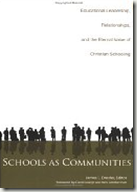
The following is an excellent book review on imageSchools as Communities: Educational Leadership, Relationships, and the Eternal Value of Christian Schooling.”  Click on the image to see the book on Amazon.

This is a book that you should seriously consider reading.  (Disclaimer: I am a contributor author, Barrett Mosbacker).

The review was published in The ICCTE Journal. 

Reviewed by Dr. David W. Robinson, Adjunct Professor, D.Mgt. program, George Fox University.

“Where there is no vision, the people perish…” Proverbs 29:18a (KJV)

Anyone who has engaged in the calling of Christian education knows that it can be — and usually is — one of the most exciting, delightful, fulfilling, and joyous ministries that a believer can know. Its golden days are a real “foretaste of glory divine,” its opportunities for those who truly love the possibilities of the mind and heart of Christ in the lives of our students are the very aroma of the Lord in our work. Lives are changed; parents are supportive; administrators are helpful; the board is productive. Sacrifices are engaged willingly, trials are gladly borne. We go home at the end of the day, and can hardly wait to return in the morning…

And anyone who has engaged in the calling of Christian education also knows that it can be — and usually is — one of the most daunting, exhausting, demoralizing, and frustrating ministries that same believer can know. Golden days can morph into drabness from one year to the next, or even overnight; its opportunities can suddenly vanish, with the mind and heart of Christ being trampled underfoot by institutional change, upheavals in leadership, financial uncertainty, or divisions and offenses within the school community…and suddenly, the aroma of Christ is seemingly nowhere to be found. Lives are no longer transformed; parents are arguing among themselves or sniping the administration/board; administrators run for the bomb shelter; the board seems unable to resolve the issues. Sacrifices now seem imposed, with trials producing grumbling, not grace. We go home at the end of the day, and are tempted to circulate our résumés…

Strange to say, this roller coaster ride is well known to all too many Christian school teachers, administrators, parents, students, and board members. The shift can happen over time, or even overnight. The results are commonly tragic (and predictable) if resolution and healing are not accomplished in time: high rates of teacher turnover; a loss of students and their families; the demoralization of the remaining students, faculty and staff; friction between boards and administrative leadership that leads to recriminations, or even terminations; and so on.

And so the question is: How can Christian schools resolve the chasm between the experiences of the first and second paragraphs above, prevent the sort of divisions and offenses within the educational body that the scriptures warn about, embody healthy and continuous educational improvement, and become the dwelling places of shalom and agapé that will transform the lives of all who are touched by that community?

This is a daunting question, cutting to the heart of what every generation of Christian educators and academic leaders must face, ready or not. In the case of Schools as Communities, it is addressed by James L. Drexler and the excellent group of nearly two dozen scholar-practitioners that he assembled for this volume. As the title states, the main theme of the work is that of community. All eighteen of the essays are represent separate explorations of particular subsets of the main challenge of fostering koinonia within the imperative for continuous school improvement in the service of Christ and our students. This is a worthy but highly ambitious task; frankly, as I read it, I wondered how well Drexler and his collaborators would carry it off.

Drexler and company proceeded by dividing the task into four main sections:

  • “Building Community: Foundational Principles”
  • “Building Community Among Faculty and Staff”
  • “Building Community for Students”; and
  • “Building Community with Others.”

Drexler doesn’t leave community without conceptual support, however; he explicitly adds supportive themes of grace, scriptural priority (“the weightier issues of the Law,” prophetically stated by the Lord in Matthew 23:23), and cultural relevance/engagement to the content of the book (xiv-xviii). Nor is the work merely theoretical; each chapter concludes with a call to praxis entitled “Now What? Application to Practice”. Its purpose is to help the reader understand how the contents of each chapter might be used in their school setting and their own ministry of leadership. Finally, each chapter has a references section that provides useful sources and online links for the reader to extend his or her ongoing exploration of educational leadership and community.

In Part One, foundational principles are explored in essays examining the primacy of grace in Christian school settings (Bruce Hekman); mercy, justice and social change as imperatives of transformational Christian education (Vernard T. Gant); the life of the leader and his or her grace-filled life as an embodiment of the Lord’s grace (Jeff Hall); and godly risk taking on the part of the school leader (Stephen R. Kaufmann and Kevin J. Eames).

Hekman encourages the Christian school to embody true grace to its students, eschewing both “sloppy grace” and formal legalism as it becomes a real community in pursuit of a profoundly Christian educational mission. In Gant’s contribution, the Christian school is viewed from the vantage point of God’s call to mercy and justice. Rather than harboring bias or prejudice, for example with respect to lower SES students and their families, our schools ought to be seeking opportunities to reform all aspects of their operations — from their curriculum to their service programs to the “habits of the heart.” As we seek to serve the Lord in our schools, we should turn away from the all-too-prevalent paternalism within our educational work, from the majoring-on-minors that so easily entangles us, and strive for a deeply Christ-like way of life (cf. Galatians 3:26-28). Faithful educational leadership will seek real community with all people, and not merely those within comfortable shouting distance.

Hall’s article shifts the focus to the educational leader, to the very life and calling of the one who shepherds a school. The love of Christ must compel leaders to love those who are collaborators in their school community, so that they are effective models of His grace to those who work in that setting. The first section rounds out with Kaufmann and Eames’ very interesting chapter on educational leadership and risk taking. Christ’s call to His people often involves radical, transformational living; a Christian school that seeks to follow Him faithfully will find itself pressing against social conventions and embedded attitudes among its own constituencies. The authors argue that Christian school leaders should look for opportunities “to engage students in culturally relevant ideas and activities,” even when they involve the risk of controversy and discomfort (76).

Part Two shifts focus to the question of community building with the faculty and staff. Gordon Brown addresses the important question of leadership models and decision making. His survey covers an impressive amount of ground in short order, with discussions of models that concentrate on the leader, models that emphasize the instructional enterprise, and models that focus on community transformation. Kevin J. Eames then shifts our gaze to organizational theory, and the ironic fact that organizations do not organize themselves. Eames draws our attention to the fact that older hierarchical, top-down, and linear organizational models have been supplanted in recent decades by approaches based on systems theory. He builds a convincing case for a biblical basis for systems theory in Christian education; all that I need point out is that anyone who links Herman Dooyeweerd’s extraordinarily important framework of domains, modalities, and sphere sovereignty to organizational theory and praxis is on the trail of something big. Really big. (Yes, that is your warm invitation to further study.)

Neil Neilson then introduces us to the notion that tensions within Christian educational enterprises are common, inescapable in this age, and actually should be “welcomed as friends” (cf. James 1:2-8), since these “liberating dichotomies” actually spur our growth and development, both personally and institutionally. He lists six provocative oppositions, and makes a good case for their role in stirring up our leadership and vision in response. Jack Beckman then takes up the baton, looking at the vital issue of professional development as a means of community building within our schools. I view such work as a vital outworking of “the equipping of the saints” (Ephesians 4:11-13), one that Beckman clearly advocates for school leaders.

In Part Three, Drexler’s team moves to the central question of community formation with and for our students. Barrett Mosbacker summarizes the challenges facing our schools in a very informative chapter on strategic stewardship. I found myself agreeing strongly with his comments about the need for an understanding of the economic underpinnings of stewardship and development work in our Christian schools, an area that is regularly bedeviled with sentiment, pietism, and even presumption masquerading as “faith.” Mosbacker’s essay is a call to arms, a medicine that can bring healing in such things; our school community will be strengthened as its leadership adopts a more focused approach in its strategic financial vision. Derek J. Keenan then shifts our attention to the question of curricular leadership. His essay calls us to consider curricular formation to be a wonderful opportunity for gathering all the stakeholders in our educational community around the challenge of creating a dynamic, holistic, Christ-honoring course system for our students. Our curriculum ought to be a profound expression of our deeply-held values, our commitments to the Lord, the world, and each other; Keenan encourages us to act on these beliefs, and to make them real in our schools.

From this platform, it is a natural progression to shift from reaching inwards — building community at home — to reaching outwards. Daphne Wharton Haddad and Susan Schneider Hasseler follow Keenan’s essay by discussing the need to construct culturally inclusive communities in Christian education. For far too long, our “outreach” to our world has reflected a paternalistic “tolerance” (“I put up with you because it makes me feel good.”) rather than a truly transformational way of living. (“We are one in the Lord, and we all have things to teach and learn from each other.” Romans 1:11-12; Galatians 3:26-28; and Romans 12:2…enough said!) Haddad and Hasseler’s call is to reform all aspects of our school community, from relationships to curriculum to classroom practice, to produce a true model of the Lord’s kingdom.

In chapter twelve, Matthew Lucas gives a framework for the very important — and very misunderstood — process of assessment. Too many in Christian school leadership map “assessment” to standardized testing alone. Lucas posits that we must move to a much broader, multi-modal approach to truly assess the effectiveness of what we are doing in our schools. All of this must be done in a way that reflects a Christian worldview in all aspects; a willy-nilly adoption of the techniques of the world without deep reflection on the values of the Lord’s kingdom will actually harm our work, giving us a “form of godliness, but denying the power thereof” (2 Timothy 3:5a; KJV). James L. Drexler follows Lucas by addressing the question of discipline and community building within our Christian schools. Drexler points out the plethora of books on this topic, and then espouses a biblical approach for the development of godly discipline. A proper anthropology allows us to avoid mere sentimentality, and also to avoid a purely legalistic/punitive view of school discipline. The scriptures do provide us with guidelines for a redemptive approach to such matters — 2 Timothy 3:16-17 comes to mind immediately, as an example — and Drexler advocates such a stance. In a community that “cares enough to confront,” many discipline issues can be prevented entirely, or can be dealt with locally and privately, as the Lord instructed us in Matthew 18. For the balance of issues, the agapé community can escalate properly through a sequence of corrective steps, always seeking to give a student the opportunity to truly repent and experience restoration to the community.

Part Three concludes with David L. Roth and Jon Keith’s examination of changing the culture in Christian schools. Anyone familiar with Christian education is aware of the problem; as the traditional Spanish proverb put it quite succinctly, “Que no haya novedad.” Or in modern English, “Let no new thing arise.” (Even more loosely: “All change is bad.”) Resistance to change, regardless of how faithful or promising it is, is a fact of organizational life. Educational leaders who assume that their vision of new opportunities will automatically be accepted by their constituencies is cruising for a bruising; a reading of the life of Moses alone would cure any romanticism on this topic. Roth and Keith advance Jesus Christ as the model for generating change in our schools, and advocate that school leaders take key elements of His leadership as a template for their own practice.

Schools as Communities concludes with Part Four, a survey of our relationships with others. Whether we know it or not, the constituencies that a Christian school addresses include those who may be far outside of our immediate school setting. In chapter fifteen, Bruce Young makes the case for collaboration in Christian education. No community can exist without working together to achieve common goals and a mission shared by all. Drawing on Urie Bronfenbrenner’s ecological model, Young usefully restructures that multi-level model (once again, via Dooyeweerd’s pioneering schema) to produce a biblical framework for envisioning the larger perspectives of our work within the kingdom of God, and under his sovereign reign.

James C. Marsh then moves to the very significant question of the relationship between the educational leader and his or her board. Any leader who doesn’t realize fully the critical nature of this connection is a leader who will probably not last very long in that position. Marsh points out that statistics bear out the fact that there is trouble in paradise: according to a 2005 study, some 70% of all school leaders are fired, and do not leave voluntarily. There is no optimistic reading of this number; clearly “churn and burn” has become the model for many Christian schools. The author surveys the three main models of Christian school governance, and then outlines a number of recommendations for a redemptive, rewarding relationship between school leadership and its board. Only in this way, says Marsh, can we have any hope of reversing the current dreary attrition in Christian school administration.

Scot Headley and Stephen Cathers follow Marsh in their essay on continual school improvement. Drawing an important distinction between assessment and evaluation, Headley and Cathers seek to enhance educational community by the creation of a culture of quality, reflection, and ongoing reformation involving all members of a school. Their school evaluation cycle (Planning, Action, Assessment, and Reflection, 350) is a concise and very useful model for practicing excellence in all realms while simultaneously maintaining close relationships throughout the process. I see this as a very well-focused embodiment of the biblical principle that the apostle Paul stated when he advised Timothy, “Be diligent in these matters; give yourself wholly to them, so that everyone may see your progress. Watch your life and doctrine closely. Persevere in them, because if you do, you will save [that is, ‘benefit and bless’] both yourself and your hearers.” (I Timothy 4:15-16, NIV) In other words, our schools can only progress towards the standards of our Lord in these things if it constantly watches its life and teaching, thus blessing all the members of its community.

In the final chapter, Brian Fikkert reminds us that our schools should be places of shalom, seeking to produce students who fully and radically embody a biblical world and life view. To do this, they will need to be lovingly and wisely trained in how to engage every dimension of the world around them in the name of the Lord’s kingdom. There are significant challenges to every aspect of traditional Christian school operations here, but also prospects for very significant blessings in the lives of every member of a Christian school community as a result. James L. Drexler then concludes quite fittingly on how all these things, wisely and lovingly accomplished in our school communities, can redound to the glory of God, and the praise of Jesus Christ our Lord.

Early in this review, I mentioned the fact that I was curious to see how well Drexler and company delivered on the ambitious promise of the full title of Schools as Communities. I don’t think that anyone could be more sympathetic to their stated aim, but I also have seen enough of educational tomes to be a bit skeptical of whether or not this volume would delight more than it would disappoint. I am pleased to say that my doubts were unjustified, and that my hopes were fulfilled. Schools as Communities does a fine job of treating its subject from a number of vectors, giving its reader a well-balanced view of the challenges and possibilities for leaders in Christian school community building. Even those new to this world — for example, prospective Christian board members, or parents, or staff members — will find this book to be very useful as a guide to the issues and possible answers that they face.

Christian colleges and universities will also find it to be useful as a candidate textbook for undergraduate studies in education, and as an adjunctive textbook (at least) in graduate schools. Certainly graduate and doctoral programs will use this as a survey-level point of departure for further studies, but Schools as Communities will function quite well in that application. The resources listed are a treasure trove for the student, and will provide the researcher with a number of leads for improving their own professional library — always a good thing!

In conclusion, Schools as Communities turned out to be a genuine delight: a pleasure to read, well grounded in scriptural principle, current theory and practice, and embodying the very sort of Christian community that it advocates. What could be better? Consider this to be an enthusiastic recommendation by a person who is not usually impressed by many educational books, even those done in the name of the Lord….

Let’s Get Creative! How Could You Use This?

By Dr. Barrett Mosbacker

Take a moment to read the article below (Reposted from Duct Tape Marketing.) Now, give this some thought and then ask yourself, “How Could We Use Twitter to Promote Our School and/or Serve our Stakeholders?”

After giving this some thought, post your ideas as a comment to this blog article to share with others!

17 Ways to Use Twitter for Business and Some Not

More and more small business folks are giving in to what seems like an insurmountable mountain of hype and jumping on the twitter bandwagon.

But, some people still look at twitter on the surface and conclude that it’s one big waste of time. I can’t say I disagree completely, however, like all social media and marketing tactics, before you can determine if something makes sense you need to analyze your objectives. So, instead of asking why you would use it, ask how it might help you achieve some other already stated objectives.

1) Would you like a way to connect and network with others in your industry or others who share you views? It’s a good a tool for that.

2) Would you like a way to get instant access to what’s being said, this minute, about your organization, people, products, competitors or brand? It’s a good tool for that.

3) Would you like a steady stream of ideas, content, links, resources, and tips focused on your area of expertise or interest? It’s a good tool for that.

4) Would you like to monitor what’s being said about your customers to help them protect their brands? It’s a good tool for that.

5) Would you like to extend the reach of your thought leadership – blog posts and other content? It can be a good tool for that.

6) Would like a way to quickly find vendors, partners, tech help, even employees for your organization? I can be a good tool for that.

7) Would you like to promote your products and services directly to a target audience? Not such a good tool for that, but it can light a path back to your web site!

Now, if that weren’t enough, the open nature of the twitter platform is spawning uses far beyond what was ever imagined or what many people can grasp - and this use of the technology will only get bigger.

Here are few things you may have never considered

8) Publish your Flickr photos on twitter - Visit twittergram and set-up an account and then just upload to Flickr but tag your photo twitter and it goes into your twitter stream.

9) If you use online todo list Remember the Milk - you can set it up to flow into twitter - this might be a way to assign todos to remote teams

10) Using strawpoll you can create mini polls into your twitter stream - great for flash feedback

11) Use twitter to keep up on traffic jams with commuterfeed

12) Have twitter alert you when you have a meeting with timer

13) Get and fill current job openings with tweetajob

14) Track FedEx, UPS and DHL shipments with TrackThis

15) Get help quitting smoking

16) Keep a diet journal

17) Get a tweet when your plants need water - - okay this one would be way cooler if it simply tweeted you when the plant watered itself.

Share ideas on how our schools could use Twitter by submitting a comment with your ideas.

The God of Technology, or The god of Technology

Jim Drexler of Covenant College alerted me to this article on CARDUS.  After reading it I immediately wrote Mr. Evans and asked his permission to post it on my blog, which is graciously granted. 

I believe you will find this article very helpful and informative.  It strikes a very positive and helpful balance for developing a Christian perspective on technology that is neither afraid nor idolatrous.  I also found this article of particular interest because Mr. Evans knows what he is talking about.  Here is an excerpt from his bio.:

Dave Evans is 30-plus year veteran executive of Silicon Valley who offers a range of professional services to rapidly growing companies and personal mentoring to individuals. Since 1990, Dave has been assisting high-tech clients in strategic planning, sales and marketing, new business development, mergers and alliances, growth management, and executive development. Dave's client list has focused on early stage start-ups but also includes Fortune companies including such leaders as Veritas/Symantec, HP, Intel, and AT&T. (He's also negotiated fishing rights for the Inuit in Alaska—but that's a whole 'nuther story).  Prior to consulting, Dave was VP and Co-Founder of software publisher Electronic Arts, led the introduction of the mouse and laser printing at Apple, and has held senior marketing positions with IBM/ROLM Corporation and voicemail inventor and manufacturer VMX (now Avaya).

Since his college days, Dave has had an abiding, faith-nourished commitment to living and helping others live a coherent life—thoroughly integrating soul and role, especially in the realm of vocation …

I also highly recommend that you read the excellent material found on the CARDUS website. 

The God of technology, or the god of Technology?

Posted with permission from Dave Evans.

July 31, 2009 - Dave Evans

After 34 years of high tech work in Silicon Valley, I have found myself drawn into more than a few discussions with people of faith about technology. How we think about technology matters, and I'd like to make some suggestions for these kinds of conversations.

First, let's define what we mean by technology. Dictionary.com (an online definition seems appropriate) defines it as "the branch of knowledge that deals with the creation and use of technical means and their interrelation with life, society and the environment, drawing upon such subjects as industrial arts, engineering, applied science, and pure science." In short, technology is about tools.

All tools—from the first stick Adam used to soften the dirt to the latest wireless LAN software I had to reinstall to transmit this article to the editors of Comment—share the same character: they enable humankind to enhance the execution of human ability. Tools allow people to do the kinds of things they can already do, but do them bigger, faster, cheaper or better than they can without the tool.

Technology is just a tool, so our thinking about it needs to be grounded in a thoughtful perspective on tools—dare I say, a thoughtful theology of tools and technology. The definition of technology which I cited contains three key elements: creation, use and interrelationship. With these defining elements in mind, let's look at two ideas related to technology that I think warrant more thoughtful attention: newness and availability.

Newness

Technology, especially within modern society's understanding of technology, is focused on the new thing brought about by the latest science. Michael Lewis captured this perspective well in his book about New New Thing book jacketlegendary Silicon Graphics founder Jim Clark, titled The New New Thing. Why are we so inexorably excited about and drawn to the new thing? I'll argue because God made us that way, and it's a good thing. We are made in God's image; we bear the imago Dei.

One of the first things we learn about God is that he is creative, and in a dynamic way. God does not merely make stuff that lies there. God makes stuff that grows and lives and moves in time, space, history and the unfolding story of God and creation.

big-bang.jpgAn astonishing hint to the nature of things is embedded in the fact that creation wasn't finished all at once in a Big Bang. Why didn't God bring the present world into being with just one quick flick of the divine wrist? He didn't zap the cosmos into completion, but labored at it a while, revealing new wonders day by day. At each step along the way, God reflected on the latest thing and concluded it was good. God created the way he did out of love. The dynamic God conceived and made a dynamic universe, and in so doing, wired the continual refreshment of newness into the very heart of all reality.

I'm not saying all new is good, but good new is very good indeed. We are invited—commanded actually—to co-create with God in order to bring respectful and loving order to this world. We are to engage ourselves in the human endeavor of stewardship to care for all creation in order that all persons, and everything else too, may more and more live into what God has in mind for the world.

It's an amazing adventure, and technology enables us to do that work. As anthropologists well know, tool making tools.jpgis an essential aspect of what makes us distinctly human, and as Christians we understand that it's an essential aspect of what makes us God's image-bearing children. It's a triple win—we get to participate in the innovating of technology (creation) and the application of that technology (use) to do good in the world (interrelationship).

I believe the movement of newness God set in motion in creation and in each of us fuels our healthy attraction to the new that we so experience in our encounter with technology. We in fact worship the (capital G) God of (small t) technology.

Availability

Most of us want the latest available technology. Usually, available technology is the newest thing that works fairly reliably and is economically accessible. When will the next iPhone or cold fusion or a 100mpg car be available?

Those are good questions, but they fall short. The key is not just the technology's availability, but how available it makes us. The purpose of technology is to buy us more time to be available to other things, or to makes us more effective in some endeavour (and so allow us a greater avail upon the world). Good technology is all about availability.

I may here sound as if I'm merely surfacing the age-old technological tension between good technology and good use of technology. While that's a relevant issue, it's not what I'm getting at here. I'm advocating for something less obvious and more profound: an availability consciousness that can transform our relationship with technology, both collectively and individually.

The Christian life is a particular way of life grounded in a continual awareness of God's constant presence and active invitation. Jesus said that he could do only what the Father showed him (John 5:19). Jesus lived in constant availability to the Father, and so should we. That means that all our endeavours and all the tools and processes and techniques and collaborations and organizations that we use to live out our lives are to be engaged, while still retaining a sense of availability to what else is going on and what else God may be showing us. We need to learn a way of being that is contextualized in a larger frame than the current situation, seeing a picture that's bigger than what meets the eye. By always being a little outside our situation, we are actually made more available to be present to the situation; this is an aspect of the freedom we gain by dying to self and becoming alive to God.

Such availability has a very real expression in our encounter with technology. Technology is attractive because of the God-given allure of the new new thing—but it's also "sticky," in that for many of us, it entraps our attention, making us so focused on it that we become less, not more, available. We may have technologically bought ourselves some time, but that time is only valuable (as opposed to merely accessible) if we can direct our use of it from a position of availability. Retaining access to this kind of awareness is what I mean by an availability consciousness. I'm not suggesting we reserve 6% of our brains to constantly chant, "What else is going on?" or "What's God saying now?" The issue is more nuanced than that—it has to do with one's point of view, one's way of seeing and engaging at all times.

Let me give an example. I went to a baseball game with a friend last night and the guy sitting next to us was drunker than he realized. He was also yelling more loudly, crudely and disruptively than he realized. He did not have access to a sufficient degree of self-awareness or self-control to see the impact of his actions. He's probably a pretty decent fellow with fewer beers in him, but neither he nor we could recognize it at the time. We all lost something in the process (he got thrown out, and we were distracted).

That's the critical question—can you recognize your degree of availability? Given the immense power for good and the incredible attractiveness of today's dazzling and elegant technologies, it's easy to lose our availability without knowing it. Ever so subtly, technology becomes the object of our attention, rather than the tool of it. Developing an availability consciousness will help us guard against accidentally slipping into making a god of Technology, rather than responding to the God of technology.

We need to match technology's advances with our own increasing maturity as technology creators, users and observers. Perhaps we can better respond to that challenge by reflecting on what newness and availability have to tell us about technology and its use.

When Change is Bad

I found this article articulates what many teachers feel—in public and Christian schools.  Too often, with the best of intentions, we throw a hodgepodge of ideas at our staff, what I call du jour training/idea of the year.  See my previous post: Rethinking Staff Development: “This Too Shall Pass.”

Solutions Are the Problem in Education

By Mary Kennedy

There used to be a saying that if you were not part of the solution, you were part of the problem. The implication was that we all, collectively, were creating the problem, and that the solution required all of us to change together.

But in education, solutions are a big part of our problem. School people are swamped by a deluge of solutions. They suffer from reform fatigue.

A few years ago, I visited teachers in several districts spread across the nation. I was struck by the variety of interruptions they experienced in their classrooms, and by how many of these had begun as good intentions. Here’s one example: A science teacher took part in a National Geographic Society project that gave his students a chance to collect samples from a local waterway and contribute them to a national database. Sounds like a great idea, right? His class got to participate in a national science study. But the timing of the project caused the teacher to interrupt his ongoing science unit. When the project was finished, students had forgotten where they were in their regular curriculum.

National Geographic is hardly alone in wanting to help educators. The number of associations, institutions, government agencies, and volunteers of all kind who want to solve educational problems has grown so large that teachers are now surrounded by helpful voices and besieged by ideas too numerous to attend to. Instead of strengthening teaching, this multitude of innovations and reforms distracts both teachers and students from their central tasks, making it difficult to concentrate, to stay on task, and to sustain a coherent direction.

Moreover, these improvements often contradict one another. Consider two ideas currently on the table for evaluating teaching practice. On one hand, we have lesson study, a highly structured undertaking that requires months of collective effort and careful thought. On the other, we have walk-throughs, quick and unstructured events that can be conducted by one person in under five minutes. These ideas seem to make entirely different assumptions about how we can learn about teaching, yet they are both popular right now.

There have always been zealous education reformers, of course. But the number and variety of helpful ideas is now so great that the solutions themselves have become a problem.

It is easy to brainstorm about alternatives in education, but hard to anticipate their unintended consequences. Take, for instance, pullout programs. These well-intentioned entitlement programs, introduced in the 1960s, pull students out of their regular classrooms for special instruction. The timing of the pullout has to fit the pullout teacher’s schedule, which means that the original teacher must adjust her instructional schedule to accommodate this movement. Since both teachers may be teaching similar content, they also need to coordinate their instruction, something that takes time. And that is not all: Every time a student is pulled from a regular classroom, and every time that student returns to the regular classroom, the ongoing instruction is interrupted. Students are distracted, and so is the teacher. Lesson continuity and coherence are at risk.

Pullout programs are one of many helpful ideas introduced to improve education. Every test, every assembly, and every public-address announcement is a helpful addition that ultimately disrupts instructional continuity. Every change of schedule, from hourly to block scheduling and back to hourly, requires teachers to revise their routines and strategies. Every new policy, from zero tolerance to team-teaching, pulls teachers’ attention away from their teaching and toward solving a logistical problem. Instead of thinking about how to engage students with curriculum content, they must think about how to revise their procedures, schedules, and strategies to accommodate the newest helpful idea.

Remember when we decided that teachers should have telephones in their rooms? The idea was to “professionalize” the job. Well, now that teachers have telephones, parents can call up at any time to leave messages for their children. So when students are struggling with the difference between ¼ and ½, or debating the merits of the Bill of Rights, the phone rings. And it is right there, in the middle of the classroom and in the middle of every lesson.

The problem is this: Both teaching and learning require sustained attention. Not only do students need opportunities to think, but so do their teachers. More than anything, teachers need time to compose their thoughts and make sure that, when they approach a new unit or a new lesson, they have a clear idea of what they want to accomplish.

Students are even more vulnerable to distractions. In my conversations with teachers, I have found that they care more about maintaining the momentum of the lesson than anything else. The central challenge of teaching is finding enough uninterrupted time to get students’ minds wrapped around an idea, and keeping it there until the idea makes sense to them. Disruptions don’t merely take a few moments of class time: After them, teachers often feel that they need to rewind the entire lesson and begin anew.

Yet we live in a time when reforms and fads have become so commonplace that every new board member or superintendent feels a need to make a personal mark on his or her district by introducing something new. As these policymakers come and go, teachers are buffeted by the raft of competing new ideas they leave behind. So routine turnovers in leadership reignite this continuing series of distractions, further reducing teachers’ chances of finding time for reflection and maintaining a stable environment for intellectual work.

No wonder that when the new superintendant comes to town, and the new professional-development program is brought in, teachers go into their classrooms and quietly shut their doors.

Every American teacher feels some level of reform fatigue. If you think you are part of the solution, check again. You may be part of the problem.

Mary Kennedy is a professor in the department of teacher education at Michigan State University, in East Lansing, Mich.  Vol. 28, Issue 37

Rethinking Staff Development: "This Too Shall Pass."

By Dr. Barrett Mosbacker

Here is the hard and sad truth: over the  last several decades Christian schools have invested tens of thousands of hours and hundreds of thousands of dollars on staff
training programs and conferences but with little sustained impact. Despite all of the research, despite recent advances in neuroscience, notwithstanding the wide-spread availability of increasingly affordable and effective technologies, and despite our grandiose pronouncements, our classrooms are virtually indistinguishable from classrooms from the 1920's or 1950's. Only the furniture has changed.

We may have made changes at the margins, but systemic change is hard to find. There are teachers, scattered here and there, who exemplify the best in teaching. And there are a few schools that break the mold and provide paradigms for others to emulate. Sadly, most of these schools are not Christian--they are public or secular private schools. By in large, most Christian schools have hearts of gold while stuck in an industrial model of teaching that has little in common with a rich biblical understanding of the learner or the effective and consistent application of current research and technology.

A harsh indictment I know. It is nevertheless motivated by a deep love for Christian education and an insatiable desire to see our schools standing as beacons of excellence, schools characterized by creative nurturing environments, rigorous learning, thoughtful and informed dialog, problem-based learning, integrated technologies, and authentic assessment.

Why?

Why—despite our best intentions and the investment of substantial time and money—do our schools remain largely unchanged? There are many reasons. One of the most important is the relatively ineffective way we design and implement staff development programs. Most of our training programs go something like this; we have a week of training in which we discuss biblical integration or some other topic du jour. Most of the training is delivered like most teachers teach—didactic presentations, perhaps supplemented by PowerPoint slides. There is nominal interaction and virtually no immediate, real-time practice or application of the concepts covered. There is seldom follow-up or accountability. With the exception of yet another discussion of biblical integration (more on this later) topics and emphasis changes from year-to-year. Teachers sit through the presentations but little changes. School begins; teachers return to their classrooms close their doors and teach just like they always have. We return to our offices to deal with day to day exigencies. Within a month in-service is forgotten. Then, sometime in the spring, we plan for next year's in-service and the cycle begins again, just like the movie Groundhog Day.

Through this process, teachers learn that "this too shall pass." Teachers often view in-service as something to endure or a time to catch up on relationships. For most, it is not an occasion for deep reflection; it is seldom stimulating, and seldom leads to change in the classroom or systemic change in our schools. Each year we pick our in-service topic, throw it against the wall and hope it will stick. It usually doesn't.

I am not cynical but my observations arise from 20 years of attending conferences, conducting in-service training programs, and consulting with other schools. Too many of our teachers reflect the sentiments expressed in the following video:

Rethinking and Redesigning Staff Training

Good teachers are to education what education is to all other professions—the indispensable element, the sunlight and oxygen, the foundation on which everything else is built. They are central to assuring excellence and rigor in the educational experience of every young person in America (Milken, 2000, p. 3).

Our schools are only as good as our teachers. Accordingly, our top priority is to hire, train, and retain the finest Christian teachers in the country. Hiring the right people from the outset is essential. Over the years I have discovered that despite my best efforts, marginal teachers with marginal gifts will only make marginal improvement. Motivated by Christian charity and patience, I have expended enormous energy and devoted countless hours striving to transform mediocre teachers into, if not great, at least effective teachers. With the satisfying exceptions when I have discovered diamonds in the rough, I have  failed. Frogs do not become princes no matter how often and passionately we kiss them!

Although we cannot turn frogs into princes, we can transform teachers with the gift of teaching—the right stuff—into remarkably effective teachers. A few can be transformed into master teachers. This situation is analogous to a good coach. A coach can only do so much with athletes lacking raw talent. However, a good coach can take athletes with natural talent and transform them into MVP's and championship teams. That is our task. For the sake of God's glory, the advancement of His kingdom, and for our students, we can do no less.

Presuming we have made good hires, designing effective training programs is the key to enhancing the effectiveness of our teachers and for creating dynamic world-class schools. There as several components to an effective training program: 1) Designing training for the adult learner, 2) Defining measurable organizational and pedagogical expectations and goals, 3) Accountability, 4) Practicing what we teach, and 5) Establishing multi-year training programs.

Design Training for the Adult Learner

Adults learn differently than students. Their motivations are also different. The following table highlights the differences between student and adult learners. For more information on adult learners, click here.

Source: Honolulu Community College. (2007, February 8, 2007). Faculty Development: Teaching Tips. Retrieved December 22, 2007.

It is particularly important to understand that as adult learners, teachers expect the learning to be immediately useful. Too often our training is theoretical and conceptual rather than immediately applicable.

Although it is essential that teachers have a thorough knowledge of theory, concepts, and research they will not change their teaching unless the application of the learning is demonstrated. We should not assume that teachers will connect the dots—we need to connect the dots between theory and practice for them.

This is the problem with much of our biblical integration training. It is lofty, mission oriented, theological, philosophical and conceptual but is seldom practical or actionable (See more on this below under Practicing What we Teach).

For example, I often ask prospective teachers to give me a specific example of biblical integration in mathematics with two caveats: they may not make reference to a statement like "numbers are orderly because God is a God of order," nor may they make reference to the animals going into the Ark two-by-two or anything similar. With rare exception teachers struggle to provide concrete, specific, theologically coherent examples. They cannot get beyond generalizations to meaningful and applicable integration.

Likewise, I have asked prospective teachers to give me a specific example of biblical integration in history but with the following caveats: they may not make reference to American history and they must go beyond a statement of God's sovereignty. Once again they are often stumped. If they cannot make reference to the Christian influence on American history or to God's sovereignty they have little idea how to integrate biblical truth in history.

I have gone through this exercise with literally hundreds of teachers with the same results. With few exceptions, most Christian teachers do not know how to provide concrete, practical, sophisticated, and actionable integration within academic subjects. Yet, training in biblical integration and the development of a biblical worldview has received more attention and time in staff development than any other single concept. By in large, the same can be said of other topics covered in our staff training programs. Teachers go through the process but little changes for the vast majority of our teachers. How is it that we are so ineffective?

I believe it is because we are not teaching the way adults need to learn, we often do not provide actionable examples, we do not have specific measures of success, and we do not hold teachers accountable for the training. We also do not take time to reflect upon the process most adults follow in deciding whether or not to embrace change. The following table provides a useful summary of the process of change acceptance that most adults go through.

Note also that adults tend to move from no response to seeking alternatives for maximizing the changes. The above responses typically correspond to the change process outlined below, which moves from "I am not concerned about it" (This too shall pass) to "I have ideas that will work even better."

The central question is: "How do we get our teachers to move from "I am not concerned about it" to "I have ideas that will work even better?" I make no pretense of having all of the answers but I offer the following for consideration and dialogue.

Define Measurable Pedagogical and Organizational Expectations and Goals

Early in my corporate career I was taught an invaluable lesson from my boss; I was NEVER EVER TO ASSUME ANYTHING! His language was colorful and he made an ineffaceable impression on me. I do not recall the reason for his instruction (obviously I assumed something that I should not have) but I did learn an invaluable lesson, making assumptions will get one into trouble or at minimum reduce one’s effectiveness. I believe we make the same mistake by assuming that teachers understand our specific expectations of them and goals for our schools. We may be right but we should not assume this to be the case.

It is critical that we clearly state our expectations and that we match our training programs with those expectations. In other words, our training and expectations must be integrated and this integration must be deliberate, not hap hazard. If our training is to move us closer to realizing our goals, our goals must be clearly defined.

What are our goals for our schools? I am not referring to our mission statements or our philosophy of education. Nor am I referring to our strategic goals per se. In this context I am referring to specific expectations for our classrooms and our schools. A statement of clear classroom expectations might look something like the following:

Classroom instruction will be dynamic with high levels of student-to-student and student-to-teacher interaction, quality questioning, Socratic dialogue, use of integrated technology, teaching strategies informed by neuroscience, and thoughtful, specific, and sophisticated biblical integration and at least two authentic assessments per quarter.

To ensure that our teachers understand clearly what is expected them I recently issued a memo outlining specific expectations. This memo was distributed to all teachers, is posted on the school's SharePoint server, and was discussed with all teachers and principals during faculty meetings. Central to our expectations is the goal of creating vibrant, engaging, creative, rigorous classrooms where students are not passive recipients of information but are engaged in the learning process.

Clear expectations also provide a framework for the design of our professional development programs. In other words, once we define the goals for instruction, training is designed to advance those goals. Training has a sustained and coherent focus.

Accountability and Follow-Through

Upon the wise recommendation of Mr. David Balik, our Dean of Faculty and Academic Affairs, we modified the evaluation instrument to match our expectations. The evaluation instrument includes a number of specific expectations tied directly to prior staff training, e.g., use of technology, questioning techniques, etc. This heightens faculty attentiveness and response to training by making it clear that "This shall NOT pass." We expect that the concepts and skills covered during staff training WILL BE IMPLEMENTED IN THE CLASSROOM. Failure to do so is not acceptable.

In other words, we are not offering ideas for consideration during in-service, we are providing training. To make this point clearer, consider an example in another profession, the medical field. Can you imagine a physician attending a training conference on the latest techniques in surgery and then ignoring them on the operating table? Can you imagine your physician going to a professional conference with the attitude that “this too shall pass?” Of course not; true professionals take training to enhance their practice--not to go through the motions. Similarly, can you imagine your tax accountant going to a seminar on changes in the tax code and then choosing to ignore them when preparing your tax return? Doing so would be malpractice and would result in fines, revocation of a license, and possible imprisonment. You could multiply the example indefinitely for pilots, attorneys, engineers, etc.

Why then do we permit professional teachers to ignore their professional training and fail to apply it in their classrooms? Are not the souls and minds of students more precious than the physical well being of a patient or the size of our tax refund?

Practice What We Teach

I have had some wonderful professors in my doctoral graduate program in educational leadership. I learned an immense amount from them and I am grateful and indebted to them for their scholarship and instruction.

Unfortunately, I must admit that more often than not, my professors taught in a manner inconsistent with the learning theories, concepts, and principles they so passionately promoted. By-in-large my learning consisted of reading, taking legal pads full of lecture notes, writing papers, and taking tests—pretty traditional practice and perfectly valid—to a point.

Sadly, I can count on one hand the number of professors of education whose instruction incorporated Socratic dialogue, problem-based learning, concept attainment, authentic assessments, technology integration, cooperative learning, or a host of other techniques that research clearly demonstrates are highly effective.

I have been guilty of the same inconsistency. Too often my in-service instruction consisted of lectures supplemented by PowerPoint slides. There is a place for this style of instruction and it can be effective. Unfortunately, it is difficult to convince teachers to change the way they teach unless we model it for them. We are not credible if we lecture about Socratic dialog but do not ask probing questions, if we lecture and never engage teachers in problem-based learning during in-service, and never provide them an authentic assessment of their own learning.

We must practice what we teach. You will soon find, as I have, that this requires more thought, more time, and is harder than giving a lecture. If nothing else, it makes one more empathetic to the challenges facing our teachers!

I can, however, give two examples of practicing what we teach--not perfectly, but in good faith and with good results. One involves biblical integration and the other technology.

Biblical Integration

Teachers who have been employed in Christian schools for any length of time have been exposed to biblical integration and the goal of helping students develop a biblical worldview ad nauseam. A harsh indictment I know but frankly our experienced teachers are beginning to yawn (quietly) at another lesson, in-service program, workshop, or keynote speech on biblical integration. They get it and are committed to it, but, as illustrated above under Design Training for the Adult Learner, most do not know how to integrate and many do not know that they do not know.

In an effort to address what I see as a significant problem in our schools—teachers who are unable to provide systemic, concrete, specific integration within each discipline—we redesigned our training program using several different approaches. We also provided helpful resources and tools.

First, biblical integration was defined in very specific terms for the faculty. They were given examples of what integration is and is not. For example, it is not icing on a cake—Bible verses applied here or there, it is not devotions before class, it is not prayer before class, it is not chapel services, and it is not simplistic, overly generalized theological concepts superficially overlaid onto an academic concept, skill, or fact. Integration is like yeast; it permeates, it infuses the curriculum content that so that it is inextricable from lesson content.

Second, most teachers have not been well prepared theologically for integration. Without solid theological grounding integration is not possible. Unfortunately, the theological knowledge of most of our teachers is limited to what they have learned from sermons, Sunday School, and through personal devotions. I find that even Christian college graduates are poorly trained for integration.

To address this deficiency, Briarwood Christian School created a Worldview Bibliography. This bibliography was taken from a bibliography available from a Christian college and significantly expanded for our faculty. We purchased most of the books listed on this bibliography and systemically assigned readings from the bibliography prior to in-service and prior to the completion of Biblical Integration Concept worksheets or BICs. Please feel free to download this Worldview Bibliography for your use. Any suggested additions would be greatly appreciated.

Third, Biblical Integration Concept Worksheets or BIC's were created. BICs are simple templates designed to help teachers work through an integrating concept for a particular lesson. This is not a perfect instrument but it does provide a tool to guide teachers in thinking through a lesson and deciding what theological truth(s) are applicable. Two completed BICs provide a good example of how teachers use them: one for math and one in science.

Forth, we provided team practice. During in-service training teachers were shown how to complete the BICs. After this introduction they were divided into discipline specific teams to spend several hours actually completing BICs as a group. During these practice sessions I visited the different groups to answer questions and to offer suggestions. Just as I suspected, most teachers had trouble thinking of specific integration concepts.

It was during one of these break-out sessions, Algebra to be specific, that I had a revelation. Standing at the back of the room, I witnessed a group of godly Christian professionals struggling to integrate theology and algebra. What I suddenly realized was that they were confusing moralizing with integration. Despite previous training, ACSI and CSI conventions, workshops, readings, keynote speeches, etc., they still conceived of integration as trying to teach a moral lesson or a character trait through the academic discipline! In this example our algebra teachers were trying to teach students to be good through algebra!

Fifth, this revelation led to more training and a different approach. In addition to reviewing the BICs, I found photos of a flower, a humming bird, and the Sombrero Galaxy. Important scientific facts were  listed with each photo. Then, rather than lecturing, I broke the entire staff into new teams and ask them to complete the following exercises over several hours.

One: Taking the facts presented and studying the images of the flower, the Sombrero Galaxy, and the humming bird, what does this information teach you about what God values, how God thinks, the nature of His work, His perspective on/approach to function, beauty, and His purposes? This is exegeting natural revelation.

Two: as image bearers, if we are to imitate God, what are the implications of the answers you provided above for the way we think, work, and live? Give specific examples for each occupation listed in the table below. The table is significantly truncated due to space limitations on the blog.


This was not an easy exercise. It required time to contemplate, to think, to extrapolate. It required contemplating and integrating both natural AND special revelation. Simple platitudes passing as a substitute for substantive integration would not work. Critical thinking and application were required.

The exercise also involved elements of problem-based learning, concept attainment, and authentic assessment as well as effective questioning. In other words, although far from perfect, this exercise sought to accomplish at least two things: modeling good instruction that goes beyond didactic instruction and practice in biblical integration.

Sixth, in addition to integrating expectations, training, and evaluation, teachers were required to submit four BICs per quarter. The principals and I reviewed the BICs and provided feedback to the teachers. This added a level of follow through and accountability to ensure that the training affected classroom practice while also providing additional practice.

Technology Integration

Like biblical integration, technology integration is often more conceptual than actual. For most Christian schools technology integration consists of computer labs, computers in the library, and Google and Wikipedia searches by students.

Recently BCS implemented several new technologies including SMART Boards, Video-Conferencing, SharePoint, Edline, and a Rapid Notification System, to name a few. Without getting into the details of the technology, one example of integrating a school expectation/goal with training will be helpful for illustrating how goals should drive training and subsequent accountability.

There were several goals for the purchase of SMART boards for every upper school classroom. SMART boards were to provide an effective means for integrating technology into instruction and to provide teachers with real-world exposure to using technology.
Training consisted of two full days of training by outside experts on using the SMART boards in specific disciplines. This training went well beyond how to use the SMART boards, it focused on how to use the technology for specific disciplines. Follow-up training and support was then provided by our IT staff.

Additionally, we mounted the SMART boards in the center of existing white boards. We did so in order to place them front and center in classrooms making it easier and more natural for teachers to default to the SMART board rather than seeing it as an auxiliary technology or tool. This strategic placement of the SMART boards essentially forced the issue—teachers would have to work hard at deliberately not using this new technology.

Just as importantly, for the first year teachers were required to submit SMART board lessons to the principals and to me for review. This ensured that every teacher was learning to use and integrate the new technology. It could not be ignored. Moreover, I developed and presented all of my in-service training programs on a SMART board to ensure that I was practicing what I teach.

Multi-Year Training Plans

If we are to avoid the flash in the pan training and the “this too shall pass” syndrome, training must have a sustained focus over time. The easiest way to accomplish this is to develop a three-to-five year training plan that builds upon previous training and that is focused on specific classroom expectations and goals.

Designing a multi-year plan is simple. It may look something like the following:

The easiest way to think of multi-year training is to conceive of it like college courses. In year one, teachers participate in 100 level courses, in year two they participate in 200 level courses, and so on. The training builds cumulatively, becoming increasing sophisticated over time with increasing levels of understanding and consistent application. Training becomes meaningful and coherent leading to systemic change.

Teachers are the heart and soul of any school. The quality of what happens in each classroom determines the quality of education that our students experience, the quality of our schools, and the degree to which we are being good stewards of our teachers’ gifts and time. It also determines the degree to which we are being good stewards of the minds and souls of our students.

Second only to making good hires, training is the critical element to ensuring that we provide our students a Christian education of world-class quality—one that prepares them to “take every thought captive to the obedience of Christ.”

Where to Begin

For those who may be interested in rethinking and redesigning their staff development programs, I recommend the following steps:

  • Define in concrete, specific, measurable terms what excellent teaching looks like in the classroom. Define these in terms of specific expectations.

  • Communicate expectations to all staff

  • Carefully and candidly assess current areas of weakness in classroom instruction relative to defined expectations. Depending upon the size of your school you may define different weaknesses by division. For example, the relative weaknesses of your elementary teachers may differ from your high school teachers. Training will need to be structured accordingly. In other words, some training sessions will include all faculty, other sessions will be division or subject specific.

  • Outline a broad three-year plan of training. This plan should include:

    • Training provided by school staff,

    • Training provided by outside experts who provide onsite training,

    • Training provided through conferences,

    • Training provided through readings,

    • Training provided through online resources (including video-conferencing),

  • Define what training will be provided in what year and by whom

  • Budget for the training,

  • Make sure that the training is practical, that teachers have opportunities to practice the training, to think, and that the training is cumulative, building upon itself rather than being an ad hoc process,

  • Revise your evaluation instrument to measure expected behaviors arising from the training,

  • Build in additional monitoring and accountability procedures to make sure that the training takes root, and

  • Constantly assess the quality of the training.

Response

This article merely scratches the surface of creating effective staff development programs. Please share your insights and best practices.

  • What deficiencies do you see in our staff training programs?

  • How do teachers respond to typical training?

  • What best practices have you discovered?

Technorati Tags: Training,Staff Development,Professionalism,Change,Adult Learning,Organizational Change,Systemic,Biblical Integration,Worldview,Instruction,Evaluation,Accountability

Reference: Milken, L. (2000). A matter of quality: A strategy for assuring the high caliber of America's teachers. Santa Monica, CA: Milken Family Foundation. p. 3

(Copyright © 2008 Barrett L. Mosbacker, Ed.D. All rights reserved. May not be reproduced or distributed without the expressed written permission of the author.)

Posted by Dr. Barrett L. Mosbacker at 1/14/2008 09:32:00 PM

3 comments:

Kris said...

Excellent thoughts. Some questions that come to mind: Is your three-year training program cyclical? Is the average tenure of teachers a factor in determing how long your program lasts?

Friday, January 25, 2008 4:08:00 PM CST

Dr. Barrett L. Mosbacker said...

The issues raised by Kris are important ones. Our current training program is not cyclical per se. Rather, the training program continues to increase in depth and sophistication as teachers consistently and effectively apply new concepts and skills to the classroom. Adjustments to the training are made to enhance its effectiveness as we assess what does and does not work.

New teachers are oriented in the fundamental concepts of our training program and are then trained by principals and our Dean as an integral part of their overall evaluation and staff development program. Our plan is to develop a formal mentoring program where our master teachers, who have been through several years of training, can progressively bring our new teachers up to speed.

This does raise another matter--staff retention. We are blessed with a high retention rate. This should be the goal of every administrator so that the substantial investment in training is not lost and to ensure greater consistency and coherence throughout the academic program. Staff retention is affected by several factors including but not limited to hiring the right teachers—teachers who are committed to the program, providing competitive salaries and benefits, and establishing a highly professional progressive culture where teachers are treated with respect, are supported, have ample training opportunities, and are held to high standards of professional Christian conduct.


Friday, January 25, 2008 5:49:00 PM CST

Anonymous said...

Your thoughts are very insightful. I've been working with the staff at the school at which I am currently teaching regarding biblical integration. As you so aptly put it, professional development that stays at the conceptual level is very difficult for teachers to implement. Sounds like your school is steps ahead of many Christian schools. I put together a website of practical ideas for teachers and biblical integration. Your teachers are welcome to use the information there, or add ideas. Thank you for all of your work, and for sharing some of it on the web.

Deborah Carpenter
Highlands International School
La Paz, Bolivia
www.biblicalintegrationideas.com

How Facebook Can Affect Your Enrollment, Marketing, and Communication

By Dr. Barrett Mosbacker

According to Sharon Gaudin of Computerworld, a recent study shows that social networks for middle-agers (that’s most of us reading this article) are now a more popular form of communication than email.

I remember that just a few years ago many Christians, including Christian school administrators and teachers, viewed social networks as the exclusive domain of teenagers or were immoral, or both and therefore should or could be ignored.  Such a perspective was a mistake then and is a mistake now.  Social networks are a form of communication and social interaction.  Social networks are neither inherently good nor inherently evil.  HOW they are used determines their value.

According to a report by Nielsen Online (download PDF), social networks are used by two-thirds of all worldwide online users.  Social networks and blogs have become the fourth most popular online products.  The report lists e-mail as No. 5 on the list of users' favorite online tools. Search tools, portals and PC software topped the list.

Other highlights of the report include:

  • Putting the growth of social networks – popularity and engagement – into context

  • How the audience to social networks is changing

  • The challenges facing advertisers on social networks

  • What advertisers can do to find the magic formula for advertising in social networks

  • Factors contributing to the Facebook phenomenon

  • Why localization has won the day in many countries

  • Where mobile social networking has taken the greatest hold

  • What ‘traditional’ publishers can do in the face of the social network phenomenon

Mind Share

“Of the social networking sites out there, Twitter and Facebook seem to have the lion's share of the mind share these days. And Facebook has the lion's share of the market share, as well. In January, online researcher comScore Inc. reported that Facebook, once thought of as the up-and-coming social network, had overshadowed rival MySpace, with nearly 222 million unique visitors in December compared to 125 million for MySpace.

To back up comScore's numbers, Facebook CEO Mark Zuckerberg noted in a January blog post that the social networking site had hit a big milestone -- 150 million active users, nearly half of whom use the network daily.”

Neilson’s report also shows the significant increase in the time spent on Facebook: In all the markets that the company tracks, Facebook is visited monthly by three of every 10 people online.

Our Parents and Prospective Parents are on Facebook

THE MOST SURPRISING FINDING OF THE REPORT is that Facebook’s greatest growth in global audience numbers has come from people aged 35-49!  Social networks aren’t just for the teenage set anymore.

This is the prime child rearing, school selecting age of the population!

Should We Use Facebook and Other Social Networks to Connect with Parents?

Frankly, I don’t know the answer to that question but I am researching the issue because I believe we should try.  Here are some of the issues to consider.

Our Mindset/Mental Model Must Change

Traditional advertising is one-way communication—the message is pushed or placed in front of the intended customer.

Social networks by definition are SOCIAL and therefore the “advertising” must be a conversation.  According to Nielson, “the point that social network members are co-creators of content and, therefore, have a sense of ownership within the site means advertising should be about participating in a relevant conversation with consumers rather than simply pushing ads on them. After all, it is social media. Advertising shouldn’t be about interrupting or invading the social network experience, it should be part of this conversation.”

This two-way conversation presents opportunities and problems.

Positively, it provides a framework for engaging in authentic conversations about education, Christian education, and our schools.  Facebook, for example, is a wonderful way to provide helpful information to current and prospective parents.

Negatively, we run the risk of false accusations and unjustified negative comments being made by disgruntled individuals.  The social network, if not managed well, could also foster gossip and slander.

In other words, promoting our schools through social networks can be a two-edged sword.

“Messaging within advertising should come from a more authentic, candid and humble perspective.

Social media has, once again, brought word of mouth to the fore as the ultimate form of advertising at a time when traditional advertising is suffering from a major lack of trust.

Nielsen’s analysis of social media conversations back in 2007 and again in December 2008 showed that ‘false’ was the term most closely associated with “advertising”.
Social media has fanned the flames of consumer distrust about advertisers claims. However, at the same time social media has provided the motive, opportunity
and means for advertisers to engage consumers in a more open and honest way.”

Building Trust and Friendships with Parents?

The report goes on to note that “social networks are ultimately about friendships, where members add value to each other’s lives through interaction.  Therefore, advertising should follow the same philosophy of adding value through interaction and consultation. Fan sites or sponsored groups are, perhaps, one of the ore successful examples of social network marketing that touch on the principles of interactivity and adding value …

However, the challenge for advertisers is that discussions within these groups won’t necessarily align itself with the brand-designed messaging. Much like a friendship, marketing on social networks requires continual investment – in terms of time and effort as opposed to financial – to be of value to both parties.”

In other words, some of the conversation on a Facebook fan page for our school will not reflect the message that we are trying to communicate.  Some of the comments posted by participants may be blatantly false. Although this presents a significant problem, it also presents an opportunity—an opportunity to correct false information, rumors, and gossip and to share positively the philosophy and impact of Christian schooling.  Doing so of course requires that someone from the school be fully engaged with the Facebook site.

What Do You Think?

  • Does your school have a Facebook presence?  If so, why?  If not, why not?

  • If your school has a Facebook presence, how has it worked?  Has it been a net positive experience or a negative one?

Technorati Tags: Facebook,Social Networking,Social Network,Advertising,Christian,Schhool,Education,Christian School,Christian Education

Can We Keep Up with the Competition?

(Reposted from Goggle Blogger)

Scan books

We are in danger of becoming increasingly irrelevant and non-competitive. If we do, we will lose students.

Historically, our competition has come from free public schools, charter schools, and homeschooling. Our new competition is coming from technology enabled courses offered by public schools, colleges and universities, and virtual schools, including virtual Christian schools. This development is changing the educational landscape and the school market. The current recession is likely to accelerate this change.

Public schools are adopting interactive technology and distance learning (D.L.) at an accelerating pace. Moreover, there is an increasing number of online virtual schools in higher education and in K-12 education. These options make virtually (pun intended) any course available to any student anytime, anywhere. Students and their parents are no longer restricted to brick and mortar traditional schools to have access to high quality fully accredited courses.

The Explosion in Distance Learning

Alabama, not historically known for innovation or high quality education, is leading the nation in connecting every public school in the state to online asynchronous courses and synchronous courses offered through video conferencing and other interactive technologies. Every student in the state now has access to a wide range of courses, including honors and AP courses that have historically been only offered to students in larger schools in wealthier school districts. The image below shows some of the courses offered through Alabama's Access Program.

Al Access Banner 2

Distance Learning Course List

FOX News.comTo view a short news clip from Fox News about the Access program, click here.

As reflected in the Alabama Access Program, distance learning is exploding. According to Drs. Horn and Christensen (authors of Disrupting Class1) of the Harvard Business School, public education enrollments in online classes have skyrocketed from 45,000 in 2000 to roughly 1 million today. It is projected that by 2020 over 50% of high school classes will be available online1.

The Florida Virtual School (FLVS) reflects this explosion in D.L. Founded in 1997, FLVS currently enrolls 63,675 students in grades 6-12. Enrollment is open to public, private, and home school students.

FLVS offers more than 90 courses—including core subjects, world languages, electives, honors, and over 10 Advanced Placement courses. FLVS courses are accepted for credit and are transferable. Florida Virtual School is accredited by the Southern Association of Colleges and Schools and courses are NCAA approved. FLVS also offers AP Exam reviews in April, even for students who did not take the course through FLVS.

Online growth trend chart

Drs. Horn and Christensen outline four reasons why distance learning will continue to grow:

  1. Distance learning technologies will keep improving.

  2. Distance learning provides the ability of teachers, students, and parents to select right learning pathways for differentiated learning thus customizing the education to the learning preferences and needs of each child.

  3. The looming teacher shortage caused by the retirement of baby boomers will propel schools to move to distance learning to gain access to hard to hire teachers in math, science, and other subjects.

  4. The cost of distance learning will fall significantly.

Distance Learning Is and Will Disrupt the Traditional Classroom and School

I highly recommend Disrupting Class: How Disruptive Innovation Will Change the Way the World Learns by Drs. Christensen, Horn, and Johnson. For a good overview, click on the play button below to watch a video podcast interview with the author, which runs approximately four minutes.

The short video below from Harvard Business School provides useful background context to Dr. Christensen's book. A key concept in this video is winning not by doing it better but doing it differently.

The key concepts in the video sound very familiar in our schools.

The Stimulus Plan is to Include $1 Billion for Ed Tech in Public Schools

According to Edweek2, the Obama Administration plans to spend $1 Billion for Ed Tech. The House Democrats' "American Recovery and Reinvestment" plan includes "$1 billion for 21st century classrooms, including computer and science labs and teacher technology training."

The House Democrats' plan overall includes $41 billion to local school districts, including $1 billion made available through the Enhancing Education Through Technology (E2T2) program, which last year was just $263 million. From the House Democrat's proposal:

We will put people to work building 21st century classrooms, labs, and libraries to help our kids compete with any worker in the world.

Such developments have the potential to make public schools more competitive with Christian schools.

Competition from an Unexpected Source-Virtual Christian Schools

I can already hear the rejoinder "but we provide a Christian education in a Christian environment. This type of education cannot be replicated by technology."

It is true that neither distance learning nor any other technology can perfectly replicate the experience of community that one finds in a brick and mortar school. Warm human interactions, prayer in the classroom, chapel services, the excitement and lessons learned through athletics and fine arts are life changing and life enriching experiences that can only occur through face-to-face human interaction.

However, it is naive to assume that these rapidly developing technologies do not pose real challenges to our schools--and real opportunities.

The Challenges

1. The number of parents theologically and philosophically committed to Christian education is relatively small. Given the growing shallowness of Christianity in the U.S. and the evangelical church in particular, this number is likely to grow smaller.

As I noted in a previous post, for many parents, the "Christian" in education is not as important as "quality" in education. Many of our parents enroll their children in our schools for reasons other than the development of a biblical worldview, which frankly, most of our parents do not understand because their entire educational experience was secular, not Christian. They may have a Christian heart but most have a secular mind.

Once having experienced the benefits of Christian education, some of our parents come to a deeper understanding of and commitment to the philosophy of Christian education. Most, however, do not start with this understanding and many never acquire it.

Based on formal and informal surveys that I have conducted with parents over the years, I find that parents enroll their children in our schools for the reasons outlined below. Although survey results vary, in general the order provided below reflects the priorities of parents when deciding to enroll their children in a Christian school.

  • A sense of security and safety
  • Christian atmosphere (meaning good values, nurture, and protection from the "world")
  • Academic quality
  • Relatively small sizes
  • Christian worldview

The essential question for us is "can distance learning replicate the above benefits of Christian education?" I believe that it can--at least partially and most importantly--well-enough for many of our parents. I believe this will become increasingly true for several reasons:

  • Younger parents will be much more knowledgeable and comfortable with online learning (many will experience it first hand in college). Online learning will not have the stigma that it does for many of our current parents, administrators, and teachers.

  • The notion of community is changing due to social networking sites like Facebook.

  • Rising tuition may make Christian education increasingly unattainable for many.

  • Technology will continue to improve resulting in enhanced synchronous interaction through high speed embedded video-conferencing technologies like Wimba.

Moreover, it is interesting to reflect upon how many of the reasons cited by parents for enrolling their children in a Christian school can be at least partially met through online classes.

  • Security and safety is provided when students are at home with parents taking coursework online.
  • Christian students interacting live with a Christian teacher does provide a Christian atmosphere, albeit in a more limited fashion. Moreover, our students view social interactions differently than we typically do. For them, interaction through social networks and other technologies IS social interaction and quite natural. As evidence, all you have to do is watch a group of teenagers together. They spend as much time texting their friends as they do interacting with those directly in front of them.
  • Academic quality can be maintained when highly qualified teachers are teaching using interactive asynchronous and synchronous technology such as video-conferencing, chat rooms, Skype and similar programs. In fact, sometimes the quality can be better! It is now possible and relatively inexpensive for students to take online courses from instructors with Masters and Ph.D.'s, e.g., from India. For an example, click here.

To put this into perspective, consider the following information provided by one online provider of tutoring services.

Tutoring Quality

Tutors Profile

  • The small class size speaks for itself.
  • A Christian worldview can be taught by using Christian teachers and Christian material. Sitting in a traditional classroom is not necessarily required. For example, Reformed Theological Seminary offers theological degrees through distance learning. As I was researching material for this article I discovered a video that I did not know existed by my own pastor outlining the benefits of distance learning for theological training.

To the extent that parents believe that they can provide their children most of what is available in a traditional Christian school by combining distance learning, homeschooling, and extra-curricular programs through community programs, we run the risk of experiencing enrollment declines. As technology improves, our younger more technology savvy parents may choose options other than the local Christian school. They will make a cost benefit assessment something like this: "I am willing to get 80% of the benefits of a traditional Christian school for 50% of the cost." The graphic below, which I developed for a workshop I recently conducted, illustrates the calculation being made by parents.

Choosing Food school graphic

This leads to the next development in the market--the Virtual Christian School.

2. There are a growing number of Christian Virtual Schools such as Sevenstar Christian Academy. Schools such as Sevenstar offer online classes taught by Christian teachers, primarily to students of Christian parents. This is a new development that adds another player in the Christian school market.

As an experiment, I did a simple Google search for "Christian school distance learning". Here is what came up (note there are more than 10 pages of search results):

Google Search Graphic

3. The recession is creating significant challenges for our parents. These challenges may affect parents' decisions regarding the enrollment of their children in a Christian school.

  • Many of our families will experience job losses for one or both spouses.
  • Many families will receive little or no pay increases, some will experience reductions. On the other hand, most of our schools will raise tuition.
  • Employers are shifting health insurance premiums to employees and increasing co-pays thus reducing family disposable income.
  • Families have lost wealth making paying for college more difficult or impossible. Some parents will decide to forego paying K-12 tuition to save money for college.
  • Families are worried about retirement. Some may reallocate tuition to retirement accounts.
  • Grandparents may have less disposable income to assist with tuition.
  • Many families will focus on reducing debt and saving money.

4. The availability of high quality academic courses through both Christian and public schools, along with the recession, may encourage more parents to homeschool their children.

The Opportunities

Distance Learning Graphic Although the explosion in distance learning poses challenges, it also presents a significant opportunity. Consider the potential benefits of D.L. for our schools:

  • Distance learning provides a vehicle for extending our school ministries by enabling our schools to offer Christian education to students who do not have access to quality Christian schools or whose parents cannot afford it. Distance learning provides the opportunity to expand the Christian school market in ways hitherto not possible.
  • We have the opportunity to form strategic alliances to offer courses to our students that we otherwise could not afford to offer as individuals schools, e.g., Chinese, astronomy, etc.
  • A new revenue stream is created by enrolling new students but without the added cost of new facilities and auxiliary services.
  • Extending our educational ministry impact to international students along with the opportunity to connect our classrooms with classrooms in other countries thus fostering cross-cultural understanding and deepening our students' interest in world affairs and missions.

These are just a few of the potential benefits of this revolution in technology and learning. The question is "how are we going to respond?" As I see it we have three options:

1. The proverbial ostrich approach--deny the reality of what is already occurring. Adopting a smug, but in my humble opinion misplaced, confidence that D.L. is a fad or at most a niche phenomenon that will not materially affect the educational marketplace or our schools.

2. Adopt a theological superiority complex that in effect relegates distance learning to a sub-Christian status because it lacks the traditional definition of community. I call this the "Christian Luddite Syndrome" or CLS.

3. Prayerfully and creativity determine how we can redeem this new technology for God's glory, the advancement of His kingdom, and for the benefit of our schools and students. In short, we Baby in Tub don't have to throw out the baby with the bath water. Whatever the shortcoming of D.L., we can and should work to redeem the technology to make it all that it can be in service to the mission of Christian education.

Can we keep up with our competition and should we care? I believe the answer to both questions is an emphatic YES. We face both a challenge and an opportunity. Our response will determine which it will be for our schools.

An African Proverb provides an insightful summary of where we may find ourselves as Christian schools:

Every morning in Africa, a gazelle wakes up.
It knows it must run faster than the fastest lion or it will be killed.
Every morning a lion wakes up.
It knows it must outrun the slowest gazelle or it will starve to death.
It doesn’t matter whether you are a lion or a gazelle.
When the sun comes up, you better start running.

You Are Invited

I am currently working on a major distance learning initiative that will involved several Christian schools in the U.S. and overseas. If you would like to learn more about this initiative and your possible involvement, please email me (christianschooljournalblog@gmail.com) for more information.

References

1. Christensen, C., Horn, M., and Johnson, C., Disrupting class (2008): How disruptive innovations will change the way the world learns, McGrawHill, p. 91

2. Source: http://blogs.edweek.org/edweek/DigitalEducation/2009/01/1_billion_for_ed_tech_in_house.html

Technorati Tags: Distance Learning,market,Christian school,Christian education,Technology,Ed Tech,Educational technology,innovation,disruptive technology,disrupting class,educational reform,enrollment

Why You Need a Hobby

By Dr. Barrett Mosbacker

I have a confession to make—I can be a workaholic.  I’m not as bad as depicted in this picture but I have caught myself checking emails on my iPhone in less than appropriate places!

Work is good.  God gave man work to do as a reflection of his image and as a statement of the honor that God bestowed upon us when he entrusted the earth to our care.  Work gives purpose to life, provides a productive outlet for our God-given talents, and is a means to enrich our lives and those around us.  Work was not the curse, work was cursed.  There is a big difference.

Nevertheless, excess can make the use of God’s good gifts a curse or even a sin.  Food is good and meant to be enjoyed.  Too much eating is gluttony, which is dishonoring to the Lord and bad for our health.  Sex is a good gift of the Lord.  Sex outside of marriage or self-centered sexual activity within marriage is sinful and demeaning.  Work is a good gift.  Workaholism can be a sin and harmful to us and to our families.

As I contemplated my life recently I realized that I have workaholic tendencies.  I am typically in the office by 6:15 to 6:30 AM, I work a full day without stopping, taking about a 15-20 minute lunch or having a working lunch meeting.  I often have evening meetings or functions to attend.

When I am home in the evenings, I am responding to emails, even while “watching” television or I am working on the graduate class that I teach.  I usually spend four to five hours on Saturdays writing articles (like this one) and preparing Sunday School lessons and faculty devotionals.  Then, there is the pool to clean, the yard to mow, the shrubs to trim.  This doesn’t even count the three miles of brisk walking I do six out of seven days.

I don’t mind work, in fact, I like it.  The Lord has given me the honor of serving the students and families of Briarwood Christian School.  I have a wonderful wife and three beautiful daughters.  The Lord has “blessed the work of my hands.”

Nevertheless, it occurred to me that I was not living a holistic life that reflected what it means to bear God’s image in all of its dimensions.  While work is a fundamental aspect of life—it is not life—there is more to life than work.  I came to the conclusion that my life was out of balance.

What to do?  I decided to restart an old hobby that I had abandoned 25 years ago—photography.  Although my skills are rusty, they are beginning to return—slowly.

The  Benefits of a Hobby

There are many benefits to a hobby.  The benefits of my photography, many of which are applicable to many hobbies, are:

  • I have learned to see.  There is wonder and beauty all around us but we miss it because our minds are preoccupied.  Photography forces me to actually see.  In fact, even when I don’t have my camera with me, I find myself looking much more closely and creatively at my surroundings, the people milling around, expressions on their faces, patterns in architecture and nature, and different colors of light, shadows, and reflections. 

For example, in the past I would have missed the simple elegance of the wine bottles and glasses sitting outside a store in Birmingham.  I would have walked by with hardly a glance.  Instead, I stopped and took a picture.  I was surprised by how nice a picture such a simple sidewalk display could make.

Likewise, I would have never walked into a local hardware store to ask permission to take pictures.  I told them I needed practice taking difficult indoor pictures in preparation for my trip to Lebanon and Germany.  I promised to send them copies of the pictures to use anyway they desired.  They readily agreed.  To my delight, I was able to capture several interesting pictures from the hardware store.

would have missed the intensity of this great grandmother’s conversation with my wife.

I would not have seen this sad sight because I would not have been out and about looking for subjects to shoot (pictures of course!).

Again, my photographs are not particularly good, as I say, I’m rusty.  The point is that photography has given me “new” eyes—eyes that see more of life around me.

  • I am less one dimensional.  The nature of my work causes me to focus on the analytical.  Photography gives me the opportunity to explore the artistic.  Photography can be thought of as “painting with light.”  It involves light, color, composition, perspective, patterns, and much more…all elements of art as depicted in the photograph below that I recently took.

This focus on the artistic encourages me to explore the more creative side of what it means to bear God’s image.  After all, God is both the master artist and the master physicist. 

  • I am able to combine my interest in the technical along with developing skills in the artistic.  Digital photography correctly using an advanced DSLR camera is very technical.  I find the ability to combine both the technical and the artistic to be invigorating. To be a good digital photographer requires an understanding of some physics, light, focal length, depth-of-field, white-balance, filters, photo editing software, and more.

  • My hobby can make me a more rounded and interesting person (Lord knows I could use the help!).  Conversations can be more interesting when they extend beyond work, family, and the news.  Photography also gives me more illustrations, literal and literary, to use when teaching lessons or making presentations.

  • More personal quiet time.  Photography gives me the opportunity to “withdraw” from the rush, from work, from responsibility.  I am able to meditate, to consider, to think, and to savor.  I have time to create, not merely to do.  There is no “to do” list and no deadline.

  • It encourages me to make new acquaintances and forge new friendships.  I have found myself walking up to strangers and engaging them in conversation, usually to ask permission to photograph them or their children, as in the photograph below.  I did not know the parents but I asked them to take photos of their girls selling doughnuts in front of a local store.  They were delighted to allow me to take photographs of the boys (of course I promised to email them copies, which I did).

The picture below was taken during the state championship baseball game.  I would have never noticed this little boy at the baseball game or his contemplative expression if I was not thinking about finding good pictures.  Many parents are delighted to receive my email with the free picture of their child attached.

I expect to have the same experience when I travel to Lebanon and Germany this summer.  I plan to do a lot of “street photography,” which will require that I initiate conversations with people that I would otherwise simply walk past.

You may already have a hobby or you may have other activities that add variety and interest to your life such as golf or scrapbooking.  If you don’t, I encourage you to consider finding a hobby that will stretch you as a human being and as a servant of Christ.  After all, he made us to enjoy him, his creation, and the life he has given us.

Are You a Workaholic?

Your life may be far more balanced than mine has been.  To check, take this “Workaholic Quiz”:

Twenty Questions from Workaholics Anonymous

  • Do you get more excited about your work than about family or anything else?

  • Are there times when you can charge through your work and other times when you can't get anything done?

  • Do you take work with you to bed? On weekends? On vacation?

  • Is work the activity you like to do best and talk about most?

  • Do you work more than 40 hours a week?

  • Do you turn your hobbies into money-making ventures?

  • Do you take complete responsibility for the outcome of your work efforts?

  • Have your family or friends given up expecting you on time?

  • Do you take on extra work because you are concerned that it won't otherwise get done?

  • Do you underestimate how long a project will take and then rush to complete it?

  • Do you believe that it is okay to work long hours if you love what you are doing?

  • Do you get impatient with people who have other priorities besides work?

  • Are you afraid that if you don't work hard you will lose your job or be a failure?

  • Is the future a constant worry for you even when things are going very well?

  • Do you do things energetically and competitively, including play?

  • Do you get irritated when people ask you to stop doing your work to do something else?

  • Have your long hours hurt your family or other relationships?

  • Do you think about your work while driving, falling asleep, or when others are talking?

  • Do you work or read during meals?

  • Do you believe that more money will solve the other problems in your life?

If you answered 'yes' to three or more of these questions, there is a chance you are a workaholic or well on your way to becoming one.(Source: Workaholics Anonymous)

If you need more balance in your life—consider a hobby!  It will make you a more rounded individual, give glory to God, and be a more effective leader.

Technorati Tags: Hobby,Photography,Productivity,Digital Photography,Workaholic,Balance,Interesting,Interest,Art,Light,Work,Pattern