I Hate to Say It, But Told You So! :-)

By Dr. Barrett Mosbacker

The title is a bit tongue in cheek but I want to update you on a major trend that I believe will have a significant impact on our schools—the rapid development, growth, and acceptance of e-publishing and e-book readers.  The textbook and library as we know them may disappear or at minimum be radically transformed. 

A few months ago I wrote Welcome to the Library. Say Goodbye to the Books:

Things are changing!  For many years e-books have resided in the back waters of publishing.  Early adopters and gadget freaks have read them but the vast majority of the population were either unaware of them or didn’t care.  The lowly status of the e-book may be about to change—and radically.

Consider the latest developments:

The US Kindle Catalog is has surpassed 400,000 Books.  On Saturday (Dec. 26) Amazon issued a press release announcing that on Christmas Day, for the first time ever, customers purchased more Kindle books than physical books." That's exciting and seemingly newsworthy, although it is natural that this would have happened with hundreds of thousands of new Kindle owners opening their Kindles and finding nothing to read on them but a snappy welcome letter from Jeff Bezos. But that's not to say it is not a big deal.

It is the latest in a steady flow of data points suggesting not only that Amazon is dominating both the hardware and content markets of the e-book sector but also that the e-book revolution itself is moving with stunning alacrity from its inflection point this past September to a tipping point that should occur, at the latest, in 2014.

In a separate article, Mr. Bezos, CEO of Amazon makes this statement (emphasis added):

Our vision for Kindle is to have every book ever printed, in every language, available in 60 seconds from anywhere on earth. We have worked with publishers to get the most popular books you want to read. The Kindle Store currently has more than 390,000 titles and we are adding more every day. Whether you prefer biographies, classics, investment guides, thrillers, or sci-fi, thousands of your favorite books are available. The Kindle Store offers 101 of 112 books currently found on the New York Times® Best Seller list. New York Times Best Sellers and most new releases are $9.99, and you'll find many books for less.

In yet another news story:

Amazon.com said Monday that its Kindle e-reader has become the most gifted item in the company's history…The online retail giant also noted that its customers purchased more Kindle e-books than physical books on Christmas Day -- a first for the company. However, not everyone buying e-books from Amazon this holiday season will be reading them on dedicated Kindle devices.

Amazon has unleashed a Kindle app for the iPhone and iPod touch that users in 60 countries can download from Apple's App Store. Moreover, in November the online retailer released a free Kindle for PC application that enables customers to read Kindle books on notebooks PCs….The new strategy makes sense in light of Forrester's projection that e-book sales will top $500 million in 2010. "This is still small compared to the overall book market, but it's growing quickly," Rotman Epps observed.

The potential for selling content that's never been consumed digitally before is huge and helps to explain why Barnes & Noble recently launched its nook e-reader at the aggressive price of $259, Rotman Epps noted. Barnes & Noble's long-term strategy is "to profit not so much off device sales as off of e-book content sales," she explained.

My Personal Experience

I confess, I am  now the proud owner of a Kindle 2.  My wonderful wife, with wise advice from my daughters, bought me the Kindle 2 Global Edition for Christmas.  Below is a picture of my Kindle on my desk in my study with full bookshelves in the background.

After using it now for several weeks, here is my take on it; it is fantastic and not because I like technology.  Simply put, it is better than a physical book.  Here are some of the reasons why I like the Kindle better than traditional books.

  • I now have access to a million (yes, a million) FREE books, letters, and essays that I can download in 60 seconds.  That alone is enough to justify buying the Kindle. Here are a couple of examples:

image
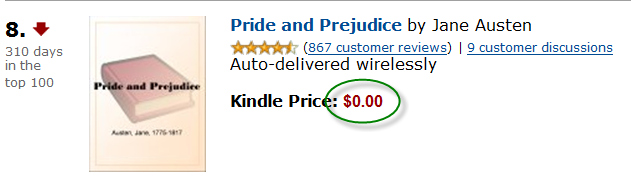
image
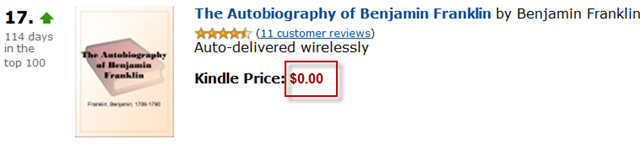
image

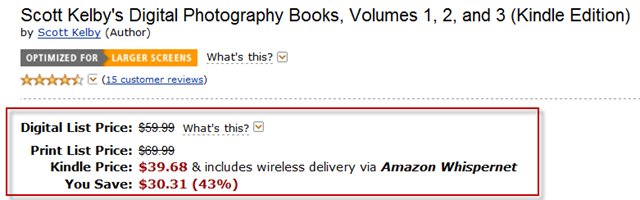
  • Virtually all Kindled edition books are cheaper than the printed versions.  For example, I purchased three volumes of a photography book.  I saved more than shown because I purchased each volume separately for only $9.99 each! I paid 29.97 for all three volumes compared to the normal price of $69.99, a savings of $40 or (57%).  Not even counting the free books, the Kindle pays for itself very quickly.
image

  • My library is full.  I have no more room for books and can’t afford new expensive bookshelves even if I had room.  However, I can store 1,500 books on the Kindle.  When I fill it, I can archive the one’s I’ve read on Amazon and download more books.  I can move books back and forth between the Kindle and Amazon, which means I’ll never be out of room.

  • I can read the books on my iPhone, my laptop, and the Kindle and they all sync.  That means if I read something on my iPhone and later open the same book or article on the Kindle, the Kindle version starts where I left off reading on my iPhone.

  • The books are archived safely on Amazon's servers. I don't have to worry about losing my books if the house burns down!

  • The new e-ink technology makes the Kindle read just like printed material.  It is not backlit there is no eye strain like there is when reading on a computer monitor.  It also means that the battery lasts much longer.

  • I can literally carry my entire library in my hand. I can read any book, essay, newspaper, magazine or blog—any place, any time, any where.  Great for the doctor’s office, on planes, etc.

  • I can highlight and annotate material and access my notes, annotations, clippings on my computer for using in articles, presentations, or for sharing with others.

  • Newspaper, magazines, and blog subscriptions are downloaded to my Kindle at night, while I sleep and before they are online or on newsstands.  When I get up to have my coffee, I can have my devotions and read the newspaper before the start of the workday.

  • I have free broadband 3g coverage via Sprint on the Kindle.  This means I can browse the web on my Kindle.  The browser is not great, but usable.

  • I can have a sample of any book or newspaper sent to my Kindle prior to buying.  This saves me from making expensive purchase mistakes.

  • I can search any book or my entire library on my Kindle by key word(s).

  • I have immediate seamless access to a built in dictionary and Wikipedia.  I can lookup anything without looking my place in the Kindle.

  • I have an always available “built-in” book light in on Kindle case (light and case sold separately).  I don’t have to find the book light.  It is always available with my Kindle.  This is great for reading in bed or on flights when I don’t want to disturb my seat mates.

Those are just a few reasons by I prefer the Kindle.  There are a few downsides:

  • Even though the Kindle can go two weeks without recharging (with wireless off), it still has to be charged.  Print books do not have to be recharged.

  • The Kindle is a computer with software, which means there will be occasional technical issues.  I’ve never had a technical problem with a book.  :-)

  • Although within limits you can share your Kindle account with other Kindle users (meaning you can share books with each other, e.g., family members), it is limited and requires that they have a Kindle. There is no restriction on sharing printed books.

  •   Some will argue that e-readers like Kindles don’t give the pleasure of holding a book in your hand.  Although I understand this concern, I believe it is over-stated.  First, there is nothing particularly pleasurable about holding a paperback.  Obviously, holding a nice leather bound book provides a certain pleasure, but who can afford many leather bound books?  Second, as indicated above, with a good leather cover on the Kindle, it feels like you are holding a good leather bound book.

  • A library in one’s study is beautiful, Kindles are not. I would not want to see a room full of Kindles.  :-) 

What are the implications for our schools?

  • It the trends are any indication, textbooks, newspapers, magazines, blogs, etc., will migrate to electronic versions.  The price point should be lower, saving schools money. 

  • We may finally be able to eliminate the heavy book bags that our students carry.

  • Lockers may no longer be necessary.

  • Curriculum can be updated more frequently, which is particularly important for science textbooks.

  • Students and teachers could have access to textbooks and other readings on cell phones, computers, and Kindles (or other e-book readers) simultaneously.

  • There may be a convergence of this technology into one handheld device.  It is rumored, for example, that Apple is working on an iSlate and Microsoft on a similar device.

  • Students can have access to the world’s best literature and historical documents—for free.

  • We can reduce the size of our libraries making room for more classrooms.

What are your thoughts about these developments?

Given the anticipated explosion in e-books and e-readers, what are your thoughts about the implications for our schools?  Would you promote the use of e-readers and e-textbooks as substitutes for printed textbooks and the traditional school library?  Do you see any intrinsic advantage or disadvantage to the move to electronic reading and publishing?

The Web Equivalent of Nudists and Should You Commit Web 2.0 Suicide?; Is There a Biblical Framework on Privacy?

Happy Data Privacy Day

By Dr. Barrett Mosbacker

Facebook recently irked me.  I am a Facebook user but I am not a heavy user.  I keep up with a few colleagues and friends but mostly I post articles on Facebook that I believe others may find interesting.  I mostly use Facebook so that I can work through the biblical, educational, and social implications of social technologies as a Christian.  We are called to bring all of life under the Lordship of Christ—that includes Facebook and similar technologies. 

I also use Twitter (you can follow me @Bmosbacker).  I usually post an occasional link to an interesting article.  The exception is that I post my status as I travel.  My wife, children and secretary are able to keep up with me in real time and are immediately alerted if I have flight delays, etc. I also follow “Breaking News” the “CDC”, “TechCrunch”, AlertNet, and a few other organizations that provide timely and useful information. 

How did Facebook irk me?  The company changed its privacy settings to a default of “public”.  That meant that any information I posted on Facebook would be available to everyone on the Internet.  Facebook made this change because it is in the company’s interest to have as much information shared publically as possible. 

I have nothing to hide.  But I am very selective and careful about anything I put online.  I assume that anything I post could be made public.  Accordingly, I set virtually all of the privacy settings to the strictest level possible, exactly what Facebook prefer that I not do.

As an aside, if you want to commit Web 2.0 suicide, now you can.  This article explains what it is and how it is done.

Having just experienced Facebook’s effort to make our lives increasingly public, I found this particular article to be very timely: We All Live in Public Now. Get Used to It. Erick Schonfeld writes:

image

As the Web becomes more social, privacy becomes harder and harder to come by. People are over-sharing on Facebook and Twitter, broadcasting their whereabouts every ten steps on Foursquare and Gowalla, and uploading photos and videos of their most private moments to the Web for all to see. It’s easy to say that privacy is dead, we all live in public now, and just deal with it.

But things are a bit more complicated. It used to be that we lived in private and chose to make parts of our lives public. Now that is being turned on its head. We live in public and choose what parts of our lives to keep private. Public is the new default.

Mr. Schonfeld goes on to quote Stowe Boyd:

Some people are the web equivalent of nudists: they live very open lives on the web, revealing the intimate details of their relationships, what they think of friends and co-workers, their interactions with family and authorities. But . . . even these apparently wide open web denizens may keep some things private, or secret.

As if to emphasize the point, one reader posted this comment to the article:

My entire life is public! I use services like Foursquare and Twitter posting my location and pictures on my family and I.  I think people of my generation won’t care as much. It’s kind of second nature to me to just post everything I’m doing. I never really stopped to think about what I’m doing as being dangerous.  The future will be filled with people like me! :)

Thus the Question: Is There a Biblical Framework on Privacy?

I recognize that our country’s forefathers embedded certain notions of privacy in the Constitution and Bill of Rights but these do not directly address the development of a biblical framework for privacy on the Internet.  More specifically:

  • How does privacy apply to 21st century technology?

  • What should we be teaching students beyond being careful about what they post?  For example, is there a positive component to living a more public life online?  After all, if one grew-up in a very small village or town there is very little privacy as we typically conceive of it. 

  • Is individual privacy a human construct or a divine one? 

  • What are the limits? 

  • Is it sinful to post personal information on the internet that is not intrinsically evil?

  • What are the caveats and limits to privacy in the digital age?

  • How can we and our students use social networking in a redemptive manner, i.e., how can they use social networking in the normal course of living to glorify Christ (and I’m not referring to presenting the Gospel or apologetics—although that is certainly a good thing)? 

I have not formulated adequate answers to these questions yet (I’m working on it) but it seems to me that we have an obligation to grapple with these issues and to help our students do likewise.  We need to help them develop a biblical (not a traditional, conservative, or liberal) worldview on privacy and social media in the digital age.

What are your thoughts?  Please share you initial ideas by living a comment on this article or by posting your thoughts on the CSJ Facebook Discussion Board.

They Are Coming After Your Students and Said So!

Dr. Barrett Mosbacker, PublisherAt a recent Executive Symposium on Distance Education that I attended a public school superintendent, not knowing I was from a private school, said to the group (to paraphrase), "we are developing a robust online program and we fully expect to recapture students from home schooling families and private schools."

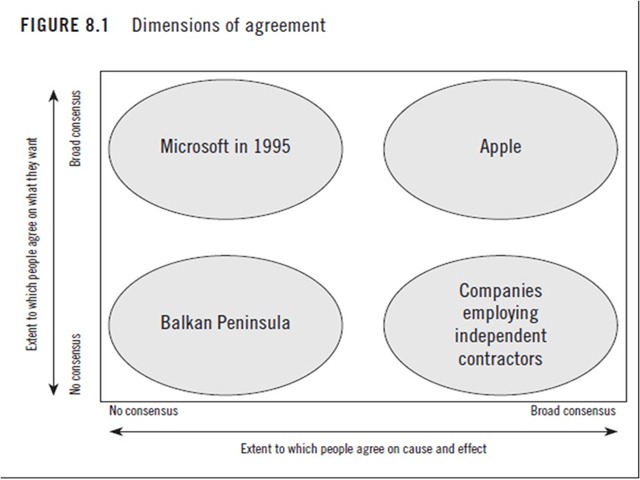
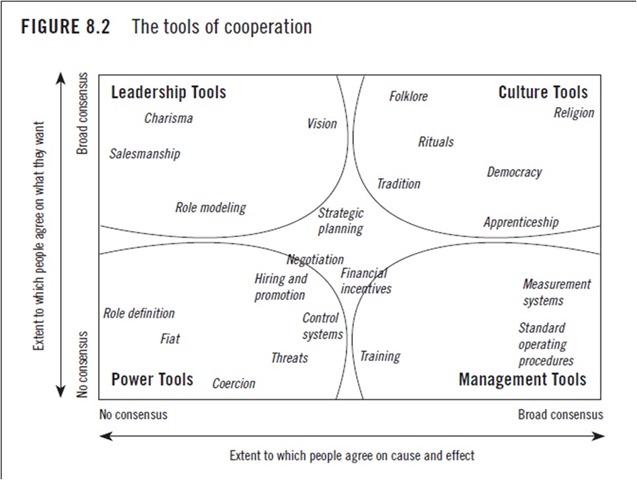
I just reread portions of Christensen's excellent book, "Disrupting Class".  I am particularly interested by his analysis of the "Dimensions of Agreement" and the "Tools of Cooperation".  I have attached graphics depicting the concepts.  These are particularly important to me because it can be difficult to get staff to accept change--I find this particularly problematic among conservative Christians, whom by definition, are "conservative."  :-)  In my estimation, moving forward, carefully and thoughtfully, with distance learning programs in imperative but it is not an easy task--the learning curve is steep, creating a feasible business plan is critical, and getting buy in can be tough.  But, Christensen argues, refreshingly, that consensus is not necessarily the goal--cooperation is!  I find that a refreshing approach given the emphasis on consensus building over the last several decades in the management literature.  I was also surprised by his observation that change is most difficult when there is wide agreement on the goals and processes currently in place.  Generally, one would think that this is a good thing. Upon reflection, however, it is easy to see why change in an organization can be very difficult when the organization is in the upper right quadrant of the dimensions of agreement chart.  This means that one of our challenges is to challenge the consensus on the goals and/or processes currently in place, which is all the more difficult when the organization is successful.  In other words, success can actually work against us, as in "good is the enemy of great."  It is what I'm calling the "Hobbit Effect."

In the Lord of the Rings, the Hobbits went merrily about their lives oblivious to the fact that Mordor was rising and threatening them.  Only a few saw the danger and acted.  I wonder if distance learning and charter schools aren't the "Mordors" of Christian education.  While we argue about uniforms, dress codes, and tuition discounts, the public system is installing a robust distance learning infrastructure and charters are multiplying.  Will we wake up in 10 years and wonder what happened to our market?’

Christensen (2008), Disrupting the classroom, p. 187

Dimensions of Agreement Christensen 

Tools of Cooperation Christensen

I am so impressed with Christensen's book that I've ordered two more:
The Innovator's Dilemma: The Revolutionary Book that Will Change the Way You Do

The Innovator's Solution: Creating and Sustaining Successful Growth

What is Google Wave and Why Should You Care?

What is Wave?

Google Wave is an online tool for real-time communication and collaboration. A wave can be both a conversation and a document where people can discuss and work together using richly formatted text, photos, videos, maps, and more.

A wave is equal parts conversation and document. People can communicate and work together with richly formatted text, photos, videos, maps, and more.

A wave is shared. Any participant can reply anywhere in the message, edit the content and add participants at any point in the process. Then playback lets anyone rewind the wave to see who said what and when.

A wave is live. With live transmission as you type, participants on a wave can have faster conversations, see edits and interact with extensions in real-time.

Why Should I Care?

If you you are like many, the rapid unrelenting wave (yes, the pun is intended) of new technologies can be mind numbing, even exhausting.  Who can keep up with it all?  Should we even try?

No, we cannot keep up with all of it but yes, we should try to stay current.  There are several reasons to stay on top of developments like Google Wave:

  • As leaders, we do not want to be caught with our pants down when a new technology explodes on the scene fundamentally changing the way we communicate and interact.  IF it is a efficient and cost effective technology we need to know about it before investing limited resources in outdated technologies, irrelevant training, and misaligned infrastructure.
  • Some technologies have the potential to be game changers—they can change the expectations of parents and students and they can change the educational market, Distance Learning and the concomitant technologies is one example.
  • Your credibility as a leader is affected by your “currency.”  If you don’t know what’s going on today it is hard to convince others that you are equipping your students for tomorrow.
  • Good technologies, effectively used, can increase your productivity.
  • Google Wave may provide additional evidence that Email as we know it no longer rules.  See my related article: “For Good or Bad: Email No Longer Rules".”

Here are three videos that explain Google Wave.  Want to try Wave?  You will need an invitation.  Click here.

The Short Version

The Longer Version

The Really Thorough, Long Version!

Not So Fast: Is Technology Diminishing Our Quality of Life?

By Dr. Barrett Mosbacker

Anyone who has been reading this blog knows that I am an advocate for the appropriate and effective use of technology in our personal lives and in our schools.  I am not a Luddite.

Nevertheless, I also share the conviction that technology, like many good things in our lives, can become an obsession and a cruel master.  Any addiction, even to good things, is harmful and unbiblical whether it is sex, food, work, or technology.

I recently came across a beautifully written article by John Freeman in the Wall Street Journal.  You can read the entire article here.  If the link is broken, you can access the article in PDF format here.

Because the article is copyrighted I will not post it here but I am providing a short excerpt with the hope that you will read the entire article. 

Not So Fast (August 29, 2009) WSJ Online

… We will die, that much is certain; and everyone we have ever loved and cared about will die, too, sometimes—heartbreakingly—before us. Being someone else, traveling the world, making new friends gives us a temporary reprieve from this knowledge, which is spared most of the animal kingdom. Busyness—or the simulated busyness of email addiction—numbs the pain of this awareness, but it can never totally submerge it. Given that our days are limited, our hours precious, we have to decide what we want to do, what we want to say, what and who we care about, and how we want to allocate our time to these things within the limits that do not and cannot change. In short, we need to slow down.

Our society does not often tell us this. Progress, since the dawn of the Industrial Age, is supposed to be a linear upward progression; graphs with upward slopes are a good sign. Process­ing speeds are always getting faster; broadband now makes dial-­up seem like traveling by horse and buggy. Growth is eternal. But only two things grow indefinitely or have indefinite growth firmly ensconced at the heart of their being: cancer and the cor­poration. For everything else, especially in nature, the consum­ing fires eventually come and force a starting over.

The ultimate form of progress, however, is learning to decide what is working and what is not; and working at this pace, emailing at this frantic rate, is pleasing very few of us. It is encroaching on parts of our lives that should be separate or sacred, altering our minds and our ability to know our world, encouraging a further distancing from our bodies and our natures and our communities. We can change this; we have to change it. Of course email is good for many things; that has never been in dispute. But we need to learn to use it far more sparingly, with far less dependency, if we are to gain control of our lives.

In the past two decades, we have witnessed one of the greatest breakdowns of the barrier between our work and per­sonal lives since the notion of leisure time emerged in Victorian Britain as a result of the Industrial Age. It has put us under great physical and mental strain, altering our brain chemistry and daily needs. It has isolated us from the people with whom we live, siphoning us away from real-world places where we gather. It has encouraged flotillas of unnecessary jabbering, making it difficult to tell signal from noise. It has made it more difficult to read slowly and enjoy it, hastening the already declining rates of literacy. It has made it harder to listen and mean it, to be idle and not fidget. This is not a sustainable way to live. This lifestyle of being constantly on causes emotional and physical burnout, work­place meltdowns, and unhappiness. How many of our most joyful memories have been created in front of a screen?

If we are to step off this hurtling machine, we must reassert principles that have been lost in the blur. It is time to launch a manifesto for a slow communication movement, a push back against the machines and the forces that encourage us to remain connected to them. Many of the values of the Internet are social improvements—it can be a great platform for solidarity, it rewards curiosity, it enables convenience. This is not the mani­festo of a Luddite, this is a human manifesto. If the technology is to be used for the betterment of human life, we must reassert that the Internet and its virtual information space is not a world unto itself but a supplement to our existing world, where the following three statements are self-evident …

Remember, click here to read the full article or if the link is broken, you can access the article in PDF format here.

Let’s Get Creative! How Could You Use This?

By Dr. Barrett Mosbacker

Take a moment to read the article below (Reposted from Duct Tape Marketing.) Now, give this some thought and then ask yourself, “How Could We Use Twitter to Promote Our School and/or Serve our Stakeholders?”

After giving this some thought, post your ideas as a comment to this blog article to share with others!

17 Ways to Use Twitter for Business and Some Not

More and more small business folks are giving in to what seems like an insurmountable mountain of hype and jumping on the twitter bandwagon.

But, some people still look at twitter on the surface and conclude that it’s one big waste of time. I can’t say I disagree completely, however, like all social media and marketing tactics, before you can determine if something makes sense you need to analyze your objectives. So, instead of asking why you would use it, ask how it might help you achieve some other already stated objectives.

1) Would you like a way to connect and network with others in your industry or others who share you views? It’s a good a tool for that.

2) Would you like a way to get instant access to what’s being said, this minute, about your organization, people, products, competitors or brand? It’s a good tool for that.

3) Would you like a steady stream of ideas, content, links, resources, and tips focused on your area of expertise or interest? It’s a good tool for that.

4) Would you like to monitor what’s being said about your customers to help them protect their brands? It’s a good tool for that.

5) Would you like to extend the reach of your thought leadership – blog posts and other content? It can be a good tool for that.

6) Would like a way to quickly find vendors, partners, tech help, even employees for your organization? I can be a good tool for that.

7) Would you like to promote your products and services directly to a target audience? Not such a good tool for that, but it can light a path back to your web site!

Now, if that weren’t enough, the open nature of the twitter platform is spawning uses far beyond what was ever imagined or what many people can grasp - and this use of the technology will only get bigger.

Here are few things you may have never considered

8) Publish your Flickr photos on twitter - Visit twittergram and set-up an account and then just upload to Flickr but tag your photo twitter and it goes into your twitter stream.

9) If you use online todo list Remember the Milk - you can set it up to flow into twitter - this might be a way to assign todos to remote teams

10) Using strawpoll you can create mini polls into your twitter stream - great for flash feedback

11) Use twitter to keep up on traffic jams with commuterfeed

12) Have twitter alert you when you have a meeting with timer

13) Get and fill current job openings with tweetajob

14) Track FedEx, UPS and DHL shipments with TrackThis

15) Get help quitting smoking

16) Keep a diet journal

17) Get a tweet when your plants need water - - okay this one would be way cooler if it simply tweeted you when the plant watered itself.

Share ideas on how our schools could use Twitter by submitting a comment with your ideas.

The God of Technology, or The god of Technology

Jim Drexler of Covenant College alerted me to this article on CARDUS.  After reading it I immediately wrote Mr. Evans and asked his permission to post it on my blog, which is graciously granted. 

I believe you will find this article very helpful and informative.  It strikes a very positive and helpful balance for developing a Christian perspective on technology that is neither afraid nor idolatrous.  I also found this article of particular interest because Mr. Evans knows what he is talking about.  Here is an excerpt from his bio.:

Dave Evans is 30-plus year veteran executive of Silicon Valley who offers a range of professional services to rapidly growing companies and personal mentoring to individuals. Since 1990, Dave has been assisting high-tech clients in strategic planning, sales and marketing, new business development, mergers and alliances, growth management, and executive development. Dave's client list has focused on early stage start-ups but also includes Fortune companies including such leaders as Veritas/Symantec, HP, Intel, and AT&T. (He's also negotiated fishing rights for the Inuit in Alaska—but that's a whole 'nuther story).  Prior to consulting, Dave was VP and Co-Founder of software publisher Electronic Arts, led the introduction of the mouse and laser printing at Apple, and has held senior marketing positions with IBM/ROLM Corporation and voicemail inventor and manufacturer VMX (now Avaya).

Since his college days, Dave has had an abiding, faith-nourished commitment to living and helping others live a coherent life—thoroughly integrating soul and role, especially in the realm of vocation …

I also highly recommend that you read the excellent material found on the CARDUS website. 

The God of technology, or the god of Technology?

Posted with permission from Dave Evans.

July 31, 2009 - Dave Evans

After 34 years of high tech work in Silicon Valley, I have found myself drawn into more than a few discussions with people of faith about technology. How we think about technology matters, and I'd like to make some suggestions for these kinds of conversations.

First, let's define what we mean by technology. Dictionary.com (an online definition seems appropriate) defines it as "the branch of knowledge that deals with the creation and use of technical means and their interrelation with life, society and the environment, drawing upon such subjects as industrial arts, engineering, applied science, and pure science." In short, technology is about tools.

All tools—from the first stick Adam used to soften the dirt to the latest wireless LAN software I had to reinstall to transmit this article to the editors of Comment—share the same character: they enable humankind to enhance the execution of human ability. Tools allow people to do the kinds of things they can already do, but do them bigger, faster, cheaper or better than they can without the tool.

Technology is just a tool, so our thinking about it needs to be grounded in a thoughtful perspective on tools—dare I say, a thoughtful theology of tools and technology. The definition of technology which I cited contains three key elements: creation, use and interrelationship. With these defining elements in mind, let's look at two ideas related to technology that I think warrant more thoughtful attention: newness and availability.

Newness

Technology, especially within modern society's understanding of technology, is focused on the new thing brought about by the latest science. Michael Lewis captured this perspective well in his book about New New Thing book jacketlegendary Silicon Graphics founder Jim Clark, titled The New New Thing. Why are we so inexorably excited about and drawn to the new thing? I'll argue because God made us that way, and it's a good thing. We are made in God's image; we bear the imago Dei.

One of the first things we learn about God is that he is creative, and in a dynamic way. God does not merely make stuff that lies there. God makes stuff that grows and lives and moves in time, space, history and the unfolding story of God and creation.

big-bang.jpgAn astonishing hint to the nature of things is embedded in the fact that creation wasn't finished all at once in a Big Bang. Why didn't God bring the present world into being with just one quick flick of the divine wrist? He didn't zap the cosmos into completion, but labored at it a while, revealing new wonders day by day. At each step along the way, God reflected on the latest thing and concluded it was good. God created the way he did out of love. The dynamic God conceived and made a dynamic universe, and in so doing, wired the continual refreshment of newness into the very heart of all reality.

I'm not saying all new is good, but good new is very good indeed. We are invited—commanded actually—to co-create with God in order to bring respectful and loving order to this world. We are to engage ourselves in the human endeavor of stewardship to care for all creation in order that all persons, and everything else too, may more and more live into what God has in mind for the world.

It's an amazing adventure, and technology enables us to do that work. As anthropologists well know, tool making tools.jpgis an essential aspect of what makes us distinctly human, and as Christians we understand that it's an essential aspect of what makes us God's image-bearing children. It's a triple win—we get to participate in the innovating of technology (creation) and the application of that technology (use) to do good in the world (interrelationship).

I believe the movement of newness God set in motion in creation and in each of us fuels our healthy attraction to the new that we so experience in our encounter with technology. We in fact worship the (capital G) God of (small t) technology.

Availability

Most of us want the latest available technology. Usually, available technology is the newest thing that works fairly reliably and is economically accessible. When will the next iPhone or cold fusion or a 100mpg car be available?

Those are good questions, but they fall short. The key is not just the technology's availability, but how available it makes us. The purpose of technology is to buy us more time to be available to other things, or to makes us more effective in some endeavour (and so allow us a greater avail upon the world). Good technology is all about availability.

I may here sound as if I'm merely surfacing the age-old technological tension between good technology and good use of technology. While that's a relevant issue, it's not what I'm getting at here. I'm advocating for something less obvious and more profound: an availability consciousness that can transform our relationship with technology, both collectively and individually.

The Christian life is a particular way of life grounded in a continual awareness of God's constant presence and active invitation. Jesus said that he could do only what the Father showed him (John 5:19). Jesus lived in constant availability to the Father, and so should we. That means that all our endeavours and all the tools and processes and techniques and collaborations and organizations that we use to live out our lives are to be engaged, while still retaining a sense of availability to what else is going on and what else God may be showing us. We need to learn a way of being that is contextualized in a larger frame than the current situation, seeing a picture that's bigger than what meets the eye. By always being a little outside our situation, we are actually made more available to be present to the situation; this is an aspect of the freedom we gain by dying to self and becoming alive to God.

Such availability has a very real expression in our encounter with technology. Technology is attractive because of the God-given allure of the new new thing—but it's also "sticky," in that for many of us, it entraps our attention, making us so focused on it that we become less, not more, available. We may have technologically bought ourselves some time, but that time is only valuable (as opposed to merely accessible) if we can direct our use of it from a position of availability. Retaining access to this kind of awareness is what I mean by an availability consciousness. I'm not suggesting we reserve 6% of our brains to constantly chant, "What else is going on?" or "What's God saying now?" The issue is more nuanced than that—it has to do with one's point of view, one's way of seeing and engaging at all times.

Let me give an example. I went to a baseball game with a friend last night and the guy sitting next to us was drunker than he realized. He was also yelling more loudly, crudely and disruptively than he realized. He did not have access to a sufficient degree of self-awareness or self-control to see the impact of his actions. He's probably a pretty decent fellow with fewer beers in him, but neither he nor we could recognize it at the time. We all lost something in the process (he got thrown out, and we were distracted).

That's the critical question—can you recognize your degree of availability? Given the immense power for good and the incredible attractiveness of today's dazzling and elegant technologies, it's easy to lose our availability without knowing it. Ever so subtly, technology becomes the object of our attention, rather than the tool of it. Developing an availability consciousness will help us guard against accidentally slipping into making a god of Technology, rather than responding to the God of technology.

We need to match technology's advances with our own increasing maturity as technology creators, users and observers. Perhaps we can better respond to that challenge by reflecting on what newness and availability have to tell us about technology and its use.

How Facebook Can Affect Your Enrollment, Marketing, and Communication

By Dr. Barrett Mosbacker

According to Sharon Gaudin of Computerworld, a recent study shows that social networks for middle-agers (that’s most of us reading this article) are now a more popular form of communication than email.

I remember that just a few years ago many Christians, including Christian school administrators and teachers, viewed social networks as the exclusive domain of teenagers or were immoral, or both and therefore should or could be ignored.  Such a perspective was a mistake then and is a mistake now.  Social networks are a form of communication and social interaction.  Social networks are neither inherently good nor inherently evil.  HOW they are used determines their value.

According to a report by Nielsen Online (download PDF), social networks are used by two-thirds of all worldwide online users.  Social networks and blogs have become the fourth most popular online products.  The report lists e-mail as No. 5 on the list of users' favorite online tools. Search tools, portals and PC software topped the list.

Other highlights of the report include:

  • Putting the growth of social networks – popularity and engagement – into context

  • How the audience to social networks is changing

  • The challenges facing advertisers on social networks

  • What advertisers can do to find the magic formula for advertising in social networks

  • Factors contributing to the Facebook phenomenon

  • Why localization has won the day in many countries

  • Where mobile social networking has taken the greatest hold

  • What ‘traditional’ publishers can do in the face of the social network phenomenon

Mind Share

“Of the social networking sites out there, Twitter and Facebook seem to have the lion's share of the mind share these days. And Facebook has the lion's share of the market share, as well. In January, online researcher comScore Inc. reported that Facebook, once thought of as the up-and-coming social network, had overshadowed rival MySpace, with nearly 222 million unique visitors in December compared to 125 million for MySpace.

To back up comScore's numbers, Facebook CEO Mark Zuckerberg noted in a January blog post that the social networking site had hit a big milestone -- 150 million active users, nearly half of whom use the network daily.”

Neilson’s report also shows the significant increase in the time spent on Facebook: In all the markets that the company tracks, Facebook is visited monthly by three of every 10 people online.

Our Parents and Prospective Parents are on Facebook

THE MOST SURPRISING FINDING OF THE REPORT is that Facebook’s greatest growth in global audience numbers has come from people aged 35-49!  Social networks aren’t just for the teenage set anymore.

This is the prime child rearing, school selecting age of the population!

Should We Use Facebook and Other Social Networks to Connect with Parents?

Frankly, I don’t know the answer to that question but I am researching the issue because I believe we should try.  Here are some of the issues to consider.

Our Mindset/Mental Model Must Change

Traditional advertising is one-way communication—the message is pushed or placed in front of the intended customer.

Social networks by definition are SOCIAL and therefore the “advertising” must be a conversation.  According to Nielson, “the point that social network members are co-creators of content and, therefore, have a sense of ownership within the site means advertising should be about participating in a relevant conversation with consumers rather than simply pushing ads on them. After all, it is social media. Advertising shouldn’t be about interrupting or invading the social network experience, it should be part of this conversation.”

This two-way conversation presents opportunities and problems.

Positively, it provides a framework for engaging in authentic conversations about education, Christian education, and our schools.  Facebook, for example, is a wonderful way to provide helpful information to current and prospective parents.

Negatively, we run the risk of false accusations and unjustified negative comments being made by disgruntled individuals.  The social network, if not managed well, could also foster gossip and slander.

In other words, promoting our schools through social networks can be a two-edged sword.

“Messaging within advertising should come from a more authentic, candid and humble perspective.

Social media has, once again, brought word of mouth to the fore as the ultimate form of advertising at a time when traditional advertising is suffering from a major lack of trust.

Nielsen’s analysis of social media conversations back in 2007 and again in December 2008 showed that ‘false’ was the term most closely associated with “advertising”.
Social media has fanned the flames of consumer distrust about advertisers claims. However, at the same time social media has provided the motive, opportunity
and means for advertisers to engage consumers in a more open and honest way.”

Building Trust and Friendships with Parents?

The report goes on to note that “social networks are ultimately about friendships, where members add value to each other’s lives through interaction.  Therefore, advertising should follow the same philosophy of adding value through interaction and consultation. Fan sites or sponsored groups are, perhaps, one of the ore successful examples of social network marketing that touch on the principles of interactivity and adding value …

However, the challenge for advertisers is that discussions within these groups won’t necessarily align itself with the brand-designed messaging. Much like a friendship, marketing on social networks requires continual investment – in terms of time and effort as opposed to financial – to be of value to both parties.”

In other words, some of the conversation on a Facebook fan page for our school will not reflect the message that we are trying to communicate.  Some of the comments posted by participants may be blatantly false. Although this presents a significant problem, it also presents an opportunity—an opportunity to correct false information, rumors, and gossip and to share positively the philosophy and impact of Christian schooling.  Doing so of course requires that someone from the school be fully engaged with the Facebook site.

What Do You Think?

  • Does your school have a Facebook presence?  If so, why?  If not, why not?

  • If your school has a Facebook presence, how has it worked?  Has it been a net positive experience or a negative one?

Technorati Tags: Facebook,Social Networking,Social Network,Advertising,Christian,Schhool,Education,Christian School,Christian Education

Can We Keep Up with the Competition?

(Reposted from Goggle Blogger)

Scan books

We are in danger of becoming increasingly irrelevant and non-competitive. If we do, we will lose students.

Historically, our competition has come from free public schools, charter schools, and homeschooling. Our new competition is coming from technology enabled courses offered by public schools, colleges and universities, and virtual schools, including virtual Christian schools. This development is changing the educational landscape and the school market. The current recession is likely to accelerate this change.

Public schools are adopting interactive technology and distance learning (D.L.) at an accelerating pace. Moreover, there is an increasing number of online virtual schools in higher education and in K-12 education. These options make virtually (pun intended) any course available to any student anytime, anywhere. Students and their parents are no longer restricted to brick and mortar traditional schools to have access to high quality fully accredited courses.

The Explosion in Distance Learning

Alabama, not historically known for innovation or high quality education, is leading the nation in connecting every public school in the state to online asynchronous courses and synchronous courses offered through video conferencing and other interactive technologies. Every student in the state now has access to a wide range of courses, including honors and AP courses that have historically been only offered to students in larger schools in wealthier school districts. The image below shows some of the courses offered through Alabama's Access Program.

Al Access Banner 2

Distance Learning Course List

FOX News.comTo view a short news clip from Fox News about the Access program, click here.

As reflected in the Alabama Access Program, distance learning is exploding. According to Drs. Horn and Christensen (authors of Disrupting Class1) of the Harvard Business School, public education enrollments in online classes have skyrocketed from 45,000 in 2000 to roughly 1 million today. It is projected that by 2020 over 50% of high school classes will be available online1.

The Florida Virtual School (FLVS) reflects this explosion in D.L. Founded in 1997, FLVS currently enrolls 63,675 students in grades 6-12. Enrollment is open to public, private, and home school students.

FLVS offers more than 90 courses—including core subjects, world languages, electives, honors, and over 10 Advanced Placement courses. FLVS courses are accepted for credit and are transferable. Florida Virtual School is accredited by the Southern Association of Colleges and Schools and courses are NCAA approved. FLVS also offers AP Exam reviews in April, even for students who did not take the course through FLVS.

Online growth trend chart

Drs. Horn and Christensen outline four reasons why distance learning will continue to grow:

  1. Distance learning technologies will keep improving.

  2. Distance learning provides the ability of teachers, students, and parents to select right learning pathways for differentiated learning thus customizing the education to the learning preferences and needs of each child.

  3. The looming teacher shortage caused by the retirement of baby boomers will propel schools to move to distance learning to gain access to hard to hire teachers in math, science, and other subjects.

  4. The cost of distance learning will fall significantly.

Distance Learning Is and Will Disrupt the Traditional Classroom and School

I highly recommend Disrupting Class: How Disruptive Innovation Will Change the Way the World Learns by Drs. Christensen, Horn, and Johnson. For a good overview, click on the play button below to watch a video podcast interview with the author, which runs approximately four minutes.

The short video below from Harvard Business School provides useful background context to Dr. Christensen's book. A key concept in this video is winning not by doing it better but doing it differently.

The key concepts in the video sound very familiar in our schools.

The Stimulus Plan is to Include $1 Billion for Ed Tech in Public Schools

According to Edweek2, the Obama Administration plans to spend $1 Billion for Ed Tech. The House Democrats' "American Recovery and Reinvestment" plan includes "$1 billion for 21st century classrooms, including computer and science labs and teacher technology training."

The House Democrats' plan overall includes $41 billion to local school districts, including $1 billion made available through the Enhancing Education Through Technology (E2T2) program, which last year was just $263 million. From the House Democrat's proposal:

We will put people to work building 21st century classrooms, labs, and libraries to help our kids compete with any worker in the world.

Such developments have the potential to make public schools more competitive with Christian schools.

Competition from an Unexpected Source-Virtual Christian Schools

I can already hear the rejoinder "but we provide a Christian education in a Christian environment. This type of education cannot be replicated by technology."

It is true that neither distance learning nor any other technology can perfectly replicate the experience of community that one finds in a brick and mortar school. Warm human interactions, prayer in the classroom, chapel services, the excitement and lessons learned through athletics and fine arts are life changing and life enriching experiences that can only occur through face-to-face human interaction.

However, it is naive to assume that these rapidly developing technologies do not pose real challenges to our schools--and real opportunities.

The Challenges

1. The number of parents theologically and philosophically committed to Christian education is relatively small. Given the growing shallowness of Christianity in the U.S. and the evangelical church in particular, this number is likely to grow smaller.

As I noted in a previous post, for many parents, the "Christian" in education is not as important as "quality" in education. Many of our parents enroll their children in our schools for reasons other than the development of a biblical worldview, which frankly, most of our parents do not understand because their entire educational experience was secular, not Christian. They may have a Christian heart but most have a secular mind.

Once having experienced the benefits of Christian education, some of our parents come to a deeper understanding of and commitment to the philosophy of Christian education. Most, however, do not start with this understanding and many never acquire it.

Based on formal and informal surveys that I have conducted with parents over the years, I find that parents enroll their children in our schools for the reasons outlined below. Although survey results vary, in general the order provided below reflects the priorities of parents when deciding to enroll their children in a Christian school.

  • A sense of security and safety
  • Christian atmosphere (meaning good values, nurture, and protection from the "world")
  • Academic quality
  • Relatively small sizes
  • Christian worldview

The essential question for us is "can distance learning replicate the above benefits of Christian education?" I believe that it can--at least partially and most importantly--well-enough for many of our parents. I believe this will become increasingly true for several reasons:

  • Younger parents will be much more knowledgeable and comfortable with online learning (many will experience it first hand in college). Online learning will not have the stigma that it does for many of our current parents, administrators, and teachers.

  • The notion of community is changing due to social networking sites like Facebook.

  • Rising tuition may make Christian education increasingly unattainable for many.

  • Technology will continue to improve resulting in enhanced synchronous interaction through high speed embedded video-conferencing technologies like Wimba.

Moreover, it is interesting to reflect upon how many of the reasons cited by parents for enrolling their children in a Christian school can be at least partially met through online classes.

  • Security and safety is provided when students are at home with parents taking coursework online.
  • Christian students interacting live with a Christian teacher does provide a Christian atmosphere, albeit in a more limited fashion. Moreover, our students view social interactions differently than we typically do. For them, interaction through social networks and other technologies IS social interaction and quite natural. As evidence, all you have to do is watch a group of teenagers together. They spend as much time texting their friends as they do interacting with those directly in front of them.
  • Academic quality can be maintained when highly qualified teachers are teaching using interactive asynchronous and synchronous technology such as video-conferencing, chat rooms, Skype and similar programs. In fact, sometimes the quality can be better! It is now possible and relatively inexpensive for students to take online courses from instructors with Masters and Ph.D.'s, e.g., from India. For an example, click here.

To put this into perspective, consider the following information provided by one online provider of tutoring services.

Tutoring Quality

Tutors Profile

  • The small class size speaks for itself.
  • A Christian worldview can be taught by using Christian teachers and Christian material. Sitting in a traditional classroom is not necessarily required. For example, Reformed Theological Seminary offers theological degrees through distance learning. As I was researching material for this article I discovered a video that I did not know existed by my own pastor outlining the benefits of distance learning for theological training.

To the extent that parents believe that they can provide their children most of what is available in a traditional Christian school by combining distance learning, homeschooling, and extra-curricular programs through community programs, we run the risk of experiencing enrollment declines. As technology improves, our younger more technology savvy parents may choose options other than the local Christian school. They will make a cost benefit assessment something like this: "I am willing to get 80% of the benefits of a traditional Christian school for 50% of the cost." The graphic below, which I developed for a workshop I recently conducted, illustrates the calculation being made by parents.

Choosing Food school graphic

This leads to the next development in the market--the Virtual Christian School.

2. There are a growing number of Christian Virtual Schools such as Sevenstar Christian Academy. Schools such as Sevenstar offer online classes taught by Christian teachers, primarily to students of Christian parents. This is a new development that adds another player in the Christian school market.

As an experiment, I did a simple Google search for "Christian school distance learning". Here is what came up (note there are more than 10 pages of search results):

Google Search Graphic

3. The recession is creating significant challenges for our parents. These challenges may affect parents' decisions regarding the enrollment of their children in a Christian school.

  • Many of our families will experience job losses for one or both spouses.
  • Many families will receive little or no pay increases, some will experience reductions. On the other hand, most of our schools will raise tuition.
  • Employers are shifting health insurance premiums to employees and increasing co-pays thus reducing family disposable income.
  • Families have lost wealth making paying for college more difficult or impossible. Some parents will decide to forego paying K-12 tuition to save money for college.
  • Families are worried about retirement. Some may reallocate tuition to retirement accounts.
  • Grandparents may have less disposable income to assist with tuition.
  • Many families will focus on reducing debt and saving money.

4. The availability of high quality academic courses through both Christian and public schools, along with the recession, may encourage more parents to homeschool their children.

The Opportunities

Distance Learning Graphic Although the explosion in distance learning poses challenges, it also presents a significant opportunity. Consider the potential benefits of D.L. for our schools:

  • Distance learning provides a vehicle for extending our school ministries by enabling our schools to offer Christian education to students who do not have access to quality Christian schools or whose parents cannot afford it. Distance learning provides the opportunity to expand the Christian school market in ways hitherto not possible.
  • We have the opportunity to form strategic alliances to offer courses to our students that we otherwise could not afford to offer as individuals schools, e.g., Chinese, astronomy, etc.
  • A new revenue stream is created by enrolling new students but without the added cost of new facilities and auxiliary services.
  • Extending our educational ministry impact to international students along with the opportunity to connect our classrooms with classrooms in other countries thus fostering cross-cultural understanding and deepening our students' interest in world affairs and missions.

These are just a few of the potential benefits of this revolution in technology and learning. The question is "how are we going to respond?" As I see it we have three options:

1. The proverbial ostrich approach--deny the reality of what is already occurring. Adopting a smug, but in my humble opinion misplaced, confidence that D.L. is a fad or at most a niche phenomenon that will not materially affect the educational marketplace or our schools.

2. Adopt a theological superiority complex that in effect relegates distance learning to a sub-Christian status because it lacks the traditional definition of community. I call this the "Christian Luddite Syndrome" or CLS.

3. Prayerfully and creativity determine how we can redeem this new technology for God's glory, the advancement of His kingdom, and for the benefit of our schools and students. In short, we Baby in Tub don't have to throw out the baby with the bath water. Whatever the shortcoming of D.L., we can and should work to redeem the technology to make it all that it can be in service to the mission of Christian education.

Can we keep up with our competition and should we care? I believe the answer to both questions is an emphatic YES. We face both a challenge and an opportunity. Our response will determine which it will be for our schools.

An African Proverb provides an insightful summary of where we may find ourselves as Christian schools:

Every morning in Africa, a gazelle wakes up.
It knows it must run faster than the fastest lion or it will be killed.
Every morning a lion wakes up.
It knows it must outrun the slowest gazelle or it will starve to death.
It doesn’t matter whether you are a lion or a gazelle.
When the sun comes up, you better start running.

You Are Invited

I am currently working on a major distance learning initiative that will involved several Christian schools in the U.S. and overseas. If you would like to learn more about this initiative and your possible involvement, please email me (christianschooljournalblog@gmail.com) for more information.

References

1. Christensen, C., Horn, M., and Johnson, C., Disrupting class (2008): How disruptive innovations will change the way the world learns, McGrawHill, p. 91

2. Source: http://blogs.edweek.org/edweek/DigitalEducation/2009/01/1_billion_for_ed_tech_in_house.html

Technorati Tags: Distance Learning,market,Christian school,Christian education,Technology,Ed Tech,Educational technology,innovation,disruptive technology,disrupting class,educational reform,enrollment