An Open Letter to Teachers

  image

Source: Justin Tarte:

Dear teachers,

We have a lot of respect for what you do. Your job is extremely difficult, and we understand the many difficulties that encompass being a teacher. Your ability to lead an entire class is frankly amazing, and more importantly, you always seem cool, calm and collected despite what might be going on. There are times when we would love to be back in the classroom; there are other times when we can't imagine going back. Your job is definitely not an easy job, but as administrators, here are a few things we would like you to keep in mind:

1) - When we ask you and your fellow teachers for opinions and feedback, we would really appreciate it if you would take us seriously and put some thought into ways we can improve our school. We know you have a lot on your mind, but if we are going to take the time to ask you, we are doing it because we value your opinion.

2) - We love visiting your classrooms to see the students growing and developing, but when we visit a classroom and the students are having a free day or are watching a movie unrelated to anything of any real value, we are disappointed and feel as if the students are being cheated. We all have bad days and difficult things going on in our lives, but please make it a priority to do something valuable for your students every single day.

3) - Professional development is something we really enjoy, but please don't rely on us to plan and develop every single PD day. We want you to have a say and a voice in YOUR professional growth, and as such we would love to hear your ideas and suggestions. We also really would like you to take our PD days seriously and go into each session with the mindset of, "what can I learn today?"

4) - Can you please stop writing office referrals and sending students to the office for not coming to class prepared or coming late to class. We are here to support you and help you do your job, but if we are constantly tied up dealing with small and petty issues like this then how are we going to have any time to tackle some of the larger issues? Please talk with some of your colleagues and see how they handle these issues...contact the student's parents...take a moment and talk to the student BEFORE sending them down to us.

5) - We understand the importance of being visible and in the halls in between classes, but our administrative team is not very large. We will try our best to be in the halls as often as possible, but sometimes things come up and they need to be dealt with immediately, consequently we need your help. We need you in the halls helping to cover the spots we aren't able to cover. It's a group effort, and you play a crucial role in our overall effectiveness.

6) - Sometimes a lesson doesn't take the entire class period, or the students get done quicker than expected, but please do not allow your students to line up at the door. Furthermore, please do not let your students stand in the hallway as they wait to leave your class. Your class time is valuable and should not be discarded so easily. If your students end class 5 minutes early every day it adds up to over 3 weeks of instructional time over the course of the year. Think what your students could learn in that much time.

7) - Time is limited, and when we try to implement new programs we are doing so because we believe they can help students. Unfortunately, when we try to initiate a new program it seems as if a lot of teachers immediately disregard the program because they think the program will be pushed to the side and simply forgotten by next year. We realize it's difficult to implement several programs simultaneously, but they are aimed at improving the educational experience for our students. Please give our programs a chance before casting them to the side...our students could be missing out.

8) - When you were hired you were hired because we think you are the best, and because we think you are the best we want to get out of your way so you can do great things. We want to empower you, encourage you, and watch you take risks in an attempt to do some awesome things, but when we see you do the same thing every year we wonder if you really want autonomy. Additionally, we would be more than happy to provide you time to observe some of your colleagues if this time was used productively. Please be the awesome teacher you were hired to be.

Don't take this open letter as us trying to tell you how to do your job. As Educators we must all be open for suggestions and advice, and we hope that if anyone had any advice or suggestions, they would take the time to inform us. As previously mentioned, we understand all the parts of your job because we were once in your shoes, but we hope this letter provides a small reminder of how much your decisions and actions affect others.

Thank you for your time, and we look forward to your response,

The administrators

An Open Letter to Administrators

  Source: Justin Tarte


imageDear administrators,

We have a lot of respect for what you do. Your job is extremely difficult, and there are lots of aspects of your job that we don't fully understand. Your ability to lead an entire staff and student body is frankly amazing, and more importantly, you always seem cool, calm and collected. There are times where we would love to have your job; there are other times where we couldn't imagine having your job. Your job is definitely not an easy job, but as teachers, here are a few things we would like you to keep in mind:

1) - When making decisions that are going to affect our classes or our students, we would really appreciate it if you would ask for our opinions and feedback first. We know you can't ask for feedback for every decision, but more often than not would be much appreciated.

2) - Will you please come to our classrooms more often. We are really doing some awesome, innovative and creative things with our students, and we would love to share our experiences and successes with you and our staff.

3) - It would really mean a lot to us if you would participate in our professional development days. As Educators, we all need to be lifelong learners, and the staff would be quite receptive if you were learning side by side with us. We know your presence can skew the way some Educators respond, but we feel that would only be temporary until your presence becomes common practice.

4) - Can you please refrain from blanketing the entire staff with a punishment/lecture when the problem lies with a small group of Educators, and not the entire staff. Just as we don't do this with students, it's not fair to do it with us either.

5) - Your time is extremely limited and you are always busy, but we would really love it if you were more visible in the hallways between classes. Establishing and building a school community are crucial to the school's success, and this is one of the easiest ways to show students and teachers we are all in this together.

6) - It would be much appreciated if you would include teachers, students and community members when developing the building's vision and goals. Additionally, it would be wise to revisit and redevelop our building's vision and goals, as society and the needs of our students are always changing. Lastly, we should really believe and follow through on our building's vision and goals.

7) - We love any new idea or initiative that can improve the education we offer at our school, but if we are going to add new programs would you please consider eliminating other programs that aren't quite as effective. Speak with students and teachers to determine which programs are really helping, and which programs we could probably do without.

8) - Lastly, the more autonomy and voice you give us Educators, the better we will perform. Allow us to do the jobs that you hired us for. Support us, empower us, and encourage us, but please don't control us. Tell us it's OK to take chances in an effort to do something awesome with our students. Provide time for us to see the awesome things other Educators are doing in our building. Please be the instructional leader you were hired to be.

Don't take this open letter as us trying to tell you how to do your job. As Educators we must all be open for suggestions and advice, and we would hope that if anyone had any advice or suggestions, they would take the time to inform us. As previously mentioned, there are parts of your job that we don't always understand because we have never been administrators, but we hope this letter provides a small reminder of how much your decisions and actions affect others.

Thank you for your time, and we look forward to your response,

The teachers

10 Simple Strategies for Re-engaging Students


This post was written by Andrew Marcinek.  The original article can be found here.

bored_Students_Class_Tired_ClassroomLast week I observed a tired classroom.

My English 101 class looked bored and uninterested in the discussion we were having. I observed one student intently working on a crossword puzzle. He was engaged. Another student was sneaking a peek at her mobile device every so often and then quickly looked back in my direction. She was almost engaged. Some students were simply staring at me so intently that I assumed they had painted eyes on the exterior of their eyelids.

Quick. React. What do you do hot shot? What. Do. You. Do?

There have been many conversations about transforming classrooms and in fact just one this week on transforming the entire educational system in #edchat. Change can be overwhelming for anyone, whether you are a new teacher or if you are a year away from retirement, but what is a good pace for change in our classrooms? Do we really need to overhaul the entire system overnight or simply take a micro approach and create small, incremental steps within our own classroom?

I came home from class and watched several videos by Michael Wesch, scanned Twitter for insight, and put on some music to ease my troubled mind. Then I reacted. I did not have time to sit around and wait. These students needed me and I was not living up to my personal standards. I took those tired faces and placed them around my computer monitor and reexamined my approach to English 101. Here's what we did.

Without disrupting the progression of the classroom too much, I decided to present the class with some new expectations for the class. I added a class wiki to facilitate our new path. Here is my list of expectations:

1. Have fun! I hope that this project will make writing a paper a more engaging process. Many times, students go through the motions in pursuit of the grade while missing out on the learning. This is where I hope this project will take us in a different direction. Too many times in higher education grades are obtained and learning is left behind. This is where that routine changes. I want you to become an expert on the issue you are covering and enjoy the process of research and writing.

2. Learn beyond the walls.  Every week we enter our classroom and shut the door. There are no windows, one computer, and eight outlets. However, most of you possess devices that connect you to the outside world and to numerous contacts. Some of you are probably reading this on a mobile device. What is wrong with this picture? It is a skewed vision of what learning should be. Therefore, this project will take our class beyond the walls and windowless concrete and carry us into a world that is constantly connected and moving.

3. Expand your audience.  I read your paper. I edit your paper. I grade your paper. Yawn. While I am an objective, worthy audience, I am simply one person. Today's student has the ability to reach out to millions on a daily basis and simply ask, "Is this good?" This project will present many windows to your work and engage you in a learning community beyond the walls of the Science Center. Learning should be transparent and open. Please allow others to collaborate with you as we engage in a new learning community.

4. Collaborate. One of our best resources as learners is our ability to connect. We can connect like never before and have the opportunity to engage with others from around the world on a daily basis. If we can learn anything from the web 2.0 generation it is that the ability to share and learn from each other is limitless.

5. Deconstruct an issue transparently.  This project will open up your research and allow others to see how you are progressing. This project will model an environment of constructive criticism and intellectual discourse. There is no room for bullying or inappropriate criticism. This environment will employ transparency so that we can share and learn from each other.

6. Make many mistakes along the way.  Unlike traditional assignments where mistakes are marked wrong, this project will mark your mistakes as learning steps. I encourage you to take risks and seek out information beyond what you think may or may not be right. In this forum, being right is hardly the end goal. Rather, the pursuit of greater understanding while exercising all of your options within a moral and ethical framework.

7. Share.  What happens when you take notes within a notebook? You eventually close that notebook and put it into a bag, or drawer. Only you possess that information. This is hardly the way our world works today and hardly the way we will conduct our research for this project. By conducting research that is transparent, it will allow us to use a variety of sources and learn from each other.

8. Provide Constructive Criticism. One of the benefits of transparent learning is the ability to not only receive feedback from the instructor but to seek feedback from a much larger audience. This community we are creating will allow us to bounce ideas and critique work as we progress. While I will also take part in this critique, I urge you to consult your classmates for feedback and suggestions.

9. Eat a sandwich.  A sandwich is like a well-constructed argumentative essay. It contains many layers but is constructed in a central...Ok, I can't continue with this nonsense. Just make a sandwich and enjoy it.

10. Engage Others.  This type of work will require you to engage an audience and be a participatory learner. It is hard to sit back and coast in this format and will require each student to be an active participant in the learning process. I look forward to learning from each of you and creating a community of resources.

After I made this list, I sat back and imagined the project unfolding. What did this student learn from my English 101 class? How are they different? My learning objectives were clearly stated from the beginning, but I wanted more for them. I wanted them to go beyond reading critically, critical analysis, evaluating a writing task for purpose, audience, etc. I wanted them to not only write about this world, but also engage with it. My hope is that they understand that learning can take on various forms. The classroom is only one learning environment.

No matter the level of teaching experience we have all encountered moments where we feel disconnected from our students. This hardly means we are an awful teacher and need to forget everything we have learned and start over, but simply react. Find the best way to connect with students and realize that not all connections will suit every student.

Connections can be made through a variety of ways. The key is not to overhaul the entire system, but simply adapt and change as you progress. Set a course for learning and be prepared for rough seas. Create a practical alternative or adaptation that blends elements of what we have been doing and what we would like to do better. The connections will follow.

What Do We Tell Students About Tornadoes and God?

tornado

By Dr. Barrett Mosbacker

What do we tell our children and students when tragedy strikes?  What do we tell them when it appears so random; one person is taken, another is spared, one home is destroyed, another escapes?  Are some just luckier than others?  Are some people just in the wrong place at the wrong time?  Are some more sinful and thus more deserving of punishment than others?  Is tragedy the work of Satan with God watching on and grieving?

Who is in charge; chance, nature, Satan, or God?

Over the last several days I have listened as well meaning Christians and pastors have sought to answer these questions.  While I understand the good intentions and that media sound bits don’t lend themselves to deep theological explanations, I confess that I have been disappointed by the responses I’ve heard.

The majority of the explanations imply that tragedies such as the tornadoes that struck last week are the work of Satan and/or nature and that a loving God is grieved but ultimately an impotent bystander as Satan, nature, and/or chance work their will upon the earth, destroying lives and property.  God is there to love, console, and to pick up the pieces left behind by Satan and/or nature.

God is loving, he does care, and he does console.

When Jesus saw her weeping, and the Jews who had come with her also weeping, he was deeply moved in his spirit and greatly troubled. And he said, Where have you laid him? They said to him, Lord, come and see.  Jesus wept. So the Jews said, See how he loved him! (John 11:35ff)

But God is also sovereign and omnipotent.  Nothing happens in this world—from the smallest event to the deepest tragedy—unless he ordains or permits it for his own purposes, his glory, and the good of his people.

God is in charge, not Satan and not nature—both must submit to God’s all wise, holy, and sovereign rule.

God often does not provide an explanation for individual events, but he does provide overall guidance for how we are to understand events in this world and how we are to respond to him.

Your word is a lamp to my feet and a light to my path. (Ps. 119:105)

Although far from complete, the following verses may be of help to you as you grapple with God’s inscrutable will and help your children or students to do the same.

Is it not from the mouth of the Most High that good and bad come? Why should a living man complain, a man, about the punishment of his sins? (Lam. 3:37ff)

As he passed by, he saw a man blind from birth. And his disciples asked him, Rabbi, who sinned, this man or his parents, that he was born blind? Jesus answered, It was not that this man sinned, or his parents, but that the works of God might be displayed in him. (John 9:1ff)

While he was yet speaking, there came another and said, Your sons and daughters were eating and drinking wine in their oldest brother’s house, and behold, a great wind came across the wilderness and struck the four corners of the house, and it fell upon the young people, and they are dead, and I alone have escaped to tell you. Then Job arose and tore his robe and shaved his head and fell on the ground and worshiped. And he said, Naked I came from my mother’s womb, and naked shall I return. The Lord gave, and the Lord has taken away; blessed be the name of the Lord. In all this Job did not sin or charge God with wrong.  (Job 1:18ff)

From its chamber comes the whirlwind, and cold from the scattering winds. By the breath of God ice is given and the broad waters are frozen fast. He loads the thick cloud with moisture; the clouds scatter his lightning. They turn around and around by his guidance, to accomplish all that he commands them on the face of the habitable world. Whether for correction or for his land or for love, he causes it to happen. (Job 37:9)

Trust in the Lord with all your heart, and do not lean on your own understanding. (Prov. 3:5)

For my thoughts are not your thoughts, neither are your ways my ways, declares the Lord. For as the heavens are higher than the earth, so are my ways higher than your ways and my thoughts than your thoughts. For as the rain and the snow come down from heaven and do not return there but water the earth, making it bring forth and sprout, giving seed to the sower and bread to the eater, so shall my word be that goes out from my mouth; it shall not return to me empty, but it shall accomplish that which I purpose, and shall succeed in the thing for which I sent it. (Isa. 55:8ff)

Thus says the Lord: Let not the wise man boast in his wisdom, let not the mighty man boast in his might, let not the rich man boast in his riches, but let him who boasts boast in this, that he understands and knows me, that I am the Lord who practices steadfast love, justice, and righteousness in the earth. For in these things I delight, declares the Lord. (Jer. 9:23)

Your eyes saw my unformed substance; in your book were written, every one of them, the days that were formed for me, when as yet there was none of them. (Ps. 139:16)

The secret things belong to the Lord our God, but the things that are revealed belong to us and to our children forever, that we may do all the words of this law. (Deut. 29:29)

Therefore I tell you, do not be anxious about your life, what you will eat or what you will drink, nor about your body, what you will put on. Is not life more than food, and the body more than clothing? Look at the birds of the air: they neither sow nor reap nor gather into barns, and yet your heavenly Father feeds them. Are you not of more value than they?  And which of you by being anxious can add a single hour to his span of life? And why are you anxious about clothing? Consider the lilies of the field, how they grow: they neither toil nor spin, yet I tell you, even Solomon in all his glory was not arrayed like one of these.  But if God so clothes the grass of the field, which today is alive and tomorrow is thrown into the oven, will he not much more clothe you, O you of little faith? Therefore do not be anxious, saying, ‘What shall we eat?’ or ‘What shall we drink?’ or ‘What shall we wear?’ For the Gentiles seek after all these things, and your heavenly Father knows that you need them all.  But seek first the kingdom of God and his righteousness, and all these things will be added to you. Therefore do not be anxious about tomorrow, for tomorrow will be anxious for itself. Sufficient for the day is its own trouble. (Matt. 6:25ff)

Rejoice with those who rejoice, weep with those who weep. (Rom. 12:15)

(Note: these verses apply only to Christians, not to non-Christians): And we know that for those who love God all things work together for good, for those who are called according to his purpose.  For those whom he foreknew he also predestined to be conformed to the image of his Son, in order that he might be the firstborn among many brothers.  And those whom he predestined he also called, and those whom he called he also justified, and those whom he justified he also glorified. (Rom. 8:28ff)

God does not tell us why he ordains and permits certain things.  He does tell us that he is sovereign, all powerful, all wise, and loving.  We do not need to defend or apologize for God.  We do need to trust, submit, and worship—just as Job did.

Our response is one of honesty as we acknowledge our pain and the pain of others, of loving care for those hurting and in need, humility as we recognize the limitations of our understanding, and of trust in God and his word—even when we are surrounded by darkness, destruction, and death.

Pigs' Brains: More Than Meets the Eye

Eggs.png

By Dr. Barrett Mosbacker

To this day I remember the morning my father made breakfast for me.  When I was a young boy my father prepared a hearty breakfast, placing before me a plate filled with scrambled eggs, toast, and bacon.  It was delicious and being a growing boy I asked for seconds.  In fact, if my recollection is correct, I ate three helpings of scrambled eggs!

When I was finished my father asked, “did you enjoy your breakfast?” “Yes,” I replied enthusiastically and gratefully.  “That was good!”

With a mischievous look on his face, he inquired, “Do you know what you ate?”  “Sure, scrambled eggs.”  He smiled.  “Those were pigs’ brains, would you like more?”

I felt sick.  I’m sure I turned green.

Not everything is as it appears.  We are easily deceived by outward appearances.  Because a plate of pigs’ brains looked like scrambled eggs and because I was expecting scrambled eggs, my mind told me, despite the “rich” flavor of these particular “eggs,” that I was eating scrambled eggs.  I was wrong, a fact that my father never tires of reminding me!

Life is like that.  We think we see things clearly.  We think we understand.  We think we have it figured out.  The truth is that appearances can be deceiving; there is often more than meets the eye.

Elisha’s servant discovered this truth. Take a moment to read this short passage to get the context:

Once when the king of Syria was warring against Israel, he took counsel with his servants, saying, “At such and such a place shall be my camp.” But the man of God sent word to the king of Israel, “Beware that you do not pass this place, for the Syrians are going down there.” And the king of Israel sent to the place about which the man of God told him. Thus he used to warn him, so that he saved himself there more than once or twice.

And the mind of the king of Syria was greatly troubled because of this thing, and he called his servants and said to them, “Will you not show me who of us is for the king of Israel?” And one of his servants said, “None, my lord, O king; but Elisha, the prophet who is in Israel, tells the king of Israel the words that you speak in your bedroom.” And he said, “Go and see where he is, that I may send and seize him.” It was told him, “Behold, he is in Dothan.” So he sent there horses and chariots and a great army, and they came by night and surrounded the city.

When the servant of the man of God rose early in the morning and went out, behold, an army with horses and chariots was all around the city. And the servant said, “Alas, my master! What shall we do?” (2 Kings 6:8-15)

All outward appearances told the frightened servant that they were surrounded and were about to be taken prisoner or killed.

But there is more than meets the eye.

[Elisha] said, “Do not be afraid, for those who are with us are more than those who are with them.” Then Elisha prayed and said, “O LORD, please open his eyes that he may see.”

So the LORD opened the eyes of the young man, and he saw, and behold, the mountain was full of horses and chariots of fire all around Elisha.  (2 Kings 6:15-17)

Do you feel surrounded?  Are you struggling with physical illness—perhaps even a life threatening one?  Is there turmoil in your marriage?  Are you wrestling with a prodigal son or daughter?  Are you the victim of verbal abuse, gossip, or slander?  Do you feel the weight and stress of financial difficulties?  Do you tire of the onslaught of crisis in this world-earthquakes, nuclear reactors, riots in the Mideast, political bickering in Washington, and corruption on Wall Street?  Are you discouraged by the relentless and precipitous decline in our country’s moral standards?

Do you feel like God has abandoned or is ignoring you?

Like Elisha’s servant we easily see our troubles and are easily frightened, worried, and sometimes overwhelmed.  We see trials in our lives but we don’t always see or sense God’s invisible chariots or his guardian angels!  He often seems absent, silent, and indifferent.

Take heart!

Always remember that no matter how dark the days, how silent God may be, how overwhelming life may seem at times, God is always present with his children.  We are never forsaken, never abandoned, never forgotten.  He IS “causing ALL things to work TOGETHER for good TO THOSE LOVE GOD, who are called according to his purpose.” (Rom. 8:28)

To reverse my story about pigs’ brains and scrambled eggs, when surrounded by fear and/or doubt, remember that what appears like pigs’ brains are actually scrambled eggs!

Ask God to give you spiritual eyes to see his love, his wisdom, and his protection.

But we have this treasure in jars of clay, to show that the surpassing power belongs to God and not to us. We are afflicted in every way, but not crushed; perplexed, but not driven to despair; persecuted, but not forsaken; struck down, but not destroyed …

So we do not lose heart. Though our outer self is wasting away, our inner self is being renewed day by day.  For this light momentary affliction is preparing for us an eternal weight of glory beyond all comparison, as we look not to the things that are seen but to the things that are unseen. For the things that are seen are transient, but the things that are unseen are eternal.  (2 Corinthians 4:7-12; 16-18)

Life may look like pigs’ brains but there is more than meets the eye in our lives—God surrounds us with his love, wisdom, guardian angels, and good purposes.  Take heart!

You Can Do This!

Girl_computer_success_good_news_winYou Can Do This!

By Zach Clark

A recent post by Barrett Mosbacker entitled, “I Just Returned From the Future” has certainly sparked some dialogue among those we’ve shared it with. Responses have ranged from frustration and despair to enthusiastic choruses of “let’s do this!”

The post certainly challenged my own thinking and I thought I would share my notes after praying and thinking about this issue of leading our Christian school leaders and teachers to understand where all this may be headed for our students.

1. It is true that great teaching isn't defined by technology.

But, teaching (great or otherwise) that fails to help students demonstrate subject mastery using contemporary technology tools will produce students who lack the skills to integrate their knowledge and wisdom into contemporary mediums. Are we successful if we graduate students who can think deeply and critically, who are well written problem-solvers but don’t have a clue how to utilize contemporary tools in relation to others?

The basics of great learning and the utilization of contemporary tools and mediums are not divorced. But, for some reason we school folks treat them like they are.

We would never teach the principles of great writing and then have students get out a stone tablet and chisel. But, nowadays, we have students still print out their papers for peer editing and teacher editing. There are few excellent companies in America today that would utilize that approach to collaborative editing and final editing. The lack of productivity would be unacceptable. We must be focused on growing top tier teachers who understand that their jobs now utilize different tools today because students will be utilizing different tools in their future.

2. Dear reader, don’t get frustrated with me, but I still hear too much talk about teaching PowerPoint, Word, Excel, video editing, and other so-called technology skills.

We should be talking instead about expecting students to communicate visually, with integrated communications tools. We should be helping students use contemporary technology to unleash the power of groups in projects, collaborate over long-distances, and dialogue with peers across the hall or across the globe. My face flushed hot with embarrassment for a teacher in a high school classroom I visited in another Christian school this week to see that students had been producing fourth grade elementary-style crafts projects to demonstrate their knowledge of biblical integration concepts. Unbelievable! Unacceptable! I know I’m not as good an educator as you, but I’ll take bets on how much better some teams from your local businesses could help students actually learn to utilize today’s technologies in how they work together, communicate, and demonstrate mastery.

When I think about the skills that some Christian school educators believe are “technology skills” I shudder. Students, get out your three-ring binder notebooks! Let’s not use Evernote or OneNote. Students write in your planners! Don’t use your iPhone calendar or Google calendars. Students take this essay question home and write me your answer! Don’t text me your answer. Don’t email me your answer. Don’t post your answer. Students, please turn in your drafts! Don’t upload them for my comments and edits. Students, please help me pass out the thirty copies I printed this morning of our sheets! Don’t ask me to post in online and review it with you on the projector screen, so you can access it from home later. Students, please add to the class discussion! Don’t upload an audio comment on what you actually think. We are dealing with a generation of teachers/leaders who think that technology is a “thing” an “add-on” rather than a change in the tools we use to actually live and work.

3. If educators keep talking to other educators about what education-technology is supposed to be, they are going to stay behind the curve.

We’ll never get there. Planning for curriculum integration of technology needs to include people [parents?] who have jobs that actually depend on their mastery of technology. I once sat in the audience while a leading curriculum and technology integration expert shared his brilliant content and wisdom. His ideas and thinking were impressive, but his personal use of technology was antiquated, unorganized, lacking mastery, and most educators wouldn’t even notice because it’s so far beyond them. He sure didn’t notice. He won’t be invited to speak at Apple, Inc. headquarters anytime soon.

What’s that ancient quote? “In the kingdom of the blind, the one-eyed man is king.”

We are talking to the wrong people. We need to keep throwing our passion and energies behind teachers who are hungry to learn about this. We are on the right track by supporting those passionate teachers who really are pushing this direction, but we need to expose them to people in our community who know how to make technology hum. We need to build strategic partnerships that support our teachers’ learning and stop expecting them to just learn from other teachers.

4. Our leaders and teachers should be modeling this.

This shouldn’t be a suggestion, but an expectation. The more we shy away from pushing this expectation, the more we perpetuate the reality that schools are one of the few places that don’t have to utilize technology effectively. Twitter and social networking are being grappled with in any industry. Also, one of the unique challenges we have is that although we do have teachers who are “early adopters” of technology, these folks aren’t always the best teachers of others because it comes so easy for them. They scare people.

A leader or teacher who struggles and conquers technology challenges is a far more effective example and teacher to other teachers. I once heard Mark Miller, Vice President for Leadership Training and Development at Chick-fil-A tell a story about Dan Cathy, their CEO building his own website back when the web was exploding. Couldn’t Mr. Cathy have easily hired someone to do that for him? Of course, but, he wanted to struggle, conquer, so he could be the example to those that would struggle after him.

5. Video technology is key, especially for leaders.

Video is such a key part of where the web is now and where it is going. Almost every teacher and certainly every leader should be pushing the envelope on this. I know many leaders are camera shy. Get over it. Push through it, work at it, practice it, keep doing it until you get better. A video message from a principal or head of school will go farther than any email ever could. If we want to personally engage today’s culture, video is a great way to do it. Our FIRST question, anytime anybody wants to communicate anything should be, “should we use video?” The answer will not always be yes, but it should be our very first communication question.

6. A practical suggestion: every teacher and leader should select a student mentor.

Each teacher and leader should seek out a student who is exceptionally gifted at some aspect of technology: web tech, mobile tech, video tech, social networking, or other and ask the student to mentor the teacher/leader on how to develop mastery of these tools. They should schedule a one to one visit with a student, at least twice a month, just to talk with the student about how they are using technology. I dare you to do this.

Here are a few questions for leaders and teachers to ponder and discuss.

Is this important? If so, please show each other your calendar so we can see how this is actually reflected in how you use your time.

How much time have you invested in the past week, month, year, decade in learning and mastering new technology?

Who are you learning from? Who challenges you on this?

A Heritage of Dentures?

Guest Article by Mark Kennedy (ACSI Canada)

Do not store up for yourself treasures on earth where moths and rust destroy and where thieves break in and steal. But store up for yourselves treasures in Heaven where moths and rust do not destroy and where thieves do not break in and steal. Matt. 6:19

While I was cleaning out my father’s nursing home room after his funeral the institution’s assistant director approached me with an expression of deepest sympathy on her face and her right hand extended.

“Mark, I know you would want to have these.”

I reached out to have my palm graced with a plastic bag full of my father’s false teeth.

My mouth said, “Oh, thank you so much!” making a reasonable stab at sincerity on short notice but a little voice in my head asked, “What am I going to do with these things?”

The best spur of the moment answer seemed to be, “Shove them in your jacket pocket and figure it out later”. Well I did that and promptly forgot about them for a few weeks- until I reached into my pocket for change in a donut shop. My “What in the world….?!” drew a fair amount of unwanted attention from the patrons and no one was impressed when I pulled the dentures out into the unforgiving light of day.

Again that “What am I going to do with these things?” question invaded my mind like an uninvited spectre. At home my sock drawer suggested itself so in they went with the argyles, boxer shorts, odd shoe laces and an antique ash tray sporting a picture of Donald Duck - don’t ask, I’ve no idea where it came from and can’t imagine what sort of chain smoking delinquent preschooler would have used it.

Every now and then over the next few weeks I would relive the Agatha Christie-esque denture horror while searching for my favorite pair of socks or lucky underwear. Rediscovering the teeth was perhaps not as jarring as finding a corpse in the library but still it was a nasty jolt before my morning coffee. And it always followed the same pattern: first shock then recognition, then restashing and finally, reforgetting. The pattern repeated itself several times over the next few months until early January 2010 when a solution hove into sight in the person of Pierre Trudeau – not the popular but dead former Canadian Prime Minister, the other one. This gentilhomme works for an online seller of sports memorabilia. He and I were organizing an auction of the7 box full of my father’s hockey memorabilia; things like rings, engraved silver plated stuff, plaques and a variety of odds and ends. Pierre thought these items might sell reasonable well and he made a few other suggestions.

In a flash of inspiration the teeth came into my mind (figuratively speaking of course).

“Would anyone be interested in my father’s old dentures?” I asked hesitating with some embarrassment. Pierre’s enthusiastic response astounded me.

“Absolutely!! Celebrity dentures are very collectible!!!”

Incredulous – that’s what I was; stunned and kind of appalled that someone would be interested in an old man’s false teeth. Why would anyone want them? And how would a person know these were really Teeder Kennedy’s anyway, not counterfeits - teeth that would be in a sense doubly false?

Well at least it seemed like a good way to get rid of the things so I added them to the 36 other items.

The auction wasn’t all that successful for us due mainly to the addition of a very popular piece belonging to another seller. The sweater that Paul Henderson wore when he scored the winning goal in the first Canada- Russia hockey series sold for over $2 million and drew a lot of attention and bids away from Dad’s stuff.

Have you ever thought ‘Someone around here must be crazy!’ and then wondered if that someone might be you? That’s how I felt at the end of the auction. Of all Dad’s things the dentures sold for the seventh highest price – and I’m pretty sure they had the most bids.

It’s not that I was ungrateful. All the auction proceeds went to provide for us, our children and grandchildren and to support ACSI’s work in Haiti. I know that is what Dad would have wanted. He would not appreciate a hockey shrine in his honor made out of things that “moths and rust destroy” and that “thieves break in and steal”. To him there was a place for engraved silverware and Stanley Cup rings and trophies – in seven broken down cardboard boxes piled in a corner of his basement (and also stuffed in his sock drawer). Neither my wife nor our daughters saw any point in keeping these things. We still have lots of pictures of Dad and newspaper clippings from his Maple Leaf days but I doubt we’ll look at them all that often. The really valuable legacy from my father – the thing that matters to me and to his grandchildren and will matter to generations yet to come can’t be hung on a wall or locked up in a trophy case. It has nothing to do with Dad’s athletic career but everything to do with his character. That’s the invisible heritage that we hope will be passed on to future generations as long as they are willing to receive it.

Now I’m not a learned theologian. I could have this wrong, but it seems to me that good character is the very kind of treasure Jesus refers to in Matthew 6:19 that will be stored up in Heaven.

And even if I’m wrong about that, I am sure there won’t be any celebrity dentures there.

Epilogue:

Last week I had a call from a principal at a member school where she has served faithfully for almost twelve years.

“I don’t know how we can keep on going after the March break.” She said, “We may have to close down now.”

She faced a problem common to so many North American Christian schools over the past few years – not enough students and too much debt. I knew she was working through the range of emotions and questions with which lots of Christian school leaders have wrestled recently. And she was tired. Her visible school, the one she worked and prayed so hard to see prosper seemed about to vanish. I prayed with her asking the Lord to rescue the school - I meant the school I could visit and touch and see in operation. But even if the Lord chooses not to intervene and the school has to close, its ministry won’t be lost. Students across this continent are still carrying treasures of faith and character that they received at Christian schools that no longer exist. Some of these treasures may well be passed on to friends and maybe even to future generations. That kind of legacy is the best thing any of our schools can offer to our students. Without it everything else is just a heritage of dentures.

Biblical Integration Lite: Telling it Like It Isn’t

Feather colour panteneGuest Article by Mark Kennedy (ACSI Canada)


When someone tells me that his school’s Christian character “goes without saying” I can’t help thinking, ‘that school may be in trouble’. Too often what goes without saying gradually goes without being, until it is simply and completely gone. It’s so easy for an educational institution to drift from its foundations with hardly anyone noticing. Historically that happened to some of North America’s most prominent universities and independent schools. Although they were once fervently Christian many of them are now completely secular or just superficially religious. They may be wealthy and respected institutions - places like Upper Canada College and Harvard University- but the Christian distinctive that so strongly marked their early years have vanished. A classic example is the entire public school system for the Province of Ontario. Founder Egerton Ryerson once declared that instruction in his public schools would be “but a sounding brass and a tinkling cymbal when not founded upon and sanctified by the undefiled and regenerating religion of Jesus Christ.”* How tragically prophetic.

These days the erosion of a school’s Christian character can start when it abandons the quest for authentic biblical integration and settles for ‘integration lite. On the surface ‘integration lite’ looks just fine. The word “Christian” is in the school’s name. The teachers are all born again and they believe in the inerrancy of Scripture. And when it comes to teaching a Christian worldview, well that’s covered by using Christian school textbooks. But there is a lot more to genuine biblical integration than that.

What’s in a name?” says Juliet in Shakespeare’s famous play “That which we call a rose by any other name would smell as sweet.

Along the same lines (and with apologies to Shakespeare), giving a skunk cabbage a more complimentary name won’t improve its aroma.

So it can be when ‘Christian’ is spliced into a school’s name. In an ‘integration lite’ type school the word ‘Christian’ in its name doesn’t guarantee moral or educational quality or even ethical standards of operation. On the other hand ‘Christian’ in the name of a school that pursues genuine biblical integration means something. It says that the school is trying to follow scriptural principles in every aspect of its ministry, even if doing so drives away potential students or causes loss of income.

Just having Christian teachers doesn’t help either unless their character is exemplary as per Jesus’ assertion in Luke 6:40 “A student is not above his teacher but everyone who is fully trained will be like his teacher.” And Christian school educators need to have the spiritual gift of teaching. In 27 years as a principal I only had to fire 3 teachers in the middle of the academic year. They were all unquestionably believers and two of the three were among the most highly trained educators I’d ever met. But they didn’t have the gift of teaching and they weren’t particularly outstanding role models. I hired them because they were Christians with impressive academic credentials. I missed the things that matter the most.

When it comes to teaching a Christian worldview ‘born again’ teachers can be counter-productive if they have only been trained in secular educational philosophies and practices. Secular teacher training operates upon the assumption that God is irrelevant in learning about the “real world”. And that’s what some Christian teachers with secular worldviews may inadvertently communicate to their students. The regrettable part isn’t that they failed to meet some kind of subjective and artificial spiritual standard. Biblical integration isn’t about twisting reality to fit into a pseudo-religious mold. It is first and foremost about teaching the whole truth on the clear understanding that all truth is God’s truth. That means a teacher has to learn how to give God back his rightful place in the classroom, in the curriculum and in the overall learning process. ‘Integration lite’ educators don’t do that. They presents pretty well all aspects their program in exactly the same way that secular teachers do – with the occasional Bible class tossed in as a mild christianizer. ‘Integration lite’ doesn’t try to present the whole truth. It is satisfied to ‘tell it like it isn’t’.

In the early years of ACSI, co-founding President Dr. Paul Kienel estimated that it took about three years of in-service training for secularly prepared Christian teachers to develop distinctly Christian educational philosophies and practices. Because our society has drifted farther away from any sort of Christian consensus since then, it probably takes longer now. Ongoing in service teacher training is a key in developing authentic biblical integration in the classroom.

Teaching a Christian worldview through biblical integration used to be a hot topic 30 years ago when the Christian school movement in North America was young and vigorous. Back then we devoted significant time and effort to it. Sometimes we got it wrong, shoe horning Bible verses awkwardly into lesson plans where they really didn’t belong or inappropriately transforming simple science lesson into didactic morality tales. But at least we took a whack at it. And we discovered that the development of effective biblical integration was a major project requiring intentional planning, research and goal setting over significant periods of time. Both then and now, even well established schools that have thoroughly explored the topic and implemented specific integration initiatives re-evaluate their program annually. They ask themselves,

“How can our school become more His school in this upcoming year?”

The ‘integration lite’ approach of depending upon Christian school textbooks to provide a biblically integrated curriculum falls short of the mark too. Aside from the fact that the most effective kind of integration, with the greatest potential blessing for students is carried in the hearts and minds of their teachers, textbooks, even Christian ones, sometimes have flaws. They may occasionally have scientific and historical errors. Some Christian academic series may unwittingly promote the view of one specific denomination or political group as ‘the Christian perspective’ even where there is a divergence of opinion among believers. Good teachers challenge students to think critically about what they read both in secular and Christian publications because they want their students to seek truth and because total inerrancy belongs to the Bible alone. Textbooks can be useful tools but they hardly ever change lives. Good teachers do.

As one pundit put it “A little Christianity can be a dangerous thing, especially for Christian schools.”- and ‘integration lite’ is the epitome of a little Christianity. The problem is that Christianity is not a little faith. It’s not just a church thing, not limited to a system of moral regulations and behaviors or religious exercises or private personal beliefs. Jesus compares his kingdom to a mustard seed, the smallest of seeds that ultimately produces a tree in which birds can perch. His kingdom encompasses all aspects of truth – and it is sometimes much bigger than we present to our students. Consequently our mandate is clear. Paul says,

We demolish arguments and every pretension that sets itself up against the knowledge of God, and we take captive every thought to make it obedient to Christ. (2 Cor 10:5)

For Christian schools, that scripture highlights the importance of genuine biblical integration and repudiates the idea of ‘integration lite’. And that does not go without saying.

* “Egerton Ryerson and His Times” by Neil McDonald, MacMillan Canada, 1978

I Just Returned from the Future

clip_image001

By Dr. Barrett Mosbacker

I just returned from the future.

In one of the strangest experiences I have had in a while, I lived the future as I read about it! I did not realize it for a while but then it struck me suddenly over dinner—”I am what I’m reading!”

Let me explain.

As I write this I am nearing the end of my annual Think Week (you can read details about Think Week in these two articles: How to Reduce Stress While Getting More Done; and in How To Find Time to Focus, Think, and Work). During my Think Week my primary focus is prayer and reading. On this trip I took several books with me including Humility (Andrew Murray), The Culture Code (Clotaire Rapaille), Think: The Life of the Mind and the Love of God (John Piper), Derailed(Tim Irwin), Death by Meeting (Patrick Lencioni), and Generous Justice (Tim Keller).

I also took Anywhere: How Global Connectivity is Revolutionizing the Way We Do Business (Emily Nagle Green). This is the book I was reading when I realized that I was living the future. I will summarize some of the key points of this book and their implications for our schools in a subsequent post but for now let me simply state the theme of the book;

Within the next ten years the global ubiquitous digital network will connect most of the world’s people, places, information, and things, which will fundamentally alter the way we live, work, teach, and learn.

The author, Emily Green, knows what she is talking about. She is the President and CEO of the Yankee Group—one of the world’s premier research firms on the impact of the global connectivity revolution with operations in North America, Europe, the Middle East, Africa, Latin America and Asia-Pacific.

One of the most fascinating parts of the book is her description of five consumer segments: Analogs, Technophytes, Digital Shut-ins, Outlet Jockeys, and Actualized Anywheres (AA’s). As I was enjoying my dinner and reading it suddenly dawned on me just how much I was exhibiting the characteristics of the Actualized Anywheres. The short description of AA’s is that they “bring the concept of a ubiquitously connected consumer to life.” This is when it struck me—-I was literally living the future she was describing!

Here is how I know. I wrote down how I was handling my recreational and work related tasks during Think Week. Here is a short list.

  • All of my books, newspapers, and magazines are on my iPad. I read, highlight, annotate, and share my reading content electronically.

  • I downloaded a book immediately onto my iPad based on a recommendation from the book I was reading at the time.

  • I held a video-call with my daughter and grand daughter using FaceTime on my iPhone.

  • I sent an email through Facebook to some friends and family. I accepted a connection request with a professional colleague on LinkedIn.

  • I used the Yelp application on my iPhone to find restaurants and read reviews before choosing a place to have dinner. I also wrote my own review on Yelp for the benefit of others.

  • I used my Garmin GPS to guide me to the restaurant.

  • While driving and while dinning, I used an iPhone application called SoundHound to identify and order songs to download. I liked the songs but could not remember the titles. SoundHound solved that problem.

  • I used an application called NoteSelf on my iPad to take notes using a stylus, including notes for this blog article. No paper or pen needed.

  • I used the Evernote application to send clippings from the books I was reading to my administrative assistant for her to type so that the information could be put into my Endnote program for future reference and citation.

  • I used Logos Bible Software on my computer to study and write a devotional for my faculty.

  • I used Adobe Acrobat to print the devotional as a PDF. I uploaded it to Box.net (cloud storage and collaboration) so it could be shared with our parents with a hyperlink in an email, and then I emailed it to all school staff using Outlook.

  • I used LoseIt on my iPhone to track my calories and my running.

  • One of the books I was reading referenced a 2004 NYT article on how Apple Outflanked Sony in music players (this had to do with Disruptive Innovation). I went to the NYT website and downloaded the article.

  • I am using my laptop to type this article using Live Writer, which I will then post to my blog using the same program.

Now, before you react with something like “are you crazy?!” let me highlight the key point. I am using mobile devices connected to a global digital network everywhere I go to get things done and to enhance and enrich my life. I have a seminary’s worth of books in my Logos Bible program. I have an entire library on my iPad for reading. I have a huge music library of beautiful music in my pocket. I can find and read reviews on local restaurants before deciding where to eat. And I was able to speak with AND see my granddaughter even though I am hours away in a hotel.

Some of my readers, perhaps many of them, have no intention or interest in using technology in the ways I describe above. That is okay. They are most likely Analogs. Most people are. All of us fall into one of the consumer segments that Emily Green describes in her book.

What does this have to do with our schools? Plenty! What I just described is how most of our younger parents and our students will conduct their personal and professional lives.

As school leaders we must understand that our younger parents (those born in the mid to late seventies) and certainly our current students and our future parents DO CARE. They will live and work much as I have described above. Mobile computing and connectivity will be a given—it will be woven into their lives. Their expectations are, and will increasingly be, that our classrooms and school-to-home communication reflect the realities of the new Anywhere Global Connectively.

This is a sea change. It is as evitable as the sun rising tomorrow.

Are we preparing our school infrastructures for this change? Are we preparing and training our faculty? Are we preparing our students for the new work world of tomorrow? Are we providing a biblical framework for understanding and using technology for God’s glory? Are we modeling the use of technology for our teachers and other administrators?

This is one of my favorite quotes from the book:

New things are an easy target for those who lack imagination … Years ago, no one understood why e-mail was worthwhile. Now, no one thinks twice about it—but they’re busy talking about why Twitter is stupid. Bob Metcalfe

Let’s put our sanctified imaginations to work—let’s travel to the future and then return to our schools to get ready!

How to Reduce Stress While Getting More Done

Multitask_Productive_Work_Business

By Dr. Barrett Mosbacker

Too much to do!  Too much stress!  Not enough time!  More expectations!  More demands!  More information!  More interruptions!  People, meetings, calls, emails, documents, events to attend, speaking engagements, budgets, training ….. and the list goes on!

Does that sound familiar?

In today’s world, we are constantly bombarded with information, the urgent, and ever increasing expectations. 

The weight upon us and the pace of our lives often leave us feeling dissatisfied, stressed,and sometimes burned-out.

There must be a better way!  There is!

How I work

Over the years I have worked hard at working smarter. My goal is to increaseeffectiveness and to decreasestress. I make no claim to having arrived—I haven’t. I have learned to juggle the myriad demands paced upon my professional and personal life by developing habits and leveraging technology to help me work smarter.

Below is a brief summary of how I approach my work and responsibilities. If you want more detail or have a question, simply leave a comment and I will respond with more information.

clip_image002

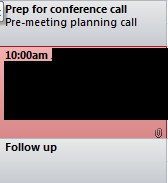
Calendar & Meeting Management

Time of Arrival at the Office

I am usually in my office by 6:00-6:15 AM, sometimes earlier—depending on how often I hit “snooze” on my alarm! This enables me to beat the rush hour traffic, making me less stressed and more efficient. I’m also in a better mood for devotions.

Prayer and Devotions

I start the day with prayer and Bible study. My devotional time is blocked and locked on my calendar. It is not always easy to begin the day with prayer and Bible study. Some days I don’t feel particularly spiritual and don’t feel like praying or reading my Bible. I am tempted to start reading and responding to email.

It doesn’t matter how I feel. I pray and study my Bible anyway. My soul is almost always warmed and enlivened through prayer and Bible study (coffee also helps!) but not always. It does not matter—I pray and study anyway. God never told me to feel like praying or to feel like reading my Bible—he simply commands me to do so.

My prayer is that the “Lord will bless the work of my hands, that he will grant wisdom, that as I plan my way he will direct my steps, and that he will grant me holy rather than selfish ambitions in my work.”

I am currently reading through the Bible using the ESV on the iPad. I leave the computer off and go to another chair in my office to pray and read. This is called “fleeing temptation.” J

Review of Next Action Items and Upcoming Appointments

After devotions, I have 30 minutes set aside to review reports, NEXT ACTION items, the day’s appointments, etc. I am able to do this easily and effectively because I use the Task function in Outlook to manage my To Do list and projects. I am able to see at a glance what is due today and for the week.

clip_image004

clip_image006

Meetings

Time is scheduled before and after every meeting for prep, travel, and follow-up. This allows me time to walk into a meeting well prepared with documents gathered. It also ensures that I setup follow-up meetings, write a memo or email, etc., immediately after the meeting so that “balls are not dropped.”

clip_image007

When someone other than a parent or staff member stops by and asks “do you have a minute,” usually a salesperson, if I’m not in a meeting or leaving for one, I will give him or her a little time in order to give a good testimony of the gospel. However, if this is an unscheduled drop-in, I start by meeting him or her at the door. I remain standing. This significantly shortens the unplanned meeting. I will invite the unscheduled guest to sit IF I believe the issue has the potential to benefit the school and if I have time. Otherwise, the meeting will end as a standup meeting or my assistant will schedule a follow-up meeting. In other words, in so far as possible and polite, I attempt to control my time rather than having someone else control it.

I also use lunch for meetings. I have to eat anyway so I might as well make it productive. Very seldom do I eat without meeting with someone.

I normally leave the office at 4:00. I go home and run four miles on the treadmill while catching up on the news—I accomplish two things at once! I shower and eat and then go to any evening meetings or events that I may have.

I am almost always in bed by 10:00 and up at 5:00 the next morning.

Friday mornings are blocked on my calendar for project work—off campus to minimize interruptions. This is an important time each week. I am able to focus on those BIG rocks that can be crowded out by the urgent.

Phone Calls

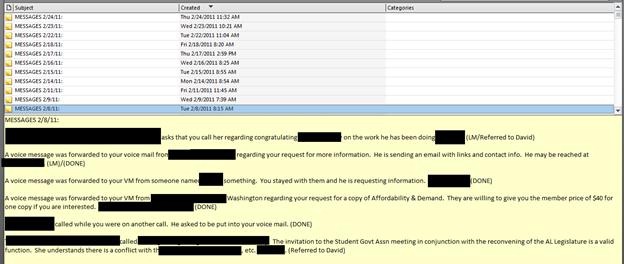
I have the blessing of having a wonderful administrative assistant. I have instructed her to log all phone calls into Outlook’s Notes function. This provides a permanent record of every call. After returning the calls I make quick notes on each log. This ensures that I return calls in a timely fashion and I have a record of my response—which can be as easy as “Returned, Left Message, Referred, etc.

clip_image009

I also return calls in the car using hands-free voice activated dialing. NEVER dial when driving. (That sentence will make my attorney happy!)

Managing Email and Information

email communication overwhelmed

clip_image010

Email management is a challenge—but not impossible! Rather than outline strategies for managing email in this article, I have created a PowerPoint Presentation that you may find useful. At the end of the presentation are links to short Microsoft training videos.

Click HERE to download the PowerPoint Presentation. You may share the PPT with whomever you wish; I only ask that you refer them to this blog.

Think Week

clip_image011

My Think Week is one of the most important practices that I have developed over the years. As I write this, I am preparing to leave for my Think Week. I will be reading 10 books and a stack of research documents—all on my iPad. For more information on Think Week see my previous post: How To Find Time to Focus, Think, and Work.

I got the idea for Think Week from articles I read about Bill Gates and his Think Week. Here are two articles that may interest you: Article 1: Bill Gates in Secret Hideaway, Article 2: Bill Gates Think Week.

Tools I Use

  • I strive to be as paperless as possible. To the extent that I have everything in digital form (which is almost everything) I can have my documents with me anytime and anywhere. They are also searchable and shareable. This is far more productive than keeping up with paper, legal pads, notebooks, post-it notes, etc.

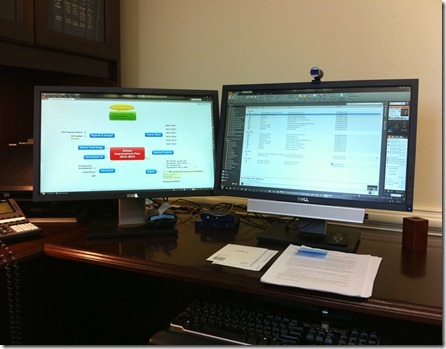
  • I use a Dell laptop on a docking station with two monitors. On the left is my project management/brainstorming software—Mindmanager from Mindjet. The center monitor is used for Outlook and other Microsoft products (Word, etc.)

clip_image012

  • I make extensive use of video-conferencing. I use ooVoo-think Skype on Steroids! Video-conferencing makes phone calls far more personal, there is less temptation to “multitask” while on a phone call, and you can share your desktop and/or files while on the call. Video-conferencing also reduces the number of emails I must process.

· I use the iPad for virtually all of my reading and note taking. There is a very effective and powerful note taking application called “Note Taker HD.” Used with a stylus it is as effective as a legal pad but with the advantage that all of your notes are in one location, searchable, and shareable.

Software I Most Frequently Use

  • Microsoft’s Office 2010

  • Docs-to-Go on my laptop and iPad. This program syncs all of my laptop documents to my iPad so that I have everything with me at all times. Docs-to-Go also enables me to read, create, and edit Microsoft documents-Word, Excel, and PowerPoint.

  • Mindmanager with a Catalyst subscription—for project management, brainstorming, and collaboration. The program tightly integrates with Outlook and Microsoft Office products making it an extremely effective task and project management tool.

  • The new I.E. 9 browser and Google's Chrome. They are fast, secure, full-featured, and customizable.

  • Note Taker HD—replaces a legal pad.

  • Logos Bible Study software—on my laptop and iPad. For in-depth Bible study.

  • Kindle software on the laptop, iPad, and iPhone—I carry my library in my pocket.

  • Skydrive—for online document storage, creation, and collaboration. Skydrive and MS Webapps integrate seamlessly with Microsoft Office.

  • ooVoo for video-conferencing.

  • Twitter—for keeping up with the news.

  • Jott—for leaving myself reminders when I’m in the car.

  • Adobe Acrobat Pro—for PDF creation and electronic forms completion and signing.

  • Loseit-see below.

Personal Health

clip_image014

Staying fit is critical to reducing stress and being efficient and effective. Although it gets tiresome, I count calories (I use a software program called LoseIt on my iPhone) and I track my exercise using the same program.

I run four miles a day six days a week (Sunday off) unless providentially hindered. I maintain my weight within the “ideal range,” for my height and age.

I do NOT like running and I do not like counting calories—but—doing so makes a big difference in how well I sleep at night and how much energy I have each day.

Because I do not like running, I do not sit down when I get home—not even for a minute!! I walk immediately to the closet and change into my exercise cloths and mount the treadmill.

Life is hectic and our jobs are demanding. Learning to thrive rather than merely survive as a leader is a challenge. It can be done. Attention to one’s spiritual and physical health, establishing good practices and habits, and making appropriate use of technology can all, when used in combination, reduce stress while we strive to accomplish more for God’s glory.