Some of Us Have Been Talking…

Dr. Marni Halvorson (Head of School, Covenant Day School)

Dear Christian school parent,

Gossip_iStockPhotoWhen something occurs that we h ave questions about, it’s not uncommon to ask others their impression or understanding. This happens frequently in connection to situations or circumstances at our Christian school. Perhaps a teacher gives an assignment to students that is unclear to a parent, or a child relays comments made in the classroom that are unsettling. A parent may turn to other parents in the carpool line for their assessment of the situation rather than going directly to the teacher. At times this fact finding clears confusion and it is back to business as usual. Other times, however, the communication begins to take on a different perspective. Second hand information can slip into idle talk or rumor; that is, we have become involved in gossip. This is true not only of parents and the carpool line; there are occasions when a teacher standing at the photocopier may ask another teacher a question that really is best directed back to a parent instead.

Words have tremendous power! They can be used for building up or for tearing down. In The Purpose Driven Life, author Rick Warren writes, “Refuse to listen to gossip. Gossip is passing on information when you are neither part of the problem nor part of the solution” (164). Note that gossip is not defined as untrue information; rather information that we are not to pass along because we are not directly involved as the source of the matter nor as the resolution thereof. What begins as perhaps an off-hand remark can morph into a communication that ultimately is highly inflammatory.

Jerry Bridges, in his book Respectable Sins, makes the point that the Bible is filled with warnings about the sins of the tongue, including gossip (159). Sin is sin, and even sins of the tongue are offensive to God. Unfavorable information can be extremely damaging. Often in the telling and re-telling, a communication “grows” details or the story gets twisted and distorted. We Christians are called to a higher standard. Scripture clearly warns us in Prov. 20:19, “A gossip betrays a confidence; so avoid a man who talks too much.” Prov. 26:20 adds, “Without wood a fire goes out; without gossip a quarrel dies down.”

We want our Christian school to be a place where gossip finds no welcome. Our faculty and staff are working to be conscientious about not spreading gossip. We have challenged ourselves to be accountable in this area. We do not want to be the source of the problem through our own words; we do not want to be the subject of someone else’s idle talk or rumor; we want to avoid being caught up as listeners.

We know that it can be awkward to find yourself near the front end of what is quickly revealing itself to be gossip. It takes spiritual sensitivity and boldness to say, “Please stop. I don’t need to hear this. Have you spoken directly to that person?” It may be uncomfortable for most of us to make such a direct request. But we want to use the gift of language in the manner God intended, to encourage and edify. Eph. 4:29 boldly directs us: “Let no unwholesome talk come out of your mouths, but only such as is good for building up, as fits the occasion, that it may give grace to those who hear.”

If you agree that we have taken on a worthy challenge, would you join us in replacing gossip with Godly conversation? We commit to doing our best to assure that you have clear and open channels to teachers, administrators and coaches so that you will have timely and accurate information, especially as it relates specifically to your son or daughter. We also commit to assuring you that your communications with us are handled with respect and confidentiality.

May God be pleased with our communications as well as our motives and actions; and may He be honored as we give grace to everyone who hears us speak.

The Power of Relationships and School Culture

Reflections about Relationships, Dr. Kynerd (Chancellor of Briarwood Christian School)

These brief Reflections are offered to encourage you to have the Lord as your shepherd, remain faithful to honor Him in the ways you handle relationships, respond to each relationship opportunity with confidence and security rooted in God, remember God’s sufficiency, and be grateful for the gift of each day.

1. People are more important to God than anything. John 3:16. Therefore Christian school workers must honor people in ways consistent with God’s love for people. Honoring people as a reflection of our love for God becomes a cornerstone for building a grace community. Love one another. John 15:12.

2. Every School worker is confronted with challenges, tension, disappointments, conflict, etc. We reveal our view of God by how we receive issues and by how we respond to the issues and the people God connected with them! Matthew 6:25-33 invites us to trust God. The alternative is to trust ourselves and/or the circumstances. Initial indicators of trusting self/circumstances are worry, criticism, complaining, or feeling underappreciated! An initial indicator of trusting God is to immediately ask “Father, what would you have me learn from this and would you guide my response?” Run from self to God!

3. Dr. Harry Reeder, pastor of Briarwood Presbyterian Church, says “One indicator of our reverence for the Lord is how we treat one another.” How are students, teachers, staff, parents, and visitors treated at your School?

4. When communicating with people “Say what you mean, mean what you say but never be mean or convey criticism in what you say.” Each contact, personal and impersonal, provides a discipleship opportunity. May we see our opportunities and responsibilities as treasured gifts from God.

5. How you respond to people and tension defines your view of people and of excellence and will have life changing impact person by person. What happens at school will last to eternity and it may impact which eternity a person has.

6. How you do what you do will define the School’s culture! School culture has an overwhelming influence on defining School success and advancement! Love Never Fails.” I Corinthians 13:8. James 1-3 instructs us in needed wisdom.

The leadership of the School plays the determining role in how people will be viewed and if God’s perspective about people will be the School’s practice with people! May we honor God by trusting and loving Him, by our dependence on Him, and by growing in gratitude to Him for people.

Solomon on Social Media

This article is reposted from http://www.challies.com/christian-living/solomon-on-social-media and is written by Tim Challies. 

By Dr. Barrett Mosbacker

Special thanks to Nancy R. DeHaan, MACSA Executive Director,  for sharing this article with me!

Solomon on Social Media

Social Media

There are many who doubt or downplay the relevance of the Old Testament to our times. Those people have probably never taken the time to read the book of Proverbs. I read from Proverbs almost every day and I am continually amazed at just how relevant this book is. It seems that wisdom is timeless. The lessons David taught Solomon speak to myself and my children as much as they did to the men and women of ancient Israel. The wisdom of God given to Solomon continues to ring loud and clear in my heart.

If Solomon were alive today and we were to ask him how we are to relate to one another in this digital world, if we were to ask him how we can honor God in our use of all these social media available to us today, here is how he might respond.

Count to ten before posting, sharing, sending, submitting. “Do you see a man who is hasty in his words? There is more hope for a fool than for him (29:20).” How many arguments could be avoided and how many relationships saved if people were only a little less hasty with their words? Before posting an article or before replying to a Facebook status, it is always (always!) a good idea to re-read what you have written and consider if your words accurately express your feelings and if expressing such feelings is necessary and edifying. And while I’m on the topic, a spell-check doesn’t hurt either.

Leave the fool to his folly. “Answer not a fool according to his folly, lest you be like him yourself (26:4).” There are times when it is best to leave a foolish person to his own devices rather than to try to change him. Sometimes it is best just to leave him alone rather than providing him more ammunition to work with. This means that it may be best to ignore the troll, to leave a rebuke unanswered, than to bait him and to suffer his wrath.

Expose folly.“Answer a fool according to his folly, lest he be wise in his own eyes (26:5).” Here it is—undeniable proof that the Bible contradicts itself! Are we to answer a fool according to his folly or not? Evidently this “contradiction” is deliberate and is in the Bible to show that there is no absolute law in this situation. There are times when folly must be exposed, either if the fool is one you believe is honestly seeking after wisdom, or if his folly will damage others. If a fool is impacting others, drawing them into his foolishness, he must be exposed for the sake of the church’s health.

Know when to walk away. “If a wise man has an argument with a fool, the fool only rages and laughs, and there is no quiet (29:9).” There are times when you need to walk away instead of carrying on an argument. Foolish people have no real desire to learn or to be wise. Instead, they only seek opportunities to loudly proclaim the folly. Walk away so you can have peace. Shut down, log off, erase—do what you need to.

Be careful what you read. “Like one who binds the stone in the sling is one who gives honor to a fool (26:8).” Be careful whose words you read and whose wisdom you trust. Foolish men may seem wise, but they will still lead others astray. If you give honor to a foolish man by reading and soaking in his words, you are as foolish as a person who binds his stone in a sling, rendering the sling useless and leaving himself defenseless.

Avoid the gossiper. “The words of a whisperer are like delicious morsels; they go down into the inner parts of the body (29:22).” There are many web sites, blogs and Twitter accounts dedicated almost entirely to gossip, to sharing what is dishonorable rather than what is noble. Avoid these people and their gossip!

Be humble. “Let another praise you, and not your own mouth; a stranger and not your own lips (27:2).” “One’s pride will bring him low, but he who is lowly in spirit will obtain honor (29:23).” Let others praise you. If you never receive praise from anyone, especially from those who are wise, it may be a good time to examine your heart and examine if you are walking in the ways of wisdom. Those who are humble and lowly in spirit will receive honor while the arrogant will be brought low.

Mind your own business. “Whoever meddles in a quarrel not his own is like one who takes a passing dog by the ears (26:17).” If you have ever grabbed a dog by the ears you know it will inevitably bring trouble. Grabbing a strange dog by the ears will bring even more trouble. Stay out of other people’s fights rather than wading into them as if they are your own. There may be times to wade into a theological dispute or to try to mediate a disagreement in the blogosphere, but wisdom would usually tell you to mind your own business.

Don’t be a troublemaker.“Whoever digs a pit will fall into it, and a stone will come back on him who starts it rolling (26:27).” Those who exist only to bring trouble to others will pay a price. And unfortunately, on the Internet there are many of these people. Don’t be one!

Examine why you write. “A continual dripping on a rainy day and a quarrelsome wife are alike (27:14).” The proverb speaks of a quarrelsome wife, but it could as easily apply to anyone. If you are writing merely to be quarrelsome or because you enjoy an argument, perhaps it is best to find something else to do. “As charcoal to hot embers and wood to fire, so is a quarrelsome man for kindling strife.” Do not be the kind of person who kindles strife for his own enjoyment.

Be careful what you teach. “Whoever misleads the upright into an evil way will fall into his own pit, and the blameless will have a godly inheritance (28:10).” Those who choose to teach others accept a grave responsibility; if they mislead others, they must expect that there will be consequences. Be careful what you teach, what you share, what beliefs you express. Remember that your words are public and that they may remain available forever.

Walk with the Lord. “Whoever trusts in his own mind is a fool, but he who walks in wisdom will be delivered (28:26).” And here is the key to everything else. Trust in the Lord rather than in yourself. Walk with the Lord and in the ways of wisdom taught in the pages of the Bible. Be a wise man or woman of the Word, rather than a fool who trusts in his own wisdom (or lack thereof). Arm yourself with spiritual maturity, with true wisdom, before venturing into the world of social media.

Is It Christian or Worldly to be World-Class?

By Dr. Barrett Mosbacker

I had the privilege of traveling to Australia and to China this summer. My trip to China was to develop relationships with school and government officials for establishing an academic and cultural connection between a Chinese high school and our new online Chinese class. The trip was also designed to lay the foundation for a possible student and/or faculty exchange program. The trip exceeded my expectations resulting in a partnership with a large Chinese high school and bringing a Chinese student to BCS to complete his last two years of high school.

I was also invited to Australia to speak to a Christian School Conference on the topic of “Building World Class Christian Schools.” This was timely because I have touched upon the subject from time-to-time in previous presentations and writings.

As I considered this topic, several questions came to mind:

  • What is world-class? Is it a cliché?

  • Should Christian schools strive to be world-class or are we merely accommodating the world?

  • Is seeking to be world-class elitist and prideful or can it be honoring to the Lord?

  • What would a world-class, Christ-honoring, Christian school look like?

These are important questions. On the one hand, we must always be vigilant not to mimic the world or adopt unbiblical values and perspectives. On the other hand, we are called as stewards to prepare our students to serve Christ in a global, technologically rich, interconnected world.

I believe we should and can build Christ-honoring world-class Christian schools but only if we carefully define what we mean by world-class. And I believe that this can be achieved by small and large Christian schools alike.

The dictionary defines world-class as “ranked among the best or most prominent in the world; of the highest order.” I offer for consideration a definition that significantly alters and expands the traditional definition of world-class making it far more biblical and practical.

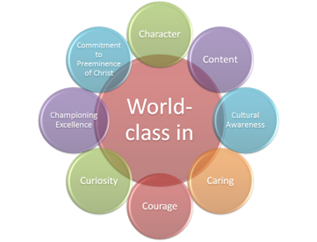
A world-class Christian school is one that is used by Christ to change lives, its community, and its culture by virtue of its commitment to the preeminence of Christ as reflected in the development of the Christian mind and character of its students and in its establishment of superior standards in teaching and learning so that the school is a model of best practices throughout the world.[1]

image

A world-class, Christ-honoring, Christian school requires a combination of traits and practices that are so unique, so “otherlyworldly” that they are in a class by themselves—not by virtue of what we are against but by what we are for and by virtue of a quality that transcends the normal.

There are eight traits that we should cultivate in the pursuit of world-class quality. We should strive to be world-class in:

  • Character

  • The Content and Quality of our Instruction

  • Being Culturally Relevant

  • Our Caring

  • Our Courage

  • Fostering Curiosity

  • Our Being Champions of Excellence, and

  • Our Commitment to the Preeminence of Christ.

World-Class Character

Ideas have consequences. One of the best ways to promote Christian ideas—biblical truth—is to get students and others to ask questions. People ask questions when they are curious. People are curious when they are seeking closure—trying to connect dots.

People ask questions because they are curious or in an effort to bring harmony to emotional, spiritual, or what psychologists call cognitive dissonance. There is a tension and people seek answers and closure to relieve the tension.

Peter admonishes us to “always be prepared to make a defense to anyone who asks you for a reason for the hope that is in you.” But, we often take this verse out of context. Whywas the question being asked in the first place?

It is because the Christians, who were suffering under Nero, were responding in a very peculiar way—instead of whining and feeling sorry for themselves, they were simultaneously grieving yet “rejoicing.”

(6) In this you rejoice, though now for a little while, if necessary, you have been grieved by various trials … (8) Though you have not seen him, you love him. Though you do not now see him, you believe in him and rejoice with joy that is inexpressible and filled with glory. (I Peter 1)

This was very unusual—they were not acting like everyone else—they were “otherly worldly”. They were able to rejoice even in the midst of dreadful circumstances—they could rejoice while crying. They, like Paul, could sing hymns while chained to Roman guards.

Those around them wanted to know “How can this be?” “How can these Christians respond this way when they are losing their jobs, their property, when they are being made fun of and slandered—even tortured and killed?

It was the uniqueness, the quality, the transcendent nature of the believers’ character and behavior—under great distress and duress—that prompted the questions and the openness to the Gospel. In other words, they were different and in being different—in being a peculiar people—they made a difference.

That is our call and our challenge. We will not change the lives of our students or the lives of our parents, let alone the community and world around us, unless we are fundamentally different—not legalists, not separatists, not kill joys—but different in our response to the issues of life—both the good and the bad.

The greatest lessons we ever teach are not spoken—they are lived. Ideas matter. Ideas have consequences but it is the character of our lives that open the door for a discussion of the ideas—of truth.

Go back for a moment in your mind’s eye. Jesus tells a small group of men standing on the hillside that they are the salt and light to the world. Most of these men were not great men of learning; they were not professors or teachers. In fact, it is quite possible that many of them did not do particularly well in school, which may explain why some of them are fishermen and tax collectors!

So how is it that they would be the Lights of the World? Obviously the direct application has to do with sharing the Gospel but there is actually a broader definition at work.

If you examine the full context of Jesus’ sermon, you realize that they were to be the light of the world—not merely because of what they would teach and preach-but because of what they would become by God’s grace. Consider the before and after context:

Before his statement about them being the Light of the World, he preached The Beatitudes (Mat 5:3-11):

(3) "Blessed are the poorin spirit, for theirs is the kingdom of heaven.

(4) "Blessed are those who mourn, for they shall be comforted.

(5) "Blessed are the meek, for they shall inherit the earth.

(6) "Blessed are those who hunger and thirst for righteousness, for they shall be satisfied.

(7) "Blessed are the merciful, for they shall receive mercy.

(8) "Blessed are the pure in heart, for they shall see God.

(9) "Blessed are the peacemakers, for they shall be called sons of God.

(10) "Blessed are those who are persecuted for righteousness' sake, for theirs is the kingdom of heaven.

(11) "Blessed are you when others revile you and persecute you and utter all kinds of evil against you falsely on my account.

After telling them that they were to be the light and salt of the world, he describes how (Mat 5:21-48):

(21) "You have heard that it was said to those of old, 'You shall not murder; and whoever murders will be liable to judgment.' (22) But I say to you that everyone who is angry with his brother will be liable to judgment …

(27) "You have heard that it was said, 'You shall not commit adultery.' (28) But I say to you that everyone who looks at a woman with lustful intent has already committed adultery with her in his heart.

(33) "Again you have heard that it was said to those of old, 'You shall not swear falsely, but shall perform to the Lord what you have sworn.' (34) But I say to you, Do not take an oath at all … (37) Let what you say be simply 'Yes' or 'No'; anything more than this comes from evil.

(38) "You have heard that it was said, 'An eye for an eye and a tooth for a tooth.' (39) But I say to you, Do not resist the one who is evil. But if anyone slaps you on the right cheek, turn to him the other also.

(43) "You have heard that it was said, 'You shall love your neighbor and hate your enemy.' (44) But I say to you, Love your enemies and pray for those who persecute you, (45)

And so on……

This demonstration of Godly character is counter-cultural, this is a much higher standard—this in a sense is world-class—in a class by itself—transcending cultural norms and cultural expectations.

We reflect this character in how we deal with personal challenges—physical, family, and financial. It is reflected in how we respond to an angry email or to the apathetic student.

It is our character that makes our message believable, that gives it credibility.

To be a Christian world-class school means that our character sets us apart from the pack; to be among best in world: ranked among the best or most prominent in the world, of the highest order—World-Class character.

World-Class Content, Curriculum, Instruction, and Standards

This leads to the second point, to be world-class means that we are to be fully committed to truth.

In one way—only Christian schools can be truly world-class because—if we are faithful to god’s word and to careful Christian scholarship—we are the only ones who teach the whole truth.

Don’t misunderstand—many unbelievers have, by common grace, much truth. And, many Christian are wrong about a great many things. But, Christians who are careful with God’s word and are careful students and teachers are able to be the light of the world because they have the whole truth—not mere fragments or distortions of it.

Psalm 19 declares:

(2) Day to day pours out speech, and night to night reveals knowledge. (3) There is no speech, or are there words, whose voice is not heard. (4) Their voice goes out through all the earth, and their words to the end of the world. In them he has set a tent for the sun … (Natural Revelation)

(7) The law of the LORD is perfect, reviving the soul; the testimony of the LORD is sure, making wise the simple; (8) the precepts of the LORD are right, rejoicing the heart; the commandment of the LORD is pure, enlightening the eyes; (Special Revelation)

Ultimately—the Word and the World are united in Christ in whom “we live and move and have our being.” To quote Dr. Poythress (Harvard Mathematician, Professor of NT, Westminster):

All scientists-including agnostics and atheists-believe in God. They have to in order to do their work … A Hindu philosopher may say that the world is an illusion. But he does not casually walk into the street in front of an oncoming bus. Sue, a radical relativist, may say that there is no truth. But she travels calmly at 30,000 feet on a plane whose safe flight depends on the unchangeable truths of aerodynamics and structural mechanics … scientists describe the regularities in God’s word governing the world.

So-called natural law is really the law of God or word of God, imperfectly and approximately described by human investigations … let us remember that we are speaking of real laws, not merely our human guesses and approximations. The real laws are in fact the word of God, specifying how the world of creatures is to function. So-called “law” is simply God speaking, God acting, God manifesting himself in time and space [Day-to-day pours forth speech]… what people call “scientific law’ is divine. We are speaking of God himself and his revelation of himself through his governance of the world … in thinking about law, scientists are thinking God’s thoughts after him.[2]

God has an opinion about everything…we are to seek to think about the world as God does. Let me give you an example. Francis Collins, —a world-class Christian scientist who takes both natural and spiritual revelation seriously—and whose Godly character has prompted many atheists to seek Christ because of his Christian response to his daughter’s rape, proclaimed in a speech to the world on the steps of the White House:

The human genome consists of all the DNA of our species, the hereditary code of life. This newly revealed text was 3 billion letters long, and written in a strange and cryptographic four-letter code. Such is the amazing complexity of the information carried within each cell of the human body, that a live reading of that code at a rate of one letter per second would take thirty-one years, even if reading continued day and night. Printing these letters out in regular font size on normal bond paper and binding them all together would result in a tower the height of the Washington Monument. For the first time on a warm summer day six months into the new millennium, this amazing script, carrying within it all of the instructions for building a human being, was available to the world …

Notice his words here:

… Without a doubt, this is the most important, most wondrous map ever produced by humankind…we are learning the language in which God created life. We are gaining ever more awe for the complexity, the beauty, and the wonder of God’s most divine and sacred gift …

… It’s a happy day for the world. It is humbling for me, and awe-inspiring, to realize that we have caught the first glimpse of our own instruction book, previously known only to God”[3]

Now that is being a light to the world. That is a reflection of the proper relationship of science and theology. That is a world-class Christian scientist! That reflects our spiritual and academic aspirations for our students!

World Class-Cultural Awareness and Relevance

David, after he had served the purpose of God in his own generation, fell asleep and was laid with his fathers. (Acts 13:36b)

Of Issachar, men who had understanding of the times, to know what Israel ought to do. (1Chron. 12:32a)

These passages make a point of emphasizing that godly leaders, those that God uses to shape their institutions, schools, communities and countries, understand their times—they are relevant and contemporary and they knew how to lead and to apply biblical principles to the contemporary context.

A world-class Christian school is relevant—its teachers and administrators are current, aware, globally informed and may I even suggest, “Withit”?

To borrow a phrase from someone else, we cannot have Flintstone schools in a Jetson world.

We are entering the second decade of the 21st century. We must understand our times and cultures if we are to effectively prepare our students to serve Christ.

In many ways, it is the tale of two cities—the best of times and the worst of times—at once an unprecedented time of progress and an unprecedented time of distress.

Progress

  • The WSJ recently heralded a potential new era in biology, scientists for the first time have created a synthetic cell, completely controlled by man-made genetic instructions.

  • We are in the midst of a third industrial revolution: Microelectronics, Computers, Robotics, Human Genome, Biotechnology, New materials, and Telecommunications.

  • The top 10 in-demand jobs in 2010 did not exist in 2004.

  • More than 3000 books are published every day.

  • In 2008, the amount of new technical information was doubling every two years. This year, 2010, it is projected to double every 72 hours!

  • Immediate access to vast amounts of information and communication: we carry a world of knowledge in our pockets!

  • There has been some progress in some cultures dealing with racial, political, and socio-economic discrimination.

  • The human race is more productive than at any time in human history.

  • More people have access to better health care than at any time in history.

  • Generally speaking, we are far more sensitive to environmental concerns than in past generations.

  • The educational opportunities available in the world are advancing rapidly enable giving more people greater access to education and a better future.

Distress

  • We live in a very violent time. More people were killed by war and their governments in the 20th century than in all human history combined. Local, regional, and international wars continue to increase.

  • Fanaticism of all sorts too often results in the killing of innocent men and women.

  • Many of the world’s economies are sinking under unsustainable debt.

  • It is increasingly difficult for the undereducated to find permanent employment to care for themselves and their families.

  • The deviate and perverted are celebrated as good while the natural and holy are condemned as evil.

Woe to those who call evil good and good evil, who put darkness for light and light for darkness, who put bitter for sweet and sweet for bitter! (Isa 5:20)

  • Materialism and sensuality are rampant.

  • Relativism and post-modernism are the reigning worldviews of our time.

These are our times-this is the world that our students are entering and in which they must provide leadership. It is a world of unprecedented opportunities and challenges!

We cannot do business as usual. We must engage with how things are, not how they were or how we wish them to be.

There is great value in tradition; there is great value in our heritage as Christians, and as Americans. But the value is not in the traditions themselves-it is in the principles and lessons learned that can be applied in new and creative ways to our contemporary context so that like the men of Issachar, men who had “understanding of the times to know what Israel ought to do,” we understand our times and know what do to—how to teach and how to lead.

I want to emphasize that while our methods may and often must change, e.g., through the application of neuroscience, technology, creative assessment techniques, and so forth, our commitment to God’s word is immutable.

World-Class Caring

We cannot and will not meet the challenges of the 21st century and of our students unless we care. We cannot be a city on the hill; we cannot be the light of the world, unless we love our neighbors as ourselves, unless we sacrifice ourselves for our students and our parents, even or especially the ones that we find it hard to like.

One of the primary ways we let our light shine is through our good works, a reflection of our love and concern for others: “let your light shine before others, so that they may see your good works and give glory to your Father.”

  • Have this mind among yourselves, which is yours in Christ Jesus, who, though he was in the form of God, did not count equality with God a thing to be grasped, but made himself nothing, taking the form of a servant, being born in the likeness of men. And being found in human form, he humbled himself by becoming obedient to the point of death, even death on a cross. (Php 2:5-8)

  • You call me Teacher and Lord, and you are right, for so I am. If I then, your Lord and Teacher, have washed your feet, you also ought to wash one another's feet. For I have given you an example, that you also should do just as I have done to you. Truly, truly, I say to you, a servant is not greater than his master, nor is a messenger greater than the one who sent him. If you know these things, blessed are you if you do them. (Joh 13:13-17)

  • A new commandment I give to you, that you love one another: just as I have loved you, you also are to love one another. By this all people will know that you are my disciples, if you have love for one another." (Joh 13:34-35)

In other words, people are more important than tasks. Administrators lead people not employees, teachers teach students, not subjects!

To be world-class Christian schools means that we love and serve our students, we do not merely teach them. Sometimes this requires tough love but it always requires love. Paul makes the point as powerfully as it can be made: “If I speak in the tongues of men and of angels, but have not love, I am a noisy gong or a clanging cymbal.” (I Cor. 13:1)

To be world-class our love, our devotion, and our sacrifice for and service to our students must be ranked among best in world: ranked among the best or most prominent in the world—of the highest order.

There should never be an instance when an unbelieving teacher, administrator, or coach is more caring, more loving, and more sacrificial in the care and teaching of his or her students than a believer!

World-Class in Courage

To be world-class takes courage.

  • It takes courage to speak the truth.

  • It takes courage to insist and to model excellence—it takes courage to refuse the mass current of mediocrity—to swim against the current.

  • It takes courage to give an honest, rather than a safe grade.

  • It takes courage to tell a parent that his/her son is not doing well, is not working hard.

  • It takes courage to tell a teacher that he/she is coasting.

  • It takes courage to tell an administrator that he or she is not providing visionary, strategic, effective leadership.

  • It takes courage to try new things, to experiment, to get beyond our comfort zones and our routines.

  • It takes courage to go beyond tradition and beyond what we have always done.

Without the courage to speak the truth in love, without the courage to experiment, without the courage to break out of the ordinary and to help our students do likewise, we cannot be world-class.

World-Class in Curiosity

We cannot shine if we are dull. We cannot be lights to our students if we have stopped learning. We cannot ignite a heart and mind of curiosity if we have lost ours—the student will be like his teacher—we cannot give what we do not possess.

Are we reading outside our professional field? Are we learning about new discoveries? Do we read those with whom we disagree? Are we learning new skills? Is there any venturesomeness about us? Or have we become stale, provincial, sheltered, and comfortable? Are we routine?

Curiosity is the very essence of Christian education because it is embedded in us as image bearers, it is the catalyst for the cultural mandate—to exercise dominion and stewardship over creation—and is it what propels us to investigate and to learn, to develop new tools and new methods.

Paul Marshall, in his wonderful book titled: Heaven in Not My Home[4], writes:

Many of those who denounce technology have no real desire to live in some primitive civilization. Instead, many of them sit amidst the fruits of technical progress all the while denouncing the technology that brought them. Technology, properly used, is a gift from God.

The topic of technique and technology preoccupies today’s world. Technique refers to “how to” do something—it is the science of “how.” It encompasses all that we can do—from going to the moon to public speaking, from designing nuclear bombs to making love, from serving a hungry neighbor to writing books. All of these are included when we talk about technique.

Along with technique comes technology, which is the made, created, embodied structure of technique. Technology includes, in one form or another, all those things that do not naturally occur, all those things that we shape and reshape. Technology infuses art as much as physics, families as much as engineering. To talk about technique and technology is to talk in one particular way about all of human life, as all of human life has some technical aspect. Responsible technical skill is both a gift and a calling. It is the human task of reshaping the materials of God’s world in new ways. It is imagination and skill in the service of usefulness.

Nor is our task in the world simply following the clear rules that God has set down, though we must certainly follow God’s commandments and learn from the creation itself. We have a creative task in the world. We must shape things in ways for which there is sometimes no clear direction. This is why imagination is not just a feature of the arts; it is a feature of human life itself. Without imagination, without experimentation, without openness to new questions and new possibilities, there can be no science and no technology. We are not challenging God when we do this, at least not when we do it in humility and faith. We are not stealing fire from the gods. We are taking up our responsibility before God to shape what he has placed in our hands.

Christian education is the exploration of God’s mind as revealed in creation! Christian education is preparing students to use their skills, their imaginations, and their curiosity to shape the world and to build God honoring culture. That is a wondrously beautiful and infinitely deep mission!

On a building at Harvard is the following inscription: “Students explore the mind of God for the art of life.” Let that sink in. “Students explore the mind of God for the art of life.” I often include this quote in my email signature line because I believe that if one takes time to mediate on it that it has profound implications for Christian education. The Psalmist writes:

Great are the works of the Lord; they are studied by all who delight in them.(Psalm 111:2)

  • When our students look into a microscope, they are peering into the mind of God.

  • When they gaze through a telescope, they are encountering the creation of an incomprehensible, infinite intelligence.

  • When they listen to music, they are experiencing the beauty and harmony of God’s character.

  • When they study mathematics, they are, to quote Edward Everett, a former president of Harvard:

Contemplating truths, which existed in the divine mind before the morning stars sang together, and which will continue to exist there, when the last of the radiant host shall have fallen from heaven.” Mathematics reflects the sustaining power of the Word of God.

  • In the study of history they are investigating the sovereignty and providence of God as worked out in time and space:

And x[God] made from one man every nation of mankind to live yon all the face of the earth, zhaving determined allotted periods and athe boundaries of their dwelling place, 27bthat they should seek God, in the hope that cthey might feel their way toward him and find him. dYet he is actually not far from each one of us, [5]

This is inexhaustible! Do we FEEL the wonder in what we teach and why we lead? Are we passionate about plunging into the depths of God’s infinite, beautiful mind as we explore this world and the universe?

Is that what you are experiencing? Is this what our students are experiencing in our classrooms? Do they leave our classrooms awestruck at who God is and what he has done? Do they leave Chemistry class a better person for having encountered Christ in chemistry?

Fostering curiosity like this will produce world-class teachers, students, and schools!

World-Class Champions of Excellence

We are to be champions in the quality of our own work and in our work-ethic. Champions, by definition, are world-class. I immediately think of Olympic champions or the World-Cup. These athletes are the best in the world.

As Christian school teachers and leaders, we should seek to be the best in the world, to have the best schools in the world—not for our glory but that men may see our “good works” and glorify our father in heaven.

This is not a matter of pride. Since we are to “do everything as unto Christ” and since Christ is the King of Kings and Lord of Lords, and since one day we must give an account for our work on this earth, how can we strive for anything less?

  • How can we serve up a warmed over lesson plan? Would you serve Christ leftovers if he came over for dinner? Why then would we serve his children left-over lessons or left-over leadership? Jesus said “as you did it to one of the least of these dmy brothers,6 you did it to me.”

  • How can school administrators provide mediocre leadership?

  • How can we fail to walk that extra mile for a student or parent (even the ones we don’t particularly like) when Jesus tells us to willingly walk an extra-mile for a Roman soldier who has occupied your country, steals your wealth through unfair taxation, who may be the very soldier who will crucify Jesus, and who may serve Nero in torturing Christians to death? How can we do less for our students and parents? How can we do less for each other?

  • How can we be satisfied to provide our students an education, that while ranking high in the U.S., may in fact be in the middle of the pack or lower when measured against international standards?

We are to be the beacon of light on the hill of excellence—drawing unbelievers to our schools to learn from us!

We are to be Champions in the quality of everything that we do: ranked among best in world: ranked among the best or most prominent in the world, of an international standard of excellence; of the highest order—not for our glory but the glory and honor of Christ.

World-Class Commitment to the Preeminence of Christ

This work is not about us. The work we do in our Christian schools is about the Kingdom of God—it is that simple and that profound. Jesus is The Alpha and the Omega of Creation and he is the Alpha and Omega of our work and our schools!

Being a world-class Christian school is a POSITIVE mission:

  • It is not about withdrawal, not about protecting, and not about sheltering; our call is about providing a positive imaginative, engaging vision of personal and cultural redemption and transformation under the Lordship of Christ.

  • It is not about what we are against as much as what we are for, what we are called to do as creative, relational, rational, redeemed image bearers.

Paul Marshall[6] makes the following observation and goes on to quote C.S. Lewis:

The major patterns of our culture and society are being shaped with almost no Christian presence. We live in a “subculture,” on our own island, increasingly far from shore.

And when we do seek influence, we often only react to someone else’s proposals. If the Disney Company puts out movies that trivialize or demonize the Christian faith, we boycott them. But this simply pulls us farther into our own shell. We have no alternative to put forward, no movies that undercut Disney because they’re better. A familiar proverb says, “The fool curses the darkness, but the wise man lights a candle.” We “curse” a lot but have few candles, and so the darkness deepens …

If Christian faith produces good families, good businesses, good art, good books, and good politics, then people will notice, and they will be intrigued. In American society, where people think they know all they want to know about Christianity, this is especially important. As usual, C. S. Lewis said it well:

I believe that any Christian who is qualified to write a good popular book on any science may do much more by that than by any directly apologetic (evangelistic) work…We can make people (often) attend to the Christian point of view for half an hour or so; but the moment they have gone away from our lecture or laid down our article, they are plunged back into a world where the opposite position is taken for granted…What we want is not more little books about Christianity, but more little books by Christians on other subjects—with their Christianity latent. You can see this most easily if you look at it the other way round. Our Faith is not very likely to be shaken by any book on Hinduism. But if whenever we read an elementary book on Geology, Botany, Politics, or Astronomy, we found that its implications were Hindu, that would shake us. It is not the books written in direct defense of Materialism that make the modern man a materialist; it is the materialistic assumptions in all the other books. In the same way, it is not books on Christianity that will really trouble him. But he would be troubled if, whenever he wanted a cheap popular introduction to some science, the best work on the market was always by a Christian.

  • It is about being empowered by God’s Spirit that God’s will be done on earth as it is in heaven. It is about leading, serving, changing, and creating under the Lord of Jesus Christ-our King and our Savior!

  • It is about being a city on the hill—a city of educational excellence that draws believer and unbeliever alike to our schools as models of character, caring, of contemporary instruction and learning, of curiosity as we explore the wonder of God’s world.

  • It is about the exaltation of Christ as He is seen and known in the Scriptures and in creation.

Conclusion—A Vision for the Future—Where in The World Are We Going?

We live in one of the most challenges times in human history and a time of nearly unparalleled opportunity. On the one hand, the world faces great challenges and threats; we live in a time when one small miscalculation, e.g., on the Korean Peninsula or in dealing with Iran, can erupt into a regional or world war with devastating consequences.

On the other hand, we live in a time when we are able to access and to disseminate information with unprecedented speed and ease. We can carry whole libraries in our pockets. With leadership, vision and the right tools, we can make our lessons available to most people on this planet!

There has seldom been a time when the light of God’s word was more needed or a time when there have been more competing false lights in the world.

As Christian school teachers and leaders, we are called to be lights on the hill, beacons of truth.

  • We must lead not follow, as individual Christian professionals and as a school!

  • We must set the standard, not rest with mediocrity the easy the familiar, the comfortable. We are called to be world-class—to rise above the norm—by being world-class in our Character, the Content of our Curriculum and Quality of our Instruction, Caring, Courage, Curiosity, in being Champions of Excellence, in our Commitment to the Preeminence of Christ.

Right Now Counts Forever

“Then I saw a new heaven and a new earth, for the first heaven and the first earth had passed away, and the sea was no more. (2) And I saw the holy city, new Jerusalem, coming down out of heaven from God, prepared as a bride adorned for her husband. (3) And I heard a loud voice from the throne saying, "Behold, the dwelling place of God is with man. He will dwell with them, and they will be his people, and God himself will be with them as their God. (4) He will wipe away every tear from their eyes, and death shall be no more, neither shall there be mourning, nor crying, nor pain anymore, for the former things have passed away." (5) And he who was seated on the throne said, "Behold, I am making all things new." Also he said, "Write this down, for these words are trustworthy and true." (6) And he said to me, "It is done! I am the Alpha and the Omega, the beginning and the end. To the thirsty I will give from the spring of the water of life without payment. (7) The one who conquers will have this heritage, and I will be his God and he will be my son … (22) And I saw no temple in the city, for its temple is the Lord God the Almighty and the Lamb. (23) And the city has no need of sun or moon to shine on it, for the glory of God gives it light, and its lamp is the Lamb. (24) By its light will the nations walk, and the kings of the earth will bring their glory into it, (25) and its gates will never be shut by day--and there will be no night there. (26) They will bring into it the glory and the honor of the nations.” (Rev 21:1-7; 22-26)

That is our future—that is the future that we are preparing our students to inherent—a new heaven and a new earth in which men from every tribe, nation, and tongue build a new culture and a new civilization. The work begins now—with our students, in our classrooms, in our Christian schools! This is the end for which we work! This is world-class Christian education!

[1] © Copyrighted Barrett Mosbacker 2010

[2] Poythress, V. S. (2006). Redeeming science: A God-centered approach. Wheaton, IL: Crossway Books.

[3] Dr. Francis Collins, A scientist presents evidence for belief: The language of God, (Free Press, New York), 2006, pp. 2-3

[4] Marshall, P. (1998). Heaven is not my home: Learning to live in God's creation

xx [Gen. 3:20; Mal. 2:10]

yy Gen. 11:8; Luke 21:35

zz [Job 12:23; 14:5]

aa Deut. 32:8; [Ps. 74:17]

bb [ch. 15:17]

cc [Job 23:3, 8, 9]

dd [Deut. 4:7; Ps. 145:18; Jer. 23:23, 24]; See ch. 14:17

[5]The Holy Bible : English standard version. 2001 (Ac 17:25–27). Wheaton: Standard Bible Society.

dd ch. 28:10; John 20:17; Rom. 8:29; Heb. 2:11; [ch. 12:50]

66 Or brothers and sisters

[6] Marshall, P. (1998). Heaven is not my home: Learning to live in God's creation

Email Tips You Can Use

Email

By Dr. Barrett Mosbacker

I recently ran across an article published by Microsoft that contained useful email tips.  I have slightly modified them and am publishing them with the hope that they may be helpful to you. 

The Dos

The following rules will help you look professional and get your message across.

· Read your message before you send it.

· Always include a subject in the subject line.

· Make your subject descriptive and action-oriented. For example: "UCEF: Please send your Board Retreat Dates," where UCEF is the name of the group, and "Please send…" is the action. Other useful prefixes include "FYI:" and "Action Required."

· If action is required, state what you want on the Subject line.

· Change the subject of the message if the topic of the conversation changes.

· Keep all messages short and to the point.

· Organize the content of your message from most important to least.

· Consider bolding important information.

· Put action items or questions on separate lines so that they stand out and get noticed.

· Bold people's names when asking questions. For example: “Ryan: What is the status of the project?”

· Limit the number of people to whom you send a message to those who need to read it.

· Put people who need to be informed on the Cc line.

· Put people who need to respond or take action on the To line.

· Use a signature when appropriate, but keep your signature simple, short, professional, and if possible, free of graphics.

· If you want an immediate response, don't send e-mail. Phone or send an instant message.

· If you are on an e-mail conversation that has more than 10 messages without a resolution, consider calling or setting up a meeting to discuss the issue. E-mail is not always an efficient medium for resolving complex issues.

· Acknowledge messages that require a more extensive response. If you are too busy to respond with a full answer right away, let the sender know that you are looking into the issue and will respond by a certain time or date. Flag it for yourself to do later.

· Use High Importance ( ) sparingly.

·  NOTE: Even if you have set up the delayed send rule, marking a message with High Importance will cause it to be sent immediately.

· If you are asking a question and there are several people who could respond, choose just one person rather than sending your question to a group.

· The key to writing good e-mail is to empathize with your recipients.

Follow up: Flagging on send

When you are sending a message to someone from whom you need a response, do the following:

· Flag it for yourself on send.

· Change the name of the flagged e-mail task in the To-Do Bar to start with Follow Up.

· Mark it with the @Waiting category.

· When you take these three steps, you know that your next action is to send another message or look for a response.

Tip    Reminding yourself to send another message is often more effective than flagging the message for your recipient. Similarly, when you promise to do something in a message, flag it for yourself so that you have a task in your To-Do Bar to remind you.

The don’ts

· Don't use stationery.

· Don't include your manager on every message you send.

· Don't send a message when you are angry. Better to write it, save it to your drafts folder, and come back to it later.

· Don't expect a quick response when sending long messages (more than two paragraphs).

· Don't send a follow-up message less than a day after the first message. If you don't hear back in a timely manner, try using the phone or instant messaging.

· Don't use read receipts or delivery receipts on every message you send. Use them only if you are unsure whether your recipients will receive the message.

· Don't attach flags or to every message you send. Your recipients will learn to ignore them.

· Don't use ALL CAPS.

· Don't send large attachments — send links instead. This rule applies especially to meeting requests, where attachments can contribute significantly to your and your recipients’ server quotas.

· Don't expand distribution lists. Expanding distribution lists makes messages harder to read and causes them to go into the wrong mail folders.

· Don't use sarcasm. Your humor may be misunderstood.

· Don't write something you wouldn't want everyone in the school to read. You never know where your e-mail might end up.

· Don't use cursive or "funny" fonts that are hard to read.

· Don't use red fonts, because they are hard to read and can be interpreted as being critical.

· Don't send a Reply to All to a distribution list asking to be removed. Ever.

Rules for distribution lists (DLs)

· If you are responding to a large distribution list, follow all of the e-mail Dos and Don'ts.

· If you need more information or are investigating the issue separately, respond to the whole distribution list to let everyone know that you are responding and then reply to the individual separately. Be sure to respond to the distribution list after the issue is resolved with the resolution. In this way, the resolution can be referenced by other people on the distribution list.

How to redirect people

If someone sends a message to a distribution list that you are a member of, and the message would be better answered by someone else or another distribution list, do the following:

· Reply with the correct distribution list or person on the To line.

· Have replies sent to the correct distribution list or person.

· Do not put the original distribution list on the Bcc line, because your message will not be filtered by other people's rules. Rather, leave the distribution list on the To or Cc line.

How to be removed from a DL

· If you receive mail from a distribution list that you do not want to be on, send a message to your network administrator or to the owner of the distribution list and ask to be removed. Do not reply to the whole distribution list. To find the DL list’s owner, double-click the distribution list name.

How to use inline comments

Adding inline comments to e-mail you receive is a convenient way to answer questions and respond directly to issues. It is considered a best practice to do the following:

· In your message, mention that you are commenting inline. For example, include "See additional comments below."

· Differentiate your text from the original message. Some suggestions include:

o Changing the font color

o Pre-pending your name or initials in brackets, for example, [Melissa], [MM]

o Changing the font to italic or bold or both

o Do not delete anything you did not write.

When to use Bcc

· Use the Bcc feature to remove extra people from an e-mail conversation when you deem that they no longer need the extra e-mail or if the conversation topic has changed.

· For example, if you are one of five people who receive a question and you want to answer it, move the other four people to the Bcc line and state something like "Bcc'ing Joe, Jeff, James, and Jennifer. Here's the answer…" Future messages will then be between only you and the original sender.

· Do not use Bcc to let a third party (such as your manager) know about a sensitive message. The Bcc recipient may not realize that he or she has received a Bcc and may respond to everyone, exposing that he or she received a Bcc. This may come across as sneaky behavior on your part.

· Rather than using Bcc to inform a third party of an issue, forward the message after you send it.

No Teaching About Sex Please, We’re Christian Schoolers (And Other Myths)

♂♀

By Mark Kennedy (ACSI/Canada)

“But I thought the reason you people started Christian schools was so your children wouldn‟t have to take sex education classes!”  Over the past 32 years I‟ve heard some pretty farfetched stuff about Christian schooling but I think that comment takes the mottled oyster. It was said by a programme director for a national television station—a station noted for its negative portrayal of evangelical Christianity. She was interviewing me I assumed, to see if I would be a suitable target for the slings and arrows of an outrageous programme host‟s questions. I tried to …

To read the full article, click here.

How and Why to Create a Word Cloud to Get Your Message Across

By Dr. Barrett Mosbacker

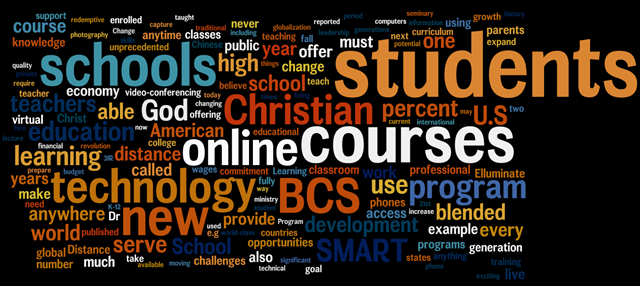
I may be way behind but I just recently discovered that I could create a word cloud to present a visual representation of written material.  Having just written an important memo to my staff on our new distance learning initiative, I decided to create a word cloud using the text of my memo.  Below is the result.

image

The size of a word in the visualization is proportional to the number of times the word appears in my memo.  What is interesting, and encouraging, is that “Student” is the most prominent word, reflecting the focus on the benefits to students of our new distance learning initiative.  

I used Wordle to create my word cloud.  Wordle has a public gallery of word clouds.  Here is one I created from President Obama’s State of the Union speech.

image

Here is a word cloud I created from President George Washington’s first Stat of the Union speech.

image

Finally, here is a word cloud I created from President Franklin Roosevelt's 1944 State of the Union speech.

image

Beyond being merely fun and interesting, which it is, it also has real educational value.  For example, as illustrated above, a history teacher could use word clouds to compare historical documents as a way of illustrating the primary focus of concern.  A literature teacher could compare two pieces of literature dealing with similar themes.  Or, you could analyze your presentations to determine if the word frequency matches your intended emphasis.  Obviously, frequency is but one indicator, but useful.

image

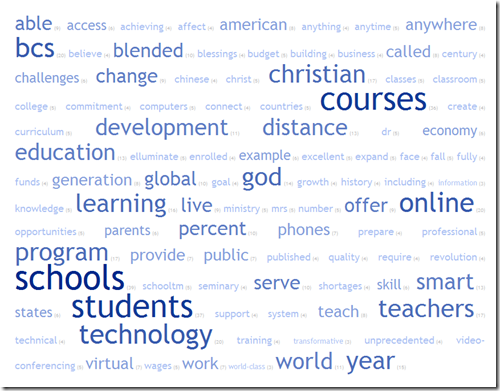
Whereas Wordle provides the flexibility to change the layout, font, color, etc., of your cloud, tagcrowd provides more options in handling the actual text, e.g., the number of words displayed, word grouping (similar words), etc.  This can be useful because you can group words that should be combined to better illustrate frequency, e.g., learned, learns, learning=learning.  The word cloud below was created from my distance learning memo using tagcrowd.

Helpful Tips

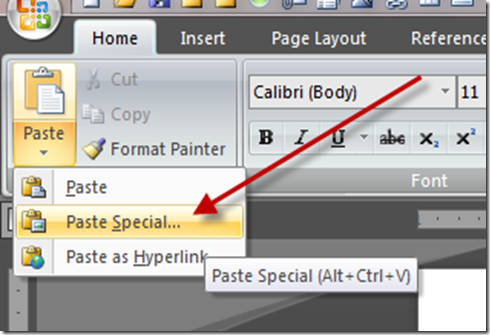
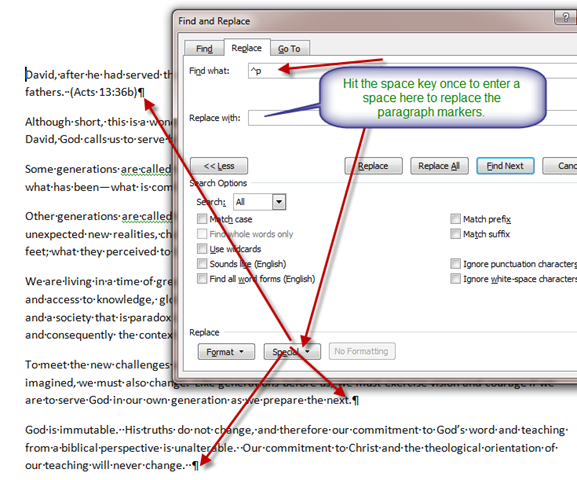
It is best to paste your text in the Wordle or Tagcrowd textbox in unformatted text format without paragraph marks, bullet points, etc.  The easiest way to do this in MS Word is to copy your text and then paste in in a new Word document as unformatted text.

image

image

Then,  using the Fine/Replace tool in Word, replace paragraph marks, etc, with a space.

image

Copy and paste the resulting text in Wordle or Tagcrowd to create your new word cloud.

Goodbye to Discs and Pages?

By Dr. Barrett Mosbacker

This article, although related specifically to Apple and Amazon, the larger story is the fast movement to digital content for books/textbooks. 

Amazon vs. Apple: Battle of the books

With its new iPad, Apple is taking aim at Amazon's core business and its Kindle book reader. Can the 'e-tail' pioneer keep up as books, music and movies go all-download?

By Michael Brush

Amazon.com (AMZN, news, msgs) has come out on top in the digital revolution that's moving sales of books -- as well as compact discs, DVDs and lots of other products -- online.

But there's a second digital uprising afoot, and some experts think Amazon won't fare as well -- and could lose a sizable chunk of its core bookselling business.

Any Amazon losses would likely be gains for Apple (AAPL, news, msgs), which could do to its "e-tail" rival what Amazon has been doing to brick-and-mortar competitors.Apple's chief weapon in this battle of online giants -- the iPad -- will be rolled out April 3, with preorders starting March 12. Among the many things people will be able to do with these flat touch-screen computers: download and read digital books from Apple's new iBookstore.

Amazon has its own successful book reader, the Kindle. But Apple dominates in music downloads, so there's good reason to think it will take a big share of the market for downloadable books. "In music, Apple is the dominant player. Now Apple wants to do the same in books," says Jeffrey Liebenson an attorney with Herrick, Feinstein who was involved in some of the early music industry negotiations with Apple. And the iPad threat is part of a bigger-picture "digital transition" risk to Amazon that has led many investors to head for the exits.

The worry? Books are joining music in a broad shift to entertainment via digital download, and that's a game Apple tends to win.

Goodbye discs and pages

Think how this second digital revolution has changed the way we get entertainment:

  • When was the last time you bought a CD? Sales of CDs declined to 301 million last year from 712 million in their peak year of 2001, according to Nielsen SoundScan. Instead, people download music -- and Apple, with its iTunes store, dominates with a 70% market share. Amazon has 8% of the music sales market.

  • The same thing is happening to DVD sales. Video stores such as Blockbuster (BBI, news, msgs) are already hurting. Consumers will soon wonder why they should buy a DVD anywhere when they can get a movie online -- instantly.

E-Book price wars

Amazon hasn't ignored these changes. You can download music at the online retailer -- and from many other places, of course -- but Apple simply rules this game.

You can also get movies over the Internet from Amazon. Here Apple isn't dominant, but the field is crowded with strong rivals: cable companies, Netflix (NFLX, news, msgs), Hulu and Vudu, which was recently purchased by Wal-Mart Stores (WMT, news, msgs).

Books are next, and Amazon is certainly a major player in the digital book market with the Kindle. But imagine that Apple does to the book market what it's done in music. How much will be left for Amazon or anyone else?

The risk to Amazon's business is real, and it is one of the main reasons Credit Suisse analyst Spencer Wang is telling investors to avoid buying Amazon stock now. He has a "hold" rating on the online retailer and a 12-month price target of $130 a share, around where the stock sells today.

Because of these worries, investors sold out of Amazon stock earlier this year when it became clear Apple was entering the e-book market, analysts say. The stock is down from a 52-week-high at $146, though, like the market as a whole, it's way up from its lows.

Among those selling has been Amazon founder and CEO Jeff Bezos. In February, he sold 2 million shares of Amazon stock at prices between $116 and $120, according to Thomson Reuters. He sold 7 million shares in 2008-09, after selling no stock at all during 2005-07.

The strong side of Amazon

Mind you, this is a battle of giants.

Amazon's stock is up 50% since I wrote in August 2008 about a different battle for online sales ("How Amazon is beating up eBay"). The Standard & Poor's 500 Index ($INX) is down more than 10% from where it was then, and eBay (EBAY, news, msgs) is down slightly.

Amazon revenue grew an impressive 37% in the fourth quarter of 2009. It owns 22% of the North American book market, according to a Credit Suisse estimate. And it can continue to grow by doing what it does best: taking market share from brick-and-mortar retailers.

It sold an estimated 2 million Kindle book readers last year, and 3.1 million are expected to be sold this year, according to estimates by Barclays Capital analyst Douglas Anmuth. Amazon's stated goal of having every book ever printed in any language available on Kindle in less than 60 seconds is a bold one -- and however realistic, it means Kindle owners should eventually be able to get virtually any book they want.

The Apple advantages

Apple, though, is a fierce competitor, which is what makes the battle intriguing. And it has two big advantages as it goes after book sales.

Advantage No. 1: Apple has eager allies in the publishers.

To promote Kindle, Amazon has been offering great deals on new and best-selling e-books, a 55% discount off a typical $22 list price to $9.99. It's selling many e-books at a loss, says Wang, the Credit Suisse analyst.

This annoys publishers. They think Amazon has too much clout in the book business, and they don't want to see that extended to e-books. And they worry that a $10 price will "cheapen" books, training consumers to always expect low prices.

Enter Apple. It has offered publishers better prices than Amazon asks -- as long as the publishers make other vendors (i.e., Amazon) raise the retail price on best-selling e-books to $12.99 to $14.99. Most of the major publishers have signed on. If the alliance sticks, it will hurt Amazon's strategy for taking market share and fueling Kindle growth.

"All the publishers I talk with are hoping the iPad will live up to the hope," says Todd Eckler, the vice president for print and publishing at North Plains, which sells software to help providers put their content online.

Advantage No. 2: Apple is better than almost anyone at making gadgets.

This is key, because the gadgets can be crucial in determining which company eventually controls the content ecosystem, including the all-important formats that can be used to lock out competitors.

One of the main reasons Apple dominates music is the popularity of its iPod players and its music-playing iPhone. Lots of companies make music players, but Apple dominates so thoroughly that "iPod" is nearly a generic term.

Though we won't know for sure until it hits the market, with its smooth interface and bright color screen, the iPad seems sure to be a comfortable way to read books, believes Scott Testa, a professor of business administration at Cabrini College in the Philadelphia area and an avid Kindle user. "The iPad is going to blow the Kindle away as far as ease of use and the quality of the screen," he says.

Amazon's gadget will have the price advantage. The Kindle starts at $250 and is likely to get cheaper soon. Apple's iPad will start at $500; if Apple wins, it will likely be because the iPad does much more.

Though the iPad's features and processing power will be overkill for the simple act of reading a book, they're likely to contribute to an evolution in what constitutes a book that could move that market toward Apple.

A next-generation iPad book could easily include video on "the making of the book" as with DVDs, an author interview or music -- features that will make book reading a richer experience, says Eckler, of North Plains, which sells software that helps publishers do these things.

Beyond books, consider that the many potential customers who already have deep libraries of iTunes music and video can play those on their iPad. They don't work on a Kindle or on other manufacturer's devices. If customers buy only one device, that's an incentive to go with the iPad.

The Google wild card

Amazon also has Google (GOOG, news, msgs) to worry about. The latter is scanning as many books as possible to build up the world's biggest digital book database.

We're still not sure how Google plans to make money off this, but one approach is obvious: Google will likely discount books (or give away books in the public domain, without copyright limits, for free), and make up the difference by charging sponsors for ad words, just as it does for search. Plus industry experts believe that like Amazon and Apple, Google will roll out its own book reader at some point soon.

So what to do with Amazon?

Against this backdrop, what does Amazon's future hold?  

An Amazon spokesman declined to comment for this column. But in a recent conference call with investors, when asked about the emerging book battles, Amazon finance chief Thomas Szkutak responded: "We think we are positioned very nicely from a digital perspective. We think we are focused on the customer, and I think Kindle is certainly a good example of that."

Even without the price advantage, the Kindle would be good enough for many book fans, particularly older readers who will be happy to read books and newspapers on the Kindle's black-and-white screen. "It is a generational thing," says Eckler. "The Kindle is simple. There are not a lot of buttons."

Wang, of Credit Suisse, believes Amazon will continue to see 7.5% annual growth in North American book sales over the next five years, even with Apple entering the market.

There's also a macroeconomic reason Amazon will be OK: Online sales still represent only 3.8% of overall retail sales in the U.S. So there is still plenty of room for Amazon, the leader in the space, to grow as more retail moves online, says Mark Mahaney of Citigroup.

The key takeaway for investors is this: Don't buy Amazon stock expecting the kind of huge gains seen over the past couple of years. Many market players will wait to see how the online retailer manages the all-digital transition, but with savvy competitors such as Apple attacking its core book market, growth will slow.

Apple's stock, on the other hand, just keeps rising. You would be buying today at an all-time high, which can be risky. But citing the iPad, plus continued strength in iPhone and Mac sales, Credit Suisse analyst Bill Shope has an outperform rating and a 12-month price target of $275 on Apple stock, from about $223 today.

For consumers, the book battle could mean higher prices on new and best-selling e-books, as Apple aligns with publishers to raise prices above Amazon's big discounts. But gadget prices should fall quickly as the competition heats up.

And the cool news is that the iPad may open up a whole new world of "words" that brings lots of cool features to the concept of a book. Amazon and others will have to match technologies or lose out. The simple act of reading is changing forever.

At the time of publication, Michael Brush did not own or control shares of any company mentioned in this column.

What’s in a Chicken McNugget? Read On Only If You Have a Strong Stomach

By Dr. Barrett Mosbacker

Ever wonder what’s actually in a McDonald’s Chicken McNugget? Turns out, the “chicken” alone contains seven ingredients. And that’s before you even get to the breading. Sadly, many of our favorite foods (especially fast foods) weren’t merely crafted in kitchens, they were also designed and perfected in labs. We uncovered the ugly truth when doing research for Eat This, Not That! Restaurant Survival Guide. What we found wasn’t pretty—or appetizing. Before you mindlessly chew your way through another value meal, take these mini-mysteries (conveniently solved below) into account. Sometimes the truth is tough to swallow.

What’s in a Chicken McNugget?

You’d think that a breaded lump of chicken would be pretty simple. Mostly, it would contain bread and chicken. But the McNugget and its peers at other fast-food restaurants are much more complicated creatures than that. The “meat” in the McNugget alone contains seven ingredients, some of which are made up of yet more ingredients. (Nope, it’s not just chicken. It’s also such nonchicken-related stuff as water, wheat starch, dextrose, safflower oil, and sodium phosphates.) The “meat” also contains something called “autolyzed yeast extract.” Then add another 20 ingredients that make up the breading, and you have the industrial chemical—we mean, fast-food meal—called the McNugget. Still, McDonald’s is practically all-natural compared to Wendy’s Chicken Nuggets, with 30 ingredients, and Burger King Chicken Fries, with a whopping 35 ingredients.

For more fast foods to watch out for, memorize this list of the 20 Worst Drive-Thru Foods.

Click here to read the entire article—if you dare!

The Worst Drive-Thru Meal in America

Worst Grilled Chicken

Worst "Healthy" Food

Worst Cheeseburger

Worst Fish Sandwich

Worst Dessert

Worst Potato Side

Worst Milkshake

Worst Chicken Strips

Worst Side

Worst Drive-Thru Kids Meal

Worst Roast Beef Sandwich

Worst Crispy Chicken Sandwich

Worst Salad

Worst Fish Entree

Worst Drive-Thru Breakfast Sandwich

Worst Hot Sandwich

Worst Mexican Entree

Worst Value-Menu Item

Worst Drink

College: Are Parents Getting Their Money’s Worth? Are They Getting “More” Than They Bargained For?

By Jeff Myers

This fall about two million American students will leave for college for the first time to receive an education at a yearly cost of $12,000 a year for a public university and up to $50,000 for a private one. Scholarships and grants reduce the cost for most families, but still, the Wall Street Journal reports that the average student leaves college with $23,186 in debt.

The total cost for this transaction is somewhere between 25 and 40 billion dollars. Per year.

Oh well, at least families are getting their money's worth.

Or not.

A recent study confirms what many parents have long suspected, that going to most colleges can make kids forget the things that are important and embrace values that are counter to what they learned growing up.

Before I share this study's results, let me say this to parents: leftist professors don't feel sorry for you. As far as they’re concerned, you’ve been oppressing the masses to get that money anyway, so it’s deliciously ironic that you not only turn your children over to the indoctrinators, but that you fork over 50k to 200k for the privilege.

Don't take my word for it. Here's what the late Richard Rorty, one of the most prominent philosophers of the 20th century, said on the subject:

"... I, like most Americans who teach humanities or social science in colleges and universities ... try to arrange things so that students who enter as bigoted, homophobic, religious fundamentalists will leave college with views more like our own ...  The fundamentalist parents of our fundamentalist students think that the entire ‘American liberal establishment’ is engaged in a conspiracy. The parents have a point...we are going to go right on trying to discredit you in the eyes of your children, trying to strip your fundamentalist religious community of dignity, trying to make your views seem silly rather than discussable. We are not so inclusivist as to tolerate intolerance such as yours ... I think those students are lucky to find themselves under the benevolent Herrschaft [domination] of people like me, and to have escaped the grip of their frightening, vicious, dangerous parents ..." [editor’s note: sorry for all the ellipses, but it's hard to summarize Rorty's windblown rhetoric].

When it comes to reshaping values, liberal universities know precisely what they’re doing. About four out of five students walk away from their Christian faith by the time they are in their twenties.

The Indoctrination Route: Citizenship--Bad; Leftist Politics--Good

In February the Intercollegiate Studies Institute released its annual report entitled, “The Shaping of the American Mind.” ISI researchers studied students' knowledge of basic citizenship questions, along with 39 issue-based propositions.

They found that college graduates are dangerously ignorant of basic civics. For example, fewer than one in two college graduates know that the phrase "We hold these truths to be self evident..." is from the Declaration of Independence (10% actually think it is from the Communist Manifesto).

When it comes to political radicalism, however, colleges pass with flying colors. Graduates are significantly MORE likely to believe in abortion on demand and same sex marriage, and significantly LESS likely to believe that the Bible is the word of God, that prayer should be allowed in schools, or that anyone can succeed in America with hard work and perseverance.

The Transformation Route: Being Caught Off Guard--Bad; Being Confidently Prepared--Good

Obviously not all colleges are destructive. There are even a handful of great ones (I would humbly suggest that the one I teach at--Bryan College--is one of the excellent few).

But most Christian parents feel hamstrung. They are concerned for their kids but also realize that with few exceptions (such as flat-out genius) most young people have no chance of attaining leadership positions without a college degree.

There is a solution and it is available now. Please, if you have a college-bound student, listen carefully to what I'm about to tell you. This is important even if your child is going to a "safe" college (some so-called "Christian" colleges are actually better at convincing kids to walk away from their faith than some secular colleges).

A two-week Summit Ministries course is a must. This summer. Find out more [here].

At Summit students ages 16-21 invest 12 days gaining the confidence they need to understand and defend an intelligent biblical worldview. They join a vast network of mentors whose books, writings and personal encouragement help sharpen them for life-long leadership. They stand shoulder to shoulder with newfound friends who help them stand strong.

Now Is Not The Time for Shortcuts

There is much at stake. Having your child read an apologetics book or go to a weekend conference is great, but it’s not the same as a two-week Summit experience, and here’s why:

1. At Summit students can ask questions as they arise. Over the course of 12 days students are able to form questions and interact with top Christian professors, mentors, and classmates. As they become comfortable, they open up in small groups, around the meal tables and in open forums with speakers. This gives students confidence that everyday people really can defend what they believe.

2. At Summit students enjoy being given the responsibility to think through issues as adults. Summit asks students to forsake adolescence and step up into mature adulthood. Over the course of 12 days they come to believe that it can actually be done.

3. Summit breaks the stranglehold of negative peer pressure. Young adults will seldom attempt to become anything more than what their peers think they can be. Summit students learn how to reverse this pressure and support one another in successfully thinking and living Christianly.

4. Summit provides personal contact with expert mentors. At Summit students spend 12 days with experts who have the depth of experience needed to delve deeply into the complex challenges they will face. These experts are specially selected based on their ability to communicate effectively with students.

5. At Summit, parents find that their parental role and their Christian values are affirmed and supported. Kids are always asking, "Who else says so besides mom and dad?" At Summit students are encouraged to honor their parents and be reconciled to them. This helps moms and dads strengthen their relationship before their sons and daughters leave for college, which is crucial.

Where Christian Leaders Send Their Own Children for Training

Summit is not a miracle cure. But for 47 years it's been a trusted source when it comes to preparing students to be the kind of leaders who shape culture, rather than who are shaped by it. That's why evangelical leaders such as James Dobson and Josh McDowell endorse it so enthusiastically. It's also why they chose to send their children to Summit before college; there simply is no substitute for the excellent training and mentoring Dr. Noebel and his staff provide.

I believe in the Summit. In fact I am planning to speak at every Summit Ministries session in the U.S. this summer in Colorado, Virginia, Tennessee and Wisconsin.

Summit enrollment is limited by space. Most sessions do fill up, but you can download an application [here]. Scholarships are available for those in financial need.

Remember: Before College, Summit. Please forward this to any parent who doesn’t yet understand this.

Dr. Jeff Myers is founder and president of Passing the Baton International. Jeff speaks to tens of thousands each year on worldview and leadership issues. This article was taken by permission from Jeff’s E-Newsletter “Get Ready to Lead.” To subscribe, please visit www.passingthebaton.org. For more information on Summit Ministries, please visit www.summit.org.

*Richard Rorty, "Universality and Truth," in Robert B. Brandom (ed.), Rorty and His Critics (Oxford: Blackwell, 2000), pp. 21-22.

**George Barna, "Twentysomethings struggle to find their lace in Christian churches"; Ken Ham and Britt Beemer, Already Gone: Why Your Kids Will Quit Church and What You Can Do to Stop It (Green Forest, AR: Master Books, 2009), p. 24.