
Take a Break: Time for a Laugh!
/Sometimes you just have to add a little humor to your day.
Reverend Jim’s Driving Test
Kramer the Movie Expert
How to Respond to a Telemarketer
This site is devoted to fostering practical and creative dialog for promoting excellence in K-12 Christian schools.
Excellence in K-12 Christian Schools / Published by Dr. Barrett Mosbacker
Sometimes you just have to add a little humor to your day.
Reverend Jim’s Driving Test
Kramer the Movie Expert
How to Respond to a Telemarketer

By Jay Matthews
Just had the privilege to view the documentary in selected theaters, "Jesus Save Us From Your Followers." I had an inside source allow me to see a DVD of it and have had some time to view it in sections.
Very clever movie and very impressive in terms of the visual presentation and trendy graphics.
The documentary explores the polarization of American culture over issues of faith and asks a great question: What is wrong? Why is there so much venom over such a beautiful message- the gospel of Jesus Christ?
Dan Merchant presents an excellent exploration of this caustic culture in these important areas.
I found the movie helpful in some points, but too silent on two large aspects of this issue.
First: We have lost civil dialogue in this culture. Disagreement usually means 'war'. Instead of honest debate- we hurl sound bites over the internet or through talking heads. I agree that we have lost humility and love in the message. The section of the movie (inspired by Blue Like Jazz) of Christian confession was very powerful.
Second: We are ignorant of opposing worldviews and uneducated in the trends of mainstream culture. The culture war mantra has made these issue oriented debates instead of human relationships.
I agree with these premises and, sadly, am guilty as charged.
But there are two other major problems in our presentation of the gospel.
1) We need to be more tender to the 'world' - but we have lost accountability inside the church. There is no discernible difference inside the American church and outside the American church today. We are guilty of loving the world. We have the same consumerist tendencies- we have the same divorce rate- we have the same pattern of addiction and cynicism. Our lips love Jesus, but our hearts love the world.
This problem stems from a lack of seeing sin as serious. We have preached the watered down gospel. To quote Niebur,
A God without wrath brought men without sin into a Kingdom without judgment through the ministrations of a Christ without a Cross.
The bad news is not bad... so the good news is not good.
2) We also stand as the most biblically illiterate generation in America. Our reading comprehension slowly dwindles and the light of the Word is dimming. I recently read a handout from C.S. Lewis to my freshman Bible class- when I finished a student said, "I didn't understand a word he said."
The purity of the church is diminishing because God's word is being eclipsed in our midst.
We should be tender to others and tough on ourselves. We need God's Spirit to convict us of sin. We need to stop posing and come clean in our sin- but we also need to move toward repentance and holiness.
One final comment- the Gospel of Christ will be offensive. Granted, it should be the only offensive part of our life as we seek to love, serve, in humility live above reproach. But if we ever think that we will live in harmony with the world.... don't be gullible.
So I come away from the movie conflicted... I want to stand for righteousness and preach forgiveness. That means drawing hard lines which will make me appear intolerant and offensive. I need to love sinners, but I cannot ignore sin.
Sin destroys.. the gospel heals. Help me Lord find the balance- help me walk in the truth. Anyone else seen this documentary? Comments? I won't be offended if you disagree!

Google Wave is an online tool for real-time communication and collaboration. A wave can be both a conversation and a document where people can discuss and work together using richly formatted text, photos, videos, maps, and more.
A wave is equal parts conversation and document. People can communicate and work together with richly formatted text, photos, videos, maps, and more.
A wave is shared. Any participant can reply anywhere in the message, edit the content and add participants at any point in the process. Then playback lets anyone rewind the wave to see who said what and when.
A wave is live. With live transmission as you type, participants on a wave can have faster conversations, see edits and interact with extensions in real-time.
If you you are like many, the rapid unrelenting wave (yes, the pun is intended) of new technologies can be mind numbing, even exhausting. Who can keep up with it all? Should we even try?
No, we cannot keep up with all of it but yes, we should try to stay current. There are several reasons to stay on top of developments like Google Wave:
 As leaders, we do not want to be caught with our pants down when a new technology explodes on the scene fundamentally changing the way we communicate and interact. IF it is a efficient and cost effective technology we need to know about it before investing limited resources in outdated technologies, irrelevant training, and misaligned infrastructure.
 Here are three videos that explain Google Wave. Want to try Wave? You will need an invitation. Click here.
 WARNING: this article is provocative. I am posting this article not because I agree with everything asserted (I don’t) but because it provokes thought and has relevance for how we are leading our schools during a time when the landscape of education is changing-perhaps dramatically. At the end of this article I pose some questions for your consideration.
WSJ: September 29, 2009
By Gary Hamel
In most organizations, change comes in only two flavors: trivial and traumatic. Review the history of the average organization and you’ll discover long periods of incremental fiddling punctuated by occasional bouts of frantic, crisis-driven change. The dynamic is not unlike that of arteriosclerosis: after years of relative inactivity, the slow accretion of arterial plaque is suddenly revealed by the business equivalent of a myocardial infarction. The only option at that juncture is a quadruple bypass: excise the leadership team, slash head count, dump “non-core” assets and overhaul the balance sheet.
Why does change have to happen this way? Why does a company have to frustrate its shareholders, infuriate its customers and squander much of its legacy before it can reinvent itself? It’s easy to blame leaders who’ve fallen prey to denial and nostalgia, but the problem goes deeper than that. Organizations by their very nature are inertial. Like a fast-spinning gyroscope that can’t be easily unbalanced, successful organizations spin around the axis of unshakeable beliefs and well-rehearsed routines—and it typically takes a dramatic outside force to destabilize the self-reinforcing system of policies and practices.
Let me return, for a moment, to the topic of my last post, organized religion. What are some of the inertial forces that have prevented churches from reinventing themselves in ways that might make them more relevant to a post-modern world? A partial list would include:
–Long-serving denominational leaders who have little experience with non-traditional models of worship and outreach.
–A matrix of top-down policies that limits the scope for local experimentation.
–Training programs (seminaries) that perpetuate a traditional view of religious observance and ministerial roles.
–Promotion criteria for church pastors that reward conformance to traditional practices.
–And a straightjacket of implicit beliefs around how you “do church.” For example:
If organized religion has become less relevant, it’s not because churches have held fast to their creedal beliefs—it’s because they’ve held fast to their conventional structures, programs, roles and routines. The problem with organized religion isn’t religion, but organization. In the first and second centuries, the Christian church was communal, organic and unstructured—a lot like the Web is today. It commanded little power (it couldn’t raise an army or depose a monarch), but had enormous influence. (The Christian church grew from a handful of believers in AD 40 to 31 million adherents by AD 350, roughly half the population of the Roman empire. ) Today many mainline denominations are institutionally powerful, but spiritually moribund—at least in the U.S.
What’s true for churches is true for other institutions: the older and more organized they get, the less adaptable they become. That’s why the most resilient things in our world—biological life, stock markets, the Internet—are loosely organized.
To thrive in turbulent times, organizations must become a bit more disorganized—less buttoned down, less uptight, less compulsive, less anal.
As a start, you’ll need to become more alert to the things that reflexively favor the status quo in your own organization. While no one’s going to stand up and say, “I’m on the side of inertia,” they may nevertheless defend management processes that reflexively favor the status quo.
All of the things that allow little organizations to grow into big ones—scale, learning effects, and accumulated expertise—are products of repetition. When the environment changes, however, the returns to repetition start to diminish. Problem is, old habits die hard, particularly when they’ve been hardwired into a company’s management processes.
–Hiring criteria that over-value “expertise” and under-value diverse life experiences.
–A planning process that institutionalizes orthodox thinking by using industry standard definitions of customer segments and product categories
–Decision-making bodies that are comprised mostly of long-serving industry veterans who tend to discount new views.
–Highly conservative budgeting criteria that starve unconventional projects of resources by demanding near certain returns, even when the funds involved are modest.
–A single approval track for new projects, where every new idea has to go up the chain of command.
–Large, monolithic organizational units built around a single, dominant, business model.
–A highly optimized but inflexible IT infrastructure.
Large organizations don’t worship shareholders or customers, they worship the past. If it were otherwise, it wouldn’t take a crisis to set a company on a new path.
The most extreme version of organizational inertia comes when those within a company are no longer able to distinguish between form and function—when their instinctual loyalty is to the “how” rather than the “what.”
If one didn’t know better, it would be easy to believe that a lot of newspaper publishers have been more committed to producing broadsheets than to delivering the news in a convenient form, or making it easy for advertisers to connect with customers.
Until recently, music companies seem to have been more committed to stamping out plastic discs than to giving their customers easy access to their favorite tunes.
Many drug companies seem a lot more interested in peddling temporary palliatives for chronic conditions than in eradicating disease.
For years, Kodak seemed more focused on making film than on leveraging new digital technologies that would make photography simpler and cheaper.
Alzheimer’s, arteriosclerosis and arthritis—these seem to be the inevitable byproducts of old age. But must organizational maturity bring a similar set of maladies? I don’t think so. Despite all the evidence to the contrary, I think a company can truly be “Forever 21.”
Questions:
By Boyd Chitwood, Ed. D.,
 A story about growing – plants and children – by God's design.
A family once was given a gift by a kind and powerful neighbor. He told them that at night, as they slept, he had planted for them a garden. If they cared for it well, it would produce for them both abundant food and astonishing beauty. What the family saw was a plot of ground with beautifully tilled, rich loam, and the signs of seeds having been freshly planted.
The father and mother resolved to care for it well; they were very grateful. The son asked if he might have a small portion of the garden to care for and, though they weren't sure he was ready for the responsibility, they gave him a small corner.
They knew plants needed food and water, but didn't know much else. The boy knew even less, so he resolved to get to know each of his plants very well, wanting to see them grow into all they were meant to be.
The father and mother watered and fertilized, and began to see growth. They saw leafy greens and grassy shoots and were overjoyed. The boy followed their lead, but also had been looking at every garden he could find, along with all the produce at the grocery store, and all the plants at the nursery. He began to recognize some of his plants as they grew. After awhile, though worried because his father and mother weren't doing it, he began to prune and weed what he knew wasn't true to the plants which were growing. He also varied his watering and fertilizing based on the growth he saw, and he picked insects off the growing plants. He tied up and supported some plants, and redirected others.
The father and mother continued to see a profusion of growth – the weather was warm, and they fed and watered the garden with dedication. More and more things grew, though they weren't sure they could recognize much of it.
In just a couple of months, both parts of the garden had grown much. The boys corner wasn't as high or as green, but his had begun to bear fruit and vegetables which he knew were good to eat. As they ripened, he picked them and more grew. He also saw astoundingly beautiful flowers begin to blossom, sharing their sweet fragrance with all who came by.
The larger garden of the father and mother was a mass of vegetable plant stalks and grass and leaves with large holes eaten out of them and a few scrawny vegetables and flower buds here and there. They watered and fertilized all the more, but were very discouraged.
The kind neighbor walked by one day and remarked on the mass of foliage in the garden. He said they must have worked with vigor and dedication. Perhaps they could come to his garden and look around a bit.
Then he saw the boy's corner and broke into a brilliant smile. "Now this," he said, "is the garden grown up into the bounty and beauty I had in mind when I planted it. Well done!"
_________________________________
Education according to God's glorious design is about hard work, but not just about watering and fertilizing. Growth conformed to the Lord's plan for each of our children is the standard of success. With pruning and training, along with weeding and feeding and watering, we pursue the highest good for our children and the greatest glory for our God.
By Mark Kennedy (ACSI Canada)
 Every now and then I hear it, even in Christian school circles. “Perception is reality”, they say with a kind of unquestioning conviction that suggests the discovery of a new immutable truth.
This, along with other snippets of pop business philosophy, have steadily made inroads into the board rooms of churches and Christian schools. Some are quite useful. It is not that we can’t gain insights and understanding from effective business principles and practices. The fact is that all truth, even in the area of business, is God’s truth. The problem comes when we accept any philosophical assertion without testing it against the teaching of scripture.
And that is my concern about the “Perception is reality” concept. In keeping with post modern thinking it implies that people can have their own private self-created realities –their own personal truths.
Some people reason that if only they could manipulate those perceptions effectively they would be able to get what they want –in our schools that could mean creating new pro Christian school “realities” in people’s minds.
It seems to me that the whole idea is false. We can’t have our own private versions of reality anymore than we can have our own personal definitions of truth. And Christians more than anyone should realize that truth (which is the only genuine reality) exists despite our perceptions. William Blake puts it well in his poem, The Eternal Gospel.
“Thus Life’s five windows of the soul
Distort the heavens from pole to pole,
And lead you to believe a lie
When you see with, not through the eye.”
To my thinking the final word on the subject comes from Isaiah. In chapter 11 verses 3 and 4 he contrasts the undependable nature of personal perceptions and with God’s truth.
“He will not judge by what he sees with his eye,
Or decide by what he years with his ears
But with righteousness he will judge the needy
With justice he will give decisions for the poor of the earth.”
Nuff said.
Things are changing! For many years e-books have resided in the back waters of publishing. Early adopters and gadget freaks have read them but the vast majority of the population were either unaware of them or didn’t care.
 The lowly status of the e-book may be about to change—and radically. David Weir, in a BNET (a business and management blog) article outlines five reasons why he believes e-book publishing and use is reaching their tipping point--becoming widely accepted and on the way to outpacing printed books in popularity.
1. Screen reading now rivals paper reading, and for those of us in the over 40 set, screen reading is often easier on the eyes thanks to adjustable font sizing.
2. Consumer awareness has increased dramatically. A year ago, consumers were skeptical and resistant to e-books. Today, consumers are doing a complete 180. The early adopters have celebrated their Sony Readers, Kindles and iPhones to their friends, and now their friends want in.
3. The amount of content is increasing. Free books have served as a gateway drug to many early adopters.
4. Ebooks are impulse buys. I met a guy at the Las Vegas airport last month who told me he purchased a Sony Reader so he wouldn’t have to lug around 20 pounds of technical manuals. Now he finds himself buying more fiction than ever before because it’s so easy and convenient.
5. Value. E-books are cheaper.
I love books. My study is wall to wall books and I have spent thousands of dollars on my traditional library. I love to read and I love the feel and smell of books.
 Nevertheless, my reading habits are changing. In fact, I recently finished reading Dr. Poythress’ excellent book, Redeeming Science (384 pages) on my iPhone version of the Kindle (Read a review: Amazon launches Kindle application for the iPhone).
After reading Dr. Poythress’ book on my iPhone, I have concluded that I would love to have the Kindle DX for the vast majority of my reading. In fact, I would like to duplicate my printed library on the Kindle.
Hint to my wife: great Christmas present!
Although there are some drawbacks to e-books/e-readers relative to printed books (mainly sentimental), the advantages are numerous including:
1. The ability to read books, newspapers, magazines, and blogs anywhere anytime without the need to carry large books and dirty newspapers. The Kindle DX for example is just over 1/3 of an inch, as thin as most magazines. This is particularly an advantage when traveling or when in waiting rooms.
2. The ability to literally carry a library in my pocket or laptop case. I could carry to 3,500 books, periodicals, and documents in the Kindle DX.
3. For those of us who are a little older, the ability to adjust font size is a big advantage (yes, pun was intended). The Kindle DX has a 9.7" diagonal e-ink screen and reads like real paper and boasts 16 shades of gray for clear text and sharp images. Additionally, the device has a display that auto-rotates from portrait to landscape as you turn the device so you can view full-width maps, graphs, tables, and Web pages.
4. I can read PDF documents enabling me to read my personal and professional documents on the go.
5. With wireless 3G I can download books and magazine to the Kindle DX anytime, anywhere; there are no monthly fees, no annual contracts, and no hunting for Wi-Fi hotspots.
6. Currently, Amazon has over 300,000 e-books; many of which are only $9.99.
7. I can have subscriptions to U.S. and international newspapers including the New York Times and Wall Street Journal (both of which I read), magazines including The New Yorker and Time, plus popular blogs, all auto-delivered wirelessly.
8. I could have an electronic backup of my library. If  there a fire in my house, I would find it hard and probably impossible to replace many of my out of print books. If my library was on the Kindle, I could re-download my library from Amazon, Project Gutenberg, etc.
According to the Kindle Review, a lot of the books available at Project Gutenberg are already available in Kindle .azw format at ManyBooks (if you’re using your laptop). There are 19,505 eBooks available at ManyBooks and they’re all free! When you get to the page for an individual book, just click on the dropdown at the top right that says ‘Free Download’ + ‘ Select Format’ and the FIRST option is Kindle.
Note: You can browse and download Manybooks on the Kindle. @ mnybks.net
For Project Gutenberg books that are not available at ManyBooks, you can go to the Project Gutenberg Website. You can download EVERY book on Gutenberg to your Kindle for Free. No conversion required. This is a good page to start at Project Gutenberg to get Free Kindle eBooks.
I am not prepared to go as far as Cushing Academy (see below) but I am reviewing the potential of using Kindles, netbooks, and other electronic devices to supplement our library and textbooks. One of the great advantages for our students would be that they would not have to carry heavy book bags around all day.
By David Abel, Globe Staff | September 4, 2009
Boston prep school nixes all the books in its library, replaces them with 18 e-readers

ASHBURNHAM - There are rolling hills and ivy-covered brick buildings. There are small classrooms, high-tech labs, and well-manicured fields. There’s even a clock tower with a massive bell that rings for special events.
Cushing Academy has all the hallmarks of a New England prep school, with one exception.
This year, after having amassed a collection of more than 20,000 books, officials at the pristine campus about 90 minutes west of Boston have decided the 144-year-old school no longer needs a traditional library. The academy’s administrators have decided to discard all their books and have given away half of what stocked their sprawling stacks - the classics, novels, poetry, biographies, tomes on every subject from the humanities to the sciences. The future, they believe, is digital.
“When I look at books, I see an outdated technology, like scrolls before books,’’ said James Tracy, headmaster of Cushing and chief promoter of the bookless campus. “This isn’t ‘Fahrenheit 451’ [the 1953 Ray Bradbury novel in which books are banned]. We’re not discouraging students from reading. We see this as a natural way to shape emerging trends and optimize technology.’’
Instead of a library, the academy is spending nearly $500,000 to create a “learning center,’’ though that is only one of the names in contention for the new space. In place of the stacks, they are spending $42,000 on three large flat-screen TVs that will project data from the Internet and $20,000 on special laptop-friendly study carrels. Where the reference desk was, they are building a $50,000 coffee shop that will include a $12,000 cappuccino machine.
And to replace those old pulpy devices that have transmitted information since Johannes Gutenberg invented the printing press in the 1400s, they have spent $10,000 to buy 18 electronic readers made by Amazon.com and Sony. Administrators plan to distribute the readers, which they’re stocking with digital material, to students looking to spend more time with literature.
Those who don’t have access to the electronic readers will be expected to do their research and peruse many assigned texts on their computers.
“Instead of a traditional library with 20,000 books, we’re building a virtual library where students will have access to millions of books,’’ said Tracy, whose office shelves remain lined with books. “We see this as a model for the 21st-century school.’’
Not everyone on campus is sold on Tracy’s vision.
They worry about an environment where students can no longer browse rows of voluptuous books, replete with glossy photographs, intricate maps, and pages dog-eared by generations of students. They worry students will be less likely to focus on long works when their devices are constantly interrupting them with e-mail and instant messages. They also worry about a world where sweat-stained literature is deemed as perishable as all the glib posts on Facebook or Twitter.
Liz Vezina, a librarian at Cushing for 17 years, said she never imagined working as the director of a library without any books.
“It makes me sad,’’ said Vezina, who hosts a book club on campus dubbed the Off-line Readers and has made a career of introducing students to books. “I’m going to miss them. I love books. I’ve grown up with them, and there’s something lost when they’re virtual. There’s a sensual side to them - the smell, the feel, the physicality of a book is something really special.’’
Alexander Coyle, chairman of the history department, is a self-described “gadget freak’’ who enjoys reading on Amazon’s Kindle, but he has always seen libraries and their hallowed content as “secular cathedrals.’’
“I wouldn’t want to ever get rid of any of my books at home,’’ he said. “I like the feel of them too much. A lot us are wondering how this changes the dignity of the library, and why we can’t move to increase digital resources while keeping the books.’’
Tracy and other administrators said the books took up too much space and that there was nowhere else on campus to stock them. So they decided to give their collection - aside from a few hundred children’s books and valuable antiquarian works - to local schools and libraries.
“We see the gain as greater than the loss,’’ said Gisele Zangari, chairwoman of the math department, who like other teachers has plans for all her students to do their class reading on electronic books by next year. “This is the start of a new era.’’
Cushing is one of the first schools in the country to abandon its books.
“I’m not aware of any other library that has done this,’’ said Keith Michael Fiels, executive director of the American Library Association, a Chicago-based organization that represents the nation’s libraries.
He said the move raises at least two concerns: Many of the books on electronic readers and the Internet aren’t free and it may become more difficult for students to happen on books with the serendipity made possible by physical browsing. There’s also the question of the durability of electronic readers.
“Unless every student has a Kindle and an unlimited budget, I don’t see how that need is going to be met,’’ Fiels said. “Books are not a waste of space, and they won’t be until a digital book can tolerate as much sand, survive a coffee spill, and have unlimited power. When that happens, there will be next to no difference between that and a book.’’
William Powers, author of a forthcoming book based on a paper he published at Harvard called “Hamlet’s Blackberry: Why Paper is Eternal,’’ called the changes at Cushing “radical’’ and “a tremendous loss for students.’’
“There are modes of learning and thinking that at the moment are only available from actual books,’’ he said. “There is a kind of deep-dive, meditative reading that’s almost impossible to do on a screen. Without books, students are more likely to do the grazing or quick reading that screens enable, rather than be by themselves with the author’s ideas.’’
Yet students at Cushing say they look forward to the new equipment, and the brave new world they’re ushering in.
Tia Alliy, a 16-year-old junior, said she visits the library nearly every day, but only once looked for a book in the stacks. She’s not alone. School officials said when they checked library records one day last spring only 48 books had been checked out, and 30 of those were children’s books.
“When you hear the word ‘library,’ you think of books,’’ Alliy said. “But very few students actually read them. And the more we use e-books, the fewer books we have to carry around.’’
Jemmel Billingslea, an 18-year-old senior, thought about the prospect of a school without books. It didn’t bother him.
“It’s a little strange,’’ he said. “But this is the future.’’
By Dr. Barrett Mosbacker
One of the mistakes we are prone to make when challenged by parents, staff, or board members is to become defensive. This is an unfortunate tendency of fallen humans dating back to the Garden of Eden. Our sinful pride and our fragile self-images propel us to make excuses, to explain away, or to protect ourselves.
While it is right to defend ourselves against false accusations and misinformation, too often we become defensive rather than listening to what may be valid criticism of ourselves or of our schools. Young teachers and administrators are particularly prone to make the mistake of being defensive, which inevitably damages their credibility.
When wrong—simply admit it, correct the problem, and move on. A major U.S. company recently made a very big mistake with its customers. Rather than ignoring the mistake or attempting to explain it away, the CEO made an unequivocal public apology:
This is an apology for the way we previously handled … Our ’solution’ to the problem was stupid, thoughtless and painfully out of line with our principles. It is wholly self-inflicted, and we deserve the criticism we’ve received. We will use the scar tissue from this painful mistake to help make better decisions going forward, ones that match our mission.
How refreshing! This is an apology that customers appreciate and that reinforces loyalty. It is also professional, honest, and mature.
When you make a mistake in your leadership or the school has failed in living up to its high principles and mission—admit it. In biblical language—confess and repent. You’ll be surprised what doing so will do for you, your leadership, and your school!
By Dr. Barrett Mosbacker
This is a follow-up article to “How To Deal Effectively with Conflict and Difficult People.”
One of my favorite movies is Star Wars. It has a compelling story, good actors, and excellent special effects.
My favorite character in Star Wars is not the hero Luke Skywalker nor the heroine Princess Leia Organa; my favorite is a short creature called Yoda. At a little more than a foot tall, Yoda is a greenish brown fuzzy creature. He is also a Jedi Master who teaches Luke Skywalker the Force. He's very wise, but talks seemingly backwards, verb first and noun last. He teaches Luke to be a Jedi and drops pearls of wisdom such as "do or do not, there is no try."
Luke learns much from Master Yoda who teaches him the danger of the dark side of the Force. One of my favorite scenes is when Yoda asks Luke, referring to the dark side, “Are you afraid?”
Luke:"I'm not afraid."
Yoda:"You will be!"
I’m not Yoda but my question to you is, “Have you ever been offended by the criticism of others?” Have your decisions been questioned, your competence questioned, or your motives impugned? Have you ever been or felt shunned because of decisions that you have made as a teacher or administrator? If not, in the words of the Jedi Master himself, “You will be!”
Over the years I’ve encountered my share of criticism—both fair and unfair. As we enter a new school year I thought this might be a good time to share some thoughts with you about how we can more effectively deal with this unpleasant reality of leadership.
Anyone with any level of responsibility is going to be criticized. Consider Moses.
Despite the fact that he gave up the riches and comforts of the King’s Court to suffer with his people and risked his own life to rescue them from slavery, as soon as the People of Israel were uncomfortable and inconvenienced, they turned on him:
And the people quarreled with Moses and said, "Would that we had perished when our brothers perished before the LORD! Why have you brought the assembly of the LORD into this wilderness, that we should die here, both we and our cattle? And why have you made us come up out of Egypt to bring us to this evil place? It is no place for grain or figs or vines or pomegranates, and there is no water to drink.
Talking about being unappreciated and having your leadership questioned! A typical “What have you done for me lately?” response!
The first step in dealing effectively with criticism is to recognize that, like conflict, criticism, is inevitable. Criticism comes with the territory. Needless to say, given the sensitive nature of the things we deal with and the hard truth that we are not perfect, we WILL be criticized. There is no escape; one might as well accept it and learn how to deal with it graciously and effectively.
Trying to avoid criticism and conflict is like spitting in the wind—despite our best efforts it is going to hit us in the face! Rather than diving for cover, pointing fingers at others, or feeling sorry for ourselves, it is wiser to accept the inevitability of criticism and to seek by God’s grace to use it for the good.
Unless we have been personally offensive to someone, the criticism we receive is usually not directed to our persons. The criticism, although voiced to us because of the role we fill, is not usually intended a personal attack.
Simply put, to lead effectively we must develop alligator skin. The way we react to criticism can block communication and opportunities to work together. Hurt feelings and resentment do not foster a positive or cooperative environment. At its worst, such reactions can have long-lasting negative effects on our relationships and are corrosive to the school’s culture.
Keep in mind that the criticism we are hearing is most often directed at a real or perceived deficiency in how something was handled—the lesson, the conversation, the disciplinary action, the policy, etc. Learning to distinguish a personal attack from a critique, even if expressed in anger, goes a long way to making it easier to deal appropriately with it. Learning not to let the criticism get under our skin, learning to control our emotions, learning to maintain a calm reasoned composure in the face of sharp criticism, and learning to preserve relationships and unity after the criticism will go a long way to fostering peace of mind and peace within our schools. In short, love people but have a tough hide!
It’s ironic; we don’t like to be criticized but we are quick to criticize the criticizer! I believe there are three reasons why we respond poorly to criticism:
1) Human pride: We don’t like to admit that we made a mistake or worse, that we sinned. It is much easier to criticize those (usually behind their backs) who criticize us than to admit that we were wrong.
2) Insecurity: Most of us have spent a life-time trying to prove ourselves worthy—in school, in athletics, in appearance, in career success, in possessions. You name it—we constantly feel the pressure to “measure up.” Criticism implies that we don’t and that can be threatening to our sense of self-worth.
3) Our sense of justice: We naturally and appropriately react when we believe that the criticism is unjust.
The antidote is to ask the Lord to grant us the grace to readily acknowledge our own sins and weaknesses, to deeply believe that our worth is anchored in the fact our intrinsic worth is grounded in God’s estimate of us, and to respond appropriately to injustice.
In other words, a little (or a lot depending on the circumstances) humility goes a long way to softening the sting of criticism. If I readily admit that I am not perfect, that I sin, that I am not always wise, that I don’t always make the right decisions, and that I am merely a hardworking administrator with clay feet, then criticism will not be nearly so threatening or demeaning.
But I say to you, Do not resist the one who is evil. But if anyone slaps you on the right cheek, turn to him the other also. And if anyone would sue you and take your tunic, let him have your cloak as well. And if anyone forces you to go one mile, go with him two miles. Give to the one who begs from you, and do not refuse the one who would borrow from you. "You have heard that it was said, 'You shall love your neighbor and hate your enemy.' But I say to you, Love your enemies and pray for those who persecute you, so that you may be sons of your Father who is in heaven. For he makes his sun rise on the evil and on the good, and sends rain on the just and on the unjust. For if you love those who love you, what reward do you have? Do not even the tax collectors do the same? And if you greet only your brothers, what more are you doing than others? Do not even the Gentiles do the same? You therefore must be perfect, as your heavenly Father is perfect. (Mat 5:39-48)
Matthew Henry provides a wonderful commentary for this passage:
See how it is cleared by the command of the Lord Jesus, who teaches us another lesson: “But I say unto you, I, who come to be the great Peace-Maker, the general Reconciler, who loved you when you were strangers and enemies, I say, Love your enemies,” Mat_5:44.
Though men are ever so bad themselves, and carry it ever so basely towards us, yet that does not discharge us from the great debt we owe them, of love to our kind, love to our kin. We cannot but find ourselves very prone to wish the hurt, or at least very coldly to desire the good, of those that hate us, and have been abusive to us; but that which is at the bottom hereof is a root of bitterness, which must be plucked up, and a remnant of corrupt nature which grace must conquer. Note, it is the great duty of Christians to love their enemies; we cannot have complacency in one that is openly wicked and profane, nor put a confidence in one that we know to be deceitful; nor are we to love all alike; but we must pay respect to the human nature, and so far honor all men: we must take notice, with pleasure, of that even in our enemies which is amiable and commendable; ingenuousness, good temper, learning, and moral virtue, kindness to others, profession of religion, etc., and love that, though they are our enemies. We must have a compassion for them, and a good will toward them. We are here told:
1. That we must speak well of them: Bless them that curse you. When we speak to them, we must answer their revilings with courteous and friendly words, and not render railing for railing; behind their backs we must commend that in them which is commendable, and when we have said all the good we can of them, not be forward to say any thing more. See 1Pe_3:9. They, in whose tongues is the law of kindness, can give good words to those who give bad words to them.
2. That we must do well to them: “Do good to them that hate you, and that will be a better proof of love than good words. Be ready to do them all the real kindness that you can, and glad of an opportunity to do it, in their bodies, estates, names, families; and especially to do good to their souls.” It was said of Archbishop Cranmer, that the way to make him a friend was to do him an ill turn; so many did he serve who had disobliged him.
3. We must pray for them: Pray for them that despitefully use you, and persecute you. Note:
(1.) It is no new thing for the most excellent saints to be hated, and cursed, and persecuted, and despitefully used, by wicked people; Christ himself was so treated.
(2.) That when at any time we meet with such usage, we have an opportunity of showing our conformity both to the precept and to the example of Christ, by praying for them who thus abuse us. If we cannot otherwise testify our love to them, yet this way we may without ostentation, and it is such a way as surely we durst not dissemble in. We must pray that God will forgive them, that they may never fare the worse for any thing they have done against us, and that he would make them to be at peace with us; and this is one way of making them so.
Easier said then done! In fact, we can’t do it without the grace of God. Pray and cultivate the grace to respond as Jesus instructs. Be willing to take it—graciously.
As I outlined in my prior article on conflict, we must LISTEN! Have you ever found yourself “hearing” but not really listening? Have you found yourself preparing your “defense" rather than considering the merits of what is being said?
Doing so is both unbiblical and disrespectful of the one voicing his or her concerns. King Solomon and the Apostle James remind us:
Know this, my beloved brothers: let every person be quick to hear, slow to speak, slow to anger; for the anger of man does not produce the righteousness of God. (Jas 1:19-20)
A rebuke goes deeper into a man of understanding than a hundred blows into a fool. (Pro 17:10)
Steven Covey, in “Seven Habits of Highly Effective People” put it this way, “seek first to understand and then to be understood.” This requires that we honestly listen to the criticism. Here are some questions to ask as you listen:
What can I/we learn from this?
What can we do better/differently?
Where is the wheat in the chaff?
How can I minister to this individual? How can I be helpful? How can I encourage him or her?
What can I do to foster a positive relationship?
How should I follow-up this conversation?
Some people simply have more credibility than others. Our tendency, with some justification, is to discount the chronic complainer, the “high maintenance” parent or employee, or to miss the message because of the inappropriate communication or behavior of the messenger.
Don’t. It is important to look for the nugget of truth that may lay beneath the harsh or emotional criticism. Listen to the content of what is being communicated, not the way it is being delivered.
This also applies to the “anonymous” letter. In years past I would typically ignore anonymous letters. My reaction was, “if they don’t have the moral courage to sign their name, I don’t have time to read it!” Rather smug, don’t you think?
I have changed my perspective on anonymous communications. I still give less weight to anonymous letters but I do read them and I do look for that nugget of truth that--notwithstanding the moral cowardice demonstrated by an anonymous letter—nevertheless still needs to be addressed.
I have a bad memory, which usually frustrates me, especially when I forget names. However, a bad memory can be a blessing!
What I mean is this: hear it, deal with it, forget it! Don’t rehearse the offense in your mind, don’t nurture the anger or hurt feelings, and don’t talk about it. Deal with any legitimate issues being brought to your attention, even if that is your own failings, work to address the problem(s), and then move on. Nothing is gained by allowing discouragement or bitterness to take root. We have more important things to do than nurse our wounds.
No one likes to be criticized and when we are it is easy to be offended. It is, however, possible to deal with criticism without being offended—at least not for long-by applying the following principles:
Criticism is Inevitable-Expect and Accept It
Grow Alligator Skin
Look at the Beam in Our Eye
Be Willing to Take it Graciously
Be Quick to Listen
Don’t Discount the Message because of the Messenger
Be Forgetful
The way we respond to criticism may be one of the most powerful lessons we ever teach. We can give wonderful speeches and inspiring devotionals but the demonstration of the Fruit of the Spirit when dealing with criticism may be what the Lord uses to minister and instruct others. If actions speak louder than words then how we deal with those who are criticizing us is more important than our pronouncements.
But the fruit of the Spirit is love, joy, peace, patience, kindness, goodness, faithfulness, gentleness, self-control; against such things there is no law. (Gal 5:22-23)
I encourage you to share your suggestions on dealing with criticism with our readers by leaving a comment to this article.
The following is an excellent book review on 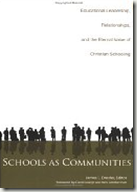 “Schools as Communities: Educational Leadership, Relationships, and the Eternal Value of Christian Schooling.” Click on the image to see the book on Amazon.
This is a book that you should seriously consider reading. (Disclaimer: I am a contributor author, Barrett Mosbacker).
The review was published in The ICCTE Journal.
Reviewed by Dr. David W. Robinson, Adjunct Professor, D.Mgt. program, George Fox University.
“Where there is no vision, the people perish…” Proverbs 29:18a (KJV)
Anyone who has engaged in the calling of Christian education knows that it can be — and usually is — one of the most exciting, delightful, fulfilling, and joyous ministries that a believer can know. Its golden days are a real “foretaste of glory divine,” its opportunities for those who truly love the possibilities of the mind and heart of Christ in the lives of our students are the very aroma of the Lord in our work. Lives are changed; parents are supportive; administrators are helpful; the board is productive. Sacrifices are engaged willingly, trials are gladly borne. We go home at the end of the day, and can hardly wait to return in the morning…
And anyone who has engaged in the calling of Christian education also knows that it can be — and usually is — one of the most daunting, exhausting, demoralizing, and frustrating ministries that same believer can know. Golden days can morph into drabness from one year to the next, or even overnight; its opportunities can suddenly vanish, with the mind and heart of Christ being trampled underfoot by institutional change, upheavals in leadership, financial uncertainty, or divisions and offenses within the school community…and suddenly, the aroma of Christ is seemingly nowhere to be found. Lives are no longer transformed; parents are arguing among themselves or sniping the administration/board; administrators run for the bomb shelter; the board seems unable to resolve the issues. Sacrifices now seem imposed, with trials producing grumbling, not grace. We go home at the end of the day, and are tempted to circulate our résumés…
Strange to say, this roller coaster ride is well known to all too many Christian school teachers, administrators, parents, students, and board members. The shift can happen over time, or even overnight. The results are commonly tragic (and predictable) if resolution and healing are not accomplished in time: high rates of teacher turnover; a loss of students and their families; the demoralization of the remaining students, faculty and staff; friction between boards and administrative leadership that leads to recriminations, or even terminations; and so on.
And so the question is: How can Christian schools resolve the chasm between the experiences of the first and second paragraphs above, prevent the sort of divisions and offenses within the educational body that the scriptures warn about, embody healthy and continuous educational improvement, and become the dwelling places of shalom and agapé that will transform the lives of all who are touched by that community?
This is a daunting question, cutting to the heart of what every generation of Christian educators and academic leaders must face, ready or not. In the case of Schools as Communities, it is addressed by James L. Drexler and the excellent group of nearly two dozen scholar-practitioners that he assembled for this volume. As the title states, the main theme of the work is that of community. All eighteen of the essays are represent separate explorations of particular subsets of the main challenge of fostering koinonia within the imperative for continuous school improvement in the service of Christ and our students. This is a worthy but highly ambitious task; frankly, as I read it, I wondered how well Drexler and his collaborators would carry it off.
Drexler and company proceeded by dividing the task into four main sections:
Drexler doesn’t leave community without conceptual support, however; he explicitly adds supportive themes of grace, scriptural priority (“the weightier issues of the Law,” prophetically stated by the Lord in Matthew 23:23), and cultural relevance/engagement to the content of the book (xiv-xviii). Nor is the work merely theoretical; each chapter concludes with a call to praxis entitled “Now What? Application to Practice”. Its purpose is to help the reader understand how the contents of each chapter might be used in their school setting and their own ministry of leadership. Finally, each chapter has a references section that provides useful sources and online links for the reader to extend his or her ongoing exploration of educational leadership and community.
In Part One, foundational principles are explored in essays examining the primacy of grace in Christian school settings (Bruce Hekman); mercy, justice and social change as imperatives of transformational Christian education (Vernard T. Gant); the life of the leader and his or her grace-filled life as an embodiment of the Lord’s grace (Jeff Hall); and godly risk taking on the part of the school leader (Stephen R. Kaufmann and Kevin J. Eames).
Hekman encourages the Christian school to embody true grace to its students, eschewing both “sloppy grace” and formal legalism as it becomes a real community in pursuit of a profoundly Christian educational mission. In Gant’s contribution, the Christian school is viewed from the vantage point of God’s call to mercy and justice. Rather than harboring bias or prejudice, for example with respect to lower SES students and their families, our schools ought to be seeking opportunities to reform all aspects of their operations — from their curriculum to their service programs to the “habits of the heart.” As we seek to serve the Lord in our schools, we should turn away from the all-too-prevalent paternalism within our educational work, from the majoring-on-minors that so easily entangles us, and strive for a deeply Christ-like way of life (cf. Galatians 3:26-28). Faithful educational leadership will seek real community with all people, and not merely those within comfortable shouting distance.
Hall’s article shifts the focus to the educational leader, to the very life and calling of the one who shepherds a school. The love of Christ must compel leaders to love those who are collaborators in their school community, so that they are effective models of His grace to those who work in that setting. The first section rounds out with Kaufmann and Eames’ very interesting chapter on educational leadership and risk taking. Christ’s call to His people often involves radical, transformational living; a Christian school that seeks to follow Him faithfully will find itself pressing against social conventions and embedded attitudes among its own constituencies. The authors argue that Christian school leaders should look for opportunities “to engage students in culturally relevant ideas and activities,” even when they involve the risk of controversy and discomfort (76).
Part Two shifts focus to the question of community building with the faculty and staff. Gordon Brown addresses the important question of leadership models and decision making. His survey covers an impressive amount of ground in short order, with discussions of models that concentrate on the leader, models that emphasize the instructional enterprise, and models that focus on community transformation. Kevin J. Eames then shifts our gaze to organizational theory, and the ironic fact that organizations do not organize themselves. Eames draws our attention to the fact that older hierarchical, top-down, and linear organizational models have been supplanted in recent decades by approaches based on systems theory. He builds a convincing case for a biblical basis for systems theory in Christian education; all that I need point out is that anyone who links Herman Dooyeweerd’s extraordinarily important framework of domains, modalities, and sphere sovereignty to organizational theory and praxis is on the trail of something big. Really big. (Yes, that is your warm invitation to further study.)
Neil Neilson then introduces us to the notion that tensions within Christian educational enterprises are common, inescapable in this age, and actually should be “welcomed as friends” (cf. James 1:2-8), since these “liberating dichotomies” actually spur our growth and development, both personally and institutionally. He lists six provocative oppositions, and makes a good case for their role in stirring up our leadership and vision in response. Jack Beckman then takes up the baton, looking at the vital issue of professional development as a means of community building within our schools. I view such work as a vital outworking of “the equipping of the saints” (Ephesians 4:11-13), one that Beckman clearly advocates for school leaders.
In Part Three, Drexler’s team moves to the central question of community formation with and for our students. Barrett Mosbacker summarizes the challenges facing our schools in a very informative chapter on strategic stewardship. I found myself agreeing strongly with his comments about the need for an understanding of the economic underpinnings of stewardship and development work in our Christian schools, an area that is regularly bedeviled with sentiment, pietism, and even presumption masquerading as “faith.” Mosbacker’s essay is a call to arms, a medicine that can bring healing in such things; our school community will be strengthened as its leadership adopts a more focused approach in its strategic financial vision. Derek J. Keenan then shifts our attention to the question of curricular leadership. His essay calls us to consider curricular formation to be a wonderful opportunity for gathering all the stakeholders in our educational community around the challenge of creating a dynamic, holistic, Christ-honoring course system for our students. Our curriculum ought to be a profound expression of our deeply-held values, our commitments to the Lord, the world, and each other; Keenan encourages us to act on these beliefs, and to make them real in our schools.
From this platform, it is a natural progression to shift from reaching inwards — building community at home — to reaching outwards. Daphne Wharton Haddad and Susan Schneider Hasseler follow Keenan’s essay by discussing the need to construct culturally inclusive communities in Christian education. For far too long, our “outreach” to our world has reflected a paternalistic “tolerance” (“I put up with you because it makes me feel good.”) rather than a truly transformational way of living. (“We are one in the Lord, and we all have things to teach and learn from each other.” Romans 1:11-12; Galatians 3:26-28; and Romans 12:2…enough said!) Haddad and Hasseler’s call is to reform all aspects of our school community, from relationships to curriculum to classroom practice, to produce a true model of the Lord’s kingdom.
In chapter twelve, Matthew Lucas gives a framework for the very important — and very misunderstood — process of assessment. Too many in Christian school leadership map “assessment” to standardized testing alone. Lucas posits that we must move to a much broader, multi-modal approach to truly assess the effectiveness of what we are doing in our schools. All of this must be done in a way that reflects a Christian worldview in all aspects; a willy-nilly adoption of the techniques of the world without deep reflection on the values of the Lord’s kingdom will actually harm our work, giving us a “form of godliness, but denying the power thereof” (2 Timothy 3:5a; KJV). James L. Drexler follows Lucas by addressing the question of discipline and community building within our Christian schools. Drexler points out the plethora of books on this topic, and then espouses a biblical approach for the development of godly discipline. A proper anthropology allows us to avoid mere sentimentality, and also to avoid a purely legalistic/punitive view of school discipline. The scriptures do provide us with guidelines for a redemptive approach to such matters — 2 Timothy 3:16-17 comes to mind immediately, as an example — and Drexler advocates such a stance. In a community that “cares enough to confront,” many discipline issues can be prevented entirely, or can be dealt with locally and privately, as the Lord instructed us in Matthew 18. For the balance of issues, the agapé community can escalate properly through a sequence of corrective steps, always seeking to give a student the opportunity to truly repent and experience restoration to the community.
Part Three concludes with David L. Roth and Jon Keith’s examination of changing the culture in Christian schools. Anyone familiar with Christian education is aware of the problem; as the traditional Spanish proverb put it quite succinctly, “Que no haya novedad.” Or in modern English, “Let no new thing arise.” (Even more loosely: “All change is bad.”) Resistance to change, regardless of how faithful or promising it is, is a fact of organizational life. Educational leaders who assume that their vision of new opportunities will automatically be accepted by their constituencies is cruising for a bruising; a reading of the life of Moses alone would cure any romanticism on this topic. Roth and Keith advance Jesus Christ as the model for generating change in our schools, and advocate that school leaders take key elements of His leadership as a template for their own practice.
Schools as Communities concludes with Part Four, a survey of our relationships with others. Whether we know it or not, the constituencies that a Christian school addresses include those who may be far outside of our immediate school setting. In chapter fifteen, Bruce Young makes the case for collaboration in Christian education. No community can exist without working together to achieve common goals and a mission shared by all. Drawing on Urie Bronfenbrenner’s ecological model, Young usefully restructures that multi-level model (once again, via Dooyeweerd’s pioneering schema) to produce a biblical framework for envisioning the larger perspectives of our work within the kingdom of God, and under his sovereign reign.
James C. Marsh then moves to the very significant question of the relationship between the educational leader and his or her board. Any leader who doesn’t realize fully the critical nature of this connection is a leader who will probably not last very long in that position. Marsh points out that statistics bear out the fact that there is trouble in paradise: according to a 2005 study, some 70% of all school leaders are fired, and do not leave voluntarily. There is no optimistic reading of this number; clearly “churn and burn” has become the model for many Christian schools. The author surveys the three main models of Christian school governance, and then outlines a number of recommendations for a redemptive, rewarding relationship between school leadership and its board. Only in this way, says Marsh, can we have any hope of reversing the current dreary attrition in Christian school administration.
Scot Headley and Stephen Cathers follow Marsh in their essay on continual school improvement. Drawing an important distinction between assessment and evaluation, Headley and Cathers seek to enhance educational community by the creation of a culture of quality, reflection, and ongoing reformation involving all members of a school. Their school evaluation cycle (Planning, Action, Assessment, and Reflection, 350) is a concise and very useful model for practicing excellence in all realms while simultaneously maintaining close relationships throughout the process. I see this as a very well-focused embodiment of the biblical principle that the apostle Paul stated when he advised Timothy, “Be diligent in these matters; give yourself wholly to them, so that everyone may see your progress. Watch your life and doctrine closely. Persevere in them, because if you do, you will save [that is, ‘benefit and bless’] both yourself and your hearers.” (I Timothy 4:15-16, NIV) In other words, our schools can only progress towards the standards of our Lord in these things if it constantly watches its life and teaching, thus blessing all the members of its community.
In the final chapter, Brian Fikkert reminds us that our schools should be places of shalom, seeking to produce students who fully and radically embody a biblical world and life view. To do this, they will need to be lovingly and wisely trained in how to engage every dimension of the world around them in the name of the Lord’s kingdom. There are significant challenges to every aspect of traditional Christian school operations here, but also prospects for very significant blessings in the lives of every member of a Christian school community as a result. James L. Drexler then concludes quite fittingly on how all these things, wisely and lovingly accomplished in our school communities, can redound to the glory of God, and the praise of Jesus Christ our Lord.
Early in this review, I mentioned the fact that I was curious to see how well Drexler and company delivered on the ambitious promise of the full title of Schools as Communities. I don’t think that anyone could be more sympathetic to their stated aim, but I also have seen enough of educational tomes to be a bit skeptical of whether or not this volume would delight more than it would disappoint. I am pleased to say that my doubts were unjustified, and that my hopes were fulfilled. Schools as Communities does a fine job of treating its subject from a number of vectors, giving its reader a well-balanced view of the challenges and possibilities for leaders in Christian school community building. Even those new to this world — for example, prospective Christian board members, or parents, or staff members — will find this book to be very useful as a guide to the issues and possible answers that they face.
Christian colleges and universities will also find it to be useful as a candidate textbook for undergraduate studies in education, and as an adjunctive textbook (at least) in graduate schools. Certainly graduate and doctoral programs will use this as a survey-level point of departure for further studies, but Schools as Communities will function quite well in that application. The resources listed are a treasure trove for the student, and will provide the researcher with a number of leads for improving their own professional library — always a good thing!
In conclusion, Schools as Communities turned out to be a genuine delight: a pleasure to read, well grounded in scriptural principle, current theory and practice, and embodying the very sort of Christian community that it advocates. What could be better? Consider this to be an enthusiastic recommendation by a person who is not usually impressed by many educational books, even those done in the name of the Lord….
Cafés evoke feelings of warmth, conversation, community and connection. Conversations in a cafe often give birth to great ideas. This is the idea behind this site.
The Christian Education Leadership Cafe is a comfortable and informative place for connecting and sharing best practices in Christian School Leadership. This site is devoted to fostering practical and creative dialog for promoting excellence in K-12 Christian schools. Discussion focuses on leadership, productivity, professional development, technology integration, personnel, dealing with stress and conflict, enrollment and marketing, and best practices for promoting and sustaining world-class quality in Christian schools.
Come on in and join the conversation.
AUTHORSHIP
Unless otherwise indicated, all articles are authored by Dr. Barrett Mosbacker.
All content on this blog is created by humans unless explicitly stated otherwise. AI tools may be used for editorial refinement, but any other use of AI, such as generating text or images, will be clearly disclosed.
_____________________
This is a personal blog, and the opinions expressed here reflect those of the author, not those of their employer or any affiliated organization. As a life-long learner, my thoughts and opinions may evolve over time. While I strive to provide accurate and authentic information, this blog may contain errors or omissions. The content is intended for informational and entertainment purposes only and should not be considered professional advice on health, finances, or any other topic. This disclaimer is subject to change at any time without notice.
Powered by Squarespace