
Product or Produce?

By Dr. Barrett Mosbacker

image

I love dessert.  One of my favorites is pecan pie.  When I sit down to enjoy a piece of warm pecan pie Ala Mode there are two things that I am careful to do: 1) I eat slowly savoring each mouth watering morsel and 2) I am very careful not to waste a single crumb.  My dog can lick a plate clean but he has nothing over me when it comes to getting every last morsel of taste off of my plate! (yes that is my dog--like father like son!) 

When it comes to my dessert, I do not waste it!

Are We Wasting Our Lives and Ministry?

Dessert is trivial when compared with one's life and ministry.  One of my fears is that my efforts will be wasted.  I sometimes ask myself, "in the end, will all of my hard work and long hours, the stress in dealing with upset parents and the occasional recalcitrant employee, and the energy expended in creating a world-class Christian school prove to  be for naught?  What if the only thing that I have achieved is the creation of a great product--superior students, excellent staff, and an outstanding school--but I have not borne fruit?  What if I am doing many good things but ultimately not the essential thing?  What if I am building and running a very efficient factory rather than planting and cultivating an orchard?"

If I build a great school and produce great students but those students do not grow to love and obey Christ and if they do not learn to love their neighbors--and if the fault lies with me because I failed to do what was necessary to produce spiritual fruit rather than creating a great product--then I will have ultimately failed in my calling.  I will have wasted the ministry entrusted to my stewardship.  That would be tragic.

Distinguishing Produce from Product: What Does Fruit Look Like?

To ensure that we are cultivating produce and not merely producing a product we need to be clear what produce or fruit is.  What does authentic fruit look like in a Christian school?

In answering this question I would like to expand upon the typical definitions, which include producing students who: Love Christ, evangelize, raise godly families, and who are serving in a local church. All of these are essential evidences of spiritual fruit in the lives of our students.  Unless these things are true we clearly have not produced the desired fruit.

Nevertheless, I would like to offer a broader understanding of the fruit we desire to produce -- an understanding that incorporates and expands upon our typical definitions so that the spiritual completely engulfs the secular.
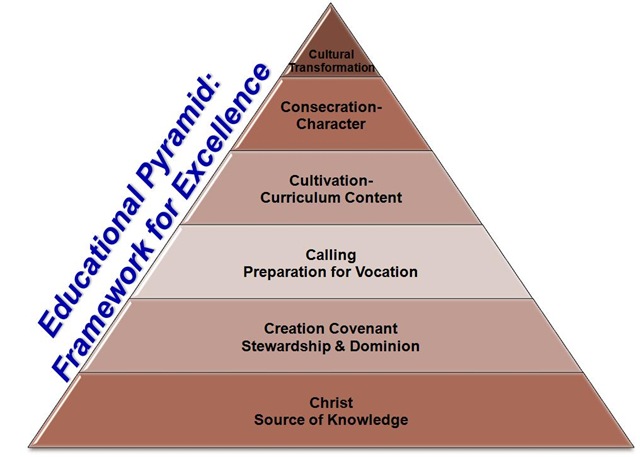
Education Pyramid

Below, for lack of a more creative title, is what I call the "Educational Pyramid" for Christian schooling.  The limitations of a blog article do not permit a comprehensive treatment of each component of the pyramid so a concise summary will have to suffice.

Each block of the Educational Pyramid builds upon the other. Beginning with the foundational understanding that Christ is the source and object of knowledge, the biblical doctrine of mankind's general call to exercise dominion and stewardship over creation is realized through each individual's vocational calling.  (for more information on this subject and the Creation Covenant, click here and see below.1)

Discovering and preparing for one's calling requires the development of a comprehensive course of instruction and co-curricular and extra-curricular programs.  Fulfilling one's calling for God's glory and in fulfillment of the Creation Covenant requires that one's time, talent, and treasure, realized through and arising from one's calling, be consecrated to God and to loving one's neighbor. 

Consecrating one's time, talent, and treasure through the dedication of one's vocation to God's glory and in loving one's neighbor inevitability leads to cultural transformation as Christians function as salt and light in this world.

More specifically, each block of the Educational Pyramid provides a rich framework for an expansive understanding of Christian education and for defining more comprehensively what we mean when we say we are striving to cultivate fruit, not merely create a product.

Christocentric Foundation

Christ is the ultimate source and object of all knowledge.  There is no knowledge, no truth, no harmony, no beauty, no freedom--nothing apart from Christ.  He is quite literally the Alpha and the Omega of existence and therefore of knowledge. 

For from him and through him and to him are all things. To him be glory forever. Amen. (Rom 11:36, ESV)

He has delivered us from the domain of darkness and transferred us to the kingdom of his beloved Son, in whom we have redemption, the forgiveness of sins. He is the image of the invisible God, the firstborn of all creation. For by him all things were created, in heaven and on earth, visible and invisible, whether thrones or dominions or rulers or authorities--all things were created through him and for him. And he is before all things, and in him all things hold together. And he is the head of the body, the church. He is the beginning, the firstborn from the dead, that in everything he might be preeminent. (Col 1:13-18, ESV)

Covenantal Mandate—General Call to Dominion and Stewardship (Gen. 1:27-30, 2:15)

Man has been called to the twin duties of exercising dominion and stewardship over creation. This is the raison d'être of his existence—to glorify God by engaging in creative and redemptive acts of dominion and stewardship over creation under the Lordship of Christ. To subdue and rule implies the sovereign exercise of control—the subjugation of creation to man. Cultivation is a stewardship activity—the process of preserving, nurturing, and improving creation for the purpose of increasing its beauty and benefit to man.

To aid him in this task, man invents tools--some simple like a shovel, some complex like a computer.  Some are cognitive like literature or mathematics.  Some are artistic like sculpture, music, or architecture. 

If the exercise of dominion and stewardship over creation for God's glory is the raison d'êtrefor our existence, then preparing students to use the tools required for doing so must be an important component of the Christian school’s curriculum. Students who graduate from a Christian school lacking fundamental skills and understanding in theology, science and technology, in the humanities, or in the arts will be handicapped in their efforts to glorify God through the redemptive exercise of dominion and stewardship.

Calling—Preparing for Vocation (Exod. 28:3, 31:6)

image

image

The general call (Creation Covenant) is personalized by God’s calling and gifting of individuals for specific vocations.  Our ultimate goal is not to prepare students to be "successful" as defined by Western culture, it is to assist our students in discovering God's gifting and calling in their lives even if  fulfilling that calling means they will make less money and not climb the ladder of "success". For a summary of the definition of vocation as I am using it, click here or see below1).

Cultivation--Curriculum Content

The doctrine of calling provides the theological and practical basis for providing a rich curriculum that encourages and stimulates the cultivation of the varied interests and aptitudes of our students.  This is typically accomplished by offering standard and advanced courses and electives in the sciences, the arts, and the humanities.  Our curriculum must be deep and broad enough to help students discover their interests and gifts (which are usually indicators of calling) and to prepare them to pursue their callings through higher education and work.

Consecration

Our prayer and hope is that our students will consecrate their gifts, knowledge, and skills in service to God and in loving their neighbor.   Paul reminds us that, “whatever we do, whether we eat or drink, we are to do it to the glory of God.”  For most of our students, this is an abstract concept.

Using Our Gifts for God’s Glory: Making the Abstract Concrete

image

To make this concept more concrete for 21st century students and to help them grasp what it means to consecrate themselves, their gifts, and their vocations to God, consider the following questions for class research, discussion, and debate: 

  • How do we use computers and other technology for the glory of God?

  • How does the Christian’s use of such technology differ from the non-Christian’s, or does it?

Similar questions can be asked about most any subject from history to physics.  By answering such questions our students will gain a more concrete and practical understanding of what it means to consecrate one’s work and life to the glory of God.

Using Our Gifts  for Loving our Neighbors

image

Continuing with the technology illustration, consider that computers are great tools for problem solving, communication, modeling, research, and information storage and retrieval. As such, they can be used to aid man’s efforts to fight disease, speed communication, improve engineering designs and safety, make space exploration feasible, improve efficiency in the generation of power, and a whole host of activities too numerous to list here. All of these activities are redemptive in nature, i.e., they contribute to the alleviation of the consequences of the curse and promote the welfare of our community and world. Used in this way, computers become instruments of love.

Again, this same approach can and should be used for every subject we teach.  For example, how can an understanding of history be used to love our neighbors?  How can becoming proficient with a musical instrument be used to love our neighbors?

A Powerful, Living Example

image

One of my favorite quotes comes from Dr. Francis Collins, a committed believer and the father of the Humane Genome Projectand as such one of the world's leading scientists.  Here is the statement he made standing beside President Bill Clinton when the announcement was made that the Humane Genome had been mapped.

image

"The human genome consists of all the DNA of our species, the hereditary code of life. This newly revealed text was 3 billion letters long, and written in a strange and cryptographic four-letter code. Such is the amazing complexity of the information carried within each cell of the human body, that a live reading of that code at a rate of one letter per second would take thirty-one years, even if reading continued day and night. Printing these letters out in regular font size on normal bond paper and binding them all together would result in a tower the height of the Washington Monument."

For the first time on a warm summer day six months into the new millennium, this amazing script, carrying within it all of the instructions for  building a human being, was available to the world …

Without a doubt, this is the most important, most wondrous map ever produced by humankind…we are learning the language in which God created life. We are gaining ever more awe for the complexity, the beauty, and the wonder of God’s most divine and sacred gift …

It’s a happy day for the world. It is humbling for me, and awe-inspiring, to realize that we have caught the first glimpse of our own instruction book (Ps. 139:16?), previously known only to God” (Dr. Francis Collins, A Scientist Presents Evidence for Belief: The Language of God, (Free Press, New York), 2006, pp. 2-3

Is this not how we want our students to fulfill their callings for God's glory and in loving their neighbors?  Does this not represent produce (fruit) and not merely a product?  Is this not for what we strive so diligently?

Cultural Transformation

Just as Francis Collins is doing, our schools should be designed to prepare our students to make positive contributions to their community and culture through personal witnessing and discipleship, scientific and economic progress, the acquisition, and dissemination of knowledge, and the amelioration of human suffering.  As Christian educators we have the opportunity to teach our students to use their learning for the glory of God and the good of our neighbors, not merely as Francis Schaeffer once put it, "for their personal peace and affluence." 

This is why Christian schools are so important--and why we must  bear fruit and not merely produce a product.

Education in general and Christian education in particular can exert a powerful influence on our students and in turn, on the quality of our national life. To be sure, there are other powerful forces shaping our students and culture. The media, technology, and politics, to name a few, but it is the quality of the education received by those who will start families, fill pulpits, develop our technology, create our entertainment, and pass our laws that will shape the character and quality of each individual and in turn the quality of our national life.

Waterdrop

Consequently, few callings allow one to contribute more directly to the shaping of lives and to the welfare of a nation than Christian education. Like raindrops falling into a pond, Christian educators shape lives and “drop” them into communities. Each life creates ripples—some small, some large—that radiate into the community affecting it for good or bad. Like a constant rain, the drops fall year after year all contributing individually and collectively to the national pool of talent and character that ultimately shapes our nation’s character and determines our national destiny.

So How Do We Ensure That We are Cultivating Produce, Not Making a Product?

image

So, with that as background, how do we ensure that we are cultivating fruit and not producing a product?  This may sound simplistic but Jesus provides the answer:

I am the true vine, and my Father is the vinedresser. Every branch of mine that does not bear fruit he takes away, and every branch that does bear fruit he prunes, that it may bear more fruit. Already you are clean because of the word that I have spoken to you. Abide in me, and I in you.  As the branch cannot bear fruit by itself, unless it abides in the vine, neither can you, unless you abide in me. I am the vine; you are the branches. Whoever abides in me and I in him, he it is that bears much fruit, for apart from me you can do nothing. (Joh 15:1-5, ESV)

Without attempting to exegete this passage, let me simply suggest that to abide in Christ so that we may bear much fruit means at least the following:

Prayerfulness

image

I find that I must guard myself against living like a "practical  atheist."  That is, if I am not diligent about prayer I can find myself working harder than I prayIf I do I may be productive but I will not bear fruit! 

Take a moment to read the following wonderful statement on reliance upon God.  As you read through this substitute preacher/preaching for teacher (administrator)/teaching/administrating. (You can download this in PDF format by clicking here or read it online at Christian Classics Ethereal Library.)

The Letter Killeth

During this affliction I was brought to examine my life in relation to eternity closer than I had done when in the enjoyment of health. In this examination relative to the discharge of my duties toward my fellow creatures as a man, a Christian minister, and an officer of the Church, I stood approved by my own conscience; but in relation to my Redeemer and Saviour the result was different. My returns of gratitude and loving obedience bear no proportion to my obligations for redeeming, preserving, and supporting me through the vicissitudes of life from infancy to old age. The coldness of my love to Him who first loved me and has done so much for me overwhelmed and confused me; and to complete my unworthy character, I had not only neglected to improve the grace given to the extent of my duty and privilege, but for want of improvement had, while abounding in perplexing care and labor, declined from first zeal and love. I was confounded, humbled myself, implored mercy, and renewed my covenant to strive and devote myself unreservedly to the Lord.—Bishop McKendree

THE preaching that kills may be, and often is, orthodox—dogmatically, inviolably orthodox. We love orthodoxy. It is good. It is the best. It is the clean, clear-cut teaching of God’s Word, the trophies won by truth in its conflict with error, the levees which faith has raised against the desolating floods of honest or reckless misbelief or unbelief; but orthodoxy, clear and hard as crystal, suspicious and militant, may be but the letter well-shaped, well-named, and well-learned, the letter which kills. Nothing is so dead as a dead orthodoxy, too dead to speculate, too dead to think, to study, or to pray.

The preaching that kills may have insight and grasp of principles, may be scholarly and critical in taste, may have every minutia of the derivation and grammar of the letter, may be able to trim the letter into its perfect pattern, and illume it as Plato and Cicero may be illumined, may study it as a lawyer studies his text-books to form his brief or to defend his case, and yet be like a frost, a killing frost. Letter-preaching may be eloquent, enameled with poetry and rhetoric, sprinkled with prayer spiced with sensation, illumined by genius and yet these be but the massive or chaste, costly mountings, the rare and beautiful flowers which coffin the corpse. The preaching which kills may be without scholarship, unmarked by any freshness of thought or feeling, clothed in tasteless generalities or vapid specialties, with style irregular, slovenly, savoring neither of closet nor of study, graced neither by thought, expression, or prayer. Under such preaching how wide and utter the desolation! how profound the spiritual death!

This letter-preaching deals with the surface and shadow of things, and not the things themselves. It does not penetrate the inner part. It has no deep insight into, no strong grasp of, the hidden life of God’s Word. It is true to the outside, but the outside is the hull which must be broken and penetrated for the kernel. The letter may be dressed so as to attract and be fashionable, but the attraction is not toward God nor is the fashion for heaven. The failure is in the preacher. God has not made him. He has never been in the hands of God like clay in the hands of the potter. He has been busy about the sermon, its thought and finish, its drawing and impressive forces; but the deep things of God have never been sought, studied, fathomed, experienced by him. He has never stood before “the throne high and lifted up,” never heard the seraphim song, never seen the vision nor felt the rush of that awful holiness, and cried out in utter abandon and despair under the sense of weakness and guilt, and had his life renewed, his heart touched, purged, inflamed by the live coal from God’s altar. His ministry may draw people to him, to the Church, to the form and ceremony; but no true drawings to God, no sweet, holy, divine communion induced. The Church has been frescoed but not edified, pleased but not sanctified. Life is suppressed; a chill is on the summer air; the soil is baked. The city of our God becomes the city of the dead; the Church a graveyard, not an embattled army. Praise and prayer are stifled; worship is dead. The preacher and the preaching have helped sin, not holiness; peopled hell, not heaven.

Preaching which kills is prayerless preaching. Without prayer the preacher creates death, and not life. The preacher who is feeble in prayer is feeble in life-giving forces. The preacher who has retired prayer as a conspicuous and largely prevailing element in his own character has shorn his preaching of its distinctive life-giving power. Professional praying there is and will be, but professional praying helps the preaching to its deadly work. Professional praying chills and kills both preaching and praying. Much of the lax devotion and lazy, irreverent attitudes in congregational praying are attributable to professional praying in the pulpit. Long, discursive, dry, and inane are the prayers in many pulpits. Without unction or heart, they fall like a killing frost on all the graces of worship. Death-dealing prayers they are. Every vestige of devotion has perished under their breath. The deader they are the longer they grow. A plea for short praying, live praying, real heart praying, praying by the Holy Spirit—direct, specific, ardent, simple, unctuous in the pulpit—is in order. A school to teach preachers how to pray, as God counts praying, would be more beneficial to true piety, true worship, and true preaching than all theological schools.

Stop! Pause! Consider! Where are we? What are we doing? Preaching to kill? Praying to kill? Praying to God! the great God, the Maker of all worlds, the Judge of all men! What reverence! what simplicity! what sincerity! what truth in the inward parts is demanded! How real we must be! How hearty! Prayer to God the noblest exercise, the loftiest effort of man, the most real thing! Shall we not discard forever accursed preaching that kills and prayer that kills, and do the real thing, the mightiest thing—prayerful praying, life-creating preaching, bring the mightiest force to bear on heaven and earth and draw on God’s exhaustless and open treasure for the need and beggary of man?

A Few Practical Practices

I have a very long way to go in improving my prayer life but by God's grace I have made a habit, not a perfect one but a consistent one, of doing the following, which I offer to you with the hope that these practical suggestions may encourage you in your prayerfulness so that you and I might bear much fruit.

  • Start each day with prayer.  I pray that God will "bless the work of my hands each day."  I take this prayer, believe it or not, from a statement by Satan concerning Job "Have you not put a hedge around him and his house and all that he has, on every side? You have blessed the work of his hands, and his possessions have increased in the land." (Job 1:10, ESV)  My interest in not possessions but God' blessing on my labor. I do not want to labor in vain.

  • Pray at the beginning of each meeting and prior to small and large decisions alike.  By prayer I do NOT mean a formalistic, ritualistic, obligatory prayer said before the start of meetings because this is what is expected.  I do not mean a mere habit.  I mean sincere short prayers that recognize the need for divine wisdom, God's kind providence, and the truth that  "Unless the LORD builds the house, those who build it labor in vain. Unless the LORD watches over the city, the watchman stays awake in vain. (Psa 127:1, ESV)

  • I often receive prayer requests by email.  In order to be faithful to pray, as soon as I read the email I stop to pray for the request.  If I do not pray then I am likely to forget.  Likewise, if someone asks me to pray for them at school or in church, I try to immediately say a silent prayer so that I keep my word that "I will pray for him or her."

  • By God's grace I try to make a habit of continuous, silent, short prayers throughout the day as issues arise, needs become known, opportunities present themselves and decisions have to be made--even in how best to respond to an email.  I sometimes pray before responding to emails in which I am asked for a decision or when frustration is being expressed, "Lord, help me to respond with grace, truth, and in wisdom."  Paul instructs us that we are to "Rejoice always, pray without ceasing, give thanks in all circumstances; for this is the will of God in Christ Jesus for you. Do not quench the Spirit."  (1Th 5:16-19, ESV)

The Study of God's Word

image

It is disingenuous and self-deluding to expect God to grant wisdom if we are not willing to gain the wisdom and understanding that He has already given to us in His Word.  To neglect God's word is to neglect God's primary instrument for our sanctification and the source of divine wisdom and understanding.  Move beyond the five-minute devotional--read and study God's word so that you nourish your own soul and have something to give to others.

Your commandment makes me wiser than my enemies, for it is ever with me. I have more understanding than all my teachers, for your testimonies are my meditation. I understand more than the aged, for I keep your precepts. I hold back my feet from every evil way, in order to keep your word. I do not turn aside from your rules, for you have taught me. How sweet are your words to my taste, sweeter than honey to my mouth! Through your precepts I get understanding; therefore I hate every false way. Your word is a lamp to my feet and a light to my path.  (Psa 119:98-105, ESV)

They are not of the world, just as I am not of the world. Sanctify them in the truth; your word is truth. (Joh 17:16-17, ESV)

Do not be conformed to this world, but be transformed by the renewal of your mind, that by testing you may discern what is the will of God, what is good and acceptable and perfect. (Rom 12:2, ESV)

I do not cease to give thanks for you, remembering you in my prayers, that the God of our Lord Jesus Christ, the Father of glory, may give you a spirit of wisdom and of revelation in the knowledge of him, ... (Eph 1:16-17, ESV)

The Worship of God and the Fellowship of the Saints

image

One cannot grow in wisdom, cannot abide in Christ, and cannot bear fruit apart from the Worship of God and the fellowship of His people.  Just as an ember will grow cold when removed from the flame, so too our souls will grow cold if not nourished through worship and fellowship.

But the hour is coming, and is now here, when the true worshipers will worship the Father in spirit and truth, for the Father is seeking such people to worship him. God is spirit, and those who worship him must worship in spirit and truth." (Joh 4:23-24, ESV)

Not neglecting to meet together, as is the habit of some, but encouraging one another, and all the more as you see the Day drawing near. (Heb 10:25, ESV)

How Are You Doing?

If you are like me you desire to cultivate fruit in the lives of your students, your staff, and your parents.  We do not want to reach the end of our work and our lives and look back and simply see a "product." 

Anyone can create a product.  Look around you--there are many unbelievers who are doing great things-building great products and companies, establishing great schools, making great scientific breakthroughs, exploring space, and curing disease.

The difference is that you and I are called to bear fruit, which transcends product making.  Products of any sort will end with this present world.  Fruit will abide forever.

  • How are you doing in abiding in Christ? 

  • How is your prayer life?

  • Are you studying God's word and not merely having a five-minute devotional?

  • Are you consistent in worship and when you are in church, are you worshipping your Creator and Redeemer or are you attending church?

Don't waste your life building and running a school or teaching a class.  Cultivate an orchard.

Without Christ we cannot bear spiritual fruit.  "As the branch cannot bear fruit by itself, unless it abides in the vine, neither can you, unless you abide in me."

I planted, Apollos watered, but God gave the growth. So neither he who plants nor he who waters is anything, but only God who gives the growth. He who plants and he who waters are one, and each will receive his wages according to his labor. For we are God's fellow workers.

You are God's field, God's building. According to the grace of God given to me, like a skilled master builder I laid a foundation, and someone else is building upon it. Let each one take care how he builds upon it. For no one can lay a foundation other than that which is laid, which is Jesus Christ.

Now if anyone builds on the foundation with gold, silver, precious stones, wood, hay, straw-- each one's work will become manifest, for the Day will disclose it, because it will be revealed by fire, and the fire will test what sort of work each one has done. If the work that anyone has built on the foundation survives, he will receive a reward. If anyone's work is burned up, he will suffer loss, though he himself will be saved, but only as through fire. (1Co 3:6-15, ESV)

______________________________________________________

image

1Vocation Defined, from Wikipedia

Definition

The word "vocation" comes from the Latinvocare, meaning "to call"; however, its usage before the sixteenth century, particularly in the Vulgate, refers to the calling of all humankind to salvation, with its more modern usage of a life-task first employed by Martin Luther.

Concept

The idea of vocation is central to the Christian belief that God has created each person with gifts and talents oriented toward specific purposes and a way of life. Particularly in the Orthodox and Catholic Churches, this idea of vocation is especially associated with a divine call to service to the Church and humanity through particular vocational life commitments such as marriage to a particular person, consecration as a religious, ordination to priestly ministry in the Church and even a holy life as a single person. In the broader sense, Christian vocation includes the use of ones gifts in their profession, family life, church and civic commitments for the sake of the greater common good.

In Religious History

The idea of a vocation or "calling" has been pivotal within Protestantism. Martin Luther taught that each individual was expected to fulfill his God-appointed task in everyday life. Although the Lutheran concept of the calling emphasized vocation, there was no particular emphasis on labor beyond what was required for one's daily bread. Calvinism transformed the idea of the calling by emphasizing relentless, disciplined labor. In the Institutes of the Christian Religion (1536), Calvin defined the role of "The Christian in his vocation." He noted that God has prescribed appointed duties to men and styled such spheres of life vocations or callings. Calvinists distinguished two callings: a general calling to serve God and a particular calling to engage in some employment by which one's usefulness is determined.

The Puritan minister Cotton Mather, in A Christian at his Calling (1701), described the obligations of the personal calling as, "some special business, and some settled business, wherein a Christian should for the most part spend the most of his time; so he may glorify God by doing good for himself." Mather admonished that it wasn't lawful ordinarily to live without some calling, "for men will fall into "horrible snares and infinite sins." This idea has endured throughout the history of Protestantism. Three centuries after John Calvin's death, Thomas Carlyle (1843) would proclaim, "The latest Gospel in this world is, 'know thy work and do it.'"

Technorati Tags:

Abiding

,

Abiding in Christ

,

Fruit Bearing

,

Product

,

Produce

,

Leadership

,

Prayer

,

prayerfulness

,

Bible

,

God's Word

,

Devotion

,

Worship

,

Creation Mandate

,

Creation Covenant

,

Vocation

,

Calling

,

Vocational calling

,

leading

,

Consecration

,

culture

Do Our Schools Need to Become Less Uptight?

WARNING: this article is provocative.  I am posting this article not because I agree with everything asserted (I don’t) but because it provokes thought and has relevance for how we are leading our schools during a time when the landscape of education is changing-perhaps dramatically.  At the end of this article I pose some questions for your consideration.
WSJ: September 29, 2009

By Gary Hamel

In most  organizations, change comes in only two flavors:  trivial and traumatic.  Review the history of the average organization and you’ll discover long periods of incremental fiddling  punctuated by occasional bouts of frantic, crisis-driven change.  The dynamic is not unlike that of  arteriosclerosis:  after years of  relative inactivity, the slow accretion of arterial plaque is suddenly  revealed by the business equivalent of a myocardial infarction. The only  option at that juncture is a quadruple bypass:  excise the leadership team, slash head  count, dump “non-core” assets and overhaul the balance sheet.

Why does  change have to happen this way?   Why does a company have to frustrate its shareholders, infuriate its  customers and squander much of its legacy before it can reinvent itself?   It’s easy to blame leaders  who’ve fallen prey to denial and nostalgia, but the problem goes deeper than  that.  Organizations by their very  nature are inertial.  Like a  fast-spinning gyroscope that can’t be easily unbalanced, successful  organizations spin around the axis of unshakeable beliefs and well-rehearsed  routines—and it typically takes a dramatic outside force to destabilize the  self-reinforcing system of policies and practices.

Let me  return, for a moment, to the topic of my last post, organized religion.   What are some of the inertial forces that have prevented churches from  reinventing themselves in ways that might make them more relevant to a  post-modern world?  A partial list  would include:

–Long-serving denominational leaders  who have little experience with non-traditional models of worship and  outreach.

–A matrix of top-down policies that  limits the scope for local experimentation.

–Training programs (seminaries) that  perpetuate a traditional view of religious observance and ministerial  roles.

–Promotion criteria for church pastors  that reward conformance to traditional practices.

–And a straightjacket of implicit  beliefs around how you “do church.”   For example:

  • Church  happens in church.
  • Preaching is the most effective way of imparting religious  wisdom.
  • Pastors lead in church while parishioners remain (mostly)  passive.
  • The  church service follows a strict template:  greet, sing, read, pray, preach,  bless, dismiss (repeat weekly).
  • Believers, rather than curious skeptics, are the church’s primary  constituency.
  • Going  to church is the primary manifestation of a spiritual life.
  • Church  is a lecture not a discussion.

If organized  religion has become less relevant, it’s not because churches have held fast to  their creedal beliefs—it’s because they’ve held fast to their conventional  structures, programs, roles and routines.  The problem with organized religion  isn’t religion, but organization.    In the first and second centuries, the Christian church was communal,  organic and unstructured—a lot like the Web is today.  It commanded little power (it couldn’t  raise an army or depose a monarch), but had enormous influence.  (The Christian church grew from a handful of believers in AD 40 to 31 million adherents by AD 350, roughly half the population of the Roman empire. ) Today many mainline denominations  are institutionally powerful, but spiritually moribund—at least in the  U.S.

What’s true  for churches is true for other institutions:  the older and more organized they get,  the less adaptable they become.   That’s why the most resilient things in our world—biological life,  stock markets, the Internet—are loosely organized. 

To thrive in  turbulent times, organizations must become a bit more disorganized—less buttoned down, less  uptight, less compulsive, less anal.

As a start,  you’ll need to become more alert to the things that reflexively favor the  status quo in your own organization.   While no one’s going to stand up  and say, “I’m on the side of inertia,” they may nevertheless defend management  processes that reflexively favor the status quo.

All of the  things that allow little organizations to grow into big ones—scale, learning  effects, and accumulated expertise—are products of repetition.  When the environment changes, however,  the returns to repetition start to diminish.  Problem is, old habits die hard,  particularly when they’ve been hardwired into a company’s management  processes. 

–Hiring criteria that over-value  “expertise” and under-value diverse life experiences.

–A planning process that  institutionalizes orthodox thinking by using industry standard definitions of  customer segments and product categories

–Decision-making bodies that are  comprised mostly of long-serving industry veterans who tend to discount new  views.

–Highly conservative budgeting criteria  that starve unconventional projects of resources by demanding near certain  returns, even when the funds involved are modest.

–A single approval track for new  projects, where every new idea has to go up the chain of command.

–Large, monolithic organizational units built around a single, dominant, business model.

–A highly optimized but inflexible IT  infrastructure.

Large  organizations don’t worship shareholders or customers, they worship the  past.  If it were otherwise, it  wouldn’t take a crisis to set a company on a new path.

The most  extreme version of organizational inertia comes when those within a company  are no longer able to distinguish between form and function—when their  instinctual loyalty is to the “how” rather than the “what.”

If one  didn’t know better, it would be easy to believe that a lot of newspaper  publishers have been more committed to producing broadsheets than to  delivering the news in a convenient form, or making it easy for advertisers to  connect with customers.

Until  recently, music companies seem to have been more committed to stamping out  plastic discs than to giving their customers easy access to their favorite  tunes.

Many drug  companies seem a lot more interested in peddling temporary palliatives for  chronic conditions than in eradicating disease.

For years,  Kodak seemed more focused on making film than on leveraging new digital  technologies that would make photography simpler and cheaper.

Alzheimer’s,  arteriosclerosis and arthritis—these seem to be the inevitable byproducts of  old age.  But must organizational  maturity bring a similar set of maladies?  I don’t think so.  Despite all the evidence to the  contrary, I think a company can truly be “Forever 21.”

Questions:

  • Is your school too “button down”, to wedded to tradition?
  • Does the administration, faculty, board members, or parents confuse form with function, preference with principle, or truth with tradition?
  • Has inertia set in at your school?  If so, how can you overcome it?
  • How would you apply the arguments / principles in the above article to addressing 21st century skills, distance learning, technology integration, recent discoveries in cognitive science, and other innovative developments in education to your school?

Where is Your School in the Organizational Life Cycle? Why Does it Matter?

By Dr. Barrett Mosbacker

The School Life Cycle

Dr. Barrett Mosbacker, PublisherSchools are organic and dynamic—they are not static. Like the human body, schools go through a lifecycle of change or stages of development. Although most schools go through a predictable cycle or series of stages, the cycle is not inevitable.

Below are typical organizational stages, which I have summarized and adapted from research on the topic.  I have not developed the last stage (renewing).

Why is this important?  Because understanding where your school is in the typical organizational lifecycle will help you understand the issues you are facing and how to adapt your leadership.

Birth/Infant Stage

  • Characterized by a strong entrepreneurial visionary leader or small group

  • Requires a strong visionary leader who can maintain a high degree of commitment

  • The leader, or small founding group, must maintain control and have significant input into the infant school. It is normal at this stage that the leader be more hands-on and in control with little or no delegation.

  • Visionary and pioneering staff

  • Staff characterized by belief, hard work, high morale

  • Tendency to latch on to a particular school of thought or philosophy of education, instruction, and/or curriculum

  • School structure is minimal and informal

  • Systems are developing

  • Minimal policies, ill-defined roles (or well written but poorly followed policies)

  • Group/committee/board micro-management of administrative functions, usually out of necessity in this infant stage

  • Change can be quick and relatively easy

  • Limited resources

  • Potential for quick growth

  • Establishing a reputation and market presence

Adolescent Growth Stage

  • Beliefs, values, goals, structure, and actions become more formalized

  • With growth, staff are added

  • Delegation is increasing

  • The challenges of growth are being confronted—facilities, resources, programs, personnel, school structure, board/administrator roles and relationships

  • The original “feel” of the small infant school is being replaced with the feel and characteristics of a larger maturing school. This can result in a change in clientele, complaints that “we have abandoned our mission,” that “we no longer feel….,” “that we are becoming……”

  • As structures begin to mature, the board grapples with its role relative to a changing school, added staff, and maturing leadership and administration

  • Faces the danger of growing too fast with growth and vision outpacing current or projected resources (usually financial and physical)—Example: adding a high school too quickly

  • Conflict and inconsistency can become more evident (there are more stakeholders; the original founders/entrepreneurs find their original vision and values being challenged and stretched. Conflicts arise from confusion regarding roles and responsibilities. Leadership must learn to share control and to delegate responsibility with concomitant authority.

  • Problems can arise when conflict erodes or ends in a critical loss of mutual respect and trust among those charged with formal and informal control of the decision-making process. This can lead to concentrating on technicalities, legal and procedural issues rather than on strategic development.

Maturing Stage

  • This stage is characterized by high visibility for the school. A strong understanding of its common purpose and mission continue to energize and drive school leadership. Leadership knows what it is doing, where it is going and how to get there.

  • School leadership makes plans and then follows up on those plans

  • Structures and policies have matured but are still developing and growing

  • Bureaucracy and systems are increasing (note: not all bureaucracy is bad—there is good and bad bureaucracy)

  • Leaders must continue to maintain the delicate balance between creating and managing. It is easy during this stage to get caught into doing what is customary, but forgetting the reason for doing it. This may lead to rigid clinging to something no longer suitable. A method may become more important than the mission.

  • Increased specialization among staff and with programs

  • Increased emphasis on high quality rather than “start-up” training

  • Standards are raised for teachers and other staff

  • Overall school quality is growing and there is clear evidence of excellence

  • The school is confident and secure

  • Morale is high

Aging Stage

  • The aging stage can be characterized by a decline in stakeholders’  understanding of and commitment to the school’s purpose.  New parents and staff may not have a sense of ownership of the school’s purpose. They assume others to be responsible, so there is decline in involvement.

  • As the aging stage progresses, the school moves from nostalgia to questioning. In the nostalgia phase the school community reflects on and longs for a comfortable past. You know the school has reached this phase when you hear: "I remember when." "We can't do that." "We've tried that and it didn't work."

In the questioning phase, school stakeholders initially question within themselves, concerning leadership and school problems. Then the questioning becomes more intense as groups begin to discuss problems. At this point, either the organization redefines itself and is revitalized by its dream, or decline sets in.

  • Expectations for growth are lowered. There is little interest in development of new  new methods. The school starts to focus on past achievements instead of future visions. Emphasis is on how things are done rather than what and why they are done.

  • Procedures and policies are kept in place even though they are no longer relevant.

  • Changes are viewed with suspicion and met with increasing resistance. Fewer changes are proposed, and no change that radically departs from status quo or disrupts the peace is considered.

The Dying Stage

  • This fifth stage is characterized by the total loss of purpose and hope. The mission is not understood. As questioning and polarization increase, the emphasis shifts to who caused the problem, rather than what to do about it.

  • Conflict, back stabbing, and infighting abound.

  • Focus shifts to the internal turf wars while newcomer, especially if they have a vision to try new things, to challenge the conventional wisdom, are seen as a nuisance, threat, or are ignored.

  • Due to the lack of interest and participation, programs are eliminated. It is difficult to find volunteers with only 10 percent of stakeholders doing 90 percent of the work.

  • Programs and structures are deleted for lack of funds and involvement. The primary goal is preservation and survival.

  • Although there are many traditions, practices and procedures in place, they serve little to reach and develop people and to fulfill the mission of the school.

  • Changes are nearly impossible. Excuses and rationalizations are made for why something can't be done.

  • While dying is frightening, changing is more so. Any suggested change tends to fuel the fire of polarization.

  • There is confusion between what constitutes an enviable principle and a personal preference.

  • Morale declines to a deep low. Few have any sense of hope and optimism. No one knows what to do about the problem, but everyone thinks that it is the other person's fault.

  • Leadership is extremely frustrated to the point of despair by not knowing how to stop decline and the infighting in this stage. Frequently the leader is perceived as the problem which may or may not be the truth. Leadership takes many hard hits in the dying stage, particularly if the primary influencers do not support the leader. If the leader is visionary, creative and aggressive, he or she will likely not last long.

  • If the leader is passive and maintenance oriented, he or she may make the patient comfortable while it continues to die.

Where is your school in the organizational lifecycle? Are you adjusting your leadership to ensure that your school navigates the lifecycle successfully so that it continues to have a lasting impact?

Educational Leadership, Relationships, and the Eternal Value of Christian Schooling

The following is an excellent book review on imageSchools as Communities: Educational Leadership, Relationships, and the Eternal Value of Christian Schooling.”  Click on the image to see the book on Amazon.

This is a book that you should seriously consider reading.  (Disclaimer: I am a contributor author, Barrett Mosbacker).

The review was published in The ICCTE Journal. 

Reviewed by Dr. David W. Robinson, Adjunct Professor, D.Mgt. program, George Fox University.

“Where there is no vision, the people perish…” Proverbs 29:18a (KJV)

Anyone who has engaged in the calling of Christian education knows that it can be — and usually is — one of the most exciting, delightful, fulfilling, and joyous ministries that a believer can know. Its golden days are a real “foretaste of glory divine,” its opportunities for those who truly love the possibilities of the mind and heart of Christ in the lives of our students are the very aroma of the Lord in our work. Lives are changed; parents are supportive; administrators are helpful; the board is productive. Sacrifices are engaged willingly, trials are gladly borne. We go home at the end of the day, and can hardly wait to return in the morning…

And anyone who has engaged in the calling of Christian education also knows that it can be — and usually is — one of the most daunting, exhausting, demoralizing, and frustrating ministries that same believer can know. Golden days can morph into drabness from one year to the next, or even overnight; its opportunities can suddenly vanish, with the mind and heart of Christ being trampled underfoot by institutional change, upheavals in leadership, financial uncertainty, or divisions and offenses within the school community…and suddenly, the aroma of Christ is seemingly nowhere to be found. Lives are no longer transformed; parents are arguing among themselves or sniping the administration/board; administrators run for the bomb shelter; the board seems unable to resolve the issues. Sacrifices now seem imposed, with trials producing grumbling, not grace. We go home at the end of the day, and are tempted to circulate our résumés…

Strange to say, this roller coaster ride is well known to all too many Christian school teachers, administrators, parents, students, and board members. The shift can happen over time, or even overnight. The results are commonly tragic (and predictable) if resolution and healing are not accomplished in time: high rates of teacher turnover; a loss of students and their families; the demoralization of the remaining students, faculty and staff; friction between boards and administrative leadership that leads to recriminations, or even terminations; and so on.

And so the question is: How can Christian schools resolve the chasm between the experiences of the first and second paragraphs above, prevent the sort of divisions and offenses within the educational body that the scriptures warn about, embody healthy and continuous educational improvement, and become the dwelling places of shalom and agapé that will transform the lives of all who are touched by that community?

This is a daunting question, cutting to the heart of what every generation of Christian educators and academic leaders must face, ready or not. In the case of Schools as Communities, it is addressed by James L. Drexler and the excellent group of nearly two dozen scholar-practitioners that he assembled for this volume. As the title states, the main theme of the work is that of community. All eighteen of the essays are represent separate explorations of particular subsets of the main challenge of fostering koinonia within the imperative for continuous school improvement in the service of Christ and our students. This is a worthy but highly ambitious task; frankly, as I read it, I wondered how well Drexler and his collaborators would carry it off.

Drexler and company proceeded by dividing the task into four main sections:

  • “Building Community: Foundational Principles”
  • “Building Community Among Faculty and Staff”
  • “Building Community for Students”; and
  • “Building Community with Others.”

Drexler doesn’t leave community without conceptual support, however; he explicitly adds supportive themes of grace, scriptural priority (“the weightier issues of the Law,” prophetically stated by the Lord in Matthew 23:23), and cultural relevance/engagement to the content of the book (xiv-xviii). Nor is the work merely theoretical; each chapter concludes with a call to praxis entitled “Now What? Application to Practice”. Its purpose is to help the reader understand how the contents of each chapter might be used in their school setting and their own ministry of leadership. Finally, each chapter has a references section that provides useful sources and online links for the reader to extend his or her ongoing exploration of educational leadership and community.

In Part One, foundational principles are explored in essays examining the primacy of grace in Christian school settings (Bruce Hekman); mercy, justice and social change as imperatives of transformational Christian education (Vernard T. Gant); the life of the leader and his or her grace-filled life as an embodiment of the Lord’s grace (Jeff Hall); and godly risk taking on the part of the school leader (Stephen R. Kaufmann and Kevin J. Eames).

Hekman encourages the Christian school to embody true grace to its students, eschewing both “sloppy grace” and formal legalism as it becomes a real community in pursuit of a profoundly Christian educational mission. In Gant’s contribution, the Christian school is viewed from the vantage point of God’s call to mercy and justice. Rather than harboring bias or prejudice, for example with respect to lower SES students and their families, our schools ought to be seeking opportunities to reform all aspects of their operations — from their curriculum to their service programs to the “habits of the heart.” As we seek to serve the Lord in our schools, we should turn away from the all-too-prevalent paternalism within our educational work, from the majoring-on-minors that so easily entangles us, and strive for a deeply Christ-like way of life (cf. Galatians 3:26-28). Faithful educational leadership will seek real community with all people, and not merely those within comfortable shouting distance.

Hall’s article shifts the focus to the educational leader, to the very life and calling of the one who shepherds a school. The love of Christ must compel leaders to love those who are collaborators in their school community, so that they are effective models of His grace to those who work in that setting. The first section rounds out with Kaufmann and Eames’ very interesting chapter on educational leadership and risk taking. Christ’s call to His people often involves radical, transformational living; a Christian school that seeks to follow Him faithfully will find itself pressing against social conventions and embedded attitudes among its own constituencies. The authors argue that Christian school leaders should look for opportunities “to engage students in culturally relevant ideas and activities,” even when they involve the risk of controversy and discomfort (76).

Part Two shifts focus to the question of community building with the faculty and staff. Gordon Brown addresses the important question of leadership models and decision making. His survey covers an impressive amount of ground in short order, with discussions of models that concentrate on the leader, models that emphasize the instructional enterprise, and models that focus on community transformation. Kevin J. Eames then shifts our gaze to organizational theory, and the ironic fact that organizations do not organize themselves. Eames draws our attention to the fact that older hierarchical, top-down, and linear organizational models have been supplanted in recent decades by approaches based on systems theory. He builds a convincing case for a biblical basis for systems theory in Christian education; all that I need point out is that anyone who links Herman Dooyeweerd’s extraordinarily important framework of domains, modalities, and sphere sovereignty to organizational theory and praxis is on the trail of something big. Really big. (Yes, that is your warm invitation to further study.)

Neil Neilson then introduces us to the notion that tensions within Christian educational enterprises are common, inescapable in this age, and actually should be “welcomed as friends” (cf. James 1:2-8), since these “liberating dichotomies” actually spur our growth and development, both personally and institutionally. He lists six provocative oppositions, and makes a good case for their role in stirring up our leadership and vision in response. Jack Beckman then takes up the baton, looking at the vital issue of professional development as a means of community building within our schools. I view such work as a vital outworking of “the equipping of the saints” (Ephesians 4:11-13), one that Beckman clearly advocates for school leaders.

In Part Three, Drexler’s team moves to the central question of community formation with and for our students. Barrett Mosbacker summarizes the challenges facing our schools in a very informative chapter on strategic stewardship. I found myself agreeing strongly with his comments about the need for an understanding of the economic underpinnings of stewardship and development work in our Christian schools, an area that is regularly bedeviled with sentiment, pietism, and even presumption masquerading as “faith.” Mosbacker’s essay is a call to arms, a medicine that can bring healing in such things; our school community will be strengthened as its leadership adopts a more focused approach in its strategic financial vision. Derek J. Keenan then shifts our attention to the question of curricular leadership. His essay calls us to consider curricular formation to be a wonderful opportunity for gathering all the stakeholders in our educational community around the challenge of creating a dynamic, holistic, Christ-honoring course system for our students. Our curriculum ought to be a profound expression of our deeply-held values, our commitments to the Lord, the world, and each other; Keenan encourages us to act on these beliefs, and to make them real in our schools.

From this platform, it is a natural progression to shift from reaching inwards — building community at home — to reaching outwards. Daphne Wharton Haddad and Susan Schneider Hasseler follow Keenan’s essay by discussing the need to construct culturally inclusive communities in Christian education. For far too long, our “outreach” to our world has reflected a paternalistic “tolerance” (“I put up with you because it makes me feel good.”) rather than a truly transformational way of living. (“We are one in the Lord, and we all have things to teach and learn from each other.” Romans 1:11-12; Galatians 3:26-28; and Romans 12:2…enough said!) Haddad and Hasseler’s call is to reform all aspects of our school community, from relationships to curriculum to classroom practice, to produce a true model of the Lord’s kingdom.

In chapter twelve, Matthew Lucas gives a framework for the very important — and very misunderstood — process of assessment. Too many in Christian school leadership map “assessment” to standardized testing alone. Lucas posits that we must move to a much broader, multi-modal approach to truly assess the effectiveness of what we are doing in our schools. All of this must be done in a way that reflects a Christian worldview in all aspects; a willy-nilly adoption of the techniques of the world without deep reflection on the values of the Lord’s kingdom will actually harm our work, giving us a “form of godliness, but denying the power thereof” (2 Timothy 3:5a; KJV). James L. Drexler follows Lucas by addressing the question of discipline and community building within our Christian schools. Drexler points out the plethora of books on this topic, and then espouses a biblical approach for the development of godly discipline. A proper anthropology allows us to avoid mere sentimentality, and also to avoid a purely legalistic/punitive view of school discipline. The scriptures do provide us with guidelines for a redemptive approach to such matters — 2 Timothy 3:16-17 comes to mind immediately, as an example — and Drexler advocates such a stance. In a community that “cares enough to confront,” many discipline issues can be prevented entirely, or can be dealt with locally and privately, as the Lord instructed us in Matthew 18. For the balance of issues, the agapé community can escalate properly through a sequence of corrective steps, always seeking to give a student the opportunity to truly repent and experience restoration to the community.

Part Three concludes with David L. Roth and Jon Keith’s examination of changing the culture in Christian schools. Anyone familiar with Christian education is aware of the problem; as the traditional Spanish proverb put it quite succinctly, “Que no haya novedad.” Or in modern English, “Let no new thing arise.” (Even more loosely: “All change is bad.”) Resistance to change, regardless of how faithful or promising it is, is a fact of organizational life. Educational leaders who assume that their vision of new opportunities will automatically be accepted by their constituencies is cruising for a bruising; a reading of the life of Moses alone would cure any romanticism on this topic. Roth and Keith advance Jesus Christ as the model for generating change in our schools, and advocate that school leaders take key elements of His leadership as a template for their own practice.

Schools as Communities concludes with Part Four, a survey of our relationships with others. Whether we know it or not, the constituencies that a Christian school addresses include those who may be far outside of our immediate school setting. In chapter fifteen, Bruce Young makes the case for collaboration in Christian education. No community can exist without working together to achieve common goals and a mission shared by all. Drawing on Urie Bronfenbrenner’s ecological model, Young usefully restructures that multi-level model (once again, via Dooyeweerd’s pioneering schema) to produce a biblical framework for envisioning the larger perspectives of our work within the kingdom of God, and under his sovereign reign.

James C. Marsh then moves to the very significant question of the relationship between the educational leader and his or her board. Any leader who doesn’t realize fully the critical nature of this connection is a leader who will probably not last very long in that position. Marsh points out that statistics bear out the fact that there is trouble in paradise: according to a 2005 study, some 70% of all school leaders are fired, and do not leave voluntarily. There is no optimistic reading of this number; clearly “churn and burn” has become the model for many Christian schools. The author surveys the three main models of Christian school governance, and then outlines a number of recommendations for a redemptive, rewarding relationship between school leadership and its board. Only in this way, says Marsh, can we have any hope of reversing the current dreary attrition in Christian school administration.

Scot Headley and Stephen Cathers follow Marsh in their essay on continual school improvement. Drawing an important distinction between assessment and evaluation, Headley and Cathers seek to enhance educational community by the creation of a culture of quality, reflection, and ongoing reformation involving all members of a school. Their school evaluation cycle (Planning, Action, Assessment, and Reflection, 350) is a concise and very useful model for practicing excellence in all realms while simultaneously maintaining close relationships throughout the process. I see this as a very well-focused embodiment of the biblical principle that the apostle Paul stated when he advised Timothy, “Be diligent in these matters; give yourself wholly to them, so that everyone may see your progress. Watch your life and doctrine closely. Persevere in them, because if you do, you will save [that is, ‘benefit and bless’] both yourself and your hearers.” (I Timothy 4:15-16, NIV) In other words, our schools can only progress towards the standards of our Lord in these things if it constantly watches its life and teaching, thus blessing all the members of its community.

In the final chapter, Brian Fikkert reminds us that our schools should be places of shalom, seeking to produce students who fully and radically embody a biblical world and life view. To do this, they will need to be lovingly and wisely trained in how to engage every dimension of the world around them in the name of the Lord’s kingdom. There are significant challenges to every aspect of traditional Christian school operations here, but also prospects for very significant blessings in the lives of every member of a Christian school community as a result. James L. Drexler then concludes quite fittingly on how all these things, wisely and lovingly accomplished in our school communities, can redound to the glory of God, and the praise of Jesus Christ our Lord.

Early in this review, I mentioned the fact that I was curious to see how well Drexler and company delivered on the ambitious promise of the full title of Schools as Communities. I don’t think that anyone could be more sympathetic to their stated aim, but I also have seen enough of educational tomes to be a bit skeptical of whether or not this volume would delight more than it would disappoint. I am pleased to say that my doubts were unjustified, and that my hopes were fulfilled. Schools as Communities does a fine job of treating its subject from a number of vectors, giving its reader a well-balanced view of the challenges and possibilities for leaders in Christian school community building. Even those new to this world — for example, prospective Christian board members, or parents, or staff members — will find this book to be very useful as a guide to the issues and possible answers that they face.

Christian colleges and universities will also find it to be useful as a candidate textbook for undergraduate studies in education, and as an adjunctive textbook (at least) in graduate schools. Certainly graduate and doctoral programs will use this as a survey-level point of departure for further studies, but Schools as Communities will function quite well in that application. The resources listed are a treasure trove for the student, and will provide the researcher with a number of leads for improving their own professional library — always a good thing!

In conclusion, Schools as Communities turned out to be a genuine delight: a pleasure to read, well grounded in scriptural principle, current theory and practice, and embodying the very sort of Christian community that it advocates. What could be better? Consider this to be an enthusiastic recommendation by a person who is not usually impressed by many educational books, even those done in the name of the Lord….

When Change is Bad

I found this article articulates what many teachers feel—in public and Christian schools.  Too often, with the best of intentions, we throw a hodgepodge of ideas at our staff, what I call du jour training/idea of the year.  See my previous post: Rethinking Staff Development: “This Too Shall Pass.”

Solutions Are the Problem in Education

By Mary Kennedy

There used to be a saying that if you were not part of the solution, you were part of the problem. The implication was that we all, collectively, were creating the problem, and that the solution required all of us to change together.

But in education, solutions are a big part of our problem. School people are swamped by a deluge of solutions. They suffer from reform fatigue.

A few years ago, I visited teachers in several districts spread across the nation. I was struck by the variety of interruptions they experienced in their classrooms, and by how many of these had begun as good intentions. Here’s one example: A science teacher took part in a National Geographic Society project that gave his students a chance to collect samples from a local waterway and contribute them to a national database. Sounds like a great idea, right? His class got to participate in a national science study. But the timing of the project caused the teacher to interrupt his ongoing science unit. When the project was finished, students had forgotten where they were in their regular curriculum.

National Geographic is hardly alone in wanting to help educators. The number of associations, institutions, government agencies, and volunteers of all kind who want to solve educational problems has grown so large that teachers are now surrounded by helpful voices and besieged by ideas too numerous to attend to. Instead of strengthening teaching, this multitude of innovations and reforms distracts both teachers and students from their central tasks, making it difficult to concentrate, to stay on task, and to sustain a coherent direction.

Moreover, these improvements often contradict one another. Consider two ideas currently on the table for evaluating teaching practice. On one hand, we have lesson study, a highly structured undertaking that requires months of collective effort and careful thought. On the other, we have walk-throughs, quick and unstructured events that can be conducted by one person in under five minutes. These ideas seem to make entirely different assumptions about how we can learn about teaching, yet they are both popular right now.

There have always been zealous education reformers, of course. But the number and variety of helpful ideas is now so great that the solutions themselves have become a problem.

It is easy to brainstorm about alternatives in education, but hard to anticipate their unintended consequences. Take, for instance, pullout programs. These well-intentioned entitlement programs, introduced in the 1960s, pull students out of their regular classrooms for special instruction. The timing of the pullout has to fit the pullout teacher’s schedule, which means that the original teacher must adjust her instructional schedule to accommodate this movement. Since both teachers may be teaching similar content, they also need to coordinate their instruction, something that takes time. And that is not all: Every time a student is pulled from a regular classroom, and every time that student returns to the regular classroom, the ongoing instruction is interrupted. Students are distracted, and so is the teacher. Lesson continuity and coherence are at risk.

Pullout programs are one of many helpful ideas introduced to improve education. Every test, every assembly, and every public-address announcement is a helpful addition that ultimately disrupts instructional continuity. Every change of schedule, from hourly to block scheduling and back to hourly, requires teachers to revise their routines and strategies. Every new policy, from zero tolerance to team-teaching, pulls teachers’ attention away from their teaching and toward solving a logistical problem. Instead of thinking about how to engage students with curriculum content, they must think about how to revise their procedures, schedules, and strategies to accommodate the newest helpful idea.

Remember when we decided that teachers should have telephones in their rooms? The idea was to “professionalize” the job. Well, now that teachers have telephones, parents can call up at any time to leave messages for their children. So when students are struggling with the difference between ¼ and ½, or debating the merits of the Bill of Rights, the phone rings. And it is right there, in the middle of the classroom and in the middle of every lesson.

The problem is this: Both teaching and learning require sustained attention. Not only do students need opportunities to think, but so do their teachers. More than anything, teachers need time to compose their thoughts and make sure that, when they approach a new unit or a new lesson, they have a clear idea of what they want to accomplish.

Students are even more vulnerable to distractions. In my conversations with teachers, I have found that they care more about maintaining the momentum of the lesson than anything else. The central challenge of teaching is finding enough uninterrupted time to get students’ minds wrapped around an idea, and keeping it there until the idea makes sense to them. Disruptions don’t merely take a few moments of class time: After them, teachers often feel that they need to rewind the entire lesson and begin anew.

Yet we live in a time when reforms and fads have become so commonplace that every new board member or superintendent feels a need to make a personal mark on his or her district by introducing something new. As these policymakers come and go, teachers are buffeted by the raft of competing new ideas they leave behind. So routine turnovers in leadership reignite this continuing series of distractions, further reducing teachers’ chances of finding time for reflection and maintaining a stable environment for intellectual work.

No wonder that when the new superintendant comes to town, and the new professional-development program is brought in, teachers go into their classrooms and quietly shut their doors.

Every American teacher feels some level of reform fatigue. If you think you are part of the solution, check again. You may be part of the problem.

Mary Kennedy is a professor in the department of teacher education at Michigan State University, in East Lansing, Mich.  Vol. 28, Issue 37

How To Deal Effectively with Conflict and Difficult People

By Dr. Barrett Mosbacker

Dealing with difficult people can be very uncomfortable!  Despite 20 years of experience, my stress level still rises whenever my administrative assistance informs me that: 

Mr. and Mrs. Jones want to see you.  They are upset about .....

One would think that by now I would have learned to be more sanguine but alas, I still feel my gut tighten in anticipation of an unpleasant conversation.

Although I have not yet learned how to reach a “state of nirvana,” I have learned a few things over the years that may be helpful to you.  I offer the following tips with the prayer that you will find them helpful the next time you face that angry email, phone call, or the unscheduled “do you have a minute?”

Conflict Cannot and Should Not Be Avoided

If two godly men like Paul and Barnabas, who ministered and faced persecution together, could not avoid conflict (Acts 15:39-40) then there should be no illusions about our ability to avoid it. Conflict is inevitable.  It is also an integral part of our ministry to students, parents, and staff.

I often tease parents during our Parent Orientation sessions.  When asking for their prayers I quip:

My job is relatively easy--"I only deal with people's children, money, and religion!

Parents laugh at this statement because they quickly realize just how difficult leading a school can be. Most of them would not want the job for any amount of pay!  Upon reflection, they become a bit more empathetic when assessing the school's response to a given situation.

A Little Humor

As illustrated by my quip, humor is a natural and effective way to reduce tension, demonstrate humility, and foster empathy--provided it is used appropriately and in the right context.  Misused or inappropriate humor can do more harm than good. Well timed and thoughtful humor, on the other hand, can relax a tense situation and put it into perspective.  Consider the following non-school examples (source: How to Use Humor to Diffuse Conflict, by Carla Rieger).

Time Deadline

Our manager was pushing the IT technician to fix a huge computer breakdown in under half a day. The technician was getting frustrated at the unreasonable request, but rather than push back with resistance, he said, "Actually, I only need two hours. The other two I'll be using to cure world hunger." They both laughed and the manager mellowed out.

Smaller Budget

A client kept returning our budget proposal saying it needed to be smaller. No matter how much trimming we did, the client kept pushing for "Smaller, smaller!" I finally took the proposal to a copier and had it reduced to two inches in size. I sent it to the client and said, "This is about as small as I can make it. Tell me what you think." He called me saying it got a huge laugh in his office and that he would now accept the proposal as soon as he could find his magnifying glass.

Again, be careful.  Humor can be very effective but it can backfire if it is poorly timed or inappropriate.

To make an apt answer is a joy to a man, and a word in season, how good it is! (Pro 15:23)

To Disciple and to be Discipled

When I know that I am about to be confronted with an angry or upset parent, or when confronted unexpectedly, I remind myself that every conflict "is an opportunity to disciple or to be discipled."  The objective is not to avoid conflict, it is not to deny that there is a problem, and it is not merely to "tolerate" the other person or the meeting.  Instead, conflict is a providentially appointed opportunity to disciple and minister to others or to be discipled by others (Rom. 8:28). 

When dealing with someone who is upset, don't ask yourself "how can I avoid this situation or how can I get through it as quickly and painlessly as possible."  Instead, ask yourself this,

How can the Lord use me in this situation to minister to Mr. and Mrs. Jones and how can the Lord use upset Mr. and Mrs. Jones to instruct me or to make the school better?

You will be surprised how much easier it is to deal with difficult situations and people when you adopt this biblical attitude.  I remind myself of the following verses when facing a difficult situation:

Iron sharpens iron, and one man sharpens another. (Proverbs 27:17)

Where there is no guidance, a people falls, but in an abundance of counselors there is safety. (Proverbs 11:14)

Better is open rebuke than hidden love. Faithful are the wounds of a friend; profuse are the kisses of an enemy. (Pro 27:5-6)

The upset parent or staff member can be our instructors!  Only pride would keep us from freely acknowledging our need for correction--even if not given in an appropriate manner.

Humility

Relax!  You and I have clay feet.  We make mistakes.  We sin.  Unlike our teenage children, we don't know everything. 

We don't have to pretend otherwise to be effective leaders. In fact, acknowledging our frailties reflects genuine humility, fosters listening, reduces defensiveness, and in general reduces tension.  It also puts us in a state of mind to learn from the situation while fostering respect for those who are upset. 

Admit mistakes.  Do not be defensive.  Own the poor decisions.  Doing so models Christian character, is instructive to those who are upset, and leads to the development of stronger schools.

Pride goes before destruction, and a haughty spirit before a fall. (Pro 16:18)

Listen!!

Know this, my beloved brothers: let every person be quick to hear, slow to speak, slow to anger. (James 1:19)

This verse reminds me of Steven Covey's statement that one of the Seven Habits of Highly Successful People is that they seek first to understand and then to be understood.  In our pride or defensiveness we often seek to justify more than we seek to understand. We want to defend more than we want to learn.  This attitude is both wrong and counter-productive.

Even if the other person is out of line or just plain wrong, we can often learn something of value from the confrontation.  This requires that we talk less and listen more

Sometimes people just need to vent.  Have you ever been in a meeting where the other party keeps repeating the same grievance over and over?  You got it the first time or certainly by the second rendition but they keep going? 

Take a deep breath (quietly!), be patient, and give them ample time.  Doing so shows respect, gives them time to vent, and may reveal something important to learn.

Speak the Truth--In Love

Humility does not mean that we ignore sin or false accusations.  It is sinful to ignore the truth in order to avoid conflict.  Sometimes we need to confront the parent or the employee with their sinful behavior.  For example, the dad who is acting inappropriately during an athletic event, the teacher who responded disrespectfully to a student, or the parent who was verbally abusive to a teacher must be confronted and corrected.  Ignoring sinful behavior in the school corrupts the school's culture.

HOW we speak the truth, however, is extremely important.  We should be clear and candid but gracious even if we have to confront the sinful behavior of others. 

Rather, speaking the truth in love, we are to grow up in every way into him who is the head, into Christ. (Eph. 4:15)

A soft answer turns away wrath, but a harsh word stirs up anger. (Pro 15:1)

The wise of heart is called discerning, and sweetness of speech increases persuasiveness. (Pro 16:21)

Turn the Other Cheek, Go the Extra Mile

Remember, LIFE AND MINISTRY ARE NOT ABOUT US!  When we remember that we are to "be living sacrifices" (Rom. 12:1-2) it is easier not to take personal offense when dealing with conflict.  Every action we take and every response we give, or don't give, reflects upon God's glory, His kingdom, the testimony of the Gospel, the reputation of our schools, and our leadership. 

When dealing with angry or unreasonable people, it is helpful to remember Jesus' instruction:

And if anyone forces you to go one mile, go with him two miles. Give to the one who begs from you, and do not refuse the one who would borrow from you. "You have heard that it was said, 'You shall love your neighbor and hate your enemy.' But I say to you, Love your enemies and pray for those who persecute you, so that you may be sons of your Father who is in heaven. For he makes his sun rise on the evil and on the good, and sends rain on the just and on the unjust. For if you love those who love you, what reward do you have? Do not even the tax collectors do the same? And if you greet only your brothers, what more are you doing than others? Do not even the Gentiles do the same? You therefore must be perfect, as your heavenly Father is perfect. (Mat 5:41-48)

We can demonstrate going the extra mile in our schools with a strong bias for "yes."  In other words, unless the request violates an important policy or foundational principle our bias should be to say yes.  While it is not always possible to agree, it is possible to agree to requests more often than we like to admit. 

One of the keys to saying "yes" is to avoid the "convenience" trap.  That is, if we are not vigilant we can too quickly say no because saying yes would require sacrifice and inconvenience.  Remember, sacrificial service not convenience, is Christ's example for our lives and ministries.

Take a moment to reflect on the following verses.

But when Herod's birthday came, the daughter of Herodias danced before the company and pleased Herod, so that he promised with an oath to give her whatever she might ask. Prompted by her mother, she said, "Give me the head of John the Baptist here on a platter." And the king was sorry, but because of his oaths and his guests he commanded it to be given. He sent and had John beheaded in the prison, and his head was brought on a platter and given to the girl, and she brought it to her mother.

And his disciples came and took the body and buried it, and they went and told Jesus. Now when Jesus heard this, he withdrew from there in a boat to a desolate place by himself. But when the crowds heard it, they followed him on foot from the towns.

When he went ashore he saw a great crowd, and he had compassion on them and healed their sick. Now when it was evening, the disciples came to him and said, "This is a desolate place, and the day is now over; send the crowds away to go into the villages and buy food for themselves." But Jesus said, "They need not go away; you give them something to eat." (Mat 14:6-16)

Note several things:

1) Jesus has just been told about the beheading of John the Baptist.  His natural human response upon hearing this terrible news is that he sought solitude, perhaps a quiet place to grieve the loss. 

2) Jesus is inconvenienced.  The inconsiderate and insensitive crowd follows Jesus--demanding more of his time and energy--notwithstanding his own desire for solitude. 

3) Jesus does not feel sorry for himself, he does not ignore the needs of those around them, and he does not complain--instead--he gives of himself yet again in order to serve them.  Rather than feeling sorry for himself he has compassion on them!

Responding versus Reacting

 Stop!  Pray! Think!  When confronted by an upset parent or employee, when reading a brusque or mean-spirited email, or when listening to an angry diatribe on the phone, do not immediately react.  Wait.  An immediate  emotionally driven response does not reflect the Fruit of the Spirit and will be counter-productive.

Rather than responding immediately take a moment to say a silent prayer.  Then reflect on the issue before responding to it. 

For example, I will often compose a response to an email and then set it aside for several hours or for a day.  Inevitably I find myself revising the email being careful with the words I choose to ensure that my response is not emotional, is clear and gracious, and deals with the facts, not the emotions surrounding the issue.

I often employ Paul’s “sandwich” style as found in  his Epistles.  You are probably familiar with his style.  He starts out with a compliment or praise, moves to instruction/correction, and closes with praise or positive acknowledgment.  Here is an example from I Corinthians.

Opening:

Grace to you and peace from God our Father and the Lord Jesus Christ. I give thanks to my God always for you because of the grace of God that was given you in Christ Jesus, that in every way you were enriched in him in all speech and all knowledge-- even as the testimony about Christ was confirmed among you--(1Co 1:3-6) …

Instruction/Correction:

… But I, brothers, could not address you as spiritual people, but as people of the flesh, as infants in Christ … (1Co 3:1) …

Closing:

… The grace of the Lord Jesus be with you. My love be with you all in Christ Jesus. Amen. (1Co 16:23-24)

Follow-up

Do not ignore the matter!  It will not go away.  Whatever the issue—address it.  Dr. Kynerd, our current Chancellor and former Superintendent, has given me very wise advice.  He counsels, “Under promise and over deliver.”  Reflect on the benefits of this statement for a moment.  What are the potential benefits if we under promise, over deliver, and always follow-up?  Conversely, what are the consequences if we over promise and under deliver?

Fruit of the Spirit

But the fruit of the Spirit is love, joy, peace, patience, kindness, goodness, faithfulness, gentleness, self-control; against such things there is no law. (Gal 5:22-23)

When dealing with conflict, ask yourself the following questions:

  • How will my response reflect love?

  • How can I find joy in this situation for myself and for the one who is upset? (“count it all joy, my brothers, when you meet trials of various kinds, for you know that the testing of your faith produces steadfastness. Jas 1:2-3)

  • How can I show kindness EVEN if I am being “abused”?

  • What good deed/work can I perform in this situation?

  • How can I use this situation to demonstrate faithfulness to my Lord, to my calling and to my students, parents, and staff?

  • How am I reflecting gentleness in my response as I seek to “speak the truth in love?”

  • Am I demonstrating self-control or am I reacting?

Keeping Authorities Informed

With the exception of gifts, people do not like surprises!  If you are dealing with an issue that is likely to come to the attention of a board member, the pastor, or others in positions of authority—inform them in advance of the situation.

I routinely give my board chairman and/or the pastors a “heads-up” on situations that may percolate.  Doing so is a courtesy to them so that they are not caught off guard.  It also fosters trust and gives you the opportunity to seek advice.  There is NO DOWNSIDE to this proactive communication!

Likewise, if there is bad news share it with the school board forthrightly.  Don’t sweep things under the rug, don’t pretend everything is fine if they aren’t.  You owe it to your board and others to keep them fully informed of the good, the bad, and the ugly.

Making the Hard but Necessary Decisions

Sometimes an effective response may be require a parting of the way.  For example, an employee may have to be dismissed or a parent may have to be told that the school can no longer serve him or her.  This should be a last resort measure but it may be necessary. 

Over the years I have had to make the unpleasant decision to terminate an employee or to tell a parent that his behavior is such that the school can no longer effectively serve his family.

Such decisions should only be made after much prayer, hard work, and longsuffering.  The highest levels of integrity must be maintained.  But failure to make these hard decisions is a failure of leadership. 

 When you make these hard decisions remember that you do not have the liberty of defending yourself to others.  With the exception of those with authority over us, we must not share information regarding the circumstances of our decision with others in order to justify ourselves.  We also do not have the liberty of gossiping (sharing something that is true is still gossip!).  The Scriptures are clear—“Love covers a multitude of sins.”  This does not mean that sin is swept under the rug—it means that we protect the reputations of our protagonists even if doing so causes others to question our leadership and decisions.  Again, this is NOT about us.

In Summary

  • Conflict cannot and should not be avoided

  • Use humor to diffuse anger

  • See conflict as an opportunity to disciple and/or to be discipled

  • Be humble

  • Listen

  • Speak the truth in love

  • Turn the other cheek, go the extra mile

  • Respond—don’t react

  • Follow-up

  • Demonstrate the Fruit of the Spirit

  • Keep the appropriate authorities informed

  • Make the hard decisions

Why You’re Not So Special-Generation Me

Reprinted from Newsweek (April 27, 2009) By: Raina Kelley

Growing up, my literary heroines were those who, like me, struggled to be good: Jo from "Little Women," Harriet the spy, Laura Ingalls and Pippi Longstocking. A strong-willed (and loud) child, I craved examples of unruly knuckleheads tethered to a loving family that encouraged us to be our best selves despite our natural inclinations. Precocious but naive, I thought of myself as an ugly duckling—misunderstood in my youth but destined for a beauty and stature completely impossible for my loved ones to comprehend. I shudder to think what a monster I would have become in the modern child-rearing era. Gorged on a diet of grade inflation, constant praise and materialistic entitlement, I probably would have succumbed to a life of heedless self- indulgence.

Perhaps, one day, we will say that the recession saved us from a parenting ethos that churns out ego-addled spoiled brats. And though it is too soon to tell if our economic free fall will cure America of its sense of economic privilege, it has made it much harder to get the money together to give our kids six-figure sweet-16 parties and plastic surgery for graduation presents, all in the name of "self esteem." And that's a good thing, because as Jean Twenge and W. Keith Campbell point out in their excellent book "The Narcissism Epidemic," released last week, we've built up the confidence of our kids, but in that process, we've created a generation of hot-house flowers puffed with a disproportionate sense of self-worth (the definition of narcissism) and without the resiliency skills they need when Mommy and Daddy can't fix something.

Indeed, when Twenge addressed students at Southern Connecticut State University a couple weeks back, their generation's narcissism was taken as a given by her audience. The fact that nearly 10 percent of 20-somethings have already experienced symptoms of narcissistic personality disorder, compared with just over 3 percent of the 65-and-over set? Not surprising. That 30 percent of college students agree with the statement: "If I show up to every class, I deserve at least a B"? Didn't get much of a rise either. When they're faced with the straight-out question—do you agree with this research, that you guys are the most narcissistic generation ever—there are uniform head nods and knowing grins to each other. "At the end of the day I love me and I don't think that's wrong," says Sharise Tucker, a 21-year-old senior at Southern Connecticut State, a self-professed narcissist. "I don't think it's a problem, having most people love themselves. I love me."

But as Twenge goes on to illustrate, all that narcissism is a problem that can range from the discourteous—residential advisers at Southern lament students disregarding curfews, playing dance music until 3 a.m., demanding new room assignments at a moment's notice and failing to understand why professors won't let them make up an exam they were too hung over to take—to the disastrous—failed marriages, abusive working environments and billion-dollar Ponzi schemes. Seems that the flip side of all that confidence isn't prodigious success but antisocial behavior.

Armed with a steady influx of trophies just for showing up, "I Am Special" coloring books and princess parties, it is hard for kids to understand why an abundance of ego might be bad for them. Hot off their own rebellions in the late '60s, my parents struggled to give me the freedom to be me while also teaching me generosity, compassion and humility. I didn't make it easy on them. I was the kind of kid who threatened to drink Drano if asked to load the dishwasher. "Don't get cocky, kid," was the response from my dad when I declared my grades too good for my behavior to be monitored. "Pretty girls are a dime a dozen," my mother would remind me when I came up with the brilliant idea that school was getting in the way of my social life. My mom would also trot out fables to keep me in check. Ever read the original ending to Cinderella? The evil stepsisters get their eyes plucked out by pigeons and end up beggars. But it worked, mostly, and "Don't believe your own bulls––t" became my mantra. Of course, I still hate to be told what to do, dislike following rules and will waste hours trying to get out of the simplest household task; but hey, I'm a work in progress.

But no matter how you were raised, the handiest cure for narcissism used to be life. Whether through fate, circumstances or moral imperative, our culture kept hubris in check. Now, we encourage it. Pastors preach of a Jesus that wants us to be rich. The famously egocentric wide receiver Terrell Owens declares at a press conference that being labeled selfish is fine with him. Donald Trump names everything he owns after himself and calls his detractors "losers." We live in a world where everyone can be a star—if only on YouTube. The general sense among students on that New Haven campus is that with the world being such a competitive, cutthroat place, they have to be narcissists. Well, you may need a supersize ego to win "America's Next Top Model" or to justify your multimillion dollar bonus. But last I checked, most of our lives don't require all that attitude. Treating the whole world as if it works for you doesn't suggest you're special, it means you're an ass. As an antidote to a skyrocketing self-worth, Twenge recommends humility, evaluating yourself more accurately, mindfulness and putting others first. Such values may seem quaint, maybe even self-defeating, to those of us who think we're special, but trust me: it gets easier with practice.

URL: http://www.newsweek.com/id/194640 

Doing A Great Job on the Wrong Things?

By: Scott Mayo

I had the distinct pleasure of reading Dr. Donovan Graham’s Teaching Redemptively: Bringing Grace and Truth Into Your Classroom in manuscript form during my Master’s program at Covenant College. It was subsequently published by Purposeful Design and is now a required reading for ACSI teacher certification. By definition, then, it is getting a wide reading in Christian school circles. That being said, I am having a hard time believing that there hasn’t been a great outcry, in that I found it to be a very troubling book on several fronts. His central premise is that the Gospel, the central element of the Christian Faith, does not permeate our schools in a manner commensurate with our profession of its importance. Sadly, our Christian schools seem to rival our secular counterparts in the area of focusing on the temporal, superficial, and measurable. In fact, because we have great kids and wonderful teachers, we tend to produce even better results, albeit results measured on the same secular yardstick.

What to do then? Well, I asked Dr. Graham that very question over lunch one day in the cafeteria. His good-natured response was that the working out of his thesis was “our job” as Christian school administrators and teachers. That answer was more profound than I originally understood. The outworking of the Gospel into daily life, including school life, does not lend itself to a recipe-like approach. The seasoning of grace will produce as many flavors as it finds sinful, hurting, difficult situations. Once I began to grasp that I didn’t have to figure out how to bring grace and truth into every classroom in every school, that freed me up to start to discern how to bring the Gospel to bear on our little school with our unique set of dreams and aspirations hindered and clouded by the site specific effects of the Fall.

Initial implementation began in the conventional way; we read the book as a faculty and then discussed sections of it throughout the year during in-services. The content of those discussions varied widely, but the structure stayed very consistent. We were always finding ourselves at “Yes, but…” moments. The “yes” was in reference to the claims of the Gospel and the necessity for all our actions to be guided and covered by grace. The “but” was the pragmatic, mundane reason why we couldn’t accommodate the Gospel in a particular school situation. Instead of acting as a conjunction, we had turned the “but” into an eraser, effectively eviscerating our “yes” to the Gospel of any real meaning. It was evident that we had good intentions, a great desire to make positive changes, and a long way to go!

We are now completing our second year of school-wide attempts to move from a place where our students derive their worth from their performance and instead find it in Christ. This has involved changes in content and process. We still teach, test, discipline, perform service projects, and field athletic teams. It’s just that we are striving to have God’s grace make a difference in each of those elements of school life. Those efforts have not always been understood, especially by the parents. We’ve been accused of giving our students a license to sin (behaviorally) and fail (academically). While not claiming to be infallible in our efforts, it is noteworthy that we had never been accused of granting license before. As Paul made clear in Romans 6:1, grace will always be misunderstood by those who measure ultimate worth and merit by performance (especially outwardly visible performance). Interestingly enough, most of the consternation was not voiced by parents concerning their own students, but was centered on how our actions with other students was somehow not “fair” to their students. During those conversations, Christ’s parable of the workers in the vineyard from Matthew 20 always echoed in my mind. It’s easy to want grace for ourselves. It’s also easy to resent grace when other receive it.

We truly believe that the image of God in our students coupled with the power of God’s grace can be used to roll back the effects of the Fall in a way unattainable by behavioristic, manipulative methods, methods that often seem to produce desirable results in the short term. In the face of all the difficulties, we are still convinced of and committed to the ideas delineated in Teaching Redemptively. To continue to make this the reality at our school, several things working together are needed. First, we must model this as well as teach it. So many times schools try to plant something at the classroom level that is choked out by the overall school atmosphere. For instance, as an administrator it makes no sense for me to expect the faculty to discipline in a relational way while I treat the teachers bureaucratically. Next, we need to continue to research, instruct, and experiment. While grace-based instruction should be situational and should never be enacted mechanically from a checklist, that certainly doesn’t mean we can’t learn great things from other schools. For instance, in Dr. Gene Frost’s Learning from the Best: Growing Greatness in the Christian School, his chapter describing the approach to discipline enacted by Lutheran High School North in Macomb, Michigan was both inspiring and useful. So much of what they are attempting to do in moving from Law to Grace is transferable in essence to any school.

Finally, as leaders we must constantly paint the big picture for those on the front lines. Sometimes that takes the form of visionary speeches. At other times, we just need to take the small, teachable moments to show how a philosophy can inform practice. Recently, I began our morning meeting by reading Luke 14:12-14 aloud. This passage is where Jesus instructs those giving a feast to invite the poor, the crippled, and the blind, i.e. those who couldn’t pay them back. I then distributed an assignment. The teachers were to reread the passage. Then, to drive home the point, I required a few written paragraphs within a week reflecting on how this story applied to their classrooms. The twist was that they had to name names in the reflection. I wanted them to realize how easy it is to reward those who are rewarding but to only tolerate those who aren’t. It’s an even greater leap to love those students who are needy in an academic or behavioral sense. It’s easy to admit that in general. It can be painful to admit that when there is a face attached.

The results were wonderful. In their written responses, the teachers were very honest about how theory and practice diverge on a daily basis. When they would mention Little Johnny by name, describe how they normally reacted to him, and then record how he should be the object of their love especially because he had less to “offer” them compared to his peers, it was evident that the desire to be gracious was making a tangible difference. For closure, I read aloud excerpts of the reflections in our morning meeting the following week. That was helpful in that various teachers identified varying ways in which teaching particular students exhibited that lack of inherent reward along with heartfelt regret for not pursuing more diligently those same students in love. If nothing else, we intentionally took time to examine our practice in light of the Gospel. While no one-shot panacea, I do believe exercises like this can aid in the process of changing the culture of a school.

Stressed Out Students

By Mitchell Salerno, Secondary Principal, Statesville Christian School

Are you stressed? Overworked? Tired? The evidence suggests that our students are. Many American high school students are reportedly overworked and pressured to produce wonderful grades, compete in athletics, and participate in clubs. What is the pot at the end of the rainbow? Getting into a great college!

However, getting into America's best colleges is certainly becoming more competitive. Consider the following article from the New York Times (click here for the article). Acceptance rates are very low. I recently learned of a school that received over 35,000 applications and accepted 7,500 students with the intention of welcoming 2,500 freshmen on campus in the fall. This pressure has produced high school environments that are competitive and cut-throat.

There are several organizations that are concerned about the stress that high school students are facing. One of them is at Stanford University, called Stressed Out Students or SOS for short (click here to visit the SOS website). This organization works with high schools to reduce the amount of stress placed on students. The following article from the Washington Post (click here for the article) and video from CNN (click here for the video) highlight the program at Stanford and provide information regarding the amount of stress that schools, parents, and others place on our young people.

The SCS faculty recently read an article by Pope (the founder and director of the SOS program) and analyzed it from a biblical worldview. In particular, we were interested in why so many of our students were seeking admission into a "great" college. In this sense, our students are no different than the average American high school student.

Recently, I was the substitute in one of our senior courses and I asked eight seniors if they felt stress. For the most part, they answered that they did. Furthermore, I asked them if grades were important and they suggested that they were. When I asked them what good grades would deliver they suggested that good grades led to a good college which led to a good job which led to money which led to happiness and being comfortable. I finally asked them what their ideal life would look like and they replied that they would have a great family, earn enough money to provide for their needs, and live in a safe neighborhood.

Before you get too excited, I would suggest that you examine your own heart. Personally, I must admit that I have had the same thoughts. Yet, is this God's ideal? Does he call us to comfort or to service?

The SCS faculty has been wrestling with our role in inculcating a biblical worldview in our students such that they seek to develop their talents for God's glory and His service. The SOS program at Stanford seeks to reduce stress by altering schedules, teaching Yoga, reducing homework, etc.; however, these are merely temporary and fleeting attempts to mediate the humanistic and materialistic foundations that undergird the real issue. As Christians, we understand that reducing stress lies not in techniques but in the One that produces peace (Read Romans 8, considering it light of the current discussion).

I have challenged the faculty to consider how we can better instill a biblical worldview in our students and how we can create an environment that is developmentally appropriate. Interestingly, I have noticed that the gospel is not congruent with popular culture. At some point we will need to address what a Christian values compared to what the world values. I would contend that the "great" college is not the most prestigious, but the one that God has providentially chosen.

I invite parents, students, and faculty to chime in on the discussion. These types of worldview discussions are uncomfortable because they challenge the world within us. I am truly interested in your thoughts.

Re-Defining Best Practices: A Disciplined Approach to Christian School Development

By Zach Clark, Director of Advancement at Westminster Christian Academy, St. Louis, MO

The latter half of my childhood, I lived in Arkansas, half a mile from an immense wetland called “The Black Swamp.” This is a vast stretch of thousands of acres of ancient timber springing out of thick mud and deep floodwaters of the local network of rivers. Growing up boating around the Black Swamp hunting and fishing, I learned the hard way how difficult it is to advance to a destination without getting lost. One of the key concepts of traveling, especially in a vast territory of trees and water, is that you have to know where you are going, and how to get there.

This is common sense right? And, what does this have to do with Christian school advancement…what most people refer to as “development” or “fundraising?”

I believe it is time to redefine best practices for development in the Christian school. This could be a call to go “back to basics,” but I find that rather than going back, we need to move forward with a clearer approach that requires disciplined action. For the school leader interested in advancing the organization and the resources needed to fund vision, it is crucial that we know where we are going, and how to get there.

So what is the destination of advancement? I believe that Christian School development is simply the process of helping others see what God is doing in the lives of students and families we serve, and enabling them to have an impact through giving. But, the actual end goal or destination of advancement should be:

Every potential donor engaged face to face in a consistent manner as they develop their vision for having an impact on the future of the Christian school.

Now here’s the problem with this as our final destination, for most Christian schools it is virtually impossible to get there. How could we ever have the human resources to engage every potential donor face to face? While it may not ever be completely achievable, I find it important to keep this end goal in front of us at all times.

So, now that we have clarified our destination, we need to know how to get there or advance in that direction. Dr. Byrle Kynerd, chancellor of Briarwood Christian School, impressed one of my core values upon me. I’ve often heard Dr. Kynerd say,

“How we do what we do is what God uses to bring about change in the lives of people.”

So, I believe that in Christian school development in particular how we do what we do is critically important and matters to God.

Unfortunately, many of the so-called “best practices” applied at Christian schools are simply those typical methods and programs every other organization uses (ministry or not.) While there is certainly no need to recreate tactics just for fun, I do believe that the time has come to apply a new set of best practices that keep in mind the above destination of engaging every person face to face.

Allow me to present several redefined “best-practices” that we are working hard to implement. Each concept is followed by a list of implications resulting from this approach. Each of these has been defined through our own process of thinking through best practices that advance us toward the right destination.

Perpetuate an organizational distaste for programs.

Instead, apply a disciplined approach to engaging people. I believe if you resist programmatic approaches to raising funds, it does help keep the focus on people.

Implications:

1. Reduce the number of or eliminate any events that have fundraising as the goal. Keep only those programs or events that result in engaging people in a stronger understanding of your Christian school. For instance, we now only have one fundraising event, a golf tournament. Our tournament has a proven track record of not only strengthening a sense of community among some of our strongest supporters, but also enabling supporters to engage new and increasing numbers of individuals to learn more about the school. If your event doesn’t accomplish a personal connection and engagement to the mission of the school, get rid of it.

2. Instead of launching new fundraising events, turn the focus of development toward the current events and community builders your Christian school already has in place. Don’t use these events as fundraisers, instead seek opportunities to make these events even more mission appropriate. Make each of these events a place for people to engage more fully in the mission, vision, and values of your school.

Meet people where they are.

Most of us, when trying to raise money, put in place goals, needs, or programs that will surely result in people coming in line and lockstep with our opportunities to give. The problem with this is that as you cast a vision for moving forward in the future, you still have to meet people where they are today. Think of it this way: it is virtually impossible to convince someone to drive you from Alabama to California when they are not convinced that they like you enough to buy more gas money to drive you to the nearest corner. Especially if they are already paying tuition for the pleasure of having you ride in their car.

Implications:

1. We do something completely different. Instead of just telling them where we want to go, we start asking them how to get there. We ask questions. We get input. We do surveys. We do interviews. And, when we think we are doing too much, we find we still have tons of people that haven’t taken the opportunity to give their input, so we keep asking.

2. We pay attention to where they are already engaged in the school. What events do they attend? What do they give money toward? What programs are their children involved in? What are they passionate about? It’s hard to meet someone where they are if you don’t know the answers to these questions.

3. We start providing people with opportunities to impact the Christian school where their heart may be stirred. Will someone give to help you buy a computer, when they are really interested in growing your financial aid? They might give to a degree, but will it be giving that is fueled by a passion for your mission?

Each individual is on his or her own road toward the vision.

This means we stop treating people as if they were all the same. Sure, you have your “groups,” I know. But, does it really make sense to have all your 10th grade families grouped together? Do they all have the same interests? Do they have same commitment level to the school? Can a person really be known and understood just because of the age of their child or the year they graduated? A particular video of Malcolm Gladwell confirmed our thinking on this issue.

Implications:

1. We keep digging deeper down in our efforts to organize and communicate with donors, working toward the dream that each individual would own their own vision to impact the Christian school. We group people in the normal ways: giving, not giving, used to give but don’t anymore, etc. But, we also group them according to: what they are interested in, when during the calendar year they like to give, how they like to be asked, how they like to be thanked, how they like to be reported to.

2. Instead of a constant barrage of requests to give, we take steps toward them. If they don’t respond to ten different requests to give, shouldn’t we find out why? Let’s move closer to them: call them, invite them to coffee, or schedule a tour of the school. Do the hard work and connect with the person, rather than the name on the mailing list.

3. Instead of constantly asking, we constantly thank and highlight results. I find that many people, especially Christian school parents, have a list of other things they do to contribute to the school, outside of giving. We start with the assumption that they already are investors. This means we keep much of our communication focused on thanking people and highlighting the impact of giving. This raises the level of awareness of the importance and impact of giving without wearing them out as quickly.

4. We seek creative ways to structure development around the donor, rather than our needs. If this sounds crazy, consider the example of the scheduling of requests to give. If you learn, overtime or through dialogue, that a family always does their giving during the month of June, no amount of letters sent to them asking them to give during the months of July-March will result in a gift. We should time our efforts, our requests, and our follow-up on what we know about the donor, not what we know about our needs.

There is a difference between doing things the easy way, and the right way.

I know I sound like a curmudgeon, but take a moment to think about this. As a Christian school with major capital campaign ongoing and annual giving goals out in the public eye, we see a lot of promotional materials for seminars and giving programs. It seems that most of the time, these are “easier, faster, better, cheaper” methods to raise funds. Our Head of School received a phone call one time about the “goose that laid the golden egg,” and the caller eagerly shared the news of how our school would see many new funds come our way through this easy approach. In the 21st century it is virtually impossible to calculate all the methods and ideas available for our consideration as we seek to improve and raise more money. The real challenge is how to apply an organizational discipline that will consistently implement the concept of doing the right things, the right way, treating people rightly.

Implications:

1. We apply creativity within a clear framework that honors the principles outlined in this article. This means the challenge is twofold: implementing strategies in a disciplined manner, while at the same time engaging the creative power of our teams in articulating new tactics and methods.

2. We study the implications of new technologies and experiment, but we remember that the need to perfect our ability to engage people face to face doesn’t change. If the tool moves us toward the individual person and enables them to grow in their understanding of who we are as a ministry, then we will consider it.

3. Even as the world changes, our calling to love people will never change. If the program or latest and greatest idea doesn’t demonstrate that we love people and a true desire to see them get involved in what God is doing through the ministry of the Christian school, then it is worthless, at least for us.