Do We Talk Too Much? "How to Speak More Strategically"

By Dr. Barrett Mosbacker

As school leaders this is problematic for several reasons:

  • It places the focus on us rather than on others or organizational initiatives

  • It raise questions about our motivations

  • It may discourage input and candor from others

  • Sharing more information than needed may create problems or complicate existing ones

  • It may cause us to miss critical information because we are so focused on what we want to say , which can lead to misunderstanding and/or bad decisions

For these reasons and more, the Bible gives simple, straightforward advice:

  • Know this, my beloved brothers: let every person be quick to hear, slow to speak, slow to anger… (James 1:19)

  • When words are many, transgression is not lacking, but whoever restrains his lips is prudent. (Proverbs: 10:19)

  • Do you see a man who is hasty in his words? There is more hope for a fool than for him. (Proverbs 29:20)

Because I'm convinced that we often talk too much, I found this article by Mr. Bregman to be relevant and insightful.   This is a guest post by Mr. Peter Bregman and is posted with permission.   The article was originally published in Harvard Business Review," click here.

NewImage.png

Peter Bregmanis the CEO of Bregman Partners, Inc., a global management consulting firm which advises CEOs and their leadership teams. He speaks, writes, and consults about how to lead and how to live. He is the author, most recently, of 18 Minutes: Find Your Focus, Master Distraction, and Get the Right Things Done, winner of the Gold medal from the Axiom Business Book awards, named the best business book of  the year on NPR, and selected by Publisher’s Weekly and the New York Post as a top 10 business book. He is also the author of Point B: A Short Guide to Leading a Big Change and co-author of five other books. Featured on PBS, ABC and CNN, Peter is a regular contributor to Harvard Business Review, Fast Company, Forbes, National Public Radio (NPR), Psychology Today, and CNN.  Peter can be reached at www.peterbregman.com.

How to Speak More Strategically

It had been three weeks since my throat started to feel sore, and it wasn't getting better. The pain was most acute when I spoke. So I decided to spend a few days speaking as little as possible. Every time I had the urge to say something, I paused for a moment to question whether it was worth irritating my throat.

This made me acutely aware of when and how I use my voice. Which led me to a surprising discovery: I spend considerable energy working against my own best interests. And if my experience listening to others is any indication, so do you.  In my observations, we speak for three main reasons:

  • To help ourselves

  • To help others

  • To connect with each other

That's not surprising. All three of those objectives are legitimate and worthwhile.

What is surprising though is how frequently we fool ourselves into thinking we're achieving those objectives when, in reality, we're thwarting them. The more I listened, the more I noticed how we undermine our own interests.

Frequently, I had the urge to gossip about someone else. I realized that I did this to help myself (I will feel better if I think I'm better than that person) and to connect with the other gossipers. But clearly that would distance me from the people about whom I was gossiping. In fact, it would probably even distance me from my fellow gossipers too; who could trust someone who talked behind other people's back? My attempt to strengthen relationships was, instead, hurting them.

I also had the urge to share information when I thought it would be helpful to someone. That's a productive reason to speak. But several times I had the urge to say something simply to show that I knew the answer. Or to get attention. Or to increase my power in the group. It became clear to me that my urge to speak in those moments came from my desire to feel special. I wanted people to like me and to think highly of me. But who likes the guy trying to show off?

Sometimes I wanted to help myself by getting the answer to a question, or making sure I was counted in a decision. That's useful. But other times, I just wanted to make sure my voice was heard over the din of the other voices. I caught myself wanting to speak over someone in a meeting. Or arguing a point to get others to agree with me so I'd feel more confident in my own opinion (which I'm hearing a lot this political season). Is that really helping someone else?

In fact, I was amazed at how often I wanted to speak simply to assure myself that I was here. I had a role. I was noticed.

As I sat silently, trying to preserve my voice, I had the opportunity to notice how and when other people spoke as well. And I noticed all the same tendencies.

If I were to reduce our counter-productive speaking to a single motivation, it would be this: We often speak to make ourselves feel better in the short-term.

But life and relationships are long-term. And when we gossip, raise our voices, speak behind other people's backs, offer unsolicited opinions, or make jokes at other people's expense we're isolating ourselves over time.

There was some good news in my experience of talking less: I listened more. And listening, it turned out, was a much more productive way to achieve my speaking objectives than speaking.

When I listened, I helped myself, helped others and built relationships at least as effectively as I did speaking and with much less collateral damage.

I'm obviously not suggesting we stop speaking; we can't achieve our three objectives unless we do. We need ask for things. We need to share information. And there are a number of ways — like offering compliments and rephrasing what we're hearing — we can build relationships through speech.

I am, however, suggesting that we think ahead — long term — when we're about to say something in the moment. And that, before speaking, we ask ourselves one simple question: Is what I'm about to say going to detract from one of the three reasons I speak? If the answer is yes, consider saving your voice.

My throat is better now and I can speak as much as I want. Which left me feeling a little nervous; now that I know how easy it is to be self-defeating, will I keep myself on the productive side of the speaking equation?

Thankfully, the sore throat left me with a gift: the memory of a sore throat.

These past few days, when I get the urge to talk, I find myself doing a little calculation in my head: If I only have so much speaking I can do in a day, is this thing I'm about to say a worthwhile use of my voice?

What's amazing is that most of the time I immediately know.

Do We Need Teachers or Are They Becoming Obsolete?

By Dr. Barrett Mosbacker

This is not a rhetorical question.  Perhaps for the first time in history serious questions are being raised about the long-term need for flesh and blood classroom teachers.  For many this may seem ridiculous but for those on the frontier of technology it is anything but ridiculous.  Consider the following developments.

Computers Approach Human Capacity to Grade Essays

A recent NPR headline* asked: "Can A Computer Grade Essays As Well As A Human? Maybe Even Better, Study Says" According to the article, the answer is a qualified yes:

Computers have been grading multiple-choice tests in schools for years. To the relief of English teachers everywhere, essays have been tougher to gauge. But look out, teachers: A new study finds that software designed to automatically read and grade essays can do as good a job as humans — maybe even better.

The study, conducted at the University of Akron, ran more than 16,000 essays from both middle school and high school tests through automated systems developed by nine companies. The essays, from six different states, had originally been graded by humans.

In a piece in The New York Times, education columnist Michael Winerip described the outcome: "Computer scoring produced "virtually identical levels of accuracy, with the software in some cases proving to be more reliable."

Artificial Intelligence

image

Machines that can think like and interact with humans beings is the goal of Artificial Intelligence (AI).  While holding a conversation with a C3PO or R2D2 is unlikely in the near future, the possibility of holding an intelligent conversation with a machine is not as preposterous or as far away as one might think.  Consider just how unrealistic, preposterous, and futuristic today's technology would have seemed just twenty or thirty years ago.  Imagine your grandfather's reaction if you told him that you foresaw a world in which:

  • Everyone will be connected by an invisible but all pervasive thing called the Internet.  We will access this Internet through computers (machines that can calculate faster than humans can think, play chess and beat the worlds best Chess Masters, and fly unmanned drones that can kill from miles in the sky), handheld phones called SMART phones (pocket sized computers), and tablet computers that look much like the slates seen on Star Trek with which one can store a digital library larger than the Library of Congress, read magazines and newspapers from around the world (mostly free), listen to music, watch streaming movies, shop online, take colleges courses online, book travel arrangements, access a map of your city or of the world, play games, socialize through something to be called Social Media, look up restaurant reviews, keep up with breaking news through Tweets (140 character ubiquitous updates), and search the Internet for almost anything you need to know.

  • Using computers, SMART phones, or tablets, we will connect to the Internet wirelessly from virtually anywhere.

  • Print books will slowly be replaced by digital books.

  • We will be able to call a digital assistant named Siri and ask her for directions, product suggestions, make an appointment, send an email, send a text message, search the Internet, suggest a restaurant, check the weather, calculate a large equation, or create a reminder for us all by voice and she will often do so with a sense of humor.

  • There will be driverless cars and pilotless planes

  • We will send a pilotless rover to Mars that will scamper about on the surface of the planet sending back photos for several years.

  • We will have voice enabled handheld mobile Global Positioning Systems on phones, tablets, and dedicated GPS devices) that communicate with satellites in space  that will give us turn-by-turn directions to our destination.

What once seemed preposterous, the stuff of science fiction, is now commonplace, illustrating that the uniformed and unimaginative dismiss the capacities and likelihood of AI to their own peril.  Consider this summary of research on the progress and promise of AI:

When will human-level AIs finally arrive? We don’t mean the narrow-AI software that already runs our trading systems, video games, battlebots and fraud detection systems. Those are great as far as they go, but when will we have really intelligent systems like C3PO, R2D2 and even beyond? When will we have Artificial General Intelligences (AGIs) we can talk to? Ones as smart as we are, or smarter?

Well, as Yogi Berra said, “it’s tough to predict, especially about the future.” But what do experts working on human-level AI think? To find out, we surveyed a number of leading specialists at the Artificial General Intelligence conference (AGI-09) in Washington DC in March 2009. These are the experts most involved in working toward the advanced AIs we’re talking about ... The majority of the experts who participated in our study were optimistic about AGI coming fairly quickly, although a few were more pessimistic about the timing. It is worth noting, however, that all the experts in our study, even the most pessimistic ones, gave at least a 10% chance of some AGI milestones being achieved within a few decades ... In broad terms, our results concur with those of the two studies mentioned above. All three studies suggest that significant numbers of interested, informed individuals believe it is likely that AGI at the human level or beyond will occur around the middle of this century, and plausibly even sooner. **

AI and Robot Teachers

Mobile technology and ubiquitous access to the Internet combined with online learning have many suggesting that the days of the traditional classroom teacher are limited.  Although hardly ready to take over the class, meet Saya, the substitute robot teacher.

Japanese School Tests Robot Teacher

Crude yes, but by what standard?  Twenty years ago this would have been amazing.  What will Saya be capable of 20 years from now?  The questions is not what is possible now but what may be possible in the not too distant future?

I am not ready to dismiss AI or robots or some other yet to be imagined technology as capable of teaching if one defines teaching as conveying information, assessing knowledge and measurable skills, and then customizing a new teaching routine to address identified weaknesses.  Such technology is already available in rudimentary form through computer aided instruction (CAI).

Teaching versus Educating

However, the transmission of information and the use of sophisticated algorithms to customize lessons and testing are not the same thing as educating students.  Transmitting knowledge is necessary for a good education but is not sufficient.  Teaching and educating are not necessarily synonymous.  No matter how sophisticated our technology becomes, it is doubtful that it can replace educators.  Here is why; the transfer of information does not:

  • Equal nor impart wisdom

  • Provide a role model

  • Convey passion and a love of a subject

  • Discipline

  • Build relationships nor teach how to navigate difficult relationships

  • Add the emotional element vital to learning

  • Question deeply by engaging in Socratic dialog

  • Mentor students

  • Serve students

  • Pray for students

  • Love students

Technology can only be conceived as a replacement for traditional classroom teachers if we reduce teaching to the transfer of information, drilling skills, and preparation for test taking.  Sadly, too many teachers have been reduced to this mundane level: such teachers ARE replaceable.

Loving, wise, dedicated, servant-hearted, educators who mentor, pray for, and discipline their students will never be replaced.  They have nothing to fear from technology.  For such educators, technology is their servant, not their masters or replacements.

Sources

http://www.npr.org/blogs/alltechconsidered/2012/04/24/151308789/for-automatic-essay-graders-efficiency-trumps-accuracy

** http://hplusmagazine.com/2010/02/05/how-long-till-human-level-ai/

The Heart of our School Service

By Dr. Barrett Mosbacker

"For you yourselves know, brothers, that our coming to you was not in vain. But though we had already suffered and been shamefully treated at Philippi, as you know, we had boldness in our God to declare to you the gospel of God in the midst of much conflict. For our appeal does not spring from error or impurity or any attempt to deceive, but just as we have been approved by God to be entrusted with the gospel, so we speak, not to please man, but to please God who tests our hearts. For we never came with words of flattery, as you know, nor with a pretext for greed? God is witness.

Nor did we seek glory from people, whether from you or from others, though we could have made demands as apostles of Christ. But we were gentle among you, like a nursing mother taking care of her own children. So, being affectionately desirous of you, we were ready to share with you not only the gospel of God but also our own selves, because you had become very dear to us. For you remember, brothers, our labor and toil: we worked night and day, that we might not be a burden to any of you, while we proclaimed to you the gospel of God. You are witnesses, and God also, how holy and righteous and blameless was our conduct toward you believers. For you know how, like a father with his children, we exhorted each one of you and encouraged you and charged you to walk in a manner worthy of God, who calls you into his own kingdom and glory." (1 Thess. 2:1ff)

Paul's heart for and ministry to the church is instructive as we strive to serve our students, parents, and each other in a way that pleases Christ.  Here are some simple thoughts and applications on this passage.

Boldness

We must be courageous and bold in declaring truth to students, parents, and to each other. The primary truth is the Gospel.  Never assume that a student or a parent is a believer.  He or she may not be.  As appropriate and with love and wisdom share the Gospel.

In the Midst of Much Conflict

We don't like conflict and we try to avoid it.  However, conflict is unavoidable and is even profitable IF the the conflict arises from being honest versus being a difficult person or responding inappropriately to others.  For example, we need to deal with the conflict that arises when we tell students or parents the truth.  If a student is failing to work hard (being lazy), is being irresponsible, has violated a school policy, is not yet good enough to start on the team, is a bully, etc., we need to say so.  We are to speak the "truth in love," never in a mean spirited or condescending manner, but we must tell the truth.  We don't avoid necessary conflict, we work through it profitability for all concerned.

Pleasing God not Man

We like to be liked.  It is tempting to do that which will make others like us or to avoid doing that which may make some dislike our decisions or us.  The praise of others must not be the motivation for our decisions and actions.  God's praise is to be our goal.  Popularity is as fleeting as your last decision or the latest fad or current values in our culture.  God's standards never change.  We are to desire his smile, not the smile of people.  However, we must also remember that Jesus grew in favor with both God and man.  We don't please God by being obnoxious, difficult, or self-righteous.

Not Self centered-It is Not about Us

Paul sacrificed what he had a right to, willingly gave it up to serve.  Although most of us are compensated well and fairly, most in Christian education could make more in a similar position in the public or corporate sectors.  Our work and ministry could also be easier if we never stretched ourselves, never tried new things, never adopted new methods, never reworked our material, etc.

But our motives are not related to compensation or avoiding extra work or frustration.  Our motive is to serve by being "living sacrifices," by "being "poured out as drink offerings" in service to students, parents, and each other.  This is not easy.  This is not what the world values and preaches.  Our sacrifices are not always known or appreciated by others.  It doesn't matter.  We seek "first the Kingdom of God and his righteousness;" we'll leave the rest to God's wise providence.

Not About our Reputation or Praise

Like Paul, we do not seek "glory" from men.  Whether we are liked and praised (although nice) is irrelevant. What matters is faithful, fruitful service to God as we render service to students, parents, and each other.  Like water on a duck, we must learn to let BOTH the smiles and frowns of others roll off of us.  It is the smile of God, not men, which we seek.

Gentle

I like the title Gentleman, Gentle-man.  In today's culture it is assumed that gentleness is weakness and real men (or modern women) are strong and aggressive.  There is nothing wrong with being strong and aggressive.  In fact, we must be to serve Christ.  Christ was very strong and aggressive (just think of how he responded to the Pharisees!).   But Jesus was also described this way:

Behold, my servant whom I have chosen, my beloved with whom my soul is well pleased.  I will put my Spirit upon him, and he will proclaim justice to the Gentiles.  He will not quarrel or cry aloud, nor will anyone hear his voice in the streets;  a bruised reed he will not break, and a smoldering wick he will not quench, until he brings justice to victory;  and in his name the Gentiles will hope. (Matthew 12:18-21)

We are to combine strength with gentleness in our dealing with others.

Sharing of Ourselves

It is easy to share a lesson, a lecture, truth, even the Gospel.  We just talk.

What is more difficult is sharing ourselves.  This requires time, sacrifice, even vulnerability.  We must share both WHAT (true, etc.) as well as WHO (ourselves).  For example, it is one thing to TELL our spouse that we love him or her, it is another thing to give OURSELVES IN OUR ACTIONS to DO loving things.  Likewise, it is one thing to tell students, parents, and each other truth and that we care.  It is another to demonstrate it.

Hard Labor

Those who have never taught or coached have no idea how hard it is!  It is hard work.  It is often under appreciated.  It takes time away from family.  It goes into the evening and weekends.  And, sometimes, no matter how hard we work, how much effort and time we put into coaching, teaching, or leading we get criticized.  Frankly, sometimes we just plain get abused by others.  So did virtually every saint I can think of in the Bible!  It goes with the territory!

Teaching, coaching, and leading in a Christian school is not a 9 to 5 job.  That is okay.  We are stewards of souls--eternal minds and hearts.  What we do counts forever.  It changes lives.  It changes communities.  It matters.  Therefore, it takes hard work and long hours.  No one makes us do this.  This is a calling.  This is a stewardship.  Whether other appreciate our hard work is irrelevant.  What matters is that we are faithful in cultivating our gifts and fulfilling our callings to the maximum of our God-given abilities.

We have not been called to a "nice life."  We have been called to labor.

Holy and Blameless Conduct

We are redeemed sinners.  We are not perfect.  We sin.  We fail.  We fall.

But, the tenor of our lives must be such that our conduct is holy and blameless, above reproach.  We are morally pure, we are honest and full of integrity, we don't gossip, we don't complain, we are full of the Fruit of the Spirit.  We are not self-serving.  We are, by God's grace, an example to others, especially to our students.

Exhorted, Encouraged, Charged

We urge and appeal to our students, parents and each other to do the right thing.  We encourage the discouraged, the tired, those who have stumbled and need a helping hand up.  We commission others--giving them instruction and a mission.

What a hard and glorious calling we have!  May God grant us the grace to fulfill it for his smile and for his kingdom!

Worthy of our Attention!


Guest article by Dr. Mitchell Salerno, Assistant Superintendent (The Master’s Academy)

As we enter 2012, Christian schools face some decisions that could dramatically affect the extent of our mission and impact.  A recent article in USA Today (http://usat.ly/wlEI2N), makes some suggestions worthy of consideration.  In the article, Abrams suggests seven trends that small businesses must consider to remain competitive and relevant.  Not surprisingly, five of the seven directly or indirectly involve technology.  As small businesses, Christian schools would be wise to consider these technological trends, seriously considering how to responsibly respond.

1. The Cloud

Technology is encroaching into every area of business and education.  Christian schools need to consider how the cloud can impact business and education.  Many schools already utilize the cloud for SIS services (i.e. RenWeb); however, most schools do not strategically consider how the cloud can impact student learning and the bottom line.  Has your school considered Google Apps.?  Does your school evaluate software programs, asking essential questions about if the cloud could reduce costs and increase productivity?  Quality Christian schools should begin to engage the cloud and become knowledgeable regarding its potential to enhance the essential functions of the school.

2.  Social Media

Much myth and hyperbole surround social media.  Rarely does one find a moderate opinion regarding social media and its purpose and values.  Zealots leap in with little discrimination or discernment, while others are fearful and avoid all forms of social media.  Worse yet, some Christian condemn social media and those that use it.  In the midst of this contentious environment, Christian schools must navigate carefully.  One thing is clear, social media has a ubiquitous presence and it is not going away any time soon.

How should Christian schools engage social media?  Certainly there are opportunities for the admissions, school communication, alumni relations, and development; however, I would suggest that in 2012 schools must seriously consider how social media can impact student learning and pedagogy.  Immediately, many are polarized by this thought.  That's too dangerous!  What would happen if students had access to all of the perils of the social media?  Really, what would happen?  Our students are engaged in this world everywhere except in our schools.

In my estimation, Christian schools must lead education by innovating methods for incorporating social media.  The modern classroom demands a skillful blend of traditional and digital pedagogy.  How can Twitter engage students and improve learning?  Do Facebook and Google+ have a place in the classroom?  As 1-to-1 technologies emerge, I question whether traditional pedagogical approaches are able to effectively utilize the power of 1-to-1 computing.  At some point, we are going to reach a tipping point where it will be impossible to ignore social media.  I believe that Christian schools should begin to engage social media for education, rather than simply utilizing it for administrative functions.

3.  Mobile

The first two trends are fueling an increase in mobile technology.  In education, these forces are encouraging distance education and computer based learning.  How do these trends impact traditional K-12 education?  Most immediately, mobile technology threatens, at least conceptually, the idea of a brick and mortar school.  While I do not believe we will see the demise of the traditional school in 2012, Christian schools must begin to engage mobile technologies.

Many Christian schools, mine included, have begun to explore 1-to-1 technologies such as the iPad.  Regardless of the device, and there will be many to emerge in the coming months and years, Christian schools must begin to ask questions on how mobile technology should impact classroom learning.  Much like the previous discussion on social media, Christian schools must not only provide mobile technology for administrative functions such as cell phones, iPads, and laptops for administrators, but they must consider how mobile devices can be incorporated into student education.  Perhaps the most challenging force prohibiting the incorporation of mobile learning is school faculty.  Much work needs to be done to encourage innovation and experimentation in the classroom.

The convergence of the cloud, social media, and mobile technologies are an exciting, yet daunting, proposition for Christian schools.  I believe 2012 will be a watershed year for Christian schools and educational technology.  Many schools will discuss technology, several will implement solutions, and a few will become models of innovation.  Regardless, we can no longer ignore the tsunami that has inundated education.

4.  Analytics

Technology provides information and information is power.  Schools can leverage this information in and out of the classroom.  Google Analytics provides data on website usage and access.  Learning management systems provide information on students access and usage.  School information systems provide information for parents, students, and teachers.  As we move into 2012, successful Christian schools will utilize the information available to them to make wise decisions.

5.  Global

"Think outside the box by thinking outside your borders" (Abrams, 2012).  Where are your borders?  This is an essential question for 2012.  We live in a world where the Kingdom can advance in a variety ways.  Therefore, it is essential that we teach our students how to leverage technology for the Kingdom.  I would suggest that Christian schools begin to determine where there borders are and how to expand them.  Personally, I am interested in connecting Christian schools together and assisting in the utilization of technology.  Christian schools have always had a global mission.  In 2012, we have tools to truly have a global impact.

Reference:

Abrams, R. (2012, January 12). Small business strategies: Seven trends you can’t ignore. USA Today. Retrieved from http://usat.ly/wlEI2N

Why Don't Christians 'Get It?': And All Jerusalem With Him

Guest article by Mark Kennedy, ACSI Canada

Do you ever wonder why so many North American Christians ‘don’t get it’ about Christian schooling - why some of the people who should be happiest about Christ’s advent in the realm of education treat Christian schools as unwanted interlopers or even as threats. That kind of spiritual paradox isn’t new. Matthew 2:3 recounts Herod’s reaction to the Messiah’s birth in his kingdom: “He was disturbed”. That’s not a surprise really. History tells us Herod sold out his Jewish heritage for the power, prestige and plunder that complicity with the Roman Empire brought. His lifestyle and privileged position were endangered by “the one who has been born King of the Jews.” But the really troubling statement doesn’t have much to do with Herod. Not only was he disturbed “but all Jerusalem with him.” Now that’s kind of shocking. You’d think the citizens of Jerusalem, the centre of the Jewish religion, would be overjoyed at the news, but they weren’t. In religion or education or any other area of life, the coming of the living Christ is a threat to those who embrace the status quo.

In education:

  • He’s a threat to people who assume current secular education is the same as it was in those rosy days of yore when ‘public schools’ meant ‘protestant schools’.
  • He’s a threat to those who bought into the myth of a neutral education. A school system that doesn’t permit children to learn about him isn’t neutral. It shuts out  the most important realities about life and learning.
  • He’s a threat to people who believe that the primary purpose of life, even for children, is evangelism. Jesus gave us a different priority. He said the greatest commandment is to love the Lord our God with all our heart and soul and mind and strength. Evangelism is only one result of obeying that commandment.
  • He’s a threat to those who believe that reality is broken into religious truth and secular truth. Fact is there’s only one kind of truth. And either it’s all God’s truth or none of it is.
  • He’s a threat to people who dismiss Christian education because they know of a Christian school that operates badly.  I know of a few churches that don’t do a very good job at their ministry. But that doesn’t give me an excuse to spend my Sunday mornings at the Loyal Order of Water Buffalos Lodge. That’s because a Christian school, like a Christian church, is meant to be a place to meet Christ and grow in Him. And believers need to support churches and schools that still do that.
  • He’s a threat to people who think that a couple hours of Christian training a week can equip a child against the influences of 30 plus hours of weekly secular education, many more hours of anti faith media and an increasingly complex anti Christian society.
  • He’s a threat to people who believe that Christianity is only about a transformed heart. In Romans 12 Paul tells us not to be conformed to the patterns (i.e. way of thinking) of the world but be transformed by the renewal of our minds. E. Stanley Jones expressed it well, “A Christianity that addresses the heart but not the mind will not long hold the heart.” Christian schools help transform minds by teaching a biblical worldview.
  • He’s a threat to people who think that teaching about the Creator of all truth and His creation is somehow sheltering students from reality.

The Academy Award winning movie, The Bridge on the River Kwai, tells the Second World War story of British soldiers in a Japanese prisoner of war camp. In order to alleviate the extreme suffering of his men, the senior British officer, Colonel Nicholson, agrees to build a bridge for his Japanese captors. And with its construction conditions for the British captives improve. The bridge becomes a  source of pride especially for Colonel Nicholson. After all he and his men have invested their lives in it. Then one day he is shocked to find a stranger, a British commando, planting explosives in order to blow the bridge up! He is emotionally torn. Should he warn the Japanese about this threat to ‘his’ bridge? In the end he come to his senses and realizes that even though his men built the bridge it belongs to Japan, and above all else he and the commando are on the same side fighting a common enemy.

Christians built the public educational systems in North America and they built them well. But now it is clear that those systems are no longer Christian in any sense. Let’s hope that more believers will come to realize that the educational status quo is fatally flawed, that Jesus’ advent in the realm of education is not a threat and that Christian schools are on their side.


How to Design & Deliver High Impact Presentations: Before & After Examples

By Dr. Barrett Mosbacker

Leaders make presentations. Transformative leaders deliver inspirational, informative, and persuasive presentations.

Good presentations are hard to design and deliver, which is why we have suffered through so many poorly delivered seminars and workshops. Although I like to think of myself as a decent speaker and presenter, the truth is that I’ve given my share of poor keynotes and boring seminars.

Fortunately for those who must listen to me (my staff) and those who will do so voluntarily during conferences, graduate classes, and workshops, I’m improving. My growth in giving higher impact presentations is the result of reading articles and books, the critique of others, and trial and error. I offer the following tips with the hope that you can benefit from my reading and experience.

image

PREPARATION

Preparation Time

The amount of time that you spend on your presentation will vary based on the subject and context but in general, a 30-60 minute high impact presentation will require 36-90 hours of preparation. You read that right; a quality one hour presentation = 36-90 hours of preparation.

Presentation authority Nancy Duarte, author of the book Slideology and principal at Duarte Design (clients include Apple, Cisco, and Al Gore among many others), puts it this way; “The amount of time required to develop a presentation is directly proportional to how high the stakes are.” Duarte goes on to provide this guidance:

  • 6-20 Hours Research and collect input from the web, colleagues, and the industry

  • 1 hour Build an audience-needs map

  • 2 hours Generate ideas via sticky notes

  • 1 hour Organize the ideas

  • 1 hour Have colleagues critique or collaborate around the impact the ideas will have on the audience

  • 2 hours Sketch a structure and/or a storyboard

  • 20-60 hours Build the slides in a presentation application

  • 3 hours Rehearse, rehearse, rehearse (in the shower, on the treadmill, or during your commute)

Total Time: 36-90 hours

Is that accurate? Thirty six to ninety hours for a one hour presentation given all that I have to do? For what it is worth, that has been my experience lately. It takes a long time to prepare a good presentation. I have spent hours over several weeks preparing and designing presentations.

You are a steward not only of your time but of your audience’s time as well. Don’t waste your time or theirs by giving a poorly designed and delivered presentation. Don’t abuse your audience with a mediocre presentation.

I recommend that you schedule time throughout the week for several weeks to prepare your presentation. Your preparation time will be more efficient if you work on it in small, frequent chunks over an extended period of time.

Know your Audience

Your presentation is not about you; it is about your audience and what they need to hear, learn, and/or do. Your presentation is a service to them.

To serve your audience well you need to know them and their perceived as well as real needs. If I am speaking to an outside group I make it a habit to ask my host the following questions:

  • How many will be in attendance?

  • What is the average age?

  • What is the average educational level?

  • What will be the gender mix: balanced, mostly women, mostly men?

  • If this is a school audience, are most in attendance teachers, administrators, board members? If all three, in what proportion?

  • What are the primary areas of interest or concern of this audience regarding this topic? What are some of their likely questions?

Tailor your presentation to your audience. The stories you tell, the examples used, and the graphics employed should match the demographics and needs of your audience. Otherwise your presentation will be largely irrelevant.

Know the Venue

To prepare properly you need to know the venue and to request things that you may need. I typically ask:

  • What type of room/auditorium will I be in?

  • What type of sound and video equipment will be available?

  • Will I be controlling my slides or will you have an AV tech. assisting?

  • Will there be a podium mic? May I use a lapel mic.? (I prefer a lapel or head mic so that I am not restricted to standing behind a podium.)

  • I am using a Mac/Windows PC, can I load my PowerPoint/Keynote presentation on the local computer or do I need to have my computer on the platform?

SLIDE DESIGN-Less is MORE!

Less is MUCH MORE! This is probably the most important lesson I have learned from my reading and my experience. Keep it simple, clean, and elegant. Remove everything that is not absolutely necessary on your slides and charts.

Less is more-fewer slides, fewer points, less text, and less time.

This is harder than it seems! We want to add information, not eliminate it. When designing your slides keep the following in mind:

  • You want to talk to your audience and you want them to listen and watch you. You do not want them reading slides!

  • Slides are NOT a teleprompter! Do not design and use slides as an outline of your talk.

  • Slides are used to illustrate key points. They should be simple, clear, and uncluttered.

  • Eliminate most transition effects--they distract from your presentation.

  • Have few to no bullet points.

  • You should seldom have more than six to eight words on a slide.

  • Use large easy to read font.

  • Use consistent font styles and colors.

  • Do not use clip art! It is cheesy and unprofessional. Find good photographs or graphics.

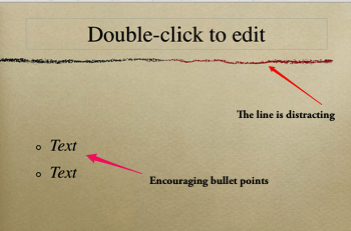
You should seldom use template designs for the same reason--they are distracting. Here is an example of a distracting verses a good slide template:

Distracting Template:

image

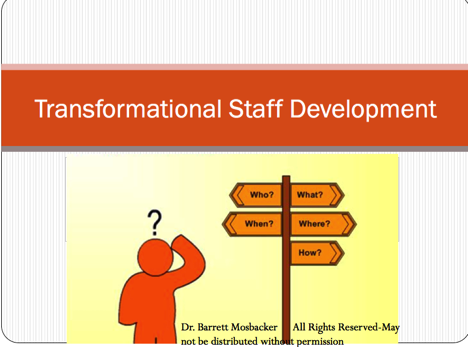
Good, Clean Template:

image

Good and Bad Examples

Assuming that a “picture is worth a thousand words,” here are some examples of before and after designs. Many of these are slides that I have produced--both good and bad and a few are provided from other sources as examples. My slides are indicated by the initials BLM.

THE BAD

image

BLM (Cheesy clipart, poor color selection, distracting text)

image

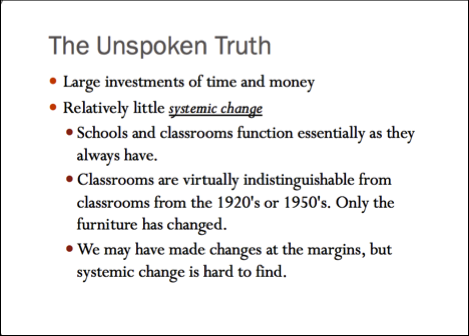
BLM (Boring with no graphics or illustration, small font, too many bullet points)

image

BLM (This one is so bad it is just embarrassing. There is nothing good about this slide. The graphics are terrible. Too many bullet points. Font too small. Poor color selection.)

image

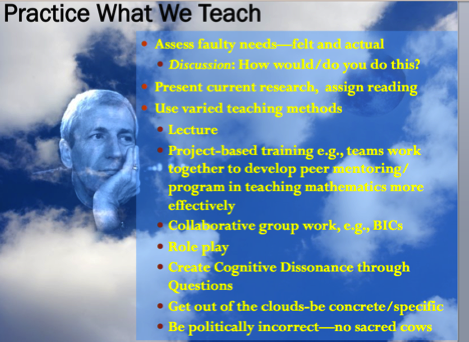
BLM (The slide has too much text, which is too small. The illustration is poorly done and the overall impact of the slide is boring and distracting.)

image

BLM (The slide has too much text and cheesy clip art.)

THE BETTER

Here is the same topic being covered with a redesigned slide from the one above.

image

BLM (This one has no clipart and no text. A high quality photo covering the entire slide is used. The photo speaks for itself. It is much more impactful than the one before with the same point to make.)

image

BLM (This title slide is affective because the professional photo reinforces the title, which is very short and to the point. The photo also matches the audience, this presentation was given in Canada in the winter.)

image

BLM (One word with a photo matching the key concept.)

image

BLM (Transition slide to next topic--simple text on solid background)

image

BLM (This is a playful slide using a professional photo but with a font matching the playful mood. This slide was designed to communicate with and encourage elementary teachers thus the colors and playfulness, which are characteristic of elementary programs.)

The following five slides tell a story and reinforce each other.

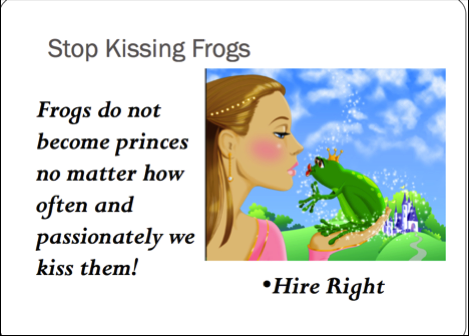
  • Slide 1 acknowledges how many feel when faced with significant change.

  • Slide 2 encourages the audience to laugh and relax because we will provide time and resources to ensure their success.

  • Slide 3 reassures that we are confident that they will be successful as a team.

  • Slide 4 reassures that we are confident of success because….

  • Slide 5 communicates that we will deal with big change in small bites.

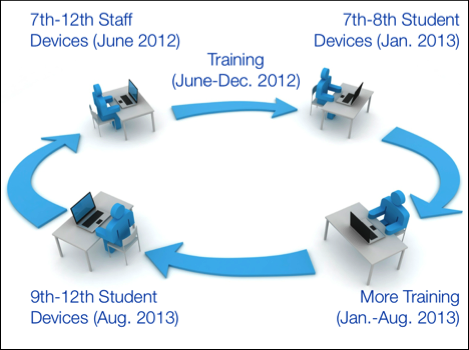
  • Slide 6 illustrates why they will be successful--a slow, deliberate training and implementation cycle.

image

BLM Slide 1

image

BLM Slide 2

image

BLM Slide 3

image

BLM Slide 4

image

BLM Slide 5

image

BLM Slide 6 This slide has animations so that each date appears and disappears in sequence.

A Word About Charts and Numbers

Charts can be very helpful in a presentation but just like your slides they need to be simple with all distracting and unnecessary elements deleted.

Numbers are usually confusing to the audience. Use as few as possible and allow extra time for the audience to do the math. Numbers should never be ultra precise: “Anticipated revenues of $660,101.83” looks silly. Are your numbers that accurate? Just say $660 thousand.

image

This is a busy, hard to read and understand chart with too many words and numbers.

image

BLM This chart is much better. Easy to understand, clean with no distracting elements, e.g., grid lines, unnecessary numbers, and text.

DELIVERY

Arrive Early and Test Everything!

It is stressful and embarrassing to stand up to deliver a presentation only to discover that something is not working. Worse, it is distracting to your audience and immediately reduces your credibility and impact.

You only have about 1 minute to make a first impression. Don’t make it with you trying to get your computer to work or your slides to show up on the screen.

Plan for Murphy to show up. He always does. Plan for the worst case scenario. What will you do if the computer crashes and burns, the video system goes out, or the sound system does not work? Prepare for the unexpected. When you do, you can go with the flow and not skip a beat.

Have your presentation so well rehearsed that you do not need slides as prompts (more on this later). You should be able to speak spontaneously. If you can’t, you don’t know your subject well enough.

If you must have notes, have a printed copy readily available.

Have electronic backup copies of your slides on a thumb drive (for use on a local computer if yours crashes) and your online for immediate download if needed. I use an iPad for this purpose.

Have copies of your notes and slides available for distribution or access online.

Talk to Your Audience, Do Not Read!

Whatever you do do NOT look at your slides and read from them! Keep your eyes on your audience. Make eye contact with individual audience members.

Remember, your slides are to illustrate key ideas, concepts, trends, and facts. Do not use your PowerPoint or Keynote presentation as a teleprompter.

Presentation Style Tips

Remember, your audience will form a first impression within 60 seconds or less! Make that first minute count!

  • Dress appropriately for your audience. It is best to “dress up” rather than “down” if in doubt.

  • Tell real life stories that reinforce your topic.

  • Turn off your cell phone.

  • Jump right in and get to the point.

  • Give your rehearsed opening statement; don't improvise at the last moment.

  • Use the opening to catch the interest and attention of the audience.

  • Briefly state the problem or topic you will be discussing.

  • Talk at a natural, moderate rate of speech.

  • Project your voice.

  • Speak clearly and distinctly.

  • Speak with enthusiasm.

  • Use appropriate well timed humor but not jokes.

  • Pause briefly to give your audience time to digest the information on each new slide.

  • Keep your eyes on the audience.

  • Use natural gestures.

  • Don’t turn your back to the audience.

  • Don’t hide behind the lectern. As much as possible don’t use a podium at all but if you must or the host site has it there for other speakers, move in front or to the side.

  • Avoid looking at your notes. Only use them as reference points to keep you on track. Talk, don’t read.

Length

  • To end on time, you must PRACTICE!

  • The audience will love you if you end short of your time. Never go over! Remember, less is MORE.

  • As a rule of thumb, plan to use 80% of your allotted time.

Demeanor

Show enthusiasm. Nobody wants to listen to a dull presentation. On the other hand, don’t overdo it. Nobody talks and gestures like a maniac in real life. How would you explain your ideas to a friend?

Recommended Reading

All truth is God’s truth. We can learn from unbelievers because by God’s common grace he reveals truth to believers and unbelievers alike. Although I do not endorse everything in the following books (e.g., some have Buddhist and Zen philosophy embedded in them), nevertheless, some of the principles are true and can help anyone design and deliver better presentations.

Why Sweating the Small Stuff Makes a Big Difference

image

By Dr. Barrett Mosbacker

For years I have been taught not to “sweat the small stuff.” I warmly embraced this notion because it reinforced my natural inclination to focus on big strategic initiatives and to pay less attention to the small details, leaving those to others.

I have changed my mind. I have concluded that small stuff make a big difference.  Small stuff deserve a great deal of our attention!

What Convinced Me

God’s Care for Us and Creation:

If anyone was going to focus on big strategic plans it would be God. As the creator and governor of the physical universe and the affairs of heaven and earth, God certainly is focused on large scale objectives.

Yet, notice the incredible attention to detail exhibited by his rule:

Are not two sparrows sold for a penny? And not one of them will fall to the ground apart from your Father. But even the hairs of your head are all numbered. Fear not, therefore; you are of more value than many sparrows. (Mt 10:29–31)

image

Consider the remarkable detail in God’s creation. Look at how intricately God designed a flower. While God wrote our names in the Book of Life before he laid the foundations of the world and “made from one man every nation of mankind to live yon all the face of the earth, having determined allotted periods and the boundaries of their dwelling place,” (Ac 17:26), he also designed the intricate details of flowers.

And why are you anxious about clothing? Consider the lilies of the‘ field, how they grow: they neither toil nor spin, yet I tell you, even Solomon in all his glory was not arrayed like one of these. (Matt. 6:28-29)

image

Ugly can be beautiful. The head and eyes of a horse-fly may not be “beautiful” in the classical sense yet the incredible creativity, detail, and symmetry is a beautiful reflection of God’s attention to detail and a nearly incomprehensible marriage of function and form.

Few things are more ethereal and ephemeral than a snow flake-especially in the U.S. South! Yet, even with something so fragile and short-lived, the variety, symmetry and beauty of a snow flake is a testament to God “sweating the small stuff.”

Not only does God’s creation “work,” it is beautiful and awe inspiring—and to the attentive soul—soul ennobling. Who has not been in the mountains, on a prairie, a beach, or a lake--and not been enthralled and enriched by the beauty made possible by God’s attention to the smallest details of his creation?

Steve Jobs:

It may seem odd to include Steve Jobs in a list with God. I do so because as an image bearer of his creator Job’s attention to detail imaged that of his creator—whether he chose to acknowledge it or not.  Jobs was fanatical about every detail of Apple’s products--even the unseen innards:

From his father Jobs had learned that a hallmark of passionate craftsmanship is making sure that even the aspects that will remain hidden are done beautifully. One of the most extreme—and telling—implementations of that philosophy came when he scrutinized the printed circuit board that would hold the chips and other components deep inside the Macintosh.

No consumer would ever see it, but Jobs began critiquing it on aesthetic grounds. “That part’s really pretty,” he said. “But look at the memory chips. That’s ugly. The lines are too close together.” One of the new engineers interrupted and asked why it mattered. “The only thing that’s important is how well it works. Nobody is going to see the PC board.”

Jobs reacted typically. “I want it to be as beautiful as possible, even if it’s inside the box. A great carpenter isn’t going to use lousy wood for the back of a cabinet, even though nobody’s going to see it.”

For Jobs, designing and manufacturing electronics was craftsmanship, not merely an economic activity.  He was fanatical about design and detail, even in product packaging because he learned that people DO judge a book by its cover:

“You should never start a company with the goal of getting rich. Your goal should be making something you believe in and making a company that will last.” Markkula wrote his principles in a one-page paper titled “The Apple Marketing Philosophy” that stressed three points.

  • The first was empathy, an intimate connection with the feelings of the customer: “We will truly understand their needs better than any other company.”

  • The second was focus: “In order to do a good job of those things that we decide to do, we must eliminate all of the unimportant opportunities.”

  • The third and equally important principle, awkwardly named, was impute. It emphasized that people form an opinion about a company or product based on the signals that it conveys. “People DO judge a book by its cover,” he wrote. “We may have the best product, the highest quality, the most useful software etc.; if we present them in a slipshod manner, they will be perceived as slipshod; if we present them in a creative, professional manner, we will impute the desired qualities.

Application to Our Leadership and Schools

Perception is important.  How we “present” our product is important.  We may have wonderful teachers and programs but unless we present them with excellence would-be and current parents may perceive our schools as second-rate.  The good news is that “good packaging” doesn’t have to be expensive, it just needs to reflect attention to detail.

Like the cover on a book or your first impression of someone you meet, perceptions are formed almost immediately.  The first impression that parents get is from a phone call to the school, the website, or a visit to the campus.

Facilities

It is easy to become “blind.”  We are like the proverbial frog in the kettle, we have grown so accustomed to our surroundings that we no longer see what a visitor sees.  Everything looks fine to us.

Take one hour and walk through your buildings with a notebook.  Write down everything that is not perfect.  Note every time you see chipped paint, scuff marks, dirty carpet, smudges on glass doors, paper/trash on the floor or in the parking lot, shrubs needing trimmed, bare patches in the grass, book bags lying around, handwritten student or school messages/signs/posters (I’m not reviewing to student projects-I’m referring to announcements, directions, etc.), messy offices and desks, stuff out of place, pictures ajar in the reception area, etc....  You may be surprised just how disheveled things can become.

Phone Calls

How are your phones answered?  Do people reach an electronic message system with a labyrinth of options or a warm professional receptionist?  I have been lobbied for years to install an automated answering system.  It is “more efficient” is the reason given.  I have refused because such a system, though more “efficient” does not reflect the warm nurturing culture of our school.  Besides, people hate electronic answering systems, don’t you?

I call a lot of schools.  I am often dismayed by the poor phone skills of those who answer the phones.  Too often I am greeted with a sweet but unprofessional receptionist (poor grammar or too casual), or a very professional but “cold” individual.  In contrast, whenever I have called Apple headquarters or Apple support, I am greeted by a cheery, pleasant professional who always proves helpful. I am always left with a good impression.

Try this.  Call your school with new ears.  Use a phone that cannot be identified as you.  Was the impression you received that of a well educated, professional, happy individual or one who was harried and poorly spoken?  If you were calling the school for the first time, what impression did you get within the first 30 seconds?

Website

Was your website custom designed by a professional or was it created using a template and/or by a volunteer?  If the latter, it will look like it and the first impressions, while perhaps not “bad,” will not be superb.  Following my own advice, we are completely redesigning our website (not yet up).

When you review your website, look for the following:

•    Simple design, uncluttered •    Easy to navigate •    Warm and friendly •    Professional (drop the apples, crayons, etc.)

Remember, people will not spend a great deal of time reading material on your website.  The website should be designed to give a positive impression of the school, highlight important information, and provide easy navigation on where to obtain more information.

I recommend that you not put the photographs of your staff on the website’s staff directory unless they are unusually and universally photogenic.  A few well chosen photographs of staff and students on your site is very effective, but a directory with staff photos is not.  Most of us are not particularly photogenic so there is little to be gained by plastering our faces on the school’s website.

Staff Appearance

The way you and your staff dress creates a powerful impression. Although dress should be appropriate for the job, overly casual attire or poorly worn clothing does not create an impression of quality.  Walk around your school; discretely notice how your teachers and staff are dressed.  Are men’s ties tied properly?  Are the collars on men’s shirts crisp or wrinkled?  Are shoes polished?  Do some of your staff look “frumpy?” Designer cloths are not necessary, but being professionally dressed in contemporary styles is.

Your Presentations

Your presentations communicate a lot about you and the school!  Every presentation you make is enhancing or diminishing the “customer’s” (students, current and prospective parents, staff) perception of the school.

Are your presentations professional and warm?  Just as being professionally “cold” is to be avoided, so too is overly folksy. Here are some “small things” to sweat about.

•    Start and end on time.  It is unprofessional and inconsiderate of those who arrived on time to start any meeting late.  Do so also “trains” people to come late, after all, the “meeting will not really start until 10 after...” •    Make sure the venue, including the stage area, is neat and clean. •    Less is more--too much information given for too long is counter-productive.  It is best to keep things simple and short and then to provide backup information.

Review your PowerPoint/Keynote slides.  Over the last several years I have read several books on presentation design.  I have radically changed how I design and use slides. I cringe when I review past presentations!

•    Your content should not be on the slides; slides are only used to illustrate or solicit interest. •    Speak as “spontaneously” as possible.  Know what you have to say well enough that you only occasionally glance at notes.  Steve Jobs famously quipped, “People who know what they’re talking about don’t need PowerPoint.” There is a place for slides, but they are never to be your notes! •    It is important to maintain eye contact with your audience--do not turn to look at slides. •    Less is more on slides--few words, large font, great photos and illustrations.  No clipart! Few if any bullet points. Here is an example of how I have changed my slides and presentations.

Old Style:

image

New Style:

image

There are many other areas of the school-especially in classrooms-where we need to be “sweating the small stuff.”  While we need to focus on long-term strategic initiatives, we must pull the clippers out to ensure that every “blade of grass” in the school reflects the quality that we assure parents is true of our schools.

“Small” stuff matters to God and it should matter to us.  Remember, Jesus said, “He who is faithful in little will be faithful in much.”

God is the master craftsman.  Steve Job insisted on craftsmanship in the products Apple designed.  Do our schools reflect craftsmanship?

Shoulders to Stand On in the Theater of Bullying

bully

A Word from the Publisher:

I am pleased to introduce The Protectors as a new sponsor of the Christian School Blog. More importantly, I can speak from personal experience regarding their effectiveness in training our faculty to create an effective and spiritual response to the problem of bullying. Please feel free to contact me personally for a reference. Dr. Mosbacker, Publisher

_________________________________

As we digest the sobering conclusion of a recent survey--that bullying is the leading concern among students returning to school--it’s essential that authority in this complex theater understand the real issues that empower this unique form of abuse to harm the mission and integrity of faith-based organizations.

Yet head-smarts have never been enough to create love, light and fairness. Equally if not more important is for administrators, teachers and related faculty to act courageously and quickly against it. Most schools do not lack an anti-bullying policy. What they sometimes lack are the will and courage to enforce it.

Leaders, remind others within your organization that bullying is not about conflict, disagreement, misunderstanding or anger management. It is about something far more insidious and initially difficult to discern: the superior use of power (usually physical, social, or verbal) to deliberately harm another over time.

Bullying is not about two people who “just don’t get along” and “who need to learn how to work out their differences on their own.” It’s about intentional domination of another with the intent to harm, usually through humiliation, isolation and the threat of further abuse. It creates pervasive fear, not just among targets but among the majority of bystanders who quietly worry that they might be next.

Most Christians are familiar with the clarifying truth that perfect love castes out fear (I John 4:18). Yet the inverse is also true: fear casts out love--and learning. Psychology 101 tells us that we don’t learn or grow well when fearful. We just survive, and no faith-based organization charged with educating young minds and stirring tender souls can achieve its mission with this condition in place. Know fear, no meaningful learning and spiritual growth.

Educators, let’s resurrect what seems to be a lost question, “Who started it?” Targets of serial bullying are more sinned against than sinner, and justice is miscarried everyday when this truth is overlooked or explained away through the misapplied proverb, “It takes two to tango.” Sometimes it takes just one.

Authority, be more skeptical than you were last school year when you see what appears to be garden-variety conflict among students. Get in touch with your inner-Columbo, Dexter. Employ your gut. Talk to other teachers and ask a few more penetrating questions among those involved. Also, be more unpredictable in your monitoring of bullying hotspots. Where there is smoke there is likely fire. Put out the fire.

Bullying is abuse that is sometimes evil--not a God-ordained path toward “personal growth.” A recent letter to The Protectors from a mother of a serial target testifies to this truth. Her son is a young adult now, but like approximately 7 out of 10 serial targets, he battles “lots of anger, difficulty with social interaction and relationships, deep-seated resentment, self-hatred, haunted by guilt and shame, and retreats into obsessive behavior when hurting.” He, like the majority of targets, has been more than bit by evil--his soul is poisoned by it. The devil and his minions walk laughing. Pray and behave that such abuse will not take place during your watch.

I recently spoke with a man who helps the poor in Third World countries. When he trains new groups of Americans who will spend the next few weeks building homes and creating other forms of tangible care, he asks them to define a small but potent word: Poverty. Most answer that it is the lack of resources. Surprisingly, “Poverty to the poor,” he reveals, “means lack of hope.”

Targets of ongoing campaigns of humiliating cruelty experience poverty of spirit. When this fundamental need is reduced to a pilot light deep within or, heaven forbid, is blown out, they sometimes turn to dark thoughts of bullycide, suicide due to bullying, or bringing a weapon to school (most school shooters told the Secret Service that they murdered classmates and faculty due to ongoing bullying).

This year, someone within your realm of care will need your help keeping blessed hope alive. And hope is not ushered in upon the wings of worn-out platitudes or a shoulder to cry on. Hope in this theater of deliberate abuse is ushered in upon courageous and justice-building shoulders to stand on.

Be those muscular and protective shoulders this school year and years to come, making your organization a beacon of God’s love, compassion and righteousness.

Paul Coughlin is an author, speaker and Founder & President of The Protectors: Freedom From Bullying--Courageous, Leadership & Character for Life. This faith-based program is used by hundreds of organizations throughout the world, including Christian schools, churches, summer camps and more. www.theprotectors.org.

Full Loyalty, No Negativity? What Can Our Schools Learn from Apple?

By Dr. Barrett Mosbacker

Wouldn’t it be wonderful if someone could write an article describing our schools titled “Full Loyalty, No Negativity?” I am a recent convert from a Windows PC to the Mac computing environment. That is a story for another day but what I want to share with you are some observations from my experiences in Apple stores  and how those observations can be applied to move more of our students, parents, and employees closer to Full Loyalty with No Negativity.

Apple_Logo_2

If you have been in an Apple Store recently (if you haven’t I encourage you to do so as an observant leader--but you may want to leave your wallet at home!) you will discover that they are almost always filled with highly engaged customers, attentive staff, and great customer service. At least, that has been my experience every time I have visited an Apple store. Moreover, whenever Apple introduces a new product or an upgrade to an existing product line, customers will line up for hours and blocks, even camping out overnight, to be first in line to buy Apple products.  Loyal Apple customers even have a nickname: “Apple Evangelists.”  That speaks volumes!  Wouldn’t it be wonderful if our parents were so enthusiastic about our schools that they would line up for hours and blocks and be tagged with the nickname “XYZChristian school evangelists?”

How do we get students, parents, and prospective parents to exhibit the same level of enthusiasm for enrolling their children in our schools and paying tuition as Apple customers do for Apple products?  Without stretching the illustration too far, I think it would be wonderful if when parents and vendors visited our schools they sensed the same type of engagement, enthusiasm, and customer service that one experiences in an Apple store.

Consider some of the observations from a recent Wall Street Journal article; Secrets From Apple's Genius Bar: Full Loyalty, No Negativity.   Below is a summary of the key observations of this article.  Beneath each summary point I have added some possible applications for our schools and for our leadership.

•    Apple goes to great lengths to train its employees at its popular retail stores, tightly managing what feels like a casual consumer experience.  A look at confidential training manuals, a recording of a store meeting and interviews with more than a dozen current and former employees reveal some of Apple's store secrets. They include: intensive control of how employees interact with customers, scripted training for on-site tech support and consideration of every store detail down to the pre-loaded photos and music on demo devices.

APPLICATION:  Our schools could benefit from systematic training in customer service. Such training would include all school personnel from administrators to groundskeepers. Everyone would understand that they are customer service agents with the mission of ensuring that students, parents, and visitors have wonderful experiences in the classroom and with every interaction with school staff.

Additionally, everyone should devote attention to quality throughout the school.  Every detail of the school should reflect quality, attentiveness, and care.  School grounds should be well kept, hallways free of clutter and book bags, walls adorned with well designed posters and student work, school communications should be warm, clear, and professional, the school’s website should be modern and easy to navigate, and all points of contact between students and parents should communicate that “we care.”

•    With their airy interiors and attractive lighting, Apple's stores project a carefree and casual atmosphere. Yet Apple keeps a tight lid on how they operate. Employees are ordered to not discuss rumors about products, technicians are forbidden from prematurely acknowledging widespread glitches and anyone caught writing about the Cupertino, Calif., company on the Internet is fired, according to current and former employees.

APPLICATION:   This is a tricky one.  Although we would not want to go to the extent described above in how we deal with our employees, nevertheless, the focus on “airy Interiors and attractive lighting in a carefree and casual atmosphere” does have relevance for our schools.

Some of our schools and employees are too uptight.  We can improve student achievement and their enjoyment of school–and thus parent satisfaction and enthusiasm for our schools–if our classrooms are characterized by an open, airy, more casual environment in which students are actively engaged in learning, who feel free to be themselves and to ask “politically incorrect questions,” and to make mistakes.  In other words, although school is a serious business it does not have to feel like a strait jacket. Schools should be a place in which the emphasis is not on what is wrong  or what not to do.  Instead, we should champion what students can do and cast a compelling vision for the future.

•    Apple is considered a pioneer in many aspects of customer service and store design. According to several employees and training manuals, sales associates are taught an unusual sales philosophy: not to sell, but rather to help customers solve problems. "Your job is to understand all of your customers' needs—some of which they may not even realize they have," one training manual says. To that end, employees receive no sales commissions and have no sales quotas.

"You were never trying to close a sale. It was about finding solutions for a customer and finding their pain points," said David Ambrose, 26 years old, who worked at an Apple store in Arlington, Va., until 2007.

APPLICATION: there are two very important principles contained in the description above. The first is the focus on innovation and the second is the focus on meeting needs. Our schools, and more importantly our students and our parents, will benefit immensely if we place an energetic and consistent emphasis on innovative teaching, innovative programs, innovative training, and innovative ways of serving our students and our parents.

Moreover, rather than focusing on our policies and procedures,  we should spend more time focusing on good customer service for both students and parents in an effort to alleviate, insofar as possible, things that produce spiritual, emotional, social, or academic pain. We should focus on finding solutions for our students and parents and less on policies and rules.

image

That is not to say that we compromise our standards, rather it is simply to say that if we devote far more attention to making our students’ and parents’ experiences with each person and situation as enjoyable as possible we will go a long way to increasing their satisfaction and deep loyalty to the school.  In effect this is nothing more than applying the Golden Rule, “As you wish that others would do to you, do so to them.” (Luke 6:31, ESV)  The result will be higher retention rates and the enthusiastic endorsement and recommendation of the school to others.  Our parents will become our school “evangelists.”

•    Apple lays out its "steps of service" in the acronym APPLE: Approach customers with a personalized warm welcome Probe politely to understand all the customer's needs Present a solution for the customer to take home today Listen for and resolve any issues or concerns, and End with a fond farewell and an invitation to return

image

APPLICATION:  What a wonderful model for our staff to follow! In fact, with a little tweaking this acronym can be readily applied to our schools. In many ways it reflects biblical servanthood, “as you wish that others would do to you, do so to them,” and  “go the extra mile.” Here is the same acronym revised to reflect a Christian school environment.

Approach every student at the beginning of the day and in the halls with a personalized warm welcome.  Greet every parent and school visitor in like manner.

Probe politely to understand student needs--spiritual, emotional, and academic.  Probe politely to understand parents’ needs.

Present solutions for students and parents to take home with them.

Listen for and resolve issues and concerns following James’ instruction, “be quick to hear and slow to speak.” (James 1:19)

End each class period and parent conference with a fond farewell, letting students know that you look forward to seeing them tomorrow and inviting parents to see you again if they continue to have concerns.

•    Apple's control of the customer experience extends down to the minutest details. The store's confidential training manual tells in-store technicians exactly what to say to customers it describes as emotional: "Listen and limit your responses to simple reassurances that you are doing so. 'Uh-huh' 'I understand,' etc."

APPLICATION: Our first impulse when confronted with someone who is angry is to get angry and our second inclination is to seek to be understood and to defend our actions or those of the school. As a consequence, we often fail to comprehend the real nature of the problem being described by the student or the parent.   We can also come across as not listening and defensive.

I have learned over the years that it is better to spend far more time listening than talking and I have also discovered that “less is more.”  Over-explaining and providing more details than necessary often exasperates rather than solves problems.  Sometimes we simply talk too much.

Moreover, it is often better to take time to thoroughly understand the nature of a problem than too quickly jumping to defend one’s actions or those of the school or to arrive at an immediate solution. It is wiser to listen and then to postpone a suggested solution until one has had time to gather all the facts and to pray for wisdom in seeking a proper response.

Accordingly, getting back to a student or a parent a day or so later may actually reflect better service than to attempt to solve a problem that has not been adequately considered or prayed about.

•    Apple employees who are six minutes late in their shifts three times in six months may be let go.

APPLICATION:  Do we hold our teachers to the same standards of punctuality and work that our teachers hold their students to? Do our teachers show up for faculty meetings or chapel services late? If so, what is the consequence? What is the consequence for a student who habitually shows up late for classes? In other words, do we model as administrators and teachers what we expect of our students?

Another way of looking at this is to ask “are our standards of service for each other, our students, and our parents as high as or lower than the standards that Apple requires of its employees who sell computer hardware and software?” Which is more important? If we are to “do everything as unto Christ,” would we show up late for one of his classes?

•    Working for an Apple store can be a competitive process usually requiring at least two rounds of interviews. Applicants are questioned about their leadership and problem-solving skills, as well as their enthusiasm for Apple products, say several current and former Apple store employees. While most retailers have to seek out staff, retail experts say many Apple stores are flooded with applicants.

APPLICATION: How intensive is your recruiting and hiring process? Do you take prospective employees through multiple interviews accompanied by rigorous questions designed not only to ascertain the applicant’s commitment to Christ and to Christian education but his or her enthusiasm for teaching, love for students, creativity and innovation in teaching and assessing students, and willingness to learn?  Or, are you too quick to settle fearing that you will not be able to hire someone to fill a need, in part, because salaries are so low? In the long run, taking shortcuts in hiring will ultimately harm students, negatively impact the school’s reputation and consequently negatively affect student retention, enrollments, and school finances.

•    Once hired, employees are trained extensively. Recruits are drilled in classes that apply Apple's principles of customer service. Back on the sales floor, new hires must shadow more experienced colleagues and aren't allowed to interact with customers on their own until they're deemed ready. That can be a couple of weeks or even longer.

APPLICATION:  How we use your mentoring program? Do you have seasoned teachers who have been given time to work in the classrooms periodically with new hires? Have you given veteran teachers the opportunity to formally and informally mentor new teachers? Or, is it more often the case that new teachers are placed in classrooms with little formal or informal mentoring beyond new staff orientation and standard in-service training programs?  Do we had students to teachers before the teachers are ready?

•    What hasn't changed is Mr. Jobs's interest in the stores. He has provided input on details down to the type of security cables used to keep products leashed to the tables, according to a person familiar with the matter. When the CEO grappled with a liver transplant two years ago, a person who visited him at the time said Mr. Jobs was poring over blueprints for future Apple stores.

image

APPLICATION:   The description above reflects three things on the part of Steve Jobs: 1. A love for Apple, 2. A focus on his mission rather than on himself, and 3. Attention to detail. Does our leadership consistently demonstrate the same characteristics as we serve our students and parents under the Lordship of Christ and for his glory?

While  we may never eliminate negativity, we can do much to foster deep loyalty to our schools and reduce the negativity that as fallen human beings we are so prone to. Although a computer company is not a school, nevertheless, we can learn a great deal from successful companies and leaders who place a focus on quality, training, and customer service.

As Christian school leaders we should be at least as devoted to these things as the CEO of Apple is to selling hardware and software, after all, we are the stewards of souls.

How to Turn Parents Into Raving Fans

By Dr. Barrett Mosbacker

Sometimes the blogging “gods” smile upon you!  For years now I have promoted the concept, that I first heard from Dr. Kynerd, that it is best to Under Promise and Over Deliver when dealing with our parents and employees.  Although I often promoted this approach as essential for building good will, I had never heard or read others promoting this approach—until now.

While reading the Wall Street Journal I stumbled upon following article.  Although written for business leaders and owners. it has direct applicability to our schools—after all, our parents and students ARE CUSTOMERS.

How to Turn Customers Into Loyal, Raving Fans, By MIKE MICHALOWICZ-WSJ

Do you want satisfied customers or do you want customers who are so thrilled with your company they become loyal, raving fans? I'll take option No.2. Satisfied customers may come back a second or third time; they may even become regulars. But unless you exceed expectations, your satisfied customers could just as easily become your competitors' satisfied customers.

If you want customers who are so loyal that they would never think of going to anyone else, and if you want customers who are so thrilled with your business that they tell everyone how amazing you are, then you're going to have to move the goal line beyond mere "satisfaction." You're going to have to wow everyone who walks through your door.

Now, I'm sure you could come up with loads of ideas that would dazzle your customers, but there's actually a simple shortcut to knocking their socks off every single time – and it won't cost you a dime. It's the "under-promise, over-deliver" (UPOD) method.

When we talk about "customer satisfaction," we strive to deliver on our promises. Complete the market study by Friday, as promised. Deliver the new couch in July, as promised. Provide two valet attendants, as promised. When you do exactly as you said you would, you end up with satisfied customers. But when you give them something more than they expect -- faster service, extra help, more options, early delivery and so on -- you end up with the loyal, raving fans you need to propel your business into the stratosphere.

The idea behind UPOD is that people are most favorably influenced by great service they don't expect, rather than great service they do expect. And they expect it because you promise it. If you tell customers they will get their new shoes the next day, and the shoes arrive the next day, those customers will be satisfied, maybe even happy. But if you tell customers they will get their new shoes in five days, and the footwear arrives the next day, your customers will be amazed and thrilled.

Here's the trick with UPOD: It's not about doing things faster or throwing in "extras." It's about building the "under-promise" part into the equation from the start. If Friday is the earliest you can complete a study, then promise to have it done the following Wednesday. "Surprise! We finished early." If you know you will deliver a couch in July, promise to have it there by August. "Great news! We wanted you to have it as soon as possible!" Build a business model in which you have enough income to cover three valet attendants, promise two, and the day of the party, send over three. "We just thought you could use the extra help. No extra charge."

Most businesses know UPOD is a good practice, but few adhere to it because people think they have to change their operation to wow customers. Just take this very simple shortcut: Change your promise.

Using UPOD will also help you avoid mistakes that inevitably occur when people rush to meet deadlines. It will enable you to respond positively to last-minute requests and help you stay calm, cool and collected as you work surprisingly reasonable hours. Most importantly, when you under-promise and over-deliver, you will inspire satisfied customers to become devoted customers – and that's money in the bank.

Take a few minutes to reflect upon this article and then jot down ways in which you can apply the UPOD principle to your leadership or your classroom.  Also reflect upon how UPOD is consistent with Jesus’ command that we are to:

You have heard that it was said,  An eye for an eye and a tooth for a tooth. But I say to you, Do not resist the one who is evil. But if anyone slaps you on the right cheek, turn to him the other also.  And if anyone would sue you and take your tunic, let him have your cloak as well. And if anyone forces you to go one mile, go with him two miles. Give to the one who begs from you, and do not refuse the one who would borrow from you. (Mt 5:38-42)