Goodbye to Discs and Pages?

By Dr. Barrett Mosbacker

This article, although related specifically to Apple and Amazon, the larger story is the fast movement to digital content for books/textbooks. 

Amazon vs. Apple: Battle of the books

With its new iPad, Apple is taking aim at Amazon's core business and its Kindle book reader. Can the 'e-tail' pioneer keep up as books, music and movies go all-download?

By Michael Brush

Amazon.com (AMZN, news, msgs) has come out on top in the digital revolution that's moving sales of books -- as well as compact discs, DVDs and lots of other products -- online.

But there's a second digital uprising afoot, and some experts think Amazon won't fare as well -- and could lose a sizable chunk of its core bookselling business.

Any Amazon losses would likely be gains for Apple (AAPL, news, msgs), which could do to its "e-tail" rival what Amazon has been doing to brick-and-mortar competitors.Apple's chief weapon in this battle of online giants -- the iPad -- will be rolled out April 3, with preorders starting March 12. Among the many things people will be able to do with these flat touch-screen computers: download and read digital books from Apple's new iBookstore.

Amazon has its own successful book reader, the Kindle. But Apple dominates in music downloads, so there's good reason to think it will take a big share of the market for downloadable books. "In music, Apple is the dominant player. Now Apple wants to do the same in books," says Jeffrey Liebenson an attorney with Herrick, Feinstein who was involved in some of the early music industry negotiations with Apple. And the iPad threat is part of a bigger-picture "digital transition" risk to Amazon that has led many investors to head for the exits.

The worry? Books are joining music in a broad shift to entertainment via digital download, and that's a game Apple tends to win.

Goodbye discs and pages

Think how this second digital revolution has changed the way we get entertainment:

  • When was the last time you bought a CD? Sales of CDs declined to 301 million last year from 712 million in their peak year of 2001, according to Nielsen SoundScan. Instead, people download music -- and Apple, with its iTunes store, dominates with a 70% market share. Amazon has 8% of the music sales market.

  • The same thing is happening to DVD sales. Video stores such as Blockbuster (BBI, news, msgs) are already hurting. Consumers will soon wonder why they should buy a DVD anywhere when they can get a movie online -- instantly.

E-Book price wars

Amazon hasn't ignored these changes. You can download music at the online retailer -- and from many other places, of course -- but Apple simply rules this game.

You can also get movies over the Internet from Amazon. Here Apple isn't dominant, but the field is crowded with strong rivals: cable companies, Netflix (NFLX, news, msgs), Hulu and Vudu, which was recently purchased by Wal-Mart Stores (WMT, news, msgs).

Books are next, and Amazon is certainly a major player in the digital book market with the Kindle. But imagine that Apple does to the book market what it's done in music. How much will be left for Amazon or anyone else?

The risk to Amazon's business is real, and it is one of the main reasons Credit Suisse analyst Spencer Wang is telling investors to avoid buying Amazon stock now. He has a "hold" rating on the online retailer and a 12-month price target of $130 a share, around where the stock sells today.

Because of these worries, investors sold out of Amazon stock earlier this year when it became clear Apple was entering the e-book market, analysts say. The stock is down from a 52-week-high at $146, though, like the market as a whole, it's way up from its lows.

Among those selling has been Amazon founder and CEO Jeff Bezos. In February, he sold 2 million shares of Amazon stock at prices between $116 and $120, according to Thomson Reuters. He sold 7 million shares in 2008-09, after selling no stock at all during 2005-07.

The strong side of Amazon

Mind you, this is a battle of giants.

Amazon's stock is up 50% since I wrote in August 2008 about a different battle for online sales ("How Amazon is beating up eBay"). The Standard & Poor's 500 Index ($INX) is down more than 10% from where it was then, and eBay (EBAY, news, msgs) is down slightly.

Amazon revenue grew an impressive 37% in the fourth quarter of 2009. It owns 22% of the North American book market, according to a Credit Suisse estimate. And it can continue to grow by doing what it does best: taking market share from brick-and-mortar retailers.

It sold an estimated 2 million Kindle book readers last year, and 3.1 million are expected to be sold this year, according to estimates by Barclays Capital analyst Douglas Anmuth. Amazon's stated goal of having every book ever printed in any language available on Kindle in less than 60 seconds is a bold one -- and however realistic, it means Kindle owners should eventually be able to get virtually any book they want.

The Apple advantages

Apple, though, is a fierce competitor, which is what makes the battle intriguing. And it has two big advantages as it goes after book sales.

Advantage No. 1: Apple has eager allies in the publishers.

To promote Kindle, Amazon has been offering great deals on new and best-selling e-books, a 55% discount off a typical $22 list price to $9.99. It's selling many e-books at a loss, says Wang, the Credit Suisse analyst.

This annoys publishers. They think Amazon has too much clout in the book business, and they don't want to see that extended to e-books. And they worry that a $10 price will "cheapen" books, training consumers to always expect low prices.

Enter Apple. It has offered publishers better prices than Amazon asks -- as long as the publishers make other vendors (i.e., Amazon) raise the retail price on best-selling e-books to $12.99 to $14.99. Most of the major publishers have signed on. If the alliance sticks, it will hurt Amazon's strategy for taking market share and fueling Kindle growth.

"All the publishers I talk with are hoping the iPad will live up to the hope," says Todd Eckler, the vice president for print and publishing at North Plains, which sells software to help providers put their content online.

Advantage No. 2: Apple is better than almost anyone at making gadgets.

This is key, because the gadgets can be crucial in determining which company eventually controls the content ecosystem, including the all-important formats that can be used to lock out competitors.

One of the main reasons Apple dominates music is the popularity of its iPod players and its music-playing iPhone. Lots of companies make music players, but Apple dominates so thoroughly that "iPod" is nearly a generic term.

Though we won't know for sure until it hits the market, with its smooth interface and bright color screen, the iPad seems sure to be a comfortable way to read books, believes Scott Testa, a professor of business administration at Cabrini College in the Philadelphia area and an avid Kindle user. "The iPad is going to blow the Kindle away as far as ease of use and the quality of the screen," he says.

Amazon's gadget will have the price advantage. The Kindle starts at $250 and is likely to get cheaper soon. Apple's iPad will start at $500; if Apple wins, it will likely be because the iPad does much more.

Though the iPad's features and processing power will be overkill for the simple act of reading a book, they're likely to contribute to an evolution in what constitutes a book that could move that market toward Apple.

A next-generation iPad book could easily include video on "the making of the book" as with DVDs, an author interview or music -- features that will make book reading a richer experience, says Eckler, of North Plains, which sells software that helps publishers do these things.

Beyond books, consider that the many potential customers who already have deep libraries of iTunes music and video can play those on their iPad. They don't work on a Kindle or on other manufacturer's devices. If customers buy only one device, that's an incentive to go with the iPad.

The Google wild card

Amazon also has Google (GOOG, news, msgs) to worry about. The latter is scanning as many books as possible to build up the world's biggest digital book database.

We're still not sure how Google plans to make money off this, but one approach is obvious: Google will likely discount books (or give away books in the public domain, without copyright limits, for free), and make up the difference by charging sponsors for ad words, just as it does for search. Plus industry experts believe that like Amazon and Apple, Google will roll out its own book reader at some point soon.

So what to do with Amazon?

Against this backdrop, what does Amazon's future hold?  

An Amazon spokesman declined to comment for this column. But in a recent conference call with investors, when asked about the emerging book battles, Amazon finance chief Thomas Szkutak responded: "We think we are positioned very nicely from a digital perspective. We think we are focused on the customer, and I think Kindle is certainly a good example of that."

Even without the price advantage, the Kindle would be good enough for many book fans, particularly older readers who will be happy to read books and newspapers on the Kindle's black-and-white screen. "It is a generational thing," says Eckler. "The Kindle is simple. There are not a lot of buttons."

Wang, of Credit Suisse, believes Amazon will continue to see 7.5% annual growth in North American book sales over the next five years, even with Apple entering the market.

There's also a macroeconomic reason Amazon will be OK: Online sales still represent only 3.8% of overall retail sales in the U.S. So there is still plenty of room for Amazon, the leader in the space, to grow as more retail moves online, says Mark Mahaney of Citigroup.

The key takeaway for investors is this: Don't buy Amazon stock expecting the kind of huge gains seen over the past couple of years. Many market players will wait to see how the online retailer manages the all-digital transition, but with savvy competitors such as Apple attacking its core book market, growth will slow.

Apple's stock, on the other hand, just keeps rising. You would be buying today at an all-time high, which can be risky. But citing the iPad, plus continued strength in iPhone and Mac sales, Credit Suisse analyst Bill Shope has an outperform rating and a 12-month price target of $275 on Apple stock, from about $223 today.

For consumers, the book battle could mean higher prices on new and best-selling e-books, as Apple aligns with publishers to raise prices above Amazon's big discounts. But gadget prices should fall quickly as the competition heats up.

And the cool news is that the iPad may open up a whole new world of "words" that brings lots of cool features to the concept of a book. Amazon and others will have to match technologies or lose out. The simple act of reading is changing forever.

At the time of publication, Michael Brush did not own or control shares of any company mentioned in this column.

What’s in a Chicken McNugget? Read On Only If You Have a Strong Stomach

By Dr. Barrett Mosbacker

Ever wonder what’s actually in a McDonald’s Chicken McNugget? Turns out, the “chicken” alone contains seven ingredients. And that’s before you even get to the breading. Sadly, many of our favorite foods (especially fast foods) weren’t merely crafted in kitchens, they were also designed and perfected in labs. We uncovered the ugly truth when doing research for Eat This, Not That! Restaurant Survival Guide. What we found wasn’t pretty—or appetizing. Before you mindlessly chew your way through another value meal, take these mini-mysteries (conveniently solved below) into account. Sometimes the truth is tough to swallow.

What’s in a Chicken McNugget?

You’d think that a breaded lump of chicken would be pretty simple. Mostly, it would contain bread and chicken. But the McNugget and its peers at other fast-food restaurants are much more complicated creatures than that. The “meat” in the McNugget alone contains seven ingredients, some of which are made up of yet more ingredients. (Nope, it’s not just chicken. It’s also such nonchicken-related stuff as water, wheat starch, dextrose, safflower oil, and sodium phosphates.) The “meat” also contains something called “autolyzed yeast extract.” Then add another 20 ingredients that make up the breading, and you have the industrial chemical—we mean, fast-food meal—called the McNugget. Still, McDonald’s is practically all-natural compared to Wendy’s Chicken Nuggets, with 30 ingredients, and Burger King Chicken Fries, with a whopping 35 ingredients.

For more fast foods to watch out for, memorize this list of the 20 Worst Drive-Thru Foods.

Click here to read the entire article—if you dare!

The Worst Drive-Thru Meal in America

Worst Grilled Chicken

Worst "Healthy" Food

Worst Cheeseburger

Worst Fish Sandwich

Worst Dessert

Worst Potato Side

Worst Milkshake

Worst Chicken Strips

Worst Side

Worst Drive-Thru Kids Meal

Worst Roast Beef Sandwich

Worst Crispy Chicken Sandwich

Worst Salad

Worst Fish Entree

Worst Drive-Thru Breakfast Sandwich

Worst Hot Sandwich

Worst Mexican Entree

Worst Value-Menu Item

Worst Drink

College: Are Parents Getting Their Money’s Worth? Are They Getting “More” Than They Bargained For?

By Jeff Myers

This fall about two million American students will leave for college for the first time to receive an education at a yearly cost of $12,000 a year for a public university and up to $50,000 for a private one. Scholarships and grants reduce the cost for most families, but still, the Wall Street Journal reports that the average student leaves college with $23,186 in debt.

The total cost for this transaction is somewhere between 25 and 40 billion dollars. Per year.

Oh well, at least families are getting their money's worth.

Or not.

A recent study confirms what many parents have long suspected, that going to most colleges can make kids forget the things that are important and embrace values that are counter to what they learned growing up.

Before I share this study's results, let me say this to parents: leftist professors don't feel sorry for you. As far as they’re concerned, you’ve been oppressing the masses to get that money anyway, so it’s deliciously ironic that you not only turn your children over to the indoctrinators, but that you fork over 50k to 200k for the privilege.

Don't take my word for it. Here's what the late Richard Rorty, one of the most prominent philosophers of the 20th century, said on the subject:

"... I, like most Americans who teach humanities or social science in colleges and universities ... try to arrange things so that students who enter as bigoted, homophobic, religious fundamentalists will leave college with views more like our own ...  The fundamentalist parents of our fundamentalist students think that the entire ‘American liberal establishment’ is engaged in a conspiracy. The parents have a point...we are going to go right on trying to discredit you in the eyes of your children, trying to strip your fundamentalist religious community of dignity, trying to make your views seem silly rather than discussable. We are not so inclusivist as to tolerate intolerance such as yours ... I think those students are lucky to find themselves under the benevolent Herrschaft [domination] of people like me, and to have escaped the grip of their frightening, vicious, dangerous parents ..." [editor’s note: sorry for all the ellipses, but it's hard to summarize Rorty's windblown rhetoric].

When it comes to reshaping values, liberal universities know precisely what they’re doing. About four out of five students walk away from their Christian faith by the time they are in their twenties.

The Indoctrination Route: Citizenship--Bad; Leftist Politics--Good

In February the Intercollegiate Studies Institute released its annual report entitled, “The Shaping of the American Mind.” ISI researchers studied students' knowledge of basic citizenship questions, along with 39 issue-based propositions.

They found that college graduates are dangerously ignorant of basic civics. For example, fewer than one in two college graduates know that the phrase "We hold these truths to be self evident..." is from the Declaration of Independence (10% actually think it is from the Communist Manifesto).

When it comes to political radicalism, however, colleges pass with flying colors. Graduates are significantly MORE likely to believe in abortion on demand and same sex marriage, and significantly LESS likely to believe that the Bible is the word of God, that prayer should be allowed in schools, or that anyone can succeed in America with hard work and perseverance.

The Transformation Route: Being Caught Off Guard--Bad; Being Confidently Prepared--Good

Obviously not all colleges are destructive. There are even a handful of great ones (I would humbly suggest that the one I teach at--Bryan College--is one of the excellent few).

But most Christian parents feel hamstrung. They are concerned for their kids but also realize that with few exceptions (such as flat-out genius) most young people have no chance of attaining leadership positions without a college degree.

There is a solution and it is available now. Please, if you have a college-bound student, listen carefully to what I'm about to tell you. This is important even if your child is going to a "safe" college (some so-called "Christian" colleges are actually better at convincing kids to walk away from their faith than some secular colleges).

A two-week Summit Ministries course is a must. This summer. Find out more [here].

At Summit students ages 16-21 invest 12 days gaining the confidence they need to understand and defend an intelligent biblical worldview. They join a vast network of mentors whose books, writings and personal encouragement help sharpen them for life-long leadership. They stand shoulder to shoulder with newfound friends who help them stand strong.

Now Is Not The Time for Shortcuts

There is much at stake. Having your child read an apologetics book or go to a weekend conference is great, but it’s not the same as a two-week Summit experience, and here’s why:

1. At Summit students can ask questions as they arise. Over the course of 12 days students are able to form questions and interact with top Christian professors, mentors, and classmates. As they become comfortable, they open up in small groups, around the meal tables and in open forums with speakers. This gives students confidence that everyday people really can defend what they believe.

2. At Summit students enjoy being given the responsibility to think through issues as adults. Summit asks students to forsake adolescence and step up into mature adulthood. Over the course of 12 days they come to believe that it can actually be done.

3. Summit breaks the stranglehold of negative peer pressure. Young adults will seldom attempt to become anything more than what their peers think they can be. Summit students learn how to reverse this pressure and support one another in successfully thinking and living Christianly.

4. Summit provides personal contact with expert mentors. At Summit students spend 12 days with experts who have the depth of experience needed to delve deeply into the complex challenges they will face. These experts are specially selected based on their ability to communicate effectively with students.

5. At Summit, parents find that their parental role and their Christian values are affirmed and supported. Kids are always asking, "Who else says so besides mom and dad?" At Summit students are encouraged to honor their parents and be reconciled to them. This helps moms and dads strengthen their relationship before their sons and daughters leave for college, which is crucial.

Where Christian Leaders Send Their Own Children for Training

Summit is not a miracle cure. But for 47 years it's been a trusted source when it comes to preparing students to be the kind of leaders who shape culture, rather than who are shaped by it. That's why evangelical leaders such as James Dobson and Josh McDowell endorse it so enthusiastically. It's also why they chose to send their children to Summit before college; there simply is no substitute for the excellent training and mentoring Dr. Noebel and his staff provide.

I believe in the Summit. In fact I am planning to speak at every Summit Ministries session in the U.S. this summer in Colorado, Virginia, Tennessee and Wisconsin.

Summit enrollment is limited by space. Most sessions do fill up, but you can download an application [here]. Scholarships are available for those in financial need.

Remember: Before College, Summit. Please forward this to any parent who doesn’t yet understand this.

Dr. Jeff Myers is founder and president of Passing the Baton International. Jeff speaks to tens of thousands each year on worldview and leadership issues. This article was taken by permission from Jeff’s E-Newsletter “Get Ready to Lead.” To subscribe, please visit www.passingthebaton.org. For more information on Summit Ministries, please visit www.summit.org.

*Richard Rorty, "Universality and Truth," in Robert B. Brandom (ed.), Rorty and His Critics (Oxford: Blackwell, 2000), pp. 21-22.

**George Barna, "Twentysomethings struggle to find their lace in Christian churches"; Ken Ham and Britt Beemer, Already Gone: Why Your Kids Will Quit Church and What You Can Do to Stop It (Green Forest, AR: Master Books, 2009), p. 24.

Asking Important Questions About Technology

By: Mitchell Salerno, High School Principal and Arlene Outerbridge, Director of Guidance (The Master's Academy)

A recent editorial in The Philadelphia Inquirer (Click here to view article) raised questions about “one-to-one computing” initiatives sprouting up in schools around the country. Zimmerman (2010) argues that this technology has the potential to drive students further away from human interaction and that there is little evidence that one-to-one initiatives actually increase student learning. Zimmerman further suggests that qualified and talented teachers, rather than the latest technology, will improve learning. Humorously, Zimmerman quotes Thomas Edison (in 1922), “I believe the motion picture is destined to revolutionize our educational system and that in a few years it will supplant largely, if not entirely, the use of textbooks.”

If you listen carefully, you will hear similar language among today’s educational reformers. Simply replace “motion picture” with “Kindle” or “iTouch” or “laptop.” Are these tools going to revolutionize education and replace textbooks?

I am a technology fan and have pushed technological initiatives at every opportunity. Our students need to understand how to live in a 21st century world and our schools are largely responsible for providing opportunities for students to interact with the abundance of technological tools available to them. However, our schools must continue to ask the hard questions such as:

· How do we see technology as a positive for our students?

· How do we see technology as a hindrance to our students?

· If we add (insert technology), how do we ensure that the positive benefits to our students outweigh the negative?

Zimmerman (2010) also raises a secondary question regarding the parent’s ability to aid the students as they navigate the new world of technology. Our students are growing up in a fundamentally different world than we grew up in. As an example, I was at the barbershop today and my barber and I were discussing the latest video games. We had seen an ad on the television and couldn’t tell if it was for a movie or a video game. It is amazing to think that technology has advanced to this point. So as all old-timers do (I am 34!), we began to tell stories of how things used to be.

As I reflect on that conversation, I am amazed at the fundamental difference between our world in the 1980s and the world today. Yet, I am also amazed at how the human condition has not changed. Christian schools, and education in general, really has not changed. We are still asking the same questions about what students need to learn, how they should learn, etc. While our ability to do stuff has increased exponentially, our “condition” has not changed at all.

It is possible that our students’ parents do not know how to deal with the rapidly changing technological landscape. Our efforts to train the children are often the easiest task we have. Zimmerman (2010) shares, possibly inadvertently, his struggles as a parent in this new technological world. Our parents might be struggling as well. Our schools need to be mindful of the “old-timer’s” struggle with encroaching technology and begin to ask questions such as:

· If we add (insert technology), how do we combat parent fears?

· How do we help parents understand the purpose and benefit of this technology?

· Have we considered the impact this technology will have on the home?

In the end, technology is merely a tool. It certainly may be leveraged for the Kingdom, but we must begin to teach our students how to properly value and utilize technology, beginning with our own actions. As we devise new ways to implement technology, let’s make sure that we are taking care to keep Christ first and refuse to allow education to be about tools rather than children.

References

Zimmerman, J. (2010, March 2). Should schools be giving out computers?. The

Philadelphia Inquirer. Retrieved from

http://www.philly.com/inquirer/opinion/85934327.html

What is CCEI and Why Should You Care?

image

By Mitchell Salerno with Jon Keith

CCEI is the Interim Programs and The Christian Coalition for Educational Innovation. 

Do you currently conduct an interim program such as J-Term or Winterim?  Are you interested in beginning an interim program in the coming years?  A group of schools that currently operates interim programs or that are interested in interim programs recently organized to form a coalition for the purpose of collaborating, partnering, and advancing interim programs.

In October 2009, several school leaders expressed interest in working together and wondered if there were other schools that wanted to do the same.  An initial email invitation was made to schools that were known to conduct interim programs and seventeen schools responded.  Excited by this initial response, all agreed to meet via conference call in November 2009.  This meeting was so successful that it became apparent that the group needed to meet in person to explore the possibilities.  To that end, fourteen schools traveled to Orlando, Florida to meet at The Master's Academy in January 2010.  This initial meeting was extremely fruitful and encouraging to all involved and the Christian Coalition for Educational Innovation (CCEI) was born.

Currently, CCEI is in the process of creating a charter and seeks to find other Christian schools that have a passion for innovation.  In particular, CCEI is interested in bringing together Christian schools that are interested in interim programs.  Member schools do not need to operate a particular form of interim program, but, rather, should be interested in interim programs in general.  Additionally, schools that desire to build relationships centered on innovation should consider membership.

If you are interested in finding out more about membership in CCEI or about interim programs, please contact Mitchell Salerno at MitchellSalerno@MastersAcademy.org or Jon Keith at JonKeith@WheatonAcademy.org

You can also download the Brochure

Why and How to Use Twitter

By Dr. Barrett Mosbacker

Why should you use Twitter?

That was my first reaction when I was first exposed to Twitter.  Frankly, I had my doubts.  However, as I have gained more experience with Twitter I have discovered that it can be a very useful and powerful tool—the trick is to use it properly to meet your needs.  If it is not used wisely it will merely produce “noise” in your life.

In the Complete Guide to Twitter, the author list the following benefits of using Twitter:

  • Being able to “live-Tweet” an event. Twitter’s “moment” when it went from banality to mainstream was at the 2007 SXSW conference when attendees were rapidly twittering conference developments as they happened. People could then stand in front of two large screens and watch the Twitter timelines rapidly and constantly updating with what was happening next. Call it instant messaging on steroids.

  • Being able to break the news live from where it happens. The best example of this is, of course, Iran when the public went onto the streets in protest of the 2009 national elections. Iranian tweeters were able to bypass official government restrictions and tweet everything that was going on in their country. It got to the point where “official” news agencies such as CNN and the BBC were forced to get their news from Twitter because their own journalists had been expelled from the country. These messages were then presented on the television screen to the viewers. Twitter messages also give the news a “human face” because they are coming directly from the people most affected by the events in question.

  • Being used by friends & family to "follow" each other: are your family and friends in another country from you? Do you have trouble keeping in touch with friends, either real or cyber? Then Twitter makes an excellent tool for keeping in touch and finding out what your family and friends are up to and what they are thinking at that particular moment.

  • Real Time Event Search Engine: because of the continuous buzz, Twitter can be considered a rapidly updating search engine, powered by real people. It can be easily used to check what people are saying about currently unfolding events, or to check up on more personal, time-related issues (e.g. if Gmail is down for everyone or just you). We will get more into detail on this later in the manual.

  • Being able to promote your blog posts: If you use a website called Twitterfeed6, you can have all your blog posts automatically posted to a Twitter feed as they are published. This has proven to be a highly effective way of promoting a blog or website. Readers who live on Twitter instead of an RSS feed can be notified of your new material in their timeline.

  • Job networking: in this current economic climate, an unemployed person needs all the edge they can get and Twitter hasn’t been left out of their job seeking armoury. The site is now being used to ask for work and to look for suitably qualified candidates. Both job seekers and job providers are leaving messages on Twitter with what they need. Private messaging takes care of the rest. ). These tweets can then be retweeted to others and discussed by those who may decide to subscribe to your site later.

  • Being able to get the resources you need: Twitter has also been used if a user needs something or has something to offer. Need someone to car-share on a trip from San Francisco to New York? Do you have a spare conference room which you can loan out to someone? Are you selling something or looking to buy something? Then Twitter can be used as your interactive classified ads column. No more placing ads in the newspaper.

For excellent tips,tricks, and powerful resources for using Twitter, download the The Complete Guide to Using Twitter

Is Perception Reality?

By Mark Kennedy, (ACSI Canada)

Every now and then I hear it, even in Christian school circles. “Perception is reality”, they say with a kind of unquestioning conviction that suggests the discovery of a new immutable truth.

This, along with other snippets of pop business philosophy, have steadily made inroads into the board rooms of churches and Christian schools. Some are quite useful. It is not that we can’t gain insights and understanding from effective business principles and practices. The fact is that all truth, even in the area of business, is God’s truth. The problem comes when we accept any philosophical assertion without testing it against the teaching of scripture.

And that is my concern about the “Perception is reality” concept. In keeping with post modern thinking it implies that people can have their own private self-created realities –their own personal truths.

Some people reason that if only they could manipulate those perceptions effectively they would be able to get what they want –in our schools that could mean creating new pro Christian school “realities” in people’s minds.

It seems to me that the whole idea is false. We can’t have our own private versions of reality anymore than we can have our own personal definitions of truth. And Christians more than anyone should realize that truth (which is the only genuine reality) exists despite our perceptions. William Blake puts it well in his poem, The Eternal Gospel.

“Thus Life’s five windows of the soul
Distort the heavens from pole to pole,
And lead you to believe a lie
When you see with, not through the eye.”

To my thinking the final word on the subject comes from Isaiah. In chapter 11 verses 3 and 4 he contrasts the undependable nature of personal perceptions and with God’s truth.

“He will not judge by what he sees with his eye,
Or decide by what he years with his ears
But with righteousness he will judge the needy
With justice he will give decisions for the poor of the earth.”

Nuff said.

What Do We Tell Our Students About God and the Death of 200,000+?

By Dr. Barrett Mosbacker

Soon after the devastating earthquake in Haiti, I sent the following email to my teachers.  Great events (good and bad) present great teaching opportunities.

To Faculty and Staff:

There are times when a teachable moment presents itself that requires setting aside our planned teaching schedule. I believe the devastating earthquake in Haiti, combined with our relief efforts on behalf of the Haitian people, presents such an opportunity.

I would like for you to consider how you could help your students work through the death of probably 200,000 people and the near destruction of an entire city and God’s character, promises, and providence. If you believe this has merit, I would encourage you to consider the following:

  • Consider providing a means for students to share their questions, concerns, doubts, perspectives, etc., anonymously so that you have some idea of what your students are thinking and feeling. It is very important that your students feel the freedom to be honest without fear of reprisal or judgment.

  • Consider having them read through the attached and then helping them spot the logical and/or theological errors in the article.

  • Be careful not to provide an interpretation of God’s providence—it is very important to address this issue in general biblical terms with good biblical exegesis without definitively interpreting what God has or has not done in Haiti and why. For example, although we know that all pain in this world is ultimately the result of sin and the curse, we do not know that God specifically judged Haiti through the earthquake (per Pat Robertson’s comments).

  • Focus should be placed on how Christians should respond to such death and destruction.

  • It would be helpful to address God’s promised provisions for his people and the destitution of many Haitian Christians. For example, how does a faithful Haitian Christian who may have lost a child, a home, and all possessions respond to Matt. 6:25ff in light of the earthquake?

  • Some discussion could focus on our own national sins.

This is not a mandate; I am merely passing on some thoughts for you to prayerfully consider as you minister to your students. I suspect many of them have many questions, concerns, doubts, assumptions, etc., that they are not expressing but that need addressed for their spiritual welfare.

Thank you,

Barrett Mosbacker

You're Fired! I Quit! How to Avoid Horror Stories in Board and Administrator Relationships

By Dr. Barrett Mosbacker

I don’t like horror films.  I find nothing redeeming about them and I don’t like leaving a movie theater feeling worse for the experience. Therefore, I don’t watch horror films.

But there is no escape—the horror stories still manage to find me.  I frequently receive calls and emails from frustrated board members, administrators, and pastors concerning alleged bad governance and inappropriate interference by the school board or the alleged ineptness of the school’s administrator.  I’ve heard some pretty horrible stories and I’ve seen some pretty bloody outcomes.

Of all of the challenges facing Christian schools, tense relationships between the school board and administrators rank in the top five. Why is this the case and more importantly, how do we turn these horror stories into love stories?

A new commandment I give to you, that you love one another: just as I have loved you, you also are to love one another. By this all people will know that you are my disciples, if you have love for one another."  (Joh 13:34-35)

There is very little I like about growing older and “more experienced”.  The one redeeming blessing is that, by God’s grace, one gains perspective and at least a modicum of wisdom with age.  With the prayer that the Lord might grant a bit of wisdom in the writing of this short article about fostering effective and positive relationships between the school board and chief administrator, I will share a few insights I have gleaned through God’s word, careful observations, and personal experience.

To Administrators

I am a school administrator so one could naturally assume that I would tend to side with administrators when dealing with poor school board relationships.  Although there is plenty of blame to go around, I begin with administrators because frequently it is the failures of administrators that precipitate problems with school boards.  Not always—sometimes administrators are the victims of boards—but too often administrators create unnecessary problems for themselves, for the board, and for the school.

Rather than writing a lengthy narrative, I will provide a simple, but I trust not simplistic, list of do’s and don’ts that the reader can contextualized for his or her situation.

Do’s

  • Nurture your spiritual growth so that you increasingly manifest the Fruit of the Spirit in all of your relationships, including those with your board.

I am not starting with this in an attempt to “be spiritual” or “politically correct” for my Christian readers.  I start with the Fruit of the Spirit because it is foundational to fostering a godly perspective and godly responses.  Carefully study each of the fruit listed: to what extent do you consistently demonstrate this fruit in every interaction with school board members?

But the fruit of the Spirit is love, joy, peace, patience, kindness, goodness, faithfulness, gentleness, self-control; against such things there is no law. And those who belong to Christ Jesus have crucified the flesh with its passions and desires. If we live by the Spirit, let us also walk by the Spirit. Let us not become conceited, provoking one another, envying one another. (Gal 5:22-26)

  • Pray for board members who mistreat you--and I do not mean imprecatory prayers either!

Board members are usually not your enemy but even if they prove to be, pray for them, remembering that the “Lord turns the king’s heart like the rivers of water.”  I did not write pray for your situation or for yourself; I wrote pray for the board member(s) who are treating you like an enemy.  Pray for him or her.  Pray that God will bless them, will grant them wisdom, and that they will manifest the Fruit of the Spirit.  I find it difficult to remain angry or bitter against those for whom I am actively praying. 

"But I say to you who hear, Love your enemies, do good to those who hate you, bless those who curse you, pray for those who abuse you. To one who strikes you on the cheek, offer the other also, and from one who takes away your cloak do not withhold your tunic either. (Luk 6:27-29)

  • Listen and invite

One of the first things I do each year is take each new board member to lunch.  My purpose is NOT to share with him or her my vision, my concerns, or my agenda.  My purpose is NOT to “sell.”  My purpose is to invite the board member to share with me his or her vision for the school and any concerns that he or she may have.  I am there to listen and to learn.  Inevitably I  have an opportunity to share my perspective but my primary motive is to carefully listen and learn from the new board member for the Scriptures teach that we are to be “Quick to hear and slow to speak” (James 1:19) and that “There is wisdom in many counselors.” (Prov. 24:6) 

To stimulate fruitful discussion I typically ask several questions:

--How long have you been interested in serving on the school board?

--What do you see as the primary strengths of the school?

--What do you see as the primary weaknesses of the school?

--What are one or two things you would most like to see done to enhance the school’s program and ministry over the next three years?

--What can I or my staff do to assist you as a school board member?

--Do you have a particular concern that I can address?

--Is there anything else you would like to share with me?

  • Integrate the board’s vision and concerns into your planning

Although it is the administrator’s primary responsibility to chart the long-term course for the school’s development, the planning should always incorporate input from board members.  The perspective of the board as a whole should be enthusiastically integrated into any plans whenever appropriate and feasible.  There should be a bias that says, “We can do that!”  School administrators are never to operate as “lone rangers” with the idea that they are to lead and the board is to follow.  Yes, the administrator has primary responsibility to lead but effective leaders will honor the board by honoring the vision, desires, and concerns expressed by board members whenever possible.

  • Under promise, over deliver

Have you ever had the experience of having great expectations for a new restaurant only to be disappointed in the food and/or service?  It is very unlikely that you will frequent that restaurant again.  On the other hand, if you go into a restaurant with no particular expectation and discover that the food is wonderful and service is outstanding you are likely to do two things: 1) tell your friends about this wonderful new restaurant and 2) return for another meal.

The principle is simple: if our modest expectations are exceeded—we are pleased.  If our expectations are not met we are disappointed, frustrated, perhaps even angry.  The same principle applies to the expectations of our parents, employees, and board members.  It is far better to under promise and over-deliver than to disappoint.

In our zeal to placate, to impress, to ‘sell’, or to demonstrate our competence, it is tempting to make promises or commitments to board members, employees or parents that we cannot keep.  If we over promise we will disappoint.  Disappointment leads to lost credibility, diminished trust, and the loss of good will.  It is far better to be conservative in one’s commitments and then to exceed those expectations. 

  • Provide energetic, visionary, positive leadership

Visionary Leaders

Be passionate.  I am not referring to personal charisma or coming off like a used car salesman.  Sustainable excitement arises from casting an achievable (remember—under promise/over deliver) vision for the future of the school.  In other words, the administrator should make a priority of articulating exciting new initiatives designed to enhance and expand the school’s programs.  The administrator should be future orientated while simultaneously dealing with real day-to-day issues. 

Providing such a vision requires that the administrator work hard at being creative or to use a worn out cliché, practicing “thinking outside the box.”  Board members want to know that the administrator is actively planning for the future—a future in which the school is stronger, more vibrant, and with an increasing impact on students and the surrounding community.

Board members are not encouraged when the administrator focuses on problems and/or “administrivia”.  Good boards want future oriented administrators who are moving the school forward.

  • Do your job

No excuses—the buck stops with you.  Although board members can “step over the line” by attempting to deal with issues that properly fall under the administrator’s purview, most do so out of ignorance and the best of intentions.  More often than not board members begin to micro-manage the affairs of the school when they are losing or have lost confidence in the administrator. This is not always the reason—sometimes board members have inappropriate and self-centered agendas (which I address to board members below), but I believe this is the exception rather than the rule.

Most board members do not want the administrator’s job.  In fact, most board members would give a big sigh of relief if they thought they no longer had to worry about how the school was being led.  It is the administrator’s responsibility to lead so competently that the school board never has to concern itself with managerial matters.  This is only possible when they have learned that their administrator will properly handle any issue that arises and is providing competent, visionary, proactive, and positive leadership.

  • Recruit and vet potential board members

Although the school’s bylaws determine how the nomination and election of board members is handled, it is the administrator’s responsibility (along with other board members) to encourage potential board members to prayerfully consider serving.  Potential board members should reflect these qualities:

--Have demonstrated Christian maturity in all of their relationships

--Consistently reflect the Fruit of the Spirit in their lives and relationships

--Have a solid, if not comprehensive, understanding of Christian education

--Currently have (or if their children are older, had) their children enrolled in the school

--Have behaved appropriately in their dealings with teachers, school staff, and other parents, e.g., they have followed Matthew 18

--Do not have personal agendas; they are not interested in serving because they want to “change this or that.”  They are kingdom focused and love the school ministry.

--They are men and women of integrity; they have demonstrated that they do what they say, they do not gossip or backbite. 

--They are not “small minded”, i.e., they are focused on important issues for the school and for Christian education, not on relatively minor matters

--They are trustworthy; they will not share confidential matters with others, including a spouse.

--They have demonstrated Christian service and leadership in other venues, e.g., serving as a deacon, elder, teaching Sunday School, going on a missions trip, serving on a committee, etc.

  • Do Unto Board Members as You Would have Them Do Unto You

This is simple and self-explanatory: do not say anything about or do anything to individual board members or the board that you would not want them to say about or do to you.  More positively, be intentional in supporting and encouraging the board and in promoting the reputation of each board member and the board as a whole.

Don’ts

  • Do not paint an inaccurate rosy picture

Every leader wants to convey to his or her superiors that everything is going well and that he or she is competent.  We always want to put the best face forward.  Consequently, the natural temptation is to report the good news and ignore or diminish the bad news when reporting to the board.  Although this is a natural and understandable temptation, it is both wrong and unwise. The truth will surface, the bad news will become evident.  You owe it to the board to tell them the whole truth and nothing but the truth. 

If enrollments are likely to decline—tell the board sooner rather than later.  If you made a bad hire, admit it, explain how you are going to address the issue, and then fix it.  If you made a mistake regarding how you handled a disciplinary or personnel matter—be the first to tell the board.  The board should never hear bad news from others that they have not first heard from you

This does not mean that you share every detail of every issue with the board.  They neither need nor desire to know this much detail.  In fact, your job is to shield them from small matters.  However, if the matter is consequential and if it is likely to be an issue ultimately deserving of the board’s attention, then you owe it to them to inform them up front. 

  • Don’t surprise the board

Likewise, if you believe a matter that would normally not go to the board but nevertheless is likely to affect them (or church pastors if your school is a church ministry), then immediately alert the appropriate board members and pastors.  Normally, it is the administrator’s responsibility to discipline students or terminate employees.  These are matters that fall under the jurisdiction of the administrator, not the school board. Nevertheless, if you have a situation that you have reason to believe will come to the attention of board members or pastors and that may cause them concern, or that may put them in an awkward situation—call them immediately.  In other words, do not put board members and pastors in the awkward and  unfair position of being confronted in the parking lot by a disgruntled parent or employee about an issue that they know nothing about. 

You will need to use judgment as to what situations should be brought proactively to the attention of board members and/or pastors.  Here are a couple of real-life examples to illustrate how I tend to address “dicey” situations.

Significant Student Disciplinary Matter

If the disciplinary matter is severe (e.g., multiple-day suspension or expulsion), I will typically call the board chair and inform him or her of my disciplinary decision (or that of a dean or principal)  and the reasons behind it.  I will then ask the chair if he or she has any questions or suggestions on how better to handle the situation.  Typically the board member expresses appreciation for being alerted to the situation and concurs with the decision.  In some instances, the board chair has provided very helpful suggestions.  There are several positive results of taking this approach:

1. The administrator gains wisdom and insight form the board chair

2. Trust is reinforced—the board chair (and the full board) know that I seek to honor them by avoiding unpleasant surprises

3.  Should a parent corner the chairman or other board member, he or she is able to say in effect, “yes, the superintendent consulted me about that…decisions of this nature fall under his jurisdiction…we support his decision….”

Terminating an Employee

The board should not be surprised by the termination of employees.  While it is the administrator’s responsibility to make hiring and firing decisions, the wise administrator will alert the board well in advance of potential dismissals.  My general approach is to highlight any personnel concerns I have in my monthly report to the board, including the reasons for my concerns, the steps I am taking to address them, and the potential of terminating or not renewing the employee(s).  Such forthrightness has the advantage of inviting the wise counsel of the board,  avoiding surprises, and fostering trust and support.

If a situation arises suddenly requiring an immediate response, I call the board chair (and appropriate pastor(s) if the matter may concern the church-e.g., if the employee has deep connections with the church) to alert him or her to the situation.  Depending upon the situation we may decide to convene the Executive Committee of the board to pray about and discuss the matter in more detail. 

Here is a concrete example.  I once had a situation in which the employee’s conduct was such that it justified termination.  The employee had long standing and deep connections with the school and the church.  Rather than handling the matter in isolation, I proactively called a meeting of the Executive Committee of the board and appropriate church pastors.  I reviewed the entire situation with the group—honestly and objectively, outlined my intended course of action, and solicited their prayers and godly advice.  I then proceeded to handle the situation based on the advice I’d received. 

Sure enough, the spouse of the employee setup an appointment with one of the pastors.  The spouse, after explaining what had happened asked, “Did you know about this?”  To the spouse’s surprise, the pastor was able to say, “Yes, I am aware of the situation.  The superintendent met with us to inform us of the situation…..” 

The result?  Trust and confidence were maintained with the board, the positive relationship between the school ministry and the church was reinforced, godly counsel was sought and received, a very hard decision was made, there was minimal fall-out because key leadership was informed, and our students and staff ultimately benefitted from the decision.

Do not mischaracterize or minimize a parent’s concerns

Although board members should never entertain the concerns of individual parents without going through the administrator, it happens.  If asked by a board member about Mrs. Jones’ concern, the temptation is to put the best spin on the situation, usually by downplaying the legitimacy of the concern. Doing so is dishonest and unfair to Mrs. Jones’ and to the school board. 

To avoid the problem, I ask the parent put to put his or her concern in a letter to the board for me to take to the upcoming board meeting.  The parent’s written letter reduces the likelihood that I will misinterpret or misrepresent the parent’s concern.  During the meeting I ask the board to read the letter, I provide my perspective on the matter, answer any questions that they have, and solicit their advice.  A decision is made and I communicate that decision to the parent. 

Obviously, parents will sometimes go directly to a board member with a concern.  Board members should always refer the parent back to the administrator for a response.  I address this matter below.

  • Don’t sweat the small stuff

Although attention to detail is important, do not take up the board’s valuable time with relatively minor matters.  Stay focused on the larger picture—school development and growth, long-range planning, major new policies, school finance, curriculum development, staff training, etc.

  • Do not die on the wrong hill

There are some matters worth fighting and dying for or being fired over.  Most matters do not rise to this level.  Choose your battles carefully.  Is it really worth creating ill will and conflict with the board over the school calendar, the dress code, the bylaws, or some other relatively minor issue in the grand scheme of things?  Probably not.  I for one, am going to be very careful where I “plant my flag.”  

  • Do not be defensive

As a rule, I have found that the more competent, self-assured, and humble (no that is not a contradiction) the administrator, the less defensive he or she is. If confronted by a board member with a concern or even an accusation, listen!  Don’t immediately jump to justifying yourself or the situation.  Ask questions.  Seek to understand.  One of my favorite quotes from Steven Covey is, “Seek first to understand and then to be understood.”  Be honest.  If you screwed up—admit it, fix it, don’t do it again, and move on.  If the board member is mistaken, provide accurate information in a godly, calm, and professional manner.  DO NOT GET EMOTIONAL AND ALWAYS MAINTAIN THE HIGH MORAL GROUND REGARDLESS OF HOW THE BOARD MEMBER (OR BOARD) IS RESPONDING.  Stick to the facts and only the facts.  Do not assign motives to others.  Do not editorialize.  Do not react—instead, respond.

  • Do not throw the bylaws in their face

image

It is not wise to “throw the bylaws” in the face of the board, even if the board is violating those bylaws.  Bylaws are important and should be followed.  However, I do not believe it is the administrator’s responsibility to enforce the bylaws—it is the Board’s responsibility.  What if they are violating the bylaws?  I recommend setting up a lunch meeting to discuss your concerns with the board chair and leaving it at that.  In most instances the violations are relatively insignificant in the scheme of things.  Ultimately, adherence to the bylaws is not the key to healthy administrative/board relationships nor to the health of the school. 

What if the violations are of such a nature that they materially compromise the integrity of the board or your integrity?  Under such circumstances, if the board chair or board are conducting business in a manner that is illegal, immoral, unethical, and/or in clear violation of the Scriptures and if the behavior is not being addressed by the board chair and/or church leadership, you may have to resign.  I caution, however, that you should consider carefully the nature of the “violations.”  Are they substantive? In the grand scheme of things does it really matter?  If the answer is no, address it with the board chair and then let it go.  If, on the other hand, the violations are important, substantial, and threatened the health of the school, church (if applicable) or  the testimony of the Gospel, and if there is no evidence that the board will correct the problem, you may need to resign.

  • Don’t speak negatively about the board or board members

Unless you have reason to be dealing with a Matt. 18 issue with the appropriate individuals, you should never speak negatively about the board, individual members of the board, or board decisions—period.  You should never go home and criticize board members or board decisions to a spouse.  You should never go to school and express disappointment, disagreement, or any other negative sentiment or comment about  a board member, the board, or board decisions to anyone.  When you leave the board meeting, it is your responsibility to support and implement board decisions to the best of your ability.

If you cannot in good conscience publically support the board’s decision, and the matter is of a substantive theological, moral, or legal nature, and you have exhausted appropriate steps to address the matter, you may need to prayerfully consider moving on.

  • Don’t say “they”, say "we”

Similarly, unless the matter is a substantive theological, moral, or legal matter that you cannot in good conscience support (in contrast to a personal or professional preference), use the plural “we decided” when communicating board decisions and actions to parents and employees, even if you disagree with the decision.  If you say, “The board decided….”, you imply disagreement (perhaps in an effort to retain the good favor of those with whom you are speaking) thus fostering division. 

You may ask, “isn’t that dishonest?”  No.  You are an ex officio member (or should be) of the board.  This means you “own” the decision, it is “our decision” not “their decision.”  In other words, do not play “good cop, bad cop.”  In a board meeting you should vigorously and respectfully share your perspective and even disagreement.  Once a decision has been made and you leave the board meeting, it is “our decision.”

To Board Members

If you have had several administrators over a relatively short period of time, if the school continues to struggle after several years of operation, if there has been a history of tension or conflict with the heads of school—the problem probably lies with the board.  Take a moment to reflect prayerfully and candidly on the following list of typical mistakes.  Are any of these true of your actions?  Has or is the board making any of these mistakes?  If so, sustained action needs to be taken to correct the problem(s).

Typical mistakes boards make:

--Failing to recruit and retain a competent administrator

--Failing to disclose (being dishonest about) the true status of school operations to a prospective administrator during the interviewing process

--Failure to properly compensate the administrator

--Treating the administrator in an unbiblical manner

--Developing policies that make it difficult for the administrator to keep the school on a financially and academically sustainable course, e.g., setting tuition rates too low to support excellence, not properly capitalizing school operations, etc.

--Failing to consistently follow school policy and the bylaws

--Making decisions based on personal preferences or agendas

--Interfering with administrative affairs, trespassing upon the prerogatives of the administrator

--Attempting to micro-manage the administrator and/or school operations

--Spending too much time on relatively minor matters, e.g., dress-codes, uniforms, the calendar…

--Electing board members because of friendships or to gain allies in promoting a personal agenda or personal preferences rather than making selections based on the spiritual maturity and expertise of the board member and his or her demonstrated support for the school and Christian education

--Permitting board members to have their children enrolled in other schools

--Giving an ear to complaining parents or employees rather than directing them back to the administrator to address

--Surprising the administrator with a difficult matter during a board meeting

--Gossiping about or back stabbing the administrator

--Overturning decisions made by the administrator unless his or her decision was immoral, unbiblical, illegal, unethical, or threatens the stability and sustainability of the school

--Failing to pray for and encourage the administrator

--Failing to cover the administrator’s backside when needed

--Failure to engage in board member training

--Failure to support difficult and sometimes controversial decisions, e.g., the expulsion of a student(s), holding parents accountable to pay their tuition bill, or the termination of an employee regardless of his or her school or church connections

--Failing to hold individual board members accountable for their actions, e.g., not fulfilling his or her responsibilities or fostering division

--Focusing on the short-term rather than long-term plans and programs

As I stated above concerning administrators, the board has a biblical obligation to “Do Unto the Administrator as You Would have Him/Her Do Unto You.”  This is simple and self-explanatory: do not say anything about or do anything to the administrator that you would not want him or her to say about you or do to you if the positions were reversed.  More positively, be intentional in supporting and encouraging the administrator and in promoting his or her leadership, welfare, and reputation.

When Boards Behave Badly is an excellent companion article highlighting problems facing many school boards.

An Invitation to Administrators and Board Members to Respond

What is your reaction to this article?  What advice would you offer to administrators?  What advice would you offer to board members?

You can leave your comments on this blog or on the Facebook discussion board for this topic.

I Hate to Say It, But Told You So! :-)

By Dr. Barrett Mosbacker

The title is a bit tongue in cheek but I want to update you on a major trend that I believe will have a significant impact on our schools—the rapid development, growth, and acceptance of e-publishing and e-book readers.  The textbook and library as we know them may disappear or at minimum be radically transformed. 

A few months ago I wrote Welcome to the Library. Say Goodbye to the Books:

Things are changing!  For many years e-books have resided in the back waters of publishing.  Early adopters and gadget freaks have read them but the vast majority of the population were either unaware of them or didn’t care.  The lowly status of the e-book may be about to change—and radically.

Consider the latest developments:

The US Kindle Catalog is has surpassed 400,000 Books.  On Saturday (Dec. 26) Amazon issued a press release announcing that on Christmas Day, for the first time ever, customers purchased more Kindle books than physical books." That's exciting and seemingly newsworthy, although it is natural that this would have happened with hundreds of thousands of new Kindle owners opening their Kindles and finding nothing to read on them but a snappy welcome letter from Jeff Bezos. But that's not to say it is not a big deal.

It is the latest in a steady flow of data points suggesting not only that Amazon is dominating both the hardware and content markets of the e-book sector but also that the e-book revolution itself is moving with stunning alacrity from its inflection point this past September to a tipping point that should occur, at the latest, in 2014.

In a separate article, Mr. Bezos, CEO of Amazon makes this statement (emphasis added):

Our vision for Kindle is to have every book ever printed, in every language, available in 60 seconds from anywhere on earth. We have worked with publishers to get the most popular books you want to read. The Kindle Store currently has more than 390,000 titles and we are adding more every day. Whether you prefer biographies, classics, investment guides, thrillers, or sci-fi, thousands of your favorite books are available. The Kindle Store offers 101 of 112 books currently found on the New York Times® Best Seller list. New York Times Best Sellers and most new releases are $9.99, and you'll find many books for less.

In yet another news story:

Amazon.com said Monday that its Kindle e-reader has become the most gifted item in the company's history…The online retail giant also noted that its customers purchased more Kindle e-books than physical books on Christmas Day -- a first for the company. However, not everyone buying e-books from Amazon this holiday season will be reading them on dedicated Kindle devices.

Amazon has unleashed a Kindle app for the iPhone and iPod touch that users in 60 countries can download from Apple's App Store. Moreover, in November the online retailer released a free Kindle for PC application that enables customers to read Kindle books on notebooks PCs….The new strategy makes sense in light of Forrester's projection that e-book sales will top $500 million in 2010. "This is still small compared to the overall book market, but it's growing quickly," Rotman Epps observed.

The potential for selling content that's never been consumed digitally before is huge and helps to explain why Barnes & Noble recently launched its nook e-reader at the aggressive price of $259, Rotman Epps noted. Barnes & Noble's long-term strategy is "to profit not so much off device sales as off of e-book content sales," she explained.

My Personal Experience

I confess, I am  now the proud owner of a Kindle 2.  My wonderful wife, with wise advice from my daughters, bought me the Kindle 2 Global Edition for Christmas.  Below is a picture of my Kindle on my desk in my study with full bookshelves in the background.

After using it now for several weeks, here is my take on it; it is fantastic and not because I like technology.  Simply put, it is better than a physical book.  Here are some of the reasons why I like the Kindle better than traditional books.

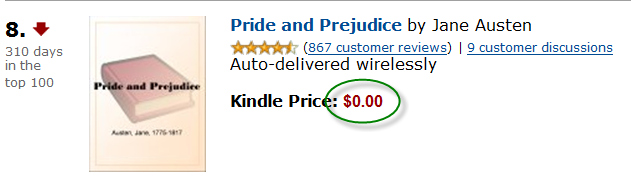
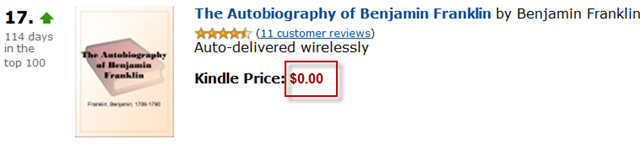
  • I now have access to a million (yes, a million) FREE books, letters, and essays that I can download in 60 seconds.  That alone is enough to justify buying the Kindle. Here are a couple of examples:

image

image

image

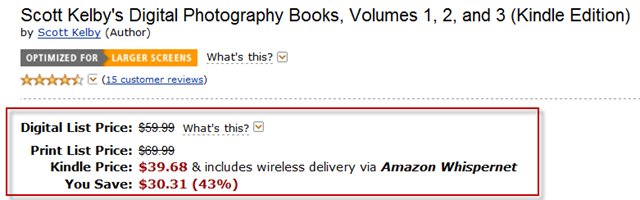
  • Virtually all Kindled edition books are cheaper than the printed versions.  For example, I purchased three volumes of a photography book.  I saved more than shown because I purchased each volume separately for only $9.99 each! I paid 29.97 for all three volumes compared to the normal price of $69.99, a savings of $40 or (57%).  Not even counting the free books, the Kindle pays for itself very quickly.

image

  • My library is full.  I have no more room for books and can’t afford new expensive bookshelves even if I had room.  However, I can store 1,500 books on the Kindle.  When I fill it, I can archive the one’s I’ve read on Amazon and download more books.  I can move books back and forth between the Kindle and Amazon, which means I’ll never be out of room.

  • I can read the books on my iPhone, my laptop, and the Kindle and they all sync.  That means if I read something on my iPhone and later open the same book or article on the Kindle, the Kindle version starts where I left off reading on my iPhone.

  • The books are archived safely on Amazon's servers. I don't have to worry about losing my books if the house burns down!

  • The new e-ink technology makes the Kindle read just like printed material.  It is not backlit there is no eye strain like there is when reading on a computer monitor.  It also means that the battery lasts much longer.

  • I can literally carry my entire library in my hand. I can read any book, essay, newspaper, magazine or blog—any place, any time, any where.  Great for the doctor’s office, on planes, etc.

  • I can highlight and annotate material and access my notes, annotations, clippings on my computer for using in articles, presentations, or for sharing with others.

  • Newspaper, magazines, and blog subscriptions are downloaded to my Kindle at night, while I sleep and before they are online or on newsstands.  When I get up to have my coffee, I can have my devotions and read the newspaper before the start of the workday.

  • I have free broadband 3g coverage via Sprint on the Kindle.  This means I can browse the web on my Kindle.  The browser is not great, but usable.

  • I can have a sample of any book or newspaper sent to my Kindle prior to buying.  This saves me from making expensive purchase mistakes.

  • I can search any book or my entire library on my Kindle by key word(s).

  • I have immediate seamless access to a built in dictionary and Wikipedia.  I can lookup anything without looking my place in the Kindle.

  • I have an always available “built-in” book light in on Kindle case (light and case sold separately).  I don’t have to find the book light.  It is always available with my Kindle.  This is great for reading in bed or on flights when I don’t want to disturb my seat mates.

Those are just a few reasons by I prefer the Kindle.  There are a few downsides:

  • Even though the Kindle can go two weeks without recharging (with wireless off), it still has to be charged.  Print books do not have to be recharged.

  • The Kindle is a computer with software, which means there will be occasional technical issues.  I’ve never had a technical problem with a book.  :-)

  • Although within limits you can share your Kindle account with other Kindle users (meaning you can share books with each other, e.g., family members), it is limited and requires that they have a Kindle. There is no restriction on sharing printed books.

  •   Some will argue that e-readers like Kindles don’t give the pleasure of holding a book in your hand.  Although I understand this concern, I believe it is over-stated.  First, there is nothing particularly pleasurable about holding a paperback.  Obviously, holding a nice leather bound book provides a certain pleasure, but who can afford many leather bound books?  Second, as indicated above, with a good leather cover on the Kindle, it feels like you are holding a good leather bound book.

  • A library in one’s study is beautiful, Kindles are not. I would not want to see a room full of Kindles.  :-) 

What are the implications for our schools?

  • It the trends are any indication, textbooks, newspapers, magazines, blogs, etc., will migrate to electronic versions.  The price point should be lower, saving schools money. 

  • We may finally be able to eliminate the heavy book bags that our students carry.

  • Lockers may no longer be necessary.

  • Curriculum can be updated more frequently, which is particularly important for science textbooks.

  • Students and teachers could have access to textbooks and other readings on cell phones, computers, and Kindles (or other e-book readers) simultaneously.

  • There may be a convergence of this technology into one handheld device.  It is rumored, for example, that Apple is working on an iSlate and Microsoft on a similar device.

  • Students can have access to the world’s best literature and historical documents—for free.

  • We can reduce the size of our libraries making room for more classrooms.

What are your thoughts about these developments?

Given the anticipated explosion in e-books and e-readers, what are your thoughts about the implications for our schools?  Would you promote the use of e-readers and e-textbooks as substitutes for printed textbooks and the traditional school library?  Do you see any intrinsic advantage or disadvantage to the move to electronic reading and publishing?