
This Year, Resolve to Build the Resume That Lasts: The Only One They Will Remember
/
Dr. Barrett Mosbacker
This time of year invites reflection on the past twelve months and planning for the next. We take inventory and ask what we did well and where we might improve. We resolve to be better and do better. Many make New Year's resolutions, some written, others held as mental goals.
Whether recorded on paper or kept in the mind, these resolutions aim toward becoming a better version of ourselves. They seek to close the gap between who we know we ought to be and who we find ourselves to be, between what we ought to do and what we actually do. We are like Paul: "For I do not understand my own actions. For I do not do what I want, but I do the very thing I hate" (Romans 7:15).
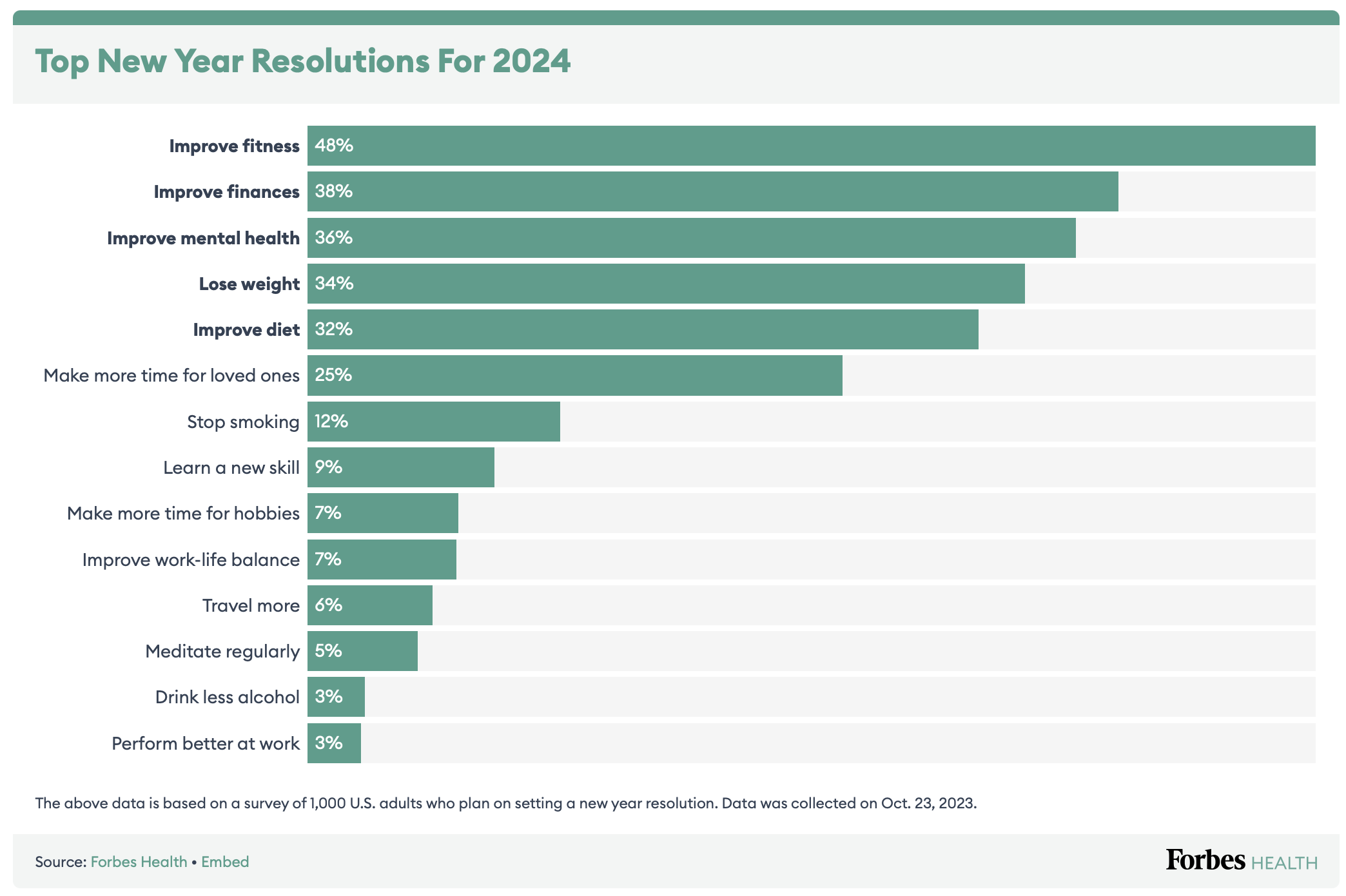
Research (1) confirms the difficulty of following through on our resolutions. Large-scale polls show that the long-term success rate for keeping New Year's resolutions is very low, settling between 6% and 9% of resolvers who maintain their goals for an entire year. The highest rates of failure occur immediately: approximately 23% of people abandon their resolutions by the end of the first week of January, and nearly half (43% to 47%) quit by the end of the month, often around the unofficial "Quitter's Day" (the second Friday in January). This chart (2) shows the top resolutions.
Resolve to Build Your Resume
While those are worthwhile goals, the most important and fruitful resolutions focus not on what we achieve but on who we become. In his book, The Road to Character, David Brooks distinguishes between two kinds of virtues:
Recently I've been thinking about the difference between the résumé virtues and the eulogy virtues. The résumé virtues are the ones you list on your résumé, the skills that you bring to the job market and that contribute to external success.
The eulogy virtues are deeper. They're the virtues that get talked about at your funeral, the ones that exist at the core of your being—whether you are kind, brave, honest or faithful; what kind of relationships you formed. Most of us would say that the eulogy virtues are more important than the résumé virtues, but I confess that for long stretches of my life I've spent more time thinking about the latter than the former. Our education system is certainly oriented around the résumé virtues more than the eulogy ones. (3)
Brooks's distinction reminds me of Jonathan Edwards's Resolutions,(4) which in many ways focused on building what we might call a eulogy resume. Here is what Edwards wrote:
I frequently hear persons in old age say how they would live, if they were to live their lives over again. Therefore, I am:
- Resolved, that I will live just so as I can think I shall wish I had done, supposing I live to old age.
- Resolved, never to do anything, which I should be afraid to do, if it were the last hour of my life.
- Resolved, that I will live so as I shall wish I had done when I come to die.
Not to be morbid, but Edwards essentially resolved to die without regrets because of how he lived. He was building a eulogy resume.
Living faithfully to resolutions like these produces a life well-lived, one honoring to God and a blessing to others. Unfortunately, we too easily find ourselves focused on our career resume rather than our eulogy resume. Many of our parents do the same, and consequently, so do many of our students.
As Christian educators, our privilege is to help our students build career resumes while doing the more important work of helping them build eulogy resumes. This requires that we begin with how we conduct our own lives.
How to Build a Eulogy Resume
To build a eulogy resume, we must focus on who we are, not solely on what we do.
Consider the common resolutions to improve fitness and health by exercising more and eating better. Those are worthy resolutions, but success depends on our self-discipline, a quality of character. Whether we follow through reveals who we are: disciplined and self-controlled, or lacking in self-control. In other words, character is the soil that nurtures good habits, which produce the good fruit of health and fitness.
Our character enables us to build a eulogy resume. And what shapes our character? Who and what we devote ourselves to.
1. Abiding in Christ
Abiding in Christ is the non-negotiable habit for changing and shaping our character for the better. Abiding in Christ is essential for producing good fruit in our lives and in the lives of others:
Abide in me, and I in you. As the branch cannot bear fruit by itself, unless it abides in the vine, neither can you, unless you abide in me (John 15:4).
Abiding in Christ requires cultivating a consistent personal devotional life in God's word, prayer, worship, and Christian fellowship. This is not complicated, but it is hard. We must build this into our schedule; it must be, in a sense, a "sacred appointment."
2. Cultivating the Fruit of the Spirit
But the fruit of the Spirit is love, joy, peace, patience, kindness, goodness, faithfulness, gentleness, self-control; against such things there is no law. (Galatians 5:22–23)
This fruit grows from time spent with Christ, in his word, and in worship and fellowship with other believers.
3. Cultivating Our Thoughts
It is often said that "We are what we eat." This is true because every cell, bone, and tissue in our bodies is built and maintained by the nutrients we consume. Physically, we are what we eat.
The same principle applies to our minds. What we read, watch, and listen to shapes the health of our souls. Good food contributes to good health; junk food to poor health. Likewise, reading the Bible and filling our minds with wholesome things contributes to soul health; absorbing junk entertainment in whatever form sickens the mind and the soul.
This is why Paul tells us in Romans 12:2:
Do not be conformed to this world, but be transformed by the renewal of your mind, that by testing you may discern what is the will of God, what is good and acceptable and perfect.
In the original Greek, the word for "transformed" is metamorphoo (from which we get metamorphosis). It implies a complete change from the inside out, suggesting that our thoughts are the "DNA" of our behavior.
Paul also instructs us in Philippians 4:8:
Finally, brothers and sisters, whatever is true, whatever is noble, whatever is right, whatever is pure, whatever is lovely, whatever is admirable—if anything is excellent or praiseworthy—think about such things.
We should frequently ask ourselves whether what we watch, read, and listen to is true, noble, pure, admirable, excellent, and worthy of praise. Or is it filled with negativity, violence, foul language, gossip and slander, and immorality?
Want to be a better person from the inside out? Spend time in God's word and with those things that ennoble heart and mind rather than degrade them.
4. Cultivating Eulogy Resumes in Our Students
The same practices that shape our own character must inform our work with students. What we cultivate in ourselves, we labor to cultivate in them.
This work is hard, and it takes time. Christian parenting and Christian education are hard work. But even though this is difficult and often frustrating, we must not, by God's grace, grow weary while doing it.
Persevering in this vital work becomes easier when we adjust our perspectives and expectations. Students do not develop at the same pace. Some grasp spiritual truths early; others struggle for years before the faith takes root. The following excerpt from a convocation speech by Robert Rayburn captures this reality and offers needed encouragement and perspective:
Christians are not the same. The Lord orders one life for one of his children and a very different life for another. This is true for little Christians as surely as it is true of adult believers. Just as some students are bright and others less so; some very athletic and others not; some outgoing and funny and others quiet and reticent; some popular and others more likely to be found alone, so some Christian young people have an easier time of it than others. Some struggle to grasp the faith as it concerns themselves, and it takes them more time. Some find it easy to be content, others are constantly restless. Such is the variety of human life and such is the variety of Christian life.
ll of this is, of course, immediately relevant to those responsible for Christian schooling. Christian students come in all shapes and sizes and can be found at many different points along the continuum of Christian spiritual development and maturity. It matters not finally so long as the nurture continues and the heart and mind mature. It is great godliness and usefulness that a Christian school is after in its students, and whether that godliness comes early or late is not, in fact, the most important issue. What finally matters is that it comes.
We go to the great expense and the great trouble and the great investment of time and energy because we have a theology of our children, a theology taught in Holy Scripture and made real in the experience of life. Our God promised to be a God to us and to our children. And the very best reason to do anything—anything, anywhere, anytime—is so as to practice the theology taught in Holy Scripture.(5)
As we enter a new year, let us resolve like Edwards that we will live as we shall wish we had when we are near the end of our lives. Let us devote ourselves to building eulogy resumes in our lives and in the lives of our students, so that at the end of our days, when we and our students submit our life resumes to the Lord, he may say, "Well done, good and faithful servants."
_____________________________
1. Batts, R. (2023, February 2). Why most New Year's resolutions fail. Fisher College of Business, Lead Read Today. https://fisher.osu.edu/blogs/leadreadtoday/why-most-new-years-resolutions-fail
Baylor College of Medicine. (2024). New Year's resolutions: Why do we give up on them so quickly? https://www.bcm.edu/news/new-years-resolutions-why-do-we-give-up-on-them-so-quickly
Drive Research. (2024). New Year's resolutions statistics and trends. https://www.driveresearch.com/market-research-company-blog/new-years-resolutions-statistics/
Forbes Health/OnePoll. (2023). New Year's resolutions statistics (2024). https://www.forbes.com/health/mind/new-years-resolutions-statistics/
2. Forbes Health/OnePoll. (2023). New Year's Resolutions Statistics (2024). Retrieved from https://www.forbes.com/health/mind/new-years-resolutions-statistics/
3. Brooks, D. (2015). The road to character [Kindle eBook]. Random House.
4. Edwards, Jonathan. "The Resolutions of Jonathan Edwards." Articles. Desiring God, December 30, 2006. https://www.desiringgod.org/articles/the-resolutions-of-jonathan-edwards.
5. Rayburn, R. S. (2008). The theology of Christian education [Convocation speech transcript]. Covenant High School Convocation.