
What a 1950s Housewife Can Teach You About Leadership Productivity
/By Dr. Barrett Mosbacker

My wife recently shared a fascinating video, “[20 Forgotten American Habits to Never Have a Messy Home Again].” I am fastidious when it comes to neatness, so the video resonated with me.
After watching it, I realized that many of the practical suggestions apply to leadership productivity, not just housework. Each leadership practice below mirrors a domestic habit from the video. The analogy is straightforward: what micro-maintenance does for a home, micro-discipline does for our productivity. Small, consistent actions repeated daily build lasting order, not heroic, stress-filled interventions.
1. Never Leave a Meeting Empty-Handed
Home Habit: Never leave a room without carrying something back to its proper place, and the “clean as you cook” kitchen flow, where dishes never waited and no soaking was permitted overnight.
Leadership Practice: Every meeting and most conversations produce at least one concrete follow-up action. Do not wait until the end of the day to deal with what the day produces. When possible, process the output of every meeting, observation, or decision as it happens. Immediately afterward, not later when you have forgotten the details, identify the task, assign the owner, and set the deadline. Convert notes into action items before you move to the next task. Return the phone call. Send the follow-up email. Draft the memo while the substance is fresh. If you allow tasks to “soak overnight,” details are forgotten, balls are dropped, and small issues harden into large problems just as food residue hardens on an unwashed dish.
A useful corollary is David Allen’s two-minute rule: if you can answer an email in two minutes, answer it now. If you can return a phone call in two minutes, return it now. If you can sign a form, write a note, or save a file in two minutes, do it now. The cumulative effect of dozens of two-minute actions completed on the spot is enormous. They never enter your task list, never occupy mental bandwidth, and never accumulate into the daunting backlog that steals afternoons and weekends.
I recommend blocking fifteen minutes before every significant meeting for preparation, reviewing the agenda and gathering materials, and fifteen minutes after for processing. Do not schedule meetings back to back. The margins before and after are where the real work of leadership happens. When you clean as you go throughout the day, you never face a mountain of deferred work at week’s end and the stress that accompanies it.
2. Establish Morning and Evening Anchors
Home Habit: Making the bed each morning and completing a brief nightly sweep to restore the home to order.
Leadership Practice: Begin every workday with a planning ritual: settle your heart and mind with Bible reading and prayer. After your devotional time, review your task list and identify the top three priorities for the day. Close every workday with a thirty-minute reset: review what you accomplished, update your task list, and set tomorrow’s agenda. These bookends frame every working day with intention and prevent you from beginning each morning buried beneath yesterday’s unfinished business.
Admiral William McRaven, in his 2014 University of Texas commencement address, argued that making your bed each morning establishes the first completed task of the day, building momentum and reinforcing that small disciplines produce large results. The same logic applies here: your first small act of discipline sets a standard, a habit, for everything that follows.
3. Clear Your Surfaces and Guard Your Calendar
Home Habit: The Good Housekeeping “clear and wipe” surface drill, where flat surfaces were never permitted to become landing zones, and the front-door mail triage, where every piece of mail was sorted, discarded, or filed the moment it crossed the threshold.
Leadership Practice: Your desk, your inbox, your task list, and your calendar are the “flat surfaces” of leadership. When they accumulate clutter, they become sources of anxiety rather than instruments of productivity. The method is triage. When information arrives, whether by paper, email, or other means, make an immediate decision: discard it, delegate it, act on it now, or file it for scheduled action or reference. Do not allow anything to pile up unsorted. At least once each day, clear your physical desk of stray papers and return items to their proper files. Process your email inbox to zero or near-zero. Review your task list and eliminate, delegate, or schedule every item.
These are pictures of my home study and office desks. I did not clean them up prior to these photos.

Home Study
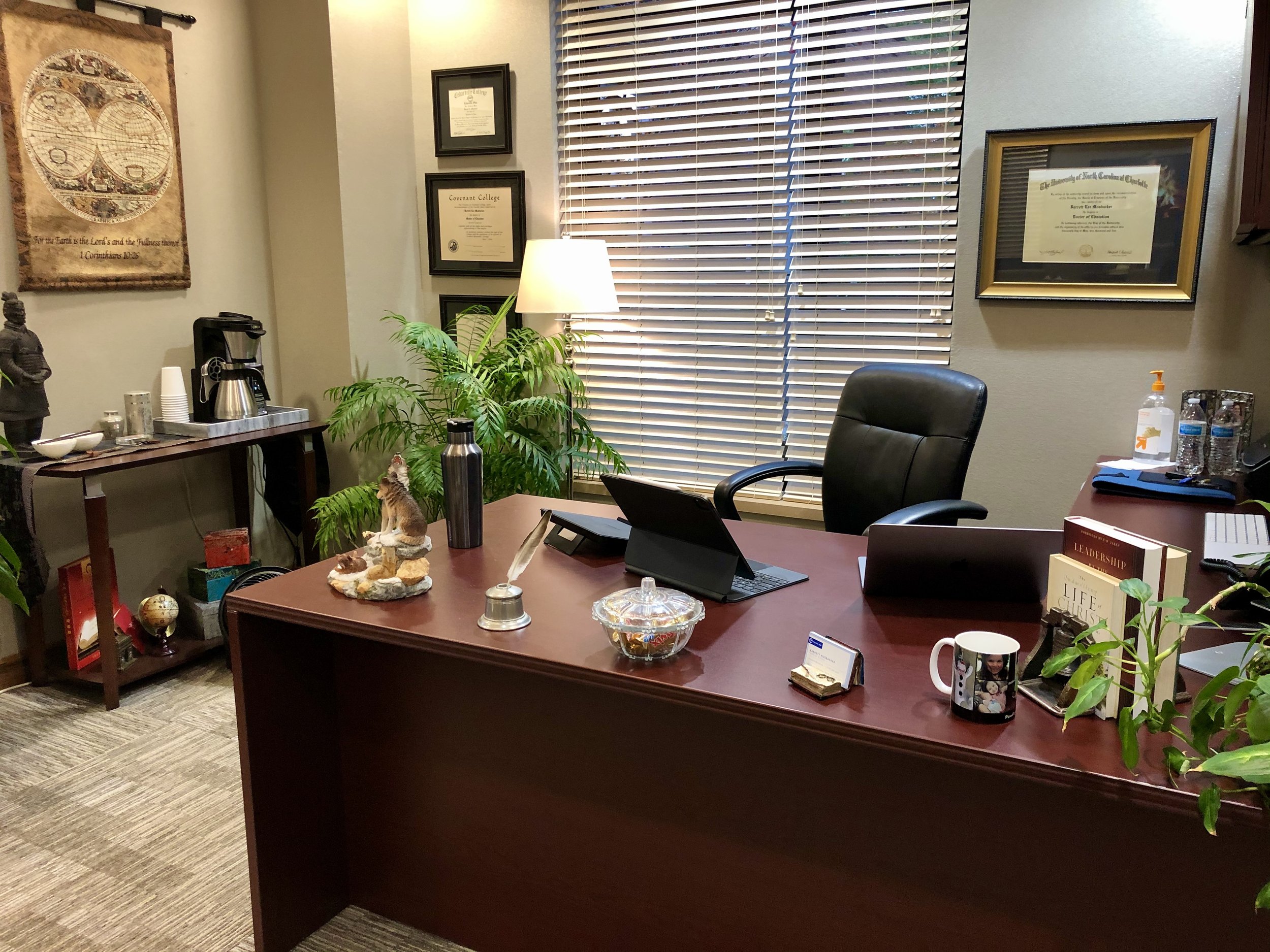
Work Desk
Apply the same discipline to decisions. When a decision lands on your desk that requires no additional information, make it immediately. Sign the form. Approve the request. Answer the question. The intermediate pile, the “I will get to it later” stack, is the leader’s equivalent of clean laundry draped over a chair. It wrinkles. It creates visual and mental clutter. It signals to others that you are slow to decide. Prompt action on routine decisions preserves your cognitive energy for the genuinely complex choices that require and deserve deliberation.
The same triage principle applies to your calendar. Before you allow any new meeting, commitment, or obligation to cross that threshold, ask: Does this serve my highest priorities? Can someone else attend? Do I need to accept this invitation? Is this the best use of my time and my school’s resources? Do not let your calendar manage you. Manage your calendar. If other people’s agendas consume your days, you will never accomplish the strategic work that only you can do. Plan your calendar; do not merely inherit it. As shown below, I block my mornings carefully to preserve time for deep work when I am freshest and most productive.
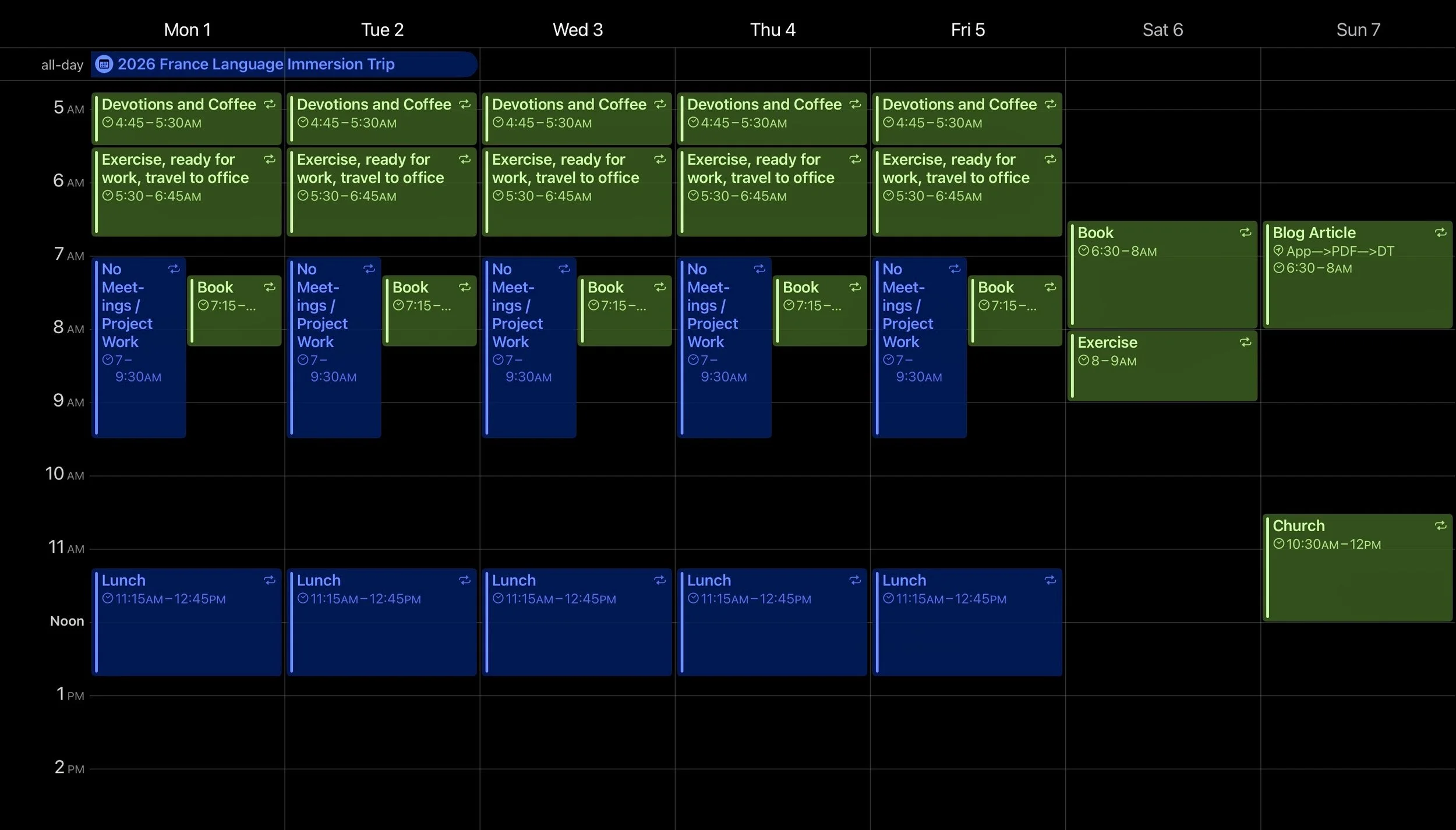
A sample weekly calendar showing protected time for devotions, deep work, and exercise.
4. Keep the Right Tools Within Reach
Home Habit: The Johnson’s cleaning caddy system, where supplies were stationed in every room so that the right tool was always within arm’s reach.
Leadership Practice: Portability is the leader’s caddy. Whether it is your iPad, a paper notebook, or your phone, ensure that the right information and the right tools travel with you throughout the day. If you observe a classroom and need to send a follow-up note, the tool should be in your hand. If an idea strikes during a conversation, your capture device should be ready. Consider a dictation app for verbal reminders on the move, or a Field Notes notebook in your pocket. The principle is the same as the cleaning caddy: when the tool is within reach, friction disappears, and you act now rather than later. When it is not, small tasks accumulate into large backlogs or vanish altogether.
5. One In, One Out
Home Habit: The cooperative extension “one-in, one-out” rule that prevented closets from overflowing by requiring that every new item displace an old one.
Leadership Practice: For every new program, initiative, committee, or task you accept, stop and ask: What will I stop doing? What can I delegate? What should I postpone? Time and resources are finite. If you add and never subtract, you create clutter just as surely as a household that never discards. I encourage you to practice disciplined, strategic subtraction. Fewer programs, executed with excellence, will always outperform a bloated portfolio of half-maintained initiatives. As Jim Collins counsels in Good to Great, the best leaders make as much use of a “stop-doing” list as a to-do list.[^1] This applies to you as a leader and to your school as a whole.
6. Distribute the Work
Home Habit: The day-of-the-week housekeeping chart that assigned every family member a clear role so that no single person bore the full burden.
Leadership Practice: Delegate deliberately. Focus your own time on what only you can do or what you do best, and distribute everything else. This is not abdication; it is stewardship of your school’s most constrained resource: the leader’s time and attention. Build systems that make delegation natural: standing meeting agendas, shared project trackers, and clear role descriptions. When you distribute the work, no single week becomes overwhelming, and your school develops bench strength.
You can also delegate to AI. Use it to draft correspondence, summarize research, format documents, and organize data, freeing your attention for the relational and strategic work that no machine can do. I highly recommend Daniel Pink’s video on The 6 Skills AI Will Never Replace.
7. The Ten-Minute Burst
Home Habit: The 1950s living room sweep, where a ten-minute burst of focused effort restored a room to guest-ready condition.
Leadership Practice: Dedicate short, focused bursts of energy to discrete tasks throughout the day. Ten minutes of concentrated effort on a cluttered desk, a backlogged email folder, or a stalled project can restore order and momentum. The key is focused intensity: close the door, silence the phone, set a timer, and work with singular purpose. These bursts are not a substitute for deep work but a complement to it. I find them especially effective for the administrative maintenance every leader must perform: the digital filing, sorting, responding, and organizing that keeps me moving forward with less stress and more effectiveness.
8. Address Problems Early and Build Preventive Systems
Home Habit: The micro-maintenance mindset that addressed crumbs, spills, and dust before they became visible problems, combined with the principle that well-stocked homes prevented messes before they started.
Leadership Practice: Ignoring problems does not make them disappear; it only allows them to accumulate and worsen. A small personnel issue left unaddressed becomes a toxic culture problem. A minor budget variance left unchecked becomes a significant fiscal concern. Address problems quickly, before they snowball into something far more costly in time, resources, and relational capital. The leader who addresses issues as they arise spends far less time in crisis management than the leader who waits for the mess to become unavoidable.
The best leaders, however, go further. They do not merely address problems early; they build systems that prevent them. A clear employee handbook prevents misunderstandings. A well-designed onboarding process prevents early attrition. A regular schedule of parent communication prevents the information vacuum that breeds rumor, gossip, and false narratives. Ask yourself: What policy, procedure, or practice, if I implemented it now, would prevent this from happening again? School-wide order, like domestic order, rests not on heroic intervention but on the quiet practice of prevention. Build the systems and the right habits, and the crises will diminish.
9. Build the Flywheel and Leverage Every Transition
Home Habit: The “never leave a room empty-handed” principle, where dozens of micro-actions per day created compounding momentum that made order feel effortless.
Leadership Practice: Jim Collins describes the flywheel effect in Good to Great: no single push creates breakthrough momentum, but many small, consistent pushes in the same direction eventually produce unstoppable force. Every micro-action you take, every decision you make promptly, every problem you address early, every meeting you process immediately, adds another push to the flywheel. Over weeks and months, your school gains a momentum that makes excellence feel natural rather than forced. The flywheel does not require you to work harder. It requires you to work consistently in the right direction. Think of the formula this way: focused intensity multiplied by time equals momentum.
One practical way to feed the flywheel is to leverage transitions. The walk between buildings, the drive between campuses, the five minutes before a parent arrives for a meeting: these are not dead time. They are transition moments you can put to work. Use the walk to dictate a voice memo. Use the drive to return a phone call (hands-free). Use the five minutes to review the parent’s file and compose your opening remarks. When you leverage transitions, you reclaim hours each week that would otherwise vanish. Never move through your day empty-handed. Every transition is an opportunity to carry something forward.
10. Create Environmental Cues
Home Habit: The science of habit loops described in the video: linking a cue (crossing a room threshold) to an action (carrying something back to its place) creates automatic behavior.
Leadership Practice: Design your environment to trigger productive habits. Place your Bible and devotional book on your desk so they are the first things you see each morning. Set your task manager to open automatically when your computer starts. Keep a notepad beside your phone for immediate capture during calls. The principle from James Clear’s Atomic Habits applies directly: reduce the friction for good habits and increase the friction for bad ones.[^2]
Let me offer a personal example. I exercise early most mornings, but I discovered that the small friction of gathering workout clothes was enough to weaken my resolve on tired mornings. So I began placing my exercise clothes on the bathroom scale the night before. When I step into the bathroom, the clothes are the first thing I see, and changing into them becomes the path of least resistance. By the time I am dressed, the decision to exercise has already been made. The cue removed the friction, and the habit became nearly automatic. If you rely on willpower alone, you will eventually exhaust it. Design your environment so that discipline becomes the path of least resistance.
11. It Is the Marathon, Not the Sprint
Home Habit: The video’s concluding truth: “Lasting order is not about cleaning harder. It is about living differently.”
Leadership Practice: Sustainable leadership productivity is not about working harder, longer, or faster. It is about leading differently, about building micro-disciplines into the fabric of your daily leadership so thoroughly that they cease to require conscious effort. The sprint mentality produces burnout, resentment, and diminishing returns. The marathon mentality produces compounding gains, stability, and a leader who finishes well.
Do not attempt to implement all eleven of these practices at once. That approach mirrors the frantic weekend cleaning marathon: exhausting and unsustainable. Instead, review the principles below, select a few that address your most pressing needs, commit to them for thirty days, and allow them to become habitual before adding the next.
- Never leave a meeting empty-handed. Process follow-up actions immediately.
- Establish morning and evening anchors. Begin with planning; close with a reset.
- Clear your surfaces and guard your calendar. Triage information and decisions on arrival.
- Keep the right tools within reach. Eliminate friction between observation and action.
- One in, one out. For every new commitment, ask what you will stop doing.
- Distribute the work. Delegate deliberately and build systems that sustain it.
- The ten-minute burst. Use short, focused intervals to restore order and momentum.
- Address problems early and build preventive systems. Act before small issues harden into crises.
- Build the flywheel and leverage every transition. Consistent micro-actions produce compounding momentum.
- Create environmental cues. Design your surroundings to trigger productive habits.
- It is the marathon, not the sprint. Sustainable discipline outperforms heroic effort every time.
Small changes compound over time precisely because they are sustainable. If you master a few micro-disciplines each month, within a year you will have transformed the rhythm and productivity of your leadership, not by revolution, but by the slow and patient evolution of better habits. One habit at a time, one day at a time, one faithful action at a time.
These eleven practices share a single conviction: leadership order, like domestic order, is built in moments, not marathons. If you wait for a retreat, a strategic plan, or a new semester to impose order, you will always be overwhelmed. If you act now, in the small and consistent rhythms of daily leadership, you will find that excellence becomes habitual and that your school begins to run with a momentum all its own.
[^1]: Collins, J. (2001). Good to great: Why some companies make the leap… and others don’t. HarperBusiness.
[^2]: Clear, J. (2018). Atomic habits: An easy & proven way to build good habits & break bad ones. Avery.