Why Don't Christians 'Get It?': And All Jerusalem With Him

Guest article by Mark Kennedy, ACSI Canada

Do you ever wonder why so many North American Christians ‘don’t get it’ about Christian schooling - why some of the people who should be happiest about Christ’s advent in the realm of education treat Christian schools as unwanted interlopers or even as threats. That kind of spiritual paradox isn’t new. Matthew 2:3 recounts Herod’s reaction to the Messiah’s birth in his kingdom: “He was disturbed”. That’s not a surprise really. History tells us Herod sold out his Jewish heritage for the power, prestige and plunder that complicity with the Roman Empire brought. His lifestyle and privileged position were endangered by “the one who has been born King of the Jews.” But the really troubling statement doesn’t have much to do with Herod. Not only was he disturbed “but all Jerusalem with him.” Now that’s kind of shocking. You’d think the citizens of Jerusalem, the centre of the Jewish religion, would be overjoyed at the news, but they weren’t. In religion or education or any other area of life, the coming of the living Christ is a threat to those who embrace the status quo.

In education:

  • He’s a threat to people who assume current secular education is the same as it was in those rosy days of yore when ‘public schools’ meant ‘protestant schools’.
  • He’s a threat to those who bought into the myth of a neutral education. A school system that doesn’t permit children to learn about him isn’t neutral. It shuts out  the most important realities about life and learning.
  • He’s a threat to people who believe that the primary purpose of life, even for children, is evangelism. Jesus gave us a different priority. He said the greatest commandment is to love the Lord our God with all our heart and soul and mind and strength. Evangelism is only one result of obeying that commandment.
  • He’s a threat to those who believe that reality is broken into religious truth and secular truth. Fact is there’s only one kind of truth. And either it’s all God’s truth or none of it is.
  • He’s a threat to people who dismiss Christian education because they know of a Christian school that operates badly.  I know of a few churches that don’t do a very good job at their ministry. But that doesn’t give me an excuse to spend my Sunday mornings at the Loyal Order of Water Buffalos Lodge. That’s because a Christian school, like a Christian church, is meant to be a place to meet Christ and grow in Him. And believers need to support churches and schools that still do that.
  • He’s a threat to people who think that a couple hours of Christian training a week can equip a child against the influences of 30 plus hours of weekly secular education, many more hours of anti faith media and an increasingly complex anti Christian society.
  • He’s a threat to people who believe that Christianity is only about a transformed heart. In Romans 12 Paul tells us not to be conformed to the patterns (i.e. way of thinking) of the world but be transformed by the renewal of our minds. E. Stanley Jones expressed it well, “A Christianity that addresses the heart but not the mind will not long hold the heart.” Christian schools help transform minds by teaching a biblical worldview.
  • He’s a threat to people who think that teaching about the Creator of all truth and His creation is somehow sheltering students from reality.

The Academy Award winning movie, The Bridge on the River Kwai, tells the Second World War story of British soldiers in a Japanese prisoner of war camp. In order to alleviate the extreme suffering of his men, the senior British officer, Colonel Nicholson, agrees to build a bridge for his Japanese captors. And with its construction conditions for the British captives improve. The bridge becomes a  source of pride especially for Colonel Nicholson. After all he and his men have invested their lives in it. Then one day he is shocked to find a stranger, a British commando, planting explosives in order to blow the bridge up! He is emotionally torn. Should he warn the Japanese about this threat to ‘his’ bridge? In the end he come to his senses and realizes that even though his men built the bridge it belongs to Japan, and above all else he and the commando are on the same side fighting a common enemy.

Christians built the public educational systems in North America and they built them well. But now it is clear that those systems are no longer Christian in any sense. Let’s hope that more believers will come to realize that the educational status quo is fatally flawed, that Jesus’ advent in the realm of education is not a threat and that Christian schools are on their side.



How to Turn Parents Into Raving Fans

By Dr. Barrett Mosbacker

Sometimes the blogging “gods” smile upon you!  For years now I have promoted the concept, that I first heard from Dr. Kynerd, that it is best to Under Promise and Over Deliver when dealing with our parents and employees.  Although I often promoted this approach as essential for building good will, I had never heard or read others promoting this approach—until now.

While reading the Wall Street Journal I stumbled upon following article.  Although written for business leaders and owners. it has direct applicability to our schools—after all, our parents and students ARE CUSTOMERS.

How to Turn Customers Into Loyal, Raving Fans, By MIKE MICHALOWICZ-WSJ

Do you want satisfied customers or do you want customers who are so thrilled with your company they become loyal, raving fans? I'll take option No.2. Satisfied customers may come back a second or third time; they may even become regulars. But unless you exceed expectations, your satisfied customers could just as easily become your competitors' satisfied customers.

If you want customers who are so loyal that they would never think of going to anyone else, and if you want customers who are so thrilled with your business that they tell everyone how amazing you are, then you're going to have to move the goal line beyond mere "satisfaction." You're going to have to wow everyone who walks through your door.

Now, I'm sure you could come up with loads of ideas that would dazzle your customers, but there's actually a simple shortcut to knocking their socks off every single time – and it won't cost you a dime. It's the "under-promise, over-deliver" (UPOD) method.

When we talk about "customer satisfaction," we strive to deliver on our promises. Complete the market study by Friday, as promised. Deliver the new couch in July, as promised. Provide two valet attendants, as promised. When you do exactly as you said you would, you end up with satisfied customers. But when you give them something more than they expect -- faster service, extra help, more options, early delivery and so on -- you end up with the loyal, raving fans you need to propel your business into the stratosphere.

The idea behind UPOD is that people are most favorably influenced by great service they don't expect, rather than great service they do expect. And they expect it because you promise it. If you tell customers they will get their new shoes the next day, and the shoes arrive the next day, those customers will be satisfied, maybe even happy. But if you tell customers they will get their new shoes in five days, and the footwear arrives the next day, your customers will be amazed and thrilled.

Here's the trick with UPOD: It's not about doing things faster or throwing in "extras." It's about building the "under-promise" part into the equation from the start. If Friday is the earliest you can complete a study, then promise to have it done the following Wednesday. "Surprise! We finished early." If you know you will deliver a couch in July, promise to have it there by August. "Great news! We wanted you to have it as soon as possible!" Build a business model in which you have enough income to cover three valet attendants, promise two, and the day of the party, send over three. "We just thought you could use the extra help. No extra charge."

Most businesses know UPOD is a good practice, but few adhere to it because people think they have to change their operation to wow customers. Just take this very simple shortcut: Change your promise.

Using UPOD will also help you avoid mistakes that inevitably occur when people rush to meet deadlines. It will enable you to respond positively to last-minute requests and help you stay calm, cool and collected as you work surprisingly reasonable hours. Most importantly, when you under-promise and over-deliver, you will inspire satisfied customers to become devoted customers – and that's money in the bank.

Take a few minutes to reflect upon this article and then jot down ways in which you can apply the UPOD principle to your leadership or your classroom.  Also reflect upon how UPOD is consistent with Jesus’ command that we are to:

You have heard that it was said,  An eye for an eye and a tooth for a tooth. But I say to you, Do not resist the one who is evil. But if anyone slaps you on the right cheek, turn to him the other also.  And if anyone would sue you and take your tunic, let him have your cloak as well. And if anyone forces you to go one mile, go with him two miles. Give to the one who begs from you, and do not refuse the one who would borrow from you. (Mt 5:38-42)

Are You Spread Too Thin? How to Thrive and Not Merely Survive as a Christian School

image

By Dr. Barrett Mosbacker

I recently read an interesting article by the CEO of Yahoo! titled The Peanut Butter Manifesto. Click here to read the memo. I highly recommend it to you.

For the purposes of this blog article I want to focus on the following statement from the memo because it is instructive for us as school leaders.

"We lack a focused, cohesive vision for our company. We want to do everything and be

everything -- to everyone. We've known this for years, talk about it incessantly, but do nothing to fundamentally address it. We are scared to be left out. We are reactive instead of charting an unwavering course. We are separated into silos that far too frequently don't talk to each other. And when we do talk, it isn't to collaborate on a clearly focused strategy, but rather to argue and fight about ownership, strategies and tactics ...

I've heard our strategy described as spreading peanut butter across the myriad opportunities that continue to evolve in the online world. The result: a thin layer of investment spread across everything we do and thus we focus on nothing in particular."

Spread Too Thin: Strategic Allocation of Limited Resources

The Christian school movement is not particularly healthy. Based on recent statistics that I have seen, the number of Christian schools and overall school enrollments are stagnant or declining.

image

Although there are external forces beyond our control that affect our schools, many of our problems are self-inflicted. One of our self-inflicted wounds is similar to that articulated by the CEO of Yahoo!--we are often not strategic in the allocation of our tangible and intangible resources and as a consequence we are not offering a substantial marginal value to our current and potential clients. I am referring to our parents a clients because notwithstanding our missions as Christian schools, our parents are essentially paying clients who make economic calculations in deciding whether to enroll or re-enroll their children in our schools.

School Finance 101

image

If there is one unalterable truth about school resource management, it is this: the laws of economics do not discriminate. The laws of economics apply equally to both religious and non-religious institutions, regardless of their mission. The laws of economics are not religious.

Economic laws, like physical laws, apply universally to all regardless of one’s religion, one’s motives, or one’s hopes and dreams. Economic laws can no more be circumvented than the law of gravity because the laws of economics are as much a creation of God as the laws of physics.

The laws of economics are the laws of God. They are in the same way that the laws of physics are the laws of God … They are the laws of God because it is He that decrees the existence of the entities whose nature it is to obey those laws: had He wanted other laws He would have had to create other things ….Like physical laws they are necessary but only hypothetically necessary. They work positis ponendis. In other words, these laws are formulated in terms of “if then” statements. Economic laws do not tell us what human beings will or will not do, how they will behave, [nor how they ought to be behave]. They tell us rather what will happen if human beings behave in certain ways.... [Emphasis added] (Sadowsky, 2005, p. 3)

Assuming that God will suspend the laws of economics because the school is a ministry, too many Christian school leaders believe they can violate those laws with impunity. With the best of intentions, usually with the goal of making Christian education affordable for everyone, many administrators and boards establish financial policies that violate basic economic principles, good business practices, and common sense.

School leaders have a responsibility to understand and to apply economic laws and sound financial practices to the management of their schools. Failure to do so is a failure to apply the very biblical worldview to school management that is its raison d'être.

The Cost of Excellence

A basic law of economics is that for an organization to survive, let alone thrive, its revenue must equal or exceed its costs. This is just as true for “Pearly Gates Christian School” as it is for IBM. Common sense enough but it is surprising how many intelligent people violate this basic axiom of economics when filling a leadership role in the Christian school. Motivated by the laudable desire to provide a Christian education to as many children as possible, many school leaders abandon common sense. Sadly, such well-meaning intentions threaten the survival of the very ministry they so earnestly believe in.

image

Artificially low tuition is one example of violating basic economic law. Yet many administrators and boards routinely establish tuition rates below the actual cost to educate and compound the problem by providing multi-child and vocationally-based tuition discounts regardless of parents’ ability to pay. With inadequate revenue, programs are often under funded, limited, and of mediocre quality. Shallow fine arts programs, out-dated and/or underutilized technology, limited foreign language offerings, and limited or non-existent programs for gifted and special needs students are common.

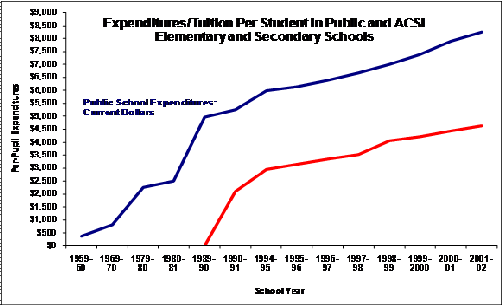
Providing a world-class Christian education cannot be done on the cheap, it is expensive. According to the NCES (2004a), expenditures for public and private education were estimated at $866 billion for 2003–04. Expenditures for elementary and secondary schools alone were estimated to total $514 billion.

Public school per pupil expenditures for the 2001-02 school year averaged $8,259. By comparison, tuition per pupil in ACSI member schools in the same year averaged $4,642, a difference of $3,617/student . The figure below illustrates per pupil expenditures in public and ACSI member schools.

clip_image003

Sources: U.S. Department of Education, National Center for Education Statistics, current expenditure per pupil in average daily attendance in public elementary and secondary schools, by state or jurisdiction: Selected years, 1959-60 to 2001-02. http://nces.ed.gov/programs/digest/d04/tables/dt04_168.asp. Association of Christian Schools International (ACSI) 1990-01 to 2001-02. By using non-tuition revenue, such as fund raising and church subsidies, actual per student expenditures are higher than tuition levels may indicate. In many Christian schools, tuition levels are set below the actual cost to educate.

This 44% differential is “funded” by paying below market compensation, through fundraising and/or church subsidies, by offering programs of limited scope and marginal quality, and/or by incurring debt.

From Cartoonstock.com

Cartoon from Cartoonstock

Many Christian schoolteachers bear the burden of subsidizing below cost tuition rates through low salaries and poor benefits. Sixty-eight percent of teachers employed in ACSI member schools with at least 10 years of experience earn less than $30,000 per year, (Association of Christian Schools International, 2005). By contrast, statistics from the NCES (2002) show that the average starting salary for teachers with no experience in public charter schools that used a salary schedule was $26,977, compared with $25,888 for public school districts.

Education is a labor-intensive enterprise with labor costs typically representing 65 to 80 percent of a school’s entire operating costs, (William J. Fowler & Monk, 2001). The combination of below cost tuition and high labor costs results in artificially depressed salary levels making staffing the school with highly trained and competent teachers throughout the program difficult, especially at the secondary level.

image

Low salaries and poor benefits often produce high staff turnover creating discontinuity in the academic program. The applicant pool is small, forcing the administrator to hire the “best available” from a pool of relatively mediocre teachers. The result is poor to average instructional and academic quality, the loss of parental confidence, low student retention rates, especially at the upper school level, and a reputation for mediocre quality.

Many Christian leaders find themselves caught in a vicious and self-defeating cycle. Under funding produces poor quality, which in turn restricts enrollment levels and school revenue. To increase revenue, school leadership needs to raise tuition rates but many current and prospective parents do not believe that the school’s quality justifies the higher cost. Parents choose to leave or not to enroll their children in the school in the first place. In a desperate attempt to stem the loss of students or to stimulate enrollment, tuition continues to be set below actual cost thus perpetuating the cycle.

Supply and Demand

image

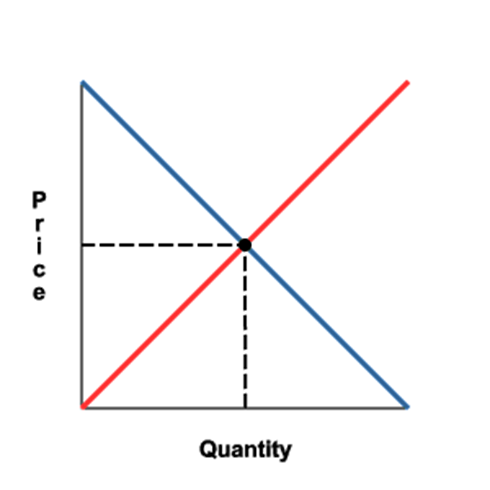
The theory of supply and demand is one of the most basic in economics. Simply stated, supply is the amount of product or service that a business or organization is willing or able to provide at a specified price. Demand is the amount of product or service that a consumer is willing to buy at a specified price, (International Society for Complexity Information and Design, n.d.). Modifying this definition for the Christian school market, the definition may read as follows; supply is the quality of education that a Christian school can provide at a specified tuition level while demand is the amount of tuition that parents are willing to pay for the perceived value of the education provided. Everything else being equal, demand (enrollment) will be strong when the market (parents) believe that the school provides a quality of education valued at equal to or above the tuition charged. If enrollment is stagnant or declining this is a sign that the market does not perceive the value offered to be equal to the tuition charged.

Common sense enough, but things are a bit more complex than the foregoing definition implies. To grasp more fully the economics of Christian schooling, two other economic principles need to be considered; price elasticity of demand and marginal value. Relax; this is not as bad as it sounds!

image

Elasticity refers to market sensitivity to price changes. Demand for very price elastic products or services will vary significantly based on price. Relatively small increases or decreases in price will have a significant impact on demand. On the other hand, demand for products and services that are price inelastic is relatively stable even with relatively wide swings in price. For example, farmers face a relatively inelastic market; modest increases or decreases in groceries have only a modest affect on consumer demand for staples. However, airfares are elastic; even slight price increases or decreases in airfare can dramatically affect ticket sales.

There are several factors that affect elasticity of demand (QuickMBA, 2004):

· Availability of substitutes, the more possible substitutes, the greater the elasticity,

· Degree of necessity or luxury: luxury products tend to have greater elasticity. Some products that initially have a low degree of necessity are habit forming and can become "necessities" to some consumers, e.g., the microwave and the cell phone.

· Proportion of the purchaser's budget consumed by the item: products that consume a large portion of the purchaser's budget tend to have greater elasticity.

For the Christian school this means that, other factors being constant, the availability of schooling options in the community will affect the administration’s ability to increase enrollments and what can be charged for tuition. The more options, the more elastic tuition rates will be. Likewise, the fewer alternatives that parents have, the less elastic tuition will be.

The quality of alternative educational options will also affect tuition elasticity. If area public and private schools are considered poor relative to the local Christian school, enrollment in the Christian school may be perceived as more of a necessity than it will be if the community is blessed with a large number of high quality public and private schools. In the latter case, parents have a smorgasbord of quality educational options. If parents perceive the local public schools to be safe, high quality learning environments, they are more likely to consider enrollment in the Christian school to be a discretionary “luxury” purchase. Only the most diehard adherents to a Christian philosophy of education will consider enrollment in the Christian school a necessity. If on the other hand, local schools are perceived to be unsafe and of poor quality, “purchasing” a Christian education is more likely to be considered a necessity, making tuition levels less elastic.

The Archdiocese of Chicago provides a compelling example of this principle. Faced with declining enrollments and a school deficit of $20 million, the Archdiocese commissioned a study to determine how to boost school enrollment. Boffetti (n.d.) reports that researchers discovered that:

Struggling schools, at the very least, needed to fill every available seat with tuition-paying students. Surprisingly, many inner-city parents, both Catholic and non-Catholic alike, did not know that Catholic education would only cost them $1,000 a year, with the diocese picking up the rest of the tab. When they learned the facts, many said they would eagerly pay to get their children out of the awful and dangerous public schools they were in.

image

Suburban parents were more sanguine. Parents who believed in the importance of Catholic education already sent their children to Catholic schools. The rest of the parents did not think it would be worth the added expense because they felt that their suburban public school system was at least equal to, if not better than, the Catholic schools in terms of academics and amenities [emphasis added]. In other words, the “Catholic” in Catholic education was not worth an extra $1,000 per year to them. (pp. 7-8)

Marginal Value

image

A closely related concept to elasticity is marginal value. Simply stated, marginal value is the amount of benefit perceived by purchasing an additional “unit” of a product or service in terms of other goods or services. Several factors influence marginal value: price and perceived value being among the most important. Brimley and Garfield (2002) define the marginal dollar (a way of understanding marginal value) as the dollar that would be better spent for some other good or service. In other words, as applied to the Christian school, marginal value or the marginal dollar can be understood as the calculation that parents make that an incremental increase in tuition, either at the school their children currently attend or at competing schools, is worth more than say a nicer home, car, or vacation. That is, as tuition increases, parents make a calculation that the added cost is or is not producing an incremental value equal to or greater than the increase in cost relative to other educational options and other purchases. If parents do not perceive the quality of education provided to be of more value than other options, parents will choose those options.

The impact of marginal value calculations made by parents is seen in the typical attrition rate from junior to senior high common in many Christian schools. Many parents conclude that the added cost of four years of Christian schooling is not justified relative to the breadth of programs offered by local high schools.

The reflex response by many school leaders is to assume that the way to increase the marginal value of their schools is to keep tuition low. This is certainly an important element in maintaining value. Another approach, however, is to increase the incremental value of the education provided relative to tuition charged by improving quality, expanding programs, hiring better teachers, and enhancing facilities. In other words, value can be increased by giving parents more for their tuition dollars. The balance between quality and cost produces a perceived value; it is perceived value relative to other educational options and other purchases that determines the willingness of parents to purchase a “Pearly Gates Christian School” education for their children.

Strategic Budgeting for Marginal Value

image

There are many ways to increase a Christian school’s marginal value: three of the most important are:

  • Hiring superior teachers,

  • Effective integration of technology, and

  • Careful stewardship of existing funds.

To accomplish these goals school leadership should engage in strategic budgeting in contrast to default budgeting. Default budgeting is budgeting based on current realities, existing exigencies, and existing allocations. By contrast, strategic budgeting aligns planned expenditures to strategic initiatives designed to enhance marginal value. Leadership allocates funds based on the school’s strategic plan, not merely on existing spending patterns.

Strategic Budgeting: Personnel

For example, because a school is only as good as its teachers, one of the most powerful ways to increase marginal value is to establish a long-term plan to enhance the school’s ability to recruit, hire, and retain superior teachers by offering competitive salaries and benefits. To accomplish this goal, prayerful, strategic, and sometimes hard decisions have to be made concerning the existing allocation of resources. Are there personnel who need to be let go? Are there curriculum offerings that need to be dropped? Are there programs that need to be eliminated or reduced?

image

image

Suppose the school offers a home economics course. The administration may have established this course several decades ago because it met a need at the time. This course is assigned a teacher and allocated resources. However, there are only 30 students enrolled out of a total of 500 high school students. Given cultural changes, marginal value would be increased by eliminating this class and allocating the funds for a media literacy or graphics design course. Such a course would serve a greater number of students and would increase the value parents are receiving for their tuition dollar.

Reevaluating the standard salary scale is another example of strategic budgeting. The basic idea is to create salary ranges designed to differentiate pay based on market supply and demand. Under such a plan there may be different compensation ranges for different classifications of teachers, e.g., for scarce specialty teachers and personnel such as advanced math and science teachers or technology specialists.

The idea of creating differentiated salary ranges whereby certain teacher classifications are paid more than others is counterintuitive for most educators. Educated and trained in a system in which teacher salaries are based on experience and credentials, regardless of competence and market conditions, is deeply ingrained in the psychology of school leadership and in the structure of schooling.

image

However, to put differentiated pay into a larger context, it is helpful to note the following research findings as reported by the Educational Research Service’s report, Teacher Compensation and Teacher Quality (Goldhaber & Eide, 2003).

Current teacher quality and staffing issues have affected some subject areas more than others. For example, studies have shown that teachers of math and science have some of the highest levels of attrition among all teachers. Additionally, some schools face teacher quality issues with the math and science teachers who do remain in the classroom….

The fact that teacher shortage and teacher quality issues affect math and science especially severely can be explained with the teacher labor market and the single-salary schedule. Lakdawalla (2000) found that the returns to technical skills have outpaced the returns to teaching skills. Teachers with math and science skills are most likely to be able to have high-paying technical jobs as viable career alternatives. This means that the opportunity cost for math and science teachers has grown more than the opportunity cost for all other teachers….

We find that the shortage for math teachers is greater than that for history teachers, because the wages of teachers are inflexible. Thus, schools will have more difficulty hiring math teachers with an adequate level of training and also face greater levels of attrition in the current math teacher labor force….

Goldhaber highlights the severity of the problem of finding and retaining highly qualified math and science teachers for most schools…

This leaves schools with difficult choices and challenges. They could procure and devote unprecedented amounts of money toward teacher compensation [or] differentiate salaries by teacher skills…[emphases added]

It is quite likely that schools will have to raise compensation for math and science teachers in order to compete with the private sector and attract individuals with technical expertise in those areas. The above point suggests a need to restructure teacher compensation and move away from the single-salary schedule…and should include concepts such as the supply and demand for particular teacher skills. (pp. 38-52)

When assessing teacher compensation, it must be borne in mind that money is not the primary motivator for teachers. If it were, many would have chosen a different profession. Hiring teachers intrinsically and passionately committed to the ministry of Christian education is critically important to ensuring that teachers are kingdom rather than self focused.

Nevertheless, the “workman is worthy of his hire.” Creating differentiated pay ranges has the benefit of positioning the school to recruit and retain the finest faculty available while not requiring the uniform and universal raising of all salaries. The result is that the school is able to attract advanced science and math teachers while simultaneously avoiding the large tuition increases that would result from adjusting the entire salary scale upward. It also enhances the marginal value of the school by increasing quality and minimizing tuition increases.

Strategic Budgeting: Technology Integration

image

Leadership can significantly enhance marginal value by enriching the academic program through integrated instructional technology. The key concept is integrated. The vast majority of both ACSI and CSI member schools offer computer classes. Very few integrate the technology into daily instruction.

Technology integration means that technology is an instructional tool, not merely a subject of instruction. Integrated technology is the seamless infusion of technology in both instruction and learning so that technology becomes a ambiguous tool used by both students and teachers. It goes beyond computer labs to the natural incorporation of technology into teaching and learning as naturally as a white board and notebook. Using technology for the sake of using technology is not the objective. The objective is to use technology to enhance teaching and learning when it is the most effective way to teach and to learn. Technology is not the end; it is the means.

The following abridged example of technology integration for a high school class illustrates the concept. Although designed for high school, this lesson could be easily modified for junior high students.

Lesson objective: Students will deepen their understanding of the relationships between social and human capital and the creation of wealth in a first and third world country.

Lesson Content and Assignment:

· The teacher will provide background reading and lectures on social and human capital, biblical concepts of economic justice, fundamental principles of economics, and the impact of educational attainment on the creation of individual and national wealth.

· Students are to use library and Internet-based resources to research economic, demographic, and educational data for both a first and third world country using resources just as the CIA Fact Book, the Library of Congress, the U.S. Census, the World Bank, International Monetary Fund, etc.

· Data is to be collected using an Access database. Students will export the data to an Excel spreadsheet. Graphs are to be created depicting important data. Working with the math department, students will run a simple correlation analysis using Excel or a program such as SPSS.

· Students will use Word to write an eight-page research report. The report is to include embedded Excel charts and graphs. The report is to be in MLA format using Endnote for the citation of references and the creation of the reference section. This written report is to provide a discussion of biblical principles of social justice, a summary of research findings, and conclusions regarding the relationship between social and human capital to the creation of wealth in a first and third world country. Students are then to answer the following question: “What does this mean to me?”

· Students will use PowerPoint to present a five-minute summary of their findings.

Assessment:

· Students will be assessed using both a traditional assessment (test) and an authentic assessment. The authentic assessment is the quality of the research, the quality of the written report, the quality of technology use and integration, and the quality of their presentations. The teacher will use a rubric to evaluate the authentic assessment.

A useful middle school example is Was It Murder? The Death of King Tutankhamun: The Boy King. This lesson can be found at the following Internet site: http://www.pekin.net/pekin108/wash/webquest/.

Unfortunately, there is little evidence that Christian schools are integrating technology in a manner even close to the lessons described above. In a national study designed to assess the current level of technology access and integration, defined as Technology Level, in CSI and ACSI schools, Mosbacker (2005) found that the majority of CSI and ACSI schools are not characterized by the level of technology integration required to prepare students with the 21st century skills needed in an information-rich, global economy.

The majority of the schools are at a relatively low technology level as measured by the CEO STaR Chart definitions. The STaR Chart is one of the most comprehensive categorizations of schools based on their level and use of the technological resources. The CEO Forum’s STaR Chart identifies and defines four school profiles ranging from the school with “Early Technology” to the “Target Technology” school characterized by integrated technology throughout the curriculum. The STaR Chart also matches potential educational outcomes — the potential benefits — to the level of technology and integration in each profile category. Based on technology presence and integration throughout the curriculum, the STaR Chart provides a technology snapshot of a school in each of the profile categories.

Most CSI and ACSI schools provide access to technology, there is little curricular integration.

Consequently, the majority of the schools are at a relatively low technology level with 77% of the schools defined as Low to Mid Technology. Twenty two percent of the schools are classified as High/Advanced Technology schools and only one school is classified as a Target Technology school.

Many parents will immediately perceive an increase in marginal value through the addition of integrated technologies. For this to become a reality, leaders will need to develop strategic budgets that fund the necessary hardware, software, and staff training, the latter being particularly important. Simply adding the funds for technology development without a strategic review of the existing budget may increase total cost unnecessarily. Realizing increases in marginal value will require reassessing current budget allocations and may require eliminating or reducing other expenditures in order to fund technology development without adding significantly to tuition. A combination of strategic budgeting and fundraising for technology purchases can make technology affordable while improving marginal value to parents.

Strategic Budgeting: Strategic Allocations

An important way to increase marginal value is to control cost by the prayerful and careful use of the resources entrusted to our care—stewardship. Jim Collins (2001) provides a poignant example of stewardship from the corporate world.

When we interviewed Ken Iverson, he told us that nearly 100 percent of the success of Nucor was due to its ability to translate its simple concept into disciplined action consistent with the concept. It grew into a $3.5 billion Fortune 500 company with only four layers of management and a corporate staff of fewer than twenty-five people—executive, financial, secretarial, the whole shebang—crammed into a rented office the size of a small dental practice. Cheap veneer furniture adorned the lobby…instead of a corporate dining room, executives hosted visiting dignitaries at Phil’s Diner, a strip mall sandwich shop across the street [emphasis added]. (p. 136)

Twenty-five members of a corporate staff to run a $3.5 billion dollar company is, by any measure, good stewardship! Look around. Has the school incrementally added more and more staff as it has grown? Is it necessary to have such a large staff? Can things be done more efficiently, for example, by utilizing administrative computing system more effectively and through better staff training? One method to assess staffing levels is to compute the total number FTE (full-time equivalent) employees to students. If that ratio is consistently increasing, it may indicate excessive staffing levels.

Being cheap is not equivalent to wise stewardship. Increased value and marginal return on the investment are the marks of wise stewardship. Being “cheap” does not promote excellence nor does it add marginal value. The wise use of resources through the strategic allocation of scarce resources does both. Excellence is promoted by allocating funds to strategic initiatives designed to enhance value and expand programs, e.g., hiring better teachers and/or developing integrated technologies.

Strategic allocation is no more complex than seeking the “biggest bang for the buck.” What will produce the greatest educational return on investment for the dollar spent? The concept of marginal return complements the concepts of marginal utility and marginal value.

Although a financial concept, marginal return, as applied to the present context, can be thought of as the return or impact on the school that is realized for the dollars invested.

For example, if a school has been given an undesignated gift of $50,000, the question is; where will that $50,000 dollars produce the greatest results? Should it be spent on new textbooks? Will buying new computers or science equipment produce a higher educational return for parents than spending the funds for a new bus or designating the funds for financial aid?

image

It is notoriously difficult to quantify the marginal return in the educational context. Nevertheless, carefully aligning expenditures to a strategic plan will increase the impact (return) for every dollar invested. The problem is that pressing short-term needs or pressure from parents often trumpets the strategic allocation of tuition revenue and financial gifts. Rather than allocating the funds based upon a strategic plan or upon a careful assessment of what will add the most marginal value for parents, many leaders spend the funds to cover short-term needs or to placate the loudest constituency.

Stewardship

If our schools are to survive, much less thrive, we must stop "spreading the peanut butter too thin." We need to think far more strategically. Where should we place our resources? What is the basis for our decision? What programs should we eliminate? What programs should we add? The the marginal value of our schools been stagnant or declining?

These are important questions that we must answer with ruthless honesty.

Technorati Tags:

Economics

,

Marginal Value

,

Private School

,

Christian School

,

Christian School Enrollment

,

Technology Integration

,

Staff Pay

,

Staff Compensation

,

Teacher Pay

,

Value

,

ROI

,

Excellence

,

Survive

,

Thrive

Welcome to the Library. Say Goodbye to the Books

By Dr. Barrett Mosbacker

Things are changing!  For many years e-books have resided in the back waters of publishing.  Early adopters and gadget freaks have read them but the vast majority of the population were either unaware of them or didn’t care.

Kindle DX: Amazon's New Addition To the Kindle Family

The lowly status of the e-book may be about to change—and radically.  David Weir, in a BNET (a business and management blog) article outlines five reasons why he believes e-book publishing and use is reaching their tipping point--becoming widely accepted and on the way to outpacing printed books in popularity.

1.  Screen reading now rivals paper reading, and for those of us in the over 40 set, screen reading is often easier on the eyes thanks to adjustable font sizing.

2.  Consumer awareness has increased dramatically.  A year ago, consumers were skeptical and resistant to e-books.  Today, consumers are doing a complete 180.  The early adopters have celebrated their Sony Readers, Kindles and iPhones to their friends, and now their friends want in.

3.  The amount of content is increasing.  Free books have served as a gateway drug to many early adopters.

4.  Ebooks are impulse buys.  I met a guy at the Las Vegas airport last month who told me he purchased a Sony Reader so he wouldn’t have to lug around 20 pounds of technical manuals.  Now he finds himself buying more fiction than ever before because it’s so easy and convenient.

5.  Value.  E-books are cheaper.

My Personal Experience

I love books.  My study is wall to wall books and I have spent thousands of dollars on my traditional library.  I love to read and I love the feel and smell of books.

img_0002

Nevertheless, my reading habits are changing.  In fact, I recently finished reading Dr. Poythress’ excellent book, Redeeming Science (384 pages) on my iPhone version of the Kindle (Read a review: Amazon launches Kindle application for the iPhone).

After reading Dr. Poythress’ book on my iPhone, I have concluded that I would love to have the Kindle DX for the vast majority of my reading.  In fact, I would like to duplicate my printed library on the Kindle.

Hint to my wife: great Christmas present!

Although there are some drawbacks to e-books/e-readers relative to printed books (mainly sentimental), the advantages are numerous including:

1. The ability to read books, newspapers, magazines, and blogs anywhere anytime without the need to carry large books and dirty newspapers.  The Kindle DX for example is just over 1/3 of an inch, as thin as most magazines.  This is particularly an advantage when traveling or when in waiting rooms.

2. The ability to literally carry a library in my pocket or laptop case.  I could carry to 3,500 books, periodicals, and documents in the Kindle DX.

3. For those of us who are a little older, the ability to adjust font size is a big advantage (yes, pun was intended).  The Kindle DX has a 9.7" diagonal e-ink screen and reads like real paper and boasts 16 shades of gray for clear text and sharp images.  Additionally, the device has a display that auto-rotates from portrait to landscape as you turn the device so you can view full-width maps, graphs, tables, and Web pages.

4. I can read PDF documents enabling me to read my personal and professional documents on the go.

5. With wireless 3G I can download books and magazine to the Kindle DX anytime, anywhere; there are no monthly fees, no annual contracts, and no hunting for Wi-Fi hotspots.

6.  Currently, Amazon has over 300,000 e-books;many of which are only $9.99.

7. I can have subscriptions to U.S. and international newspapers including the New York Times and Wall Street Journal (both of which I read), magazines including The New Yorker and Time, plus popular blogs, all auto-delivered wirelessly.

house_on_fire

8. I could have an electronic backup of my library.  If there a fire in my house, I would find it hard and probably impossible to replace many of my out of print books.  If my library was on the Kindle, I could re-download my library from Amazon, Project Gutenberg, etc.

According to the Kindle Review, a lot of the books available at Project Gutenberg are already available in Kindle .azw format at ManyBooks (if you’re using your laptop). There are 19,505 eBooks available at ManyBooks and they’re all free! When you get to the page for an individual book, just click on the dropdown at the top right that says ‘Free Download’ + ‘ Select Format’ and the FIRST option is Kindle.

Note: You can browse and download Manybooks on the Kindle. @ mnybks.net

For Project Gutenberg books that are not available at ManyBooks, you can go to the Project Gutenberg Website. You can download EVERY book on Gutenberg to your Kindle for Free. No conversion required. This is a good page to start at Project Gutenberg to get Free Kindle eBooks.

Potential for Our Schools

I am not prepared to go as far as Cushing Academy (see below) but I am reviewing the potential of using Kindles, netbooks, and other electronic devices to supplement our library and textbooks.  One of the great advantages for our students would be that they would not have to carry heavy book bags around all day.

Welcome to the library. Say goodbye to the books.

Cushing Academy embraces a digital future

By David Abel, Globe Staff  |  September 4, 2009

Boston prep school nixes all the books in its library, replaces them with 18 e-readers

ASHBURNHAM - There are rolling hills and ivy-covered brick buildings. There are small classrooms, high-tech labs, and well-manicured fields. There’s even a clock tower with a massive bell that rings for special events.

Cushing Academy has all the hallmarks of a New England prep school, with one exception.

This year, after having amassed a collection of more than 20,000 books, officials at the pristine campus about 90 minutes west of Boston have decided the 144-year-old school no longer needs a traditional library. The academy’s administrators have decided to discard all their books and have given away half of what stocked their sprawling stacks - the classics, novels, poetry, biographies, tomes on every subject from the humanities to the sciences. The future, they believe, is digital.

“When I look at books, I see an outdated technology, like scrolls before books,’’ said James Tracy, headmaster of Cushing and chief promoter of the bookless campus. “This isn’t ‘Fahrenheit 451’ [the 1953 Ray Bradbury novel in which books are banned]. We’re not discouraging students from reading. We see this as a natural way to shape emerging trends and optimize technology.’’

Instead of a library, the academy is spending nearly $500,000 to create a “learning center,’’ though that is only one of the names in contention for the new space. In place of the stacks, they are spending $42,000 on three large flat-screen TVs that will project data from the Internet and $20,000 on special laptop-friendly study carrels. Where the reference desk was, they are building a $50,000 coffee shop that will include a $12,000 cappuccino machine.

And to replace those old pulpy devices that have transmitted information since Johannes Gutenberg invented the printing press in the 1400s, they have spent $10,000 to buy 18 electronic readers made by Amazon.com and Sony. Administrators plan to distribute the readers, which they’re stocking with digital material, to students looking to spend more time with literature.

Those who don’t have access to the electronic readers will be expected to do their research and peruse many assigned texts on their computers.

“Instead of a traditional library with 20,000 books, we’re building a virtual library where students will have access to millions of books,’’ said Tracy, whose office shelves remain lined with books. “We see this as a model for the 21st-century school.’’

Not everyone on campus is sold on Tracy’s vision.

They worry about an environment where students can no longer browse rows of voluptuous books, replete with glossy photographs, intricate maps, and pages dog-eared by generations of students. They worry students will be less likely to focus on long works when their devices are constantly interrupting them with e-mail and instant messages. They also worry about a world where sweat-stained literature is deemed as perishable as all the glib posts on Facebook or Twitter.

Liz Vezina, a librarian at Cushing for 17 years, said she never imagined working as the director of a library without any books.

“It makes me sad,’’ said Vezina, who hosts a book club on campus dubbed the Off-line Readers and has made a career of introducing students to books. “I’m going to miss them. I love books. I’ve grown up with them, and there’s something lost when they’re virtual. There’s a sensual side to them - the smell, the feel, the physicality of a book is something really special.’’

Alexander Coyle, chairman of the history department, is a self-described “gadget freak’’ who enjoys reading on Amazon’s Kindle, but he has always seen libraries and their hallowed content as “secular cathedrals.’’

“I wouldn’t want to ever get rid of any of my books at home,’’ he said. “I like the feel of them too much. A lot us are wondering how this changes the dignity of the library, and why we can’t move to increase digital resources while keeping the books.’’

Tracy and other administrators said the books took up too much space and that there was nowhere else on campus to stock them. So they decided to give their collection - aside from a few hundred children’s books and valuable antiquarian works - to local schools and libraries.

“We see the gain as greater than the loss,’’ said Gisele Zangari, chairwoman of the math department, who like other teachers has plans for all her students to do their class reading on electronic books by next year. “This is the start of a new era.’’

Cushing is one of the first schools in the country to abandon its books.

“I’m not aware of any other library that has done this,’’ said Keith Michael Fiels, executive director of the American Library Association, a Chicago-based organization that represents the nation’s libraries.

He said the move raises at least two concerns: Many of the books on electronic readers and the Internet aren’t free and it may become more difficult for students to happen on books with the serendipity made possible by physical browsing. There’s also the question of the durability of electronic readers.

“Unless every student has a Kindle and an unlimited budget, I don’t see how that need is going to be met,’’ Fiels said. “Books are not a waste of space, and they won’t be until a digital book can tolerate as much sand, survive a coffee spill, and have unlimited power. When that happens, there will be next to no difference between that and a book.’’

William Powers, author of a forthcoming book based on a paper he published at Harvard called “Hamlet’s Blackberry: Why Paper is Eternal,’’ called the changes at Cushing “radical’’ and “a tremendous loss for students.’’

“There are modes of learning and thinking that at the moment are only available from actual books,’’ he said. “There is a kind of deep-dive, meditative reading that’s almost impossible to do on a screen. Without books, students are more likely to do the grazing or quick reading that screens enable, rather than be by themselves with the author’s ideas.’’

Yet students at Cushing say they look forward to the new equipment, and the brave new world they’re ushering in.

Tia Alliy, a 16-year-old junior, said she visits the library nearly every day, but only once looked for a book in the stacks. She’s not alone. School officials said when they checked library records one day last spring only 48 books had been checked out, and 30 of those were children’s books.

“When you hear the word ‘library,’ you think of books,’’ Alliy said. “But very few students actually read them. And the more we use e-books, the fewer books we have to carry around.’’

Jemmel Billingslea, an 18-year-old senior, thought about the prospect of a school without books. It didn’t bother him.

“It’s a little strange,’’ he said. “But this is the future.’’

Email Tips You Can Use

Email

By Dr. Barrett Mosbacker

I recently ran across an article published by Microsoft that contained useful email tips.  I have slightly modified them and am publishing them with the hope that they may be helpful to you. 

The Dos

The following rules will help you look professional and get your message across.

· Read your message before you send it.

· Always include a subject in the subject line.

· Make your subject descriptive and action-oriented. For example: "UCEF: Please send your Board Retreat Dates," where UCEF is the name of the group, and "Please send…" is the action. Other useful prefixes include "FYI:" and "Action Required."

· If action is required, state what you want on the Subject line.

· Change the subject of the message if the topic of the conversation changes.

· Keep all messages short and to the point.

· Organize the content of your message from most important to least.

· Consider bolding important information.

· Put action items or questions on separate lines so that they stand out and get noticed.

· Bold people's names when asking questions. For example: “Ryan: What is the status of the project?”

· Limit the number of people to whom you send a message to those who need to read it.

· Put people who need to be informed on the Cc line.

· Put people who need to respond or take action on the To line.

· Use a signature when appropriate, but keep your signature simple, short, professional, and if possible, free of graphics.

· If you want an immediate response, don't send e-mail. Phone or send an instant message.

· If you are on an e-mail conversation that has more than 10 messages without a resolution, consider calling or setting up a meeting to discuss the issue. E-mail is not always an efficient medium for resolving complex issues.

· Acknowledge messages that require a more extensive response. If you are too busy to respond with a full answer right away, let the sender know that you are looking into the issue and will respond by a certain time or date. Flag it for yourself to do later.

· Use High Importance ( ) sparingly.

·  NOTE: Even if you have set up the delayed send rule, marking a message with High Importance will cause it to be sent immediately.

· If you are asking a question and there are several people who could respond, choose just one person rather than sending your question to a group.

· The key to writing good e-mail is to empathize with your recipients.

Follow up: Flagging on send

When you are sending a message to someone from whom you need a response, do the following:

· Flag it for yourself on send.

· Change the name of the flagged e-mail task in the To-Do Bar to start with Follow Up.

· Mark it with the @Waiting category.

· When you take these three steps, you know that your next action is to send another message or look for a response.

Tip    Reminding yourself to send another message is often more effective than flagging the message for your recipient. Similarly, when you promise to do something in a message, flag it for yourself so that you have a task in your To-Do Bar to remind you.

The don’ts

· Don't use stationery.

· Don't include your manager on every message you send.

· Don't send a message when you are angry. Better to write it, save it to your drafts folder, and come back to it later.

· Don't expect a quick response when sending long messages (more than two paragraphs).

· Don't send a follow-up message less than a day after the first message. If you don't hear back in a timely manner, try using the phone or instant messaging.

· Don't use read receipts or delivery receipts on every message you send. Use them only if you are unsure whether your recipients will receive the message.

· Don't attach flags or to every message you send. Your recipients will learn to ignore them.

· Don't use ALL CAPS.

· Don't send large attachments — send links instead. This rule applies especially to meeting requests, where attachments can contribute significantly to your and your recipients’ server quotas.

· Don't expand distribution lists. Expanding distribution lists makes messages harder to read and causes them to go into the wrong mail folders.

· Don't use sarcasm. Your humor may be misunderstood.

· Don't write something you wouldn't want everyone in the school to read. You never know where your e-mail might end up.

· Don't use cursive or "funny" fonts that are hard to read.

· Don't use red fonts, because they are hard to read and can be interpreted as being critical.

· Don't send a Reply to All to a distribution list asking to be removed. Ever.

Rules for distribution lists (DLs)

· If you are responding to a large distribution list, follow all of the e-mail Dos and Don'ts.

· If you need more information or are investigating the issue separately, respond to the whole distribution list to let everyone know that you are responding and then reply to the individual separately. Be sure to respond to the distribution list after the issue is resolved with the resolution. In this way, the resolution can be referenced by other people on the distribution list.

How to redirect people

If someone sends a message to a distribution list that you are a member of, and the message would be better answered by someone else or another distribution list, do the following:

· Reply with the correct distribution list or person on the To line.

· Have replies sent to the correct distribution list or person.

· Do not put the original distribution list on the Bcc line, because your message will not be filtered by other people's rules. Rather, leave the distribution list on the To or Cc line.

How to be removed from a DL

· If you receive mail from a distribution list that you do not want to be on, send a message to your network administrator or to the owner of the distribution list and ask to be removed. Do not reply to the whole distribution list. To find the DL list’s owner, double-click the distribution list name.

How to use inline comments

Adding inline comments to e-mail you receive is a convenient way to answer questions and respond directly to issues. It is considered a best practice to do the following:

· In your message, mention that you are commenting inline. For example, include "See additional comments below."

· Differentiate your text from the original message. Some suggestions include:

o Changing the font color

o Pre-pending your name or initials in brackets, for example, [Melissa], [MM]

o Changing the font to italic or bold or both

o Do not delete anything you did not write.

When to use Bcc

· Use the Bcc feature to remove extra people from an e-mail conversation when you deem that they no longer need the extra e-mail or if the conversation topic has changed.

· For example, if you are one of five people who receive a question and you want to answer it, move the other four people to the Bcc line and state something like "Bcc'ing Joe, Jeff, James, and Jennifer. Here's the answer…" Future messages will then be between only you and the original sender.

· Do not use Bcc to let a third party (such as your manager) know about a sensitive message. The Bcc recipient may not realize that he or she has received a Bcc and may respond to everyone, exposing that he or she received a Bcc. This may come across as sneaky behavior on your part.

· Rather than using Bcc to inform a third party of an issue, forward the message after you send it.

No Teaching About Sex Please, We’re Christian Schoolers (And Other Myths)

♂♀

By Mark Kennedy (ACSI/Canada)

“But I thought the reason you people started Christian schools was so your children wouldn‟t have to take sex education classes!”  Over the past 32 years I‟ve heard some pretty farfetched stuff about Christian schooling but I think that comment takes the mottled oyster. It was said by a programme director for a national television station—a station noted for its negative portrayal of evangelical Christianity. She was interviewing me I assumed, to see if I would be a suitable target for the slings and arrows of an outrageous programme host‟s questions. I tried to …

To read the full article, click here.

Is Perception Reality?

By Mark Kennedy, (ACSI Canada)

Every now and then I hear it, even in Christian school circles. “Perception is reality”, they say with a kind of unquestioning conviction that suggests the discovery of a new immutable truth.

This, along with other snippets of pop business philosophy, have steadily made inroads into the board rooms of churches and Christian schools. Some are quite useful. It is not that we can’t gain insights and understanding from effective business principles and practices. The fact is that all truth, even in the area of business, is God’s truth. The problem comes when we accept any philosophical assertion without testing it against the teaching of scripture.

And that is my concern about the “Perception is reality” concept. In keeping with post modern thinking it implies that people can have their own private self-created realities –their own personal truths.

Some people reason that if only they could manipulate those perceptions effectively they would be able to get what they want –in our schools that could mean creating new pro Christian school “realities” in people’s minds.

It seems to me that the whole idea is false. We can’t have our own private versions of reality anymore than we can have our own personal definitions of truth. And Christians more than anyone should realize that truth (which is the only genuine reality) exists despite our perceptions. William Blake puts it well in his poem, The Eternal Gospel.

“Thus Life’s five windows of the soul
Distort the heavens from pole to pole,
And lead you to believe a lie
When you see with, not through the eye.”

To my thinking the final word on the subject comes from Isaiah. In chapter 11 verses 3 and 4 he contrasts the undependable nature of personal perceptions and with God’s truth.

“He will not judge by what he sees with his eye,
Or decide by what he years with his ears
But with righteousness he will judge the needy
With justice he will give decisions for the poor of the earth.”

Nuff said.